

OBD-II Code P0456: Evaporative Emission System Leak Detected (Very Small Leak)
The Ultimate Guide to Understanding, Diagnosing, and Fixing P0456
- Tighten or replace your gas cap with an OEM version first, as this resolves over 50% of P0456 codes instantly.
- Expect to pay between $100 and $200 for a professional EVAP smoke test if a new gas cap does not clear the code within 3 days.
- Never top off your gas tank past the first click, as liquid fuel destroys the charcoal canister and leads to a $300+ repair.
- Check for manufacturer Technical Service Bulletins (TSBs) before replacing parts, as software updates fix false P0456 codes on many 2015+ vehicles.
What Does P0456 Mean?

Your car's computer detected a very small leak in the Evaporative Emission (EVAP) system. The EVAP system captures gasoline vapors from the fuel tank to prevent them from escaping into the atmosphere. During a routine self-test, the system found a pressure loss equivalent to a pinhole leak smaller than 0.020 inches.
Technical definition: Evaporative Emission System Leak Detected (Very Small Leak). This indicates the powertrain control module (PCM) ran a vacuum or pressure test on the EVAP system and detected a slow pressure decay, signifying a leak between 0.010 and 0.020 inches in diameter.
Can I Drive With P0456?
Yes. You can safely drive with a P0456 code. It does not affect vehicle performance or safety. However, ignoring it causes a slight decrease in fuel economy, automatic failure of emissions tests, and masks new engine issues because the Check Engine Light remains illuminated.
Common Causes

- Loose, Worn, or Incorrect Gas Cap (Very Common) — The most frequent cause of P0456. The rubber seal degrades over time, or the cap isn't tightened past the 'click'. Generic aftermarket caps also frequently fail to meet OEM pressure specifications and trigger the code.
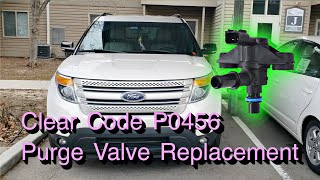
- Faulty Purge Valve (Solenoid) (Common) — Controls fuel vapor flow from the charcoal canister to the engine. If it fails to close completely, it creates a constant 0.010-0.020 inch vacuum leak detected during the EVAP self-test. 🎬 Watch: How to check and replace a faulty purge valve
- Cracked or Disconnected EVAP Hoses (Common) — Rubber and plastic vapor lines become brittle from heat, age, and occasionally rodent damage. Even a hairline crack in the lines running from the gas tank to the engine triggers this code.
- Faulty Vent Valve (Solenoid) (Less Common) — Allows fresh air into the EVAP system and seals it during tests. Often located under the vehicle near the rear axle, it sticks partially open due to road debris, dust, or moisture.
- Contaminated Leak Detection Pump / ESIM (Less Common) — Dedicated leak-testing modules (like Chrysler's ESIM or Hyundai's NVLD) frequently fail internally or become contaminated by dust and salt, falsely reporting a leak when the system is sealed.
- Cracked Charcoal Canister (Rare) — Stores fuel vapors. Hairline cracks develop from road debris or vibration. Overfilling the gas tank ('topping off') also saturates and destroys the internal charcoal media, causing leaks.
- Faulty Fuel Tank Pressure (FTP) Sensor (Rare) — Reports tank pressure to the PCM. A faulty sensor sends incorrect voltage data, tricking the computer into seeing a leak when the system is actually sealed. This is the primary suspect when a smoke test shows no leaks.
- Leaking Fuel Filler Neck (Rare) — Rust or physical damage creates pinhole leaks in the metal pipe leading to the gas tank. A deteriorated flapper seal on capless fuel systems also causes this.
Symptoms

- Check Engine Light is On — This is the primary and often only symptom. The light remains illuminated until the leak is fixed and the code is cleared.
- Failed Emissions Test — A P0456 code results in an automatic failure for any state-required OBD-II emissions or smog inspection.
- Remote Start Disabled — Modern vehicles automatically disable the remote start feature when the Check Engine Light is active for an EVAP code.
- Faint Fuel Smell — You will occasionally notice a slight smell of raw gasoline near the rear tire or gas cap after the vehicle has been parked.
- Slight Decrease in Fuel Economy — Because fuel vapors escape instead of being burned by the engine, fuel economy drops by 1-2%.
Diagnostic Flowchart

Tap your situation to follow the diagnostic path that matches what you're seeing on this code.
Common Fixes & Costs
- Replace Gas Cap
— Parts: $15-$60, Labor: $0, ~0.1 hr book time
(DIY)
: OEM FC1081 (Alt: Motorcraft, Stant)
: OEM GT295 (Alt: ACDelco, Stant)
: OEM 52030377AB (Alt: Mopar, Stant) - Replace EVAP Purge Valve/Solenoid
— Parts: $40-$150, Labor: $75-$150, ~0.8 hr book time
(Intermediate)
: OEM JL3Z-9B325-B (Alt: Motorcraft, Dorman)
: OEM 12690512 (Alt: ACDelco, Delphi)
: OEM 4891735AC (Alt: Mopar, Standard Motor Products) - Replace EVAP Vent Valve/Solenoid
— Parts: $50-$175, Labor: $100-$225, ~1.2 hr book time
(Intermediate)
: OEM AU5Z-9C915-B (Alt: Motorcraft, Dorman)
: OEM 19207763 (Alt: ACDelco, Dorman)
: OEM 4861962AD (ESIM Assembly) (Alt: Mopar, Standard Motor Products) - Repair or Replace EVAP Hose — Parts: $10-$50, Labor: $50-$150, ~1.0 hr book time (Intermediate)
- Replace Charcoal Canister
— Parts: $200-$500, Labor: $100-$300, ~1.5 hr book time
(Professional)
: OEM FL3Z-9D653-F (Alt: Motorcraft, Bosch)
: OEM 84499313 (Alt: ACDelco, Spectra Premium)
: OEM 68252512AA (Alt: Mopar, Spectra Premium)
DIY vs Professional
- Replace Gas Cap — Beginner:
- Replace EVAP Purge Valve/Solenoid — Beginner:
- Replace EVAP Vent Valve/Solenoid — Beginner:
- Repair or Replace EVAP Hose — Beginner:
- Replace Charcoal Canister — Beginner:
Used vs. New Parts: Buying Guide
When a used part is worth it: Only for expensive, non-electronic assemblies like a charcoal canister on a vehicle with over 120,000 miles. Always buy new electronic purge and vent valves.
Donor-vehicle mileage cap: roughly under 80000 miles for the part to have meaningful remaining life.
Donor quality checklist:
- Verify donor vehicle was not scrapped for emissions or fuel system issues.
- Avoid parts from rust-belt vehicles, as connectors and housings are compromised.
- Match the part number exactly; visual similarities do not guarantee compatibility.
- Inspect plastic for brittleness and rubber hoses for cracks before purchasing.
Decision logic:
- If Part is an electronic solenoid/valve (Purge/Vent Valve) → Buy new. Used valves have unknown life expectancy and are a common failure item.
- If Part is a charcoal canister and the vehicle is >120K miles → A used part from a verified low-mileage donor is an acceptable risk to save money.
- If The cost of a new part is less than double the cost of labor for installation → Buy new to avoid paying for labor twice if the used part fails.
Warranty tradeoff: Used parts offer a 30-day exchange warranty at best. New aftermarket parts have a 1-year warranty. New OEM parts carry a 1-2 year warranty.
Worst-case if a used part fails: $250-$500 if a used part fails shortly after installation, representing repeat labor costs.
What Happens If You Wait — Timeline
- 0-1 month: Code P0456 sets, and the Check Engine Light turns on. There are no noticeable symptoms. Remote start is disabled. (MPG impact: 0-1%% · Added cost: $0)
- 1-6 months: A faint fuel smell becomes noticeable after parking. The leak worsens due to vibration and temperature cycles. Fuel economy drops slightly. (MPG impact: 1-3%% · Added cost: $20-$50 in wasted fuel)
- 6-12 months: The very small leak degrades into a small leak (P0442) or a large leak (P0455) as cracks in hoses expand. The fuel smell becomes consistent. (MPG impact: 2-5%% · Added cost: $50-$150)
- 12+ months: Ignoring the light masks new, critical engine codes. If the leak is from a stuck-open purge valve, the altered air-fuel mixture permanently damages the catalytic converter. (MPG impact: 3-7%% · Added cost: $1200-$2500)
Cost of Not Fixing It
- 0-3 months: Automatic failure of state emissions inspection. Fuel economy drops by 1-2%. (Added cost: $0)
- 3-12 months: The 0.020-inch leak expands into a large leak (P0455) due to vibration and temperature changes. A raw fuel smell becomes noticeable. (Added cost: $20-$50 in wasted fuel.)
- 12+ months: The constant Check Engine Light masks new, critical engine codes. A stuck-open purge valve alters the air-fuel mixture, permanently damaging the catalytic converter. (Added cost: $1200-$2500)
Diagnosis Steps

- Inspect and Tighten the Gas Cap
Remove the gas cap and inspect the rubber O-ring for cracks or flattening. Reinstall it and turn until it clicks at least three times. If the seal is visibly worn, replace it immediately with an OEM cap.
Tools: None (Beginner) - Clear the Code and Drive
Clear the code using a scanner. Drive the car normally for 3-5 days, ensuring the fuel tank stays between 1/4 and 3/4 full. If the light stays off, a loose gas cap was the sole issue.
Tools: OBD-II Scanner (Beginner) - Visually Inspect EVAP Hoses
Trace the black plastic and rubber EVAP lines from the engine bay to the charcoal canister at the rear. Look for dry rot, hairline cracks, or disconnected fittings. Pay close attention to areas rubbing against the metal chassis.
Tools: Flashlight (Beginner) - Check for Technical Service Bulletins (TSBs)
Search your specific year, make, and model for P0456 TSBs. Manufacturers frequently release software updates to fix overly sensitive EVAP monitors that falsely trigger this code.
Tools: Internet Access (Intermediate) - Perform a 'Smoke Test'
Connect an EVAP smoke machine to the green service port under the hood. Pump low-pressure (0.5 PSI) vapor into the system. The smoke escapes from the exact location of the pinhole leak, eliminating all guesswork.
Tools: EVAP Smoke Machine (Advanced) - Manually Test the Purge Valve
Disconnect the purge valve in the engine bay. While it is unplugged (de-energized), attempt to blow air through it. It must be completely sealed. If any air passes through, the valve is stuck open and requires replacement.
Tools: None (or Vacuum Pump) (Intermediate) - Test Valve Function with a Scan Tool
Use a bidirectional scanner to command the vent valve closed and the purge valve open while the engine is running. Watch the Fuel Tank Pressure (FTP) sensor data. The system should build a vacuum. Command the purge valve closed; if the vacuum decays rapidly, a leak is confirmed.
Tools: Bidirectional Scan Tool (Advanced) - Test Fuel Tank Pressure (FTP) Sensor Voltage
With the key on and engine off, backprobe the FTP sensor. It should read approximately 2.5V at atmospheric pressure. A static voltage stuck at 0V or 5V indicates a dead sensor, which causes false P0456 codes.
Tools: Multimeter, Scan Tool (Advanced)
When This Code Triggers (Freeze-Frame Conditions)
- Fuel Level: 15-85% (The EVAP monitor will not run on a full or nearly empty tank. This is the absolute most critical parameter for the self-test to initiate.)
- Engine Coolant Temp: 40-95°F (at startup) (The test requires a 'cold soak,' meaning the engine must start at a temperature nearly identical to the outside ambient air.)
- Vehicle Speed: 45-65 mph (A period of steady-state highway cruising is required to run the vacuum test portion of the EVAP monitor.)
- Engine Run Time: < 30 minutes (The EVAP leak test is designed to complete within the first 30 minutes of driving after a cold start.)
Related Codes
- P0455 — Indicates a 'Large Leak'. A P0456 often degrades into a P0455 over time as a small hose crack expands or a gas cap completely fails.
- P0442 — Signifies a 'Small Leak' (0.020 to 0.040 inches). The causes and diagnostic procedures are identical to P0456.
- P0441 — Means 'Incorrect Purge Flow'. If a purge valve is stuck open, it triggers both P0441 (flow when commanded closed) and P0456 (vacuum leak).
- P0457 — Indicates a leak detected immediately after a refueling event. This specifically points to a loose gas cap as the primary culprit.
Climate & Environmental Factors
- Cold Weather: Plastic and rubber EVAP hoses shrink and become brittle in freezing temperatures, opening up microscopic cracks. This causes intermittent P0456 codes that only appear in winter.
- Road Salt & Humidity: Salt and moisture corrode the electrical pins on vent solenoids mounted under the vehicle. On Hyundai/Kia models, coastal salt particulates contaminate the NVLD sensor, triggering false codes.
- High Altitude: Extreme changes in barometric pressure disrupt the EVAP system's baseline vacuum readings, occasionally causing the monitor to falsely report a leak.
How to Talk to a Mechanic About This Code
Say this: "I have a P0456 code. I replaced the gas cap with an OEM part and drove it for a week, but the code returned. I need a diagnostic smoke test to locate the leak."
This shows you've done the basic steps and are not a novice. Requesting a specific, correct diagnostic procedure (a smoke test) directs the mechanic to the most efficient path and prevents them from charging you for basic code-reading.
Avoid saying:
- 'My check engine light is on, can you look at it?'
- 'Just fix whatever's wrong.'
- 'I think it's the purge valve.' (Don't guess, you anchor them to a wrong diagnosis).
Questions to ask before authorizing the repair:
- What was the result of the smoke test? Where exactly did you see the smoke leaking from?
- Can you show me the failed part or a picture of the leak?
- Is this repair covered by any extended emissions warranty or technical service bulletins?
- What is the warranty on the parts and labor for this specific repair?
Where to Take It: Dealer vs Independent vs Chain
- Dealer:
A good choice if the vehicle is newer, under warranty, or has a known TSB. Otherwise, it is too expensive for a common EVAP code.
Best for: Vehicles under warranty (emissions warranties are often longer than powertrain)., Complex, manufacturer-specific issues requiring ECM software updates., When you suspect a TSB or recall applies.
Downsides: Highest labor rates, often 50% higher than an independent shop., Dealers frequently recommend replacing entire $500 assemblies instead of a $20 hose. (Typical cost: +50% vs. baseline) - Independent Shop:
The best fit for most P0456 repairs. A reputable independent shop with a smoke machine efficiently diagnoses and fixes this code at a reasonable price.
Best for: Most out-of-warranty vehicles., Standard diagnostics like smoke tests and component replacement (hoses, valves).
Downsides: Quality varies widely; verify they own an EVAP smoke machine before booking., May lack access to the latest manufacturer-specific software updates. (Typical cost: +0% vs. baseline) - Chain Shop:
Acceptable for reading the code for free. AVOID for actual diagnosis of a persistent P0456, as they are likely to replace parts without proper testing.
Best for: Extremely simple, clear-cut repairs like buying a replacement gas cap.
Downsides: Technicians lack advanced EVAP diagnostic experience., Frequently upsell unnecessary fuel system cleanings instead of fixing the leak. (Typical cost: -10% vs. baseline)
When to Walk Away From the Repair
If the estimated repair cost exceeds 40% of your car's private-party value, and your state does not require emissions testing, ignore the code.
- Car worth $4000, fix is $300: Fix it. The repair cost is a small fraction of the car's value and is necessary for resale or inspection.
- Car worth $12000, fix is $800: Fix it. This is a reasonable cost to maintain the vehicle's function and value.
- Car worth $2500, fix is $1500: Walk away. The repair cost is over half the car's value.
What Scan Tool You Need for This Code
Minimum: A basic code reader that reads and clears engine trouble codes. For P0456, a basic scanner is useful for the initial 'replace gas cap and clear code' step.
A basic scanner only tells you the code; it cannot help you find the leak. To diagnose further, you need a tool that reads live data (like fuel tank pressure) and performs active tests (commanding valves to open/close).
Budget: BlueDriver Pro (~$99) — Reads and clears codes, provides freeze-frame data, and graphs live data for the Fuel Tank Pressure sensor.
Mid-range: Foxwell NT510 Elite (~$180) — Features bidirectional controls. This allows you to command the purge and vent valves closed, sealing the system for testing without a smoke machine.
Professional: Autel MaxiCOM MK808 (~$500) — Offers full bidirectional control, extensive live data, and specific EVAP system leak test functions that automate the diagnostic process.
Rent vs buy: For a one-time P0456 code, use the free service at an auto parts store to read the code. If the gas cap doesn't fix it, paying a shop $150 for a smoke test is more cost-effective than buying a bidirectional scanner.
How to Clear the Code After You Fix It
- Use an OBD-II scan tool to clear the code.
- Perform a complete EVAP drive cycle to run the readiness monitor.
Drive cycle (~30 minutes): Start with a cold engine (sat 8+ hours) and fuel tank between 1/4 and 3/4 full. Idle for 3 minutes. Drive for 15-20 minutes with a mix of steady highway speeds (45-65 mph) and stop-and-go city driving. Allow the vehicle to cool down completely. The monitor requires 2-3 similar trips to set.
Readiness monitors affected: Evaporative System, Catalyst monitor, O2 sensor monitor
Watch out for:
- Disconnecting the battery clears the code but resets all readiness monitors, guaranteeing an emissions test failure.
- The EVAP monitor absolutely will not run if the fuel tank is above 85% or below 15%.
- The code returns immediately if the underlying leak was not fixed.
Will This Fail Emissions / State Inspection?
Yes — this code typically fails an OBD-II emissions inspection.
- California: A P0456 code is an automatic failure. All readiness monitors must be 'Ready' for the test to proceed. You must complete the drive cycle after repair before re-testing.
- New York: P0456 causes an automatic failure. For 2001 and newer vehicles, NY allows one readiness monitor to be 'Not Ready', which is often the EVAP monitor, but the Check Engine Light must be off.
- Texas: In the 17 counties requiring emissions testing, P0456 results in a failure. After repairs, you must complete the drive cycle to set the readiness monitors before a re-test.
Most Commonly Affected Vehicles
- Ford F-150, Explorer, Escape, Mustang (2011-2019) — Prone to purge valve failures (Part CP9Z-9C915-A). On capless fuel systems, the spring-loaded filler door fails to seal, requiring cleaning with the emergency funnel.
- Chevrolet/GMC Silverado, Sierra, Tahoe, Equinox (2007-2021) — Frequently experiences vent valve failures due to its exposed location near the rear axle. 2019-2021 models with the 2.0L Turbo have an extended 15-year warranty for the EVAP purge pump.
- Chrysler/Dodge/Jeep Grand Caravan, Pacifica, Ram 1500, Challenger (2008-2022) — The Evaporative System Integrity Monitor (ESIM) is a massive failure point (Part 4861962AD). Software updates are also required to fix false codes per TSB #18-092-23.
- Hyundai Elantra, Sonata, Ioniq (2010-2020) — Hybrid models suffer from contamination of the NVLD sensor. TSB 19-01-030H dictates installing a new air filter kit for the EVAP system to prevent false codes.
- Nissan Sentra, Altima, Rogue (2008-2021) — Traced to a leaking O-ring on the EVAP vent control valve. Per TSB NTB17-082E, the entire valve assembly must be replaced as the O-ring is no longer sold separately.
- Honda Accord, Civic, CR-V (2008-2017) — Commonly affected by failing purge valves (Part 36162-R1A-A01 for Civics). The gas cap is also a highly frequent cause.
- Toyota Camry, Corolla, RAV4 (2007-2018) — Purge valve failure is the most common cause. On older models, the entire charcoal canister assembly must be replaced as a single unit when internal valves fail.
- Volkswagen Jetta, Golf, Tiguan (2013-2022) — The N80 purge valve fails constantly. 2022 models have an extended 15-year warranty for the EVAP Leak Detection Pump (LDP). ECM software updates are frequently required.
Manufacturer-Specific Notes
- Ford: On capless fuel systems, debris prevents the internal flap from sealing. Insert and remove the emergency plastic funnel (located with the spare tire) 5-10 times to clear the debris and restore the seal.
- GM (Chevrolet/GMC): The original EVAP vent valve design on trucks is highly susceptible to dirt intrusion. Replacement parts feature an updated, relocated breather tube to prevent repeat failures.
- Chrysler/Dodge/Jeep: The ESIM (Evaporative System Integrity Module) fails internally without creating a physical leak. If a smoke test shows nothing, replace the $30 ESIM before buying a new charcoal canister.
- Toyota/Lexus: Toyota integrates multiple EVAP valves directly into the charcoal canister. If a vent valve fails, you must replace the entire $400 canister assembly.
- Hyundai/Kia: Salt particulates in coastal air contaminate the Natural Vacuum Leak Detection (NVLD) sensor. TSBs require installing an updated EVAP air filter kit to prevent false codes.
- Nissan: TSB NTB17-082E states P0456 is caused by a leaking O-ring on the EVAP vent control valve. You must replace the entire valve assembly, as the O-ring is not sold separately.
- Volkswagen/Audi: Overly sensitive leak detection logic in the ECM triggers false P0456 codes. Always check for dealer software updates before replacing the N80 purge valve.
Real Owner Stories
2016 Toyota Camry (~49k miles) - The Easy Fix
Check Engine Light appeared the day after a routine oil change. No other symptoms were noticed.
What they tried:
- Scanned the code at an auto parts store.
- Mechanic advised replacing the gas cap before paying for a diagnostic fee.
- Owner replaced the gas cap with an OEM Toyota part.
Outcome: The Check Engine Light turned off after three days of normal driving. The simple gas cap replacement resolved the issue.
Lesson: Always check the gas cap first. After a fix, the Check Engine Light won't turn off immediately; the car needs to complete a drive cycle over a few days.
2019 Ram 1500 - Misdiagnosis Avoided
Check Engine Light came on with P0456. The truck has a capless fuel system, eliminating a 'loose gas cap' as the cause.
What they tried:
- Owner researched common causes and found the purge solenoid was a frequent failure point.
- Cleared the code to see if it was a one-time glitch, but it returned.
- Replaced the EVAP purge valve under the hood.
Outcome: Swapping the $45 EVAP purge valve and clearing the code permanently resolved the Check Engine Light.
Lesson: On capless systems, components like the purge valve are the most common culprits. Clearing the code once to see if it immediately returns is a valid diagnostic step.
2015 Jeep Grand Cherokee - The Not-A-Leak Leak
Owner struggled with a persistent P0456 code for two years. They replaced the purge valve and visually inspected hoses without success.
What they tried:
- Replaced the purge valve and connecting pipes.
- Paid a shop for a smoke test, which found zero visible leaks.
Outcome: The actual cause was a faulty Evaporative System Integrity Module (ESIM). This component fails internally without creating a physical leak. Replacing the $20 ESIM finally fixed the code.
Lesson: If a smoke test shows no leaks, the problem is a faulty sensor or testing module, like the ESIM on Chrysler products or a faulty FTP sensor.
How to Prevent This Code From Triggering
- Stop fueling at the first click (Every fill-up) — Topping off the tank forces liquid fuel into the charcoal canister, which is designed only for vapor. This saturates the charcoal, ruins the canister, and leads to a $300+ repair.
- Clean and inspect the gas cap seal (Every 6 months or during oil changes) — The gas cap's rubber O-ring dries out and cracks. Wiping it with a clean cloth removes debris. Replace the cap every 5 years as preventive maintenance.
- Visually inspect EVAP hoses (Annually or during under-car service) — Heat and road salt make rubber hoses brittle. A quick visual check for cracks at bends and connection points catches a leak before it triggers a code.
- Apply dielectric grease to solenoid connectors (Every 2 years, especially in rust-belt regions) — Moisture and salt corrode the electrical pins on the purge and vent valves. A small amount of dielectric grease protects these connections from the elements.
Frequently Asked Questions
Will a loose gas cap really cause the Check Engine Light to come on?
Yes. The gas cap seals the EVAP system. If it is loose, damaged, or aftermarket, the system fails its pressure test and triggers P0456.
I replaced my gas cap and the light is still on. What's next?
The computer requires a specific drive cycle over 2-3 days to re-test the system. If the light remains on after a week, you have a physical leak requiring a smoke test.
What are the most common mistakes when diagnosing P0456?
The biggest mistake is replacing expensive valves without performing a smoke test first. Another common error is buying a cheap aftermarket gas cap that fails to seal properly. Finally, ignoring TSBs leads to wasted money when a simple software update is the actual fix.
My smoke test showed no leaks, but the P0456 code came back. What now?
This points to a faulty sensor reporting bad data, not a physical leak. The most likely culprits are a failing Fuel Tank Pressure (FTP) sensor or an overly sensitive computer requiring a software update.
How much does it cost to fix P0456?
Costs range from $25 for an OEM gas cap to $500+ for a new charcoal canister. A professional diagnostic smoke test costs $100 to $200 and is the fastest way to pinpoint the exact leak.
Can I use petroleum jelly on my gas cap seal?
No. Petroleum jelly degrades the rubber seal over time and is incompatible with fuel vapors. Replace a faulty gas cap with a new OEM part instead.
Why did the code appear after filling up with gas?
The EVAP system runs its self-test after refueling events. Failing to tighten the cap past the first click immediately triggers the code.
Key Takeaways
- Tighten or replace your gas cap with an OEM version first, as this resolves over 50% of P0456 codes instantly.
- Expect to pay between $100 and $200 for a professional EVAP smoke test if a new gas cap does not clear the code within 3 days.
- Never top off your gas tank past the first click, as liquid fuel destroys the charcoal canister and leads to a $300+ repair.
- Check for manufacturer Technical Service Bulletins (TSBs) before replacing parts, as software updates fix false P0456 codes on many 2015+ vehicles.
Helpful Videos


The information in this article is provided for general reference and educational purposes only. Vehicle specifications, procedures, and part compatibility can vary by production date, trim level, and region. Always consult your vehicle's factory service manual and verify part numbers before purchasing or performing repairs. Safety-critical components such as airbags, seat belts, and braking systems should be installed by a qualified professional.
- 🎬 Helpful Videos
- What Does P0456 Mean?
- Can I Drive With P0456?
- Common Causes
- Symptoms
- Diagnostic Flowchart
- Common Fixes & Costs
- DIY vs Professional
- Used vs. New Parts: Buying Guide
- What Happens If You Wait — Timeline
- Cost of Not Fixing It
- Diagnosis Steps
- When This Code Triggers (Freeze-Frame Conditions)
- Related Codes
- Climate & Environmental Factors
- How to Talk to a Mechanic About This Code
- Where to Take It: Dealer vs Independent vs Chain
- When to Walk Away From the Repair
- What Scan Tool You Need for This Code
- How to Clear the Code After You Fix It
- Will This Fail Emissions / State Inspection?
- Most Commonly Affected Vehicles
- Manufacturer-Specific Notes
- Real Owner Stories
- 2016 Toyota Camry (~49k miles) - The Easy Fix
- 2019 Ram 1500 - Misdiagnosis Avoided
- 2015 Jeep Grand Cherokee - The Not-A-Leak Leak
- How to Prevent This Code From Triggering
- Frequently Asked Questions
- Will a loose gas cap really cause the Check Engine Light to come on?
- I replaced my gas cap and the light is still on. What's next?
- What are the most common mistakes when diagnosing P0456?
- My smoke test showed no leaks, but the P0456 code came back. What now?
- How much does it cost to fix P0456?
- Can I use petroleum jelly on my gas cap seal?
- Why did the code appear after filling up with gas?
- Key Takeaways
- 🎟️ Get 5% Off