

P0442 on 2000-2008 Jaguar S-Type: EVAP Small Leak Causes and Fixes
For a 2000-2008 Jaguar S-Type, P0442 almost always means a small leak in the EVAP system. The most common fix is replacing the gas cap with a genuine OEM part, as aftermarket caps are known to cause issues. If that doesn't work, the next most likely culprits are a faulty canister purge valve or a cracked hose. A professional smoke test is the most reliable way to find leaks that aren't obvious.
- Always start with the simplest fix: check that your gas cap is tight. If the code persists, replace the cap with a genuine Jaguar part.
- The second most likely cause on an S-Type is a faulty canister purge valve, which is a relatively simple DIY replacement located in the engine bay.
- If the gas cap and purge valve don't solve the issue, a smoke test is the best way to find the leak, which is likely a cracked EVAP hose.
- Do not let a mechanic replace unrelated parts; P0442 is strictly an EVAP system issue.
- You can continue driving your car with this code, but you will not pass an emissions test until it is resolved.
What's Unique About the 2000-2008 Jaguar S-Type
While the causes for P0442 on the S-Type are common to many vehicles (gas cap, hoses), this platform has specific failure points. Forum users frequently point to the canister purge valve as a common culprit that is relatively easy to replace. Additionally, some S-Type models, particularly later ones, may have issues with the fuel tank port seals under the rear seat, which can dry out and cause a small leak detectable by a P0442 code. Jaguar also issued a TSB for some models regarding a deteriorated hose to the secondary emissions canister causing this code. The S-Type's platform mates, the Lincoln LS and 2002-2005 Ford Thunderbird, also share common P0442 issues related to purge valves and cracked EVAP lines.
Generation note: The Jaguar S-Type (X200) had a significant facelift for the 2003 model year (sometimes referred to as X202, X204, X206). While many EVAP components are similar, there are differences in the fuel tank and canister systems, particularly between V6 and V8 models. 🎬 Watch: Diagnostic walkthrough for a P0442 code on the 4.2L V8. For example, the vapor canister for a 2003-2005 3.0L V6 is not compatible with the 4.2L V8. Later models (around 2007) also introduced a more complex Diagnostic Module for Tank Leakage (DMTL) pump, which combines the pump and a change-over valve into one module.
Symptoms You May Notice
- Check Engine Light is on
- A faint smell of fuel, particularly around the rear of the car or after filling up
- Failure to pass an emissions inspection
- Slightly reduced fuel economy
- Replacing oxygen sensors or other unrelated engine components. One owner reported a dealer mistakenly chased a 'misfire' problem for $1500 before the EVAP issue was correctly identified and fixed by replacing the purge valve.
Most Likely Causes
- Loose or Faulty Fuel Filler Cap 🔴 High Probability The gas cap seal is a rubber component 🎬 See this easy fix for small EVAP leaks. that degrades over time with exposure to fuel vapors and weather. It's the most frequently used part of the system and the seal simply wears out. Aftermarket caps are a frequent source of problems.
How to confirm: Ensure the cap is tightened until it clicks at least three times. Inspect the rubber gasket on the cap for cracks, stiffness, or damage. Check the metal filler neck for rust, corrosion, or debris that could prevent a good seal. A new OEM cap is a cheap and effective diagnostic step.
Typical fix: First, try cleaning the cap's seal and the filler neck with a wire brush if corroded. If the code returns, replace the fuel cap. It is highly recommended to use a genuine Jaguar OEM part (Part No. XR854779), as aftermarket caps are known to cause sealing issues.
Est. part cost: $25-$50 - Faulty Canister Purge Valve 🟡 Medium Probability This valve is frequently cited in Jaguar forums as a common failure point for P0442 on the S-Type. It can become stuck open or closed, or develop an internal leak not always detectable by a smoke test.
How to confirm: With the engine idling, you may hear a loud, rhythmic clicking sound from the valve, located under the hood on the driver's side. A definitive test involves applying vacuum with a hand pump to see if it holds, or using a scan tool to command it open and closed while monitoring system pressure.
Typical fix: Replacement of the purge valve is straightforward. It is held by two bolts and has three clip-on pipe connections. The part is located in the engine bay and is generally easy to access.
Est. part cost: $50-$150 - Cracked or Disconnected EVAP Hoses 🟡 Medium Probability The plastic and rubber hoses in the EVAP system become brittle over time due to heat and age, leading to small cracks, especially at connection points and bends. A specific TSB (JTB00495NAS1) notes that the hose to the secondary emissions canister is a known failure point.
How to confirm: The most effective method is a smoke test. This involves injecting low-pressure smoke into the EVAP system 🎬 Watch: How to find and repair common EVAP system leaks. and looking for where it escapes. A visual inspection may reveal obvious cracks, but small leaks often require smoke.
Typical fix: Replace the cracked hose or leaking connector. In some cases, a small section of hose can be replaced, but often the entire line assembly is the required part.
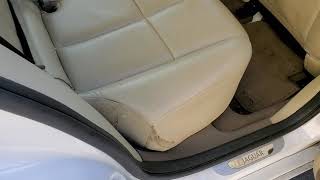
Est. part cost: $20-$100 - Leaking Fuel Tank Port Gasket ⚪ Low Probability On some S-Types, the gaskets for the fuel pump and sender access ports under the rear seat can dry out and leak, causing a fuel smell and this code.
How to confirm: Remove the rear seat bottom cushion by sliding two black tabs at the front of the seat. Lift the insulation to expose two black round covers. Remove the covers and inspect the top of the fuel tank for signs of fuel leakage, staining, or a strong fuel odor.
Typical fix: The sealing ring and clamp must be replaced. This involves a specific updated collar and a clamp that is tightened until the hex head breaks off, ensuring proper torque.
Est. part cost: $50-$75
Rare But Worth Checking
- Cracked Charcoal Canister: Less common than a hose or valve failure, the plastic body of the charcoal canister itself can develop a hairline crack, causing a leak. This is usually found only with a smoke test. On the S-Type, replacement can be a major job requiring the fuel tank to be dropped.
- Leaking Fuel Tank: While rare, a small rust perforation or a seam leak in the fuel tank itself can trigger a P0442 code. This is a serious safety issue and would likely be accompanied by a strong fuel smell.
- Corroded Fuel Filler Neck: The metal lip where the gas cap seals can rust or corrode, creating an uneven surface that prevents a proper seal even with a new cap. Cleaning the surface with a wire brush can sometimes resolve this.
Diagnosis Steps
- Check for any other stored trouble codes.
- Inspect the gas cap. Ensure it is tight and the seal is not cracked or worn. Clean the seal and filler neck. If in doubt, replace it with an OEM part (Jaguar P/N: XR854779).
- Clear the code and perform a drive cycle to see if it returns.
- If the code returns, perform a visual inspection of all accessible EVAP hoses and lines under the hood and under the car for obvious cracks, damage, or loose connections.
- Listen for a loud, constant clicking from the purge valve at idle, which could indicate it has failed.
- Inspect the fuel tank access ports under the rear seat for any signs of fuel leakage.
- If no obvious faults are found, the most reliable next step is to have a professional smoke test performed on the EVAP system to pinpoint the exact location of the leak.
Parts You'll Likely Need
- Fuel Filler Cap
(OEM #XR854779)— This is the most common cause due to its seal wearing out. It's the first and cheapest part to replace. Using an OEM part is critical for proper sealing.
Trusted brands: Jaguar (OEM)
OEM price range: $25-$50
Aftermarket price range: $15-$30 - Canister Purge Valve
(OEM #XR849660 (fits most 2000-2008 models), XR830786 (fits 2002.5-2005))— A very common failure point on this platform that causes a small leak when it sticks open or fails internally.
Trusted brands: Bosch, Denso, Jaguar (OEM)
OEM price range: $50-$150
Aftermarket price range: $40-$100
Related Codes That Often Appear With This One
- P0456 — P0456 indicates a 'very small leak', while P0442 indicates a 'small leak'. They often appear together or interchangeably as the leak size can be borderline, or one can progress to the other. One owner reported P0442 appearing first, then P0456 a few days later.
- P0455 — P0455 indicates a 'gross leak' (large leak). You might see this code if a hose has completely disconnected or the gas cap was left off entirely. A faulty cap can sometimes cause P0455 instead of the more common P0442.
Technical Service Bulletins (TSBs) & Recalls
- JTB00495NAS1: Addresses DTCs P0442 and P0456, noting a potential cause is a deteriorated and cracked hose to the secondary emissions canister.
- TSB Bulletin #JTB00436NAS1: Notes that during diagnosis, technicians may find P0442-00 stored in the Engine Control Module (ECM) along with other EVAP-related codes.
- TSB Bulletin #JTB00436NAS2: An updated bulletin confirming that P0442-00 may be stored in the ECM, potentially alongside codes like P043E-00, P0447-00, and P0496-00.
Platform-Specific Known Issues
- TSB JTB00495NAS1 was issued for P0442/P0456 codes caused by a deteriorated hose to the secondary emissions canister.
- Forum members frequently report success fixing P0442 by replacing the canister purge valve, suggesting it's a weak point on the S-Type.
- The gaskets for the fuel pump/sender access ports under the rear seat are known to dry out and crack, requiring an updated collar and clamp for repair.
Mechanic-Grade Diagnostic Values
- Canister Purge Valve Solenoid Resistance — expected: Approximately 15-30 Ohms. Failure: A reading significantly outside of this range indicates a faulty internal coil in the valve.
- Canister Purge Valve Harness Voltage — expected: Battery voltage (approx. 12V) at the power pin with the key on.. Failure: No voltage suggests a wiring or fuse issue upstream of the valve.
- Resistance between Purge Valve Connector and ECM Connector — expected: Less than 5.0 Ohms. Failure: Resistance greater than 5.0 Ohms indicates high resistance in the wiring harness, which can cause communication issues.
Scan Tool Commands That Help
- Jaguar SDD (Symptom Driven Diagnostics) / IDS: Evaporative System Diagnostic Test — This is the dealer-level function to command the EVAP system to seal and run a pressure/vacuum test. It can differentiate between a leak failure and an electrical/hardware failure, guiding the diagnostic path.
- Jaguar SDD (Symptom Driven Diagnostics) / IDS: Canister Close Valve (CCV) or DMTL Pump Activation — Used to manually command the vent valve/DMTL pump to close the system to the atmosphere. This is a necessary step before performing a smoke test to ensure the system is sealed for the test.
Wiring & Ground Locations
- PI1 — The main Engine Control Module (ECM) connector, located on the right rear side of the engine compartment firewall.. This is the termination point for the EVAP canister purge valve control circuit. Pin 66 is the drive circuit from the ECM to the purge valve, and a continuity/resistance check is made to this pin.
- EC63 — The electrical connector for the canister purge valve, located in the engine bay on the driver's side.. This is the connector where voltage and resistance tests are performed directly on the purge valve and its harness.
- CA30 / FH77 — Main harness ground connectors located at the left 'A' pillar.. While not exclusive to the EVAP system, poor grounds at major body connection points like these can cause a variety of intermittent electrical faults and sensor issues that could potentially mimic an EVAP problem.
Real Owner Repair Stories
- JaguarForums.com user (Jaguar S-Type (year not specified)) — P0442 and P0456 codes.
❌ Tried (didn't work) Replacing the gas cap with a new dealer part., A professional smoke test which found no leaks.
✅ What actually fixed it Replacing the canister purge valve resolved the codes. The user noted that even though the smoke test was clean, the valve can develop small internal cracks or fail in a way that isn't detectable by smoke. - YouTube video by CHAUSTER BUFFET (2005 Jaguar S-Type 4.2L) — P0442 code and a customer complaint of a gas smell.
❌ Tried (didn't work) The video directly identifies the problem without showing failed attempts.
✅ What actually fixed it The leak was from a dried-out gasket on the fuel pump access port under the rear passenger-side seat. The fix required replacing the gasket and installing an updated collar and a special clamp that is tightened until its hex head breaks off to ensure correct torque.
"I Checked Everything" — The Actual Cause
- A common scenario reported by S-Type owners is passing a smoke test but still having a P0442 code. The ultimate cause is often a faulty canister purge valve. The valve's internal diaphragm can leak intermittently or in a way that a static, low-pressure smoke test doesn't reveal, but the onboard diagnostic pressure test does. One owner confirmed that after a new gas cap and a clean smoke test failed to fix the issue, replacing the purge valve was the final solution.
When the Usual Fixes Don't Work
- In one documented case, a dealership misdiagnosed a P0442 code as a 'misfire' problem, leading to $1500 in unnecessary repairs. The owner later self-diagnosed and fixed the issue by replacing the canister purge valve for about $105, which immediately resolved the code. This highlights how even professional shops can misinterpret codes if they don't follow a logical diagnostic procedure for the specific fault.
OEM Part Supersession History
2R83-9C915-AA (Ford Engineering Number)→XR849660 (Jaguar Part Number)— Standard part numbering update from Ford-era engineering number to Jaguar's own part number system.
Heads up: The purge valve XR849660 is listed for most 2002.5-2008 models. Earlier 2000-2002 models may use a different part. Always verify by VIN, as there can be overlap.
Model Year Variations Within This Range
- 2000-2006 (approx.): These earlier models use a traditional Canister Close Valve (CCV) to seal the EVAP system for pressure testing. The CCV is typically located near the charcoal canister.
- 2007-2008 (approx.): Later models introduced a Diagnostic Module for Tank Leakage (DMTL) pump. This module combines the function of the older CCV with a small pump that actively pressurizes the system to check for leaks, rather than relying on vacuum. A failure of the DMTL pump itself can cause EVAP codes.
- 2003-2005: There is a known incompatibility for the main vapor canister between the 3.0L V6 and 4.2L V8 models, despite some aftermarket suppliers listing them as interchangeable. The OEM part numbers and system configurations are different.
Diagnostic Flowchart
Real Owner Stories
Aggregated from forums and TSBs cited above. Mileages and costs reflect what owners reported in those sources.
Jaguar S-Type
Symptoms: Check engine light with codes P0442 (small evap leak) and P0456 (very small evap leak). A clear continuous clicking sound every two minutes or so coming from the original purge valve canister while idling.
What fixed it: Replaced the purge valve canister. The part is easily accessible under the hood on the driver side, held by two bolts and three clip-on pipes.
Cost: $105
Source hint: Jaguar Forums thread 'p0442 (small evap leak) and p0456 (very small evap leak)'
Jaguar S-Type
Symptoms: Check engine light with code P0442: evaporative emission system leak (small leak). The code would come back within a day after being cleared.
What fixed it: Replaced the fuel cap with a new one from the Jaguar Dealer.
Cost: $24.00
Source hint: Jaguar Forums thread 'Hey guys need some advice on another code!(P0442) Resolved'
Related OBD-II Codes
Frequently Asked Questions
Does TSB JTB00495NAS1 apply to my Jaguar S-Type for code P0442?
I hear a loud clicking noise under the hood of my S-Type. Is this related to P0442?
Should I buy an aftermarket gas cap to fix the P0442 code on my S-Type?
I smell fuel inside my S-Type, especially near the back seat. What causes this with a P0442 code?
My Lincoln LS has the same P0442 code. Are the causes similar to the Jaguar S-Type?
Helpful Videos
![How to Fix P0442 Engine Code in 7 Minutes [6 DIY Methods / Under $3.67]](https://img.youtube.com/vi/KISPTedKJmQ/mqdefault.jpg)
Used OEM Parts in Stock

New Aftermarket Parts Available



The information in this article is provided for general reference and educational purposes only. Vehicle specifications, procedures, and part compatibility can vary by production date, trim level, and region. Always consult your vehicle's factory service manual and verify part numbers before purchasing or performing repairs. Safety-critical components such as airbags, seat belts, and braking systems should be installed by a qualified professional.
- Jaguar S-Type:
- 🎬 Helpful Videos
- 🛍️ Shop This Part
- What's Unique About the 2000-2008 Jaguar S-Type
- Symptoms You May Notice
- Most Likely Causes
- Rare But Worth Checking
- Diagnosis Steps
- Parts You'll Likely Need
- Related Codes That Often Appear With This One
- Technical Service Bulletins (TSBs) & Recalls
- Platform-Specific Known Issues
- Mechanic-Grade Diagnostic Values
- Scan Tool Commands That Help
- Wiring & Ground Locations
- Real Owner Repair Stories
- "I Checked Everything" — The Actual Cause
- When the Usual Fixes Don't Work
- OEM Part Supersession History
- Model Year Variations Within This Range
- Diagnostic Flowchart
- Real Owner Stories
- Jaguar S-Type
- Jaguar S-Type
- Related OBD-II Codes
- Frequently Asked Questions
- 🎟️ Get 5% Off