

P0351 on 2005-2016 Volkswagen Golf: Ignition Coil 'A' Circuit Causes and Fixes
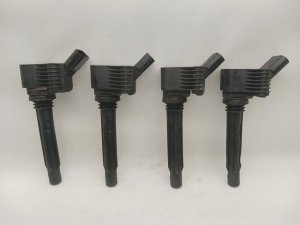
On a 2005-2016 VW Golf, code P0351 almost always means the ignition coil on cylinder 1 has failed. This is a very common issue and a straightforward DIY fix. A replacement coil typically costs between $25 for an aftermarket part and $50 for an OEM-branded part. It is highly recommended to replace all coils as a set with the latest revision part.
- P0351 on a VW Golf almost always points to a bad ignition coil on cylinder 1.
- The easiest way to diagnose the problem is to swap the cylinder 1 coil with another one and see if the fault code moves to the new cylinder.
- This is a very simple and inexpensive DIY repair that requires minimal tools and can be done in under 15 minutes.
- Do not ignore a flashing Check Engine Light, as continued driving with a misfire can cause expensive damage to the catalytic converter.
What's Unique About the 2005-2016 Volkswagen Golf
Ignition coil failures are a well-documented weak point on many Volkswagen engines from this era, including the popular 2.5L 5-cylinder and 2.0T TSI/FSI engines. The coil-on-plug design, while efficient, is prone to failure from constant heat cycles and engine vibration. VW and its OEM suppliers (like Bosch) have released numerous revisions of these coils over the years to improve durability, identifiable by a letter at the end of the part number (e.g., 07K905715F superseded by 07K905715G). For owners of these Golfs, experiencing a P0351 code is a very common, almost expected, maintenance event.
Generation note: The 2005-2016 range covers three generations of the VW Golf: the Mk5 (2006-2009 in the US, also called the Rabbit), Mk6 (2010-2014), and the early Mk7 (2015-2016). While specific part numbers for ignition coils differ between engines (e.g., 2.5L vs 2.0T) and have been revised multiple times, the fundamental problem of coil-on-plug failure and the diagnostic process are identical across all of them.
Symptoms You May Notice
- Engine misfires, which can feel like shaking, shuddering, or stumbling, especially during acceleration.
- Rough or erratic engine idle.
- Noticeable loss of power and poor acceleration.
- Flashing or solid Check Engine Light on the dashboard.
- Difficulty starting the engine.
- Increased fuel consumption.
- A smell of gasoline from the exhaust due to unburnt fuel.
- Replacing the spark plug when the ignition coil is the actual point of failure. The coil swap test is the fastest way to avoid this.
- Replacing other ignition components before confirming the fault is isolated to cylinder 1.
- Assuming a new-looking coil is good. Aftermarket coils can be faulty out of the box, and even OEM coils can fail prematurely.
Most Likely Causes
- Failed Ignition Coil on Cylinder 1 🔴 High Probability Ignition coils on this generation of VW engines are a known high-failure item due to heat exposure and vibration. VW has updated the part number multiple times to improve reliability, confirming the weakness of earlier designs.
How to confirm: Swap the ignition coil from cylinder 1 with the coil from another cylinder (e.g., cylinder 2). Clear the codes and run the engine. If the code changes to P0352 (Coil 'B' Circuit), the ignition coil is confirmed to be faulty.
Typical fix: Replace the failed ignition coil. It is strongly recommended to replace all coils at the same time with the latest revision part available to prevent repeat failures of the other original coils.
Est. part cost: $25-$60 per coil - Worn or Fouled Spark Plug in Cylinder 1 🟡 Medium Probability A spark plug with an excessive gap or heavy deposits forces the ignition coil to work harder to create a spark, which can lead to premature coil failure or trigger a circuit fault code. It's a common maintenance item.
How to confirm: After confirming the coil is good, remove the spark plug from cylinder 1. Inspect it for wear (rounded electrode), damage, or fouling (black, oily, or white deposits). The recommended gap is critical; an out-of-spec gap can cause issues.
Typical fix: Replace the spark plug. It is best practice to replace all spark plugs as a set at the manufacturer's recommended service interval (typically 40k-60k miles).
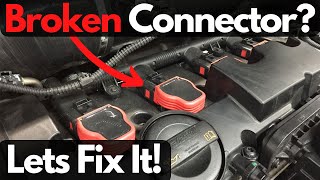
Est. part cost: $10-$25 per plug - Damaged Wiring or Connector for Ignition Coil 1 ⚪ Low Probability The plastic connector for the ignition coil and its locking tab become extremely brittle from engine heat and often break when being handled during a coil or spark plug change. Wires can also chafe or break at the connector bend over time.
How to confirm: Visually inspect the wiring harness and connector going to the ignition coil on cylinder 1. Look for a broken locking tab, cracked plastic, loose pins, corrosion, or any signs of melted or frayed wires. Wiggle the connector with the engine running to see if it induces a misfire.
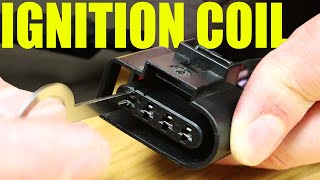
Typical fix: If the connector is broken, a new connector pigtail (Part No. 1J0973724 or 4B0973724) can be spliced into the harness. Damaged wires must be carefully repaired with solder and heat shrink.
Est. part cost: $15-$35 for a connector pigtail kit
Rare But Worth Checking
- Failed Powertrain Control Module (PCM) Driver: In very rare instances, the internal driver chip in the ECU that fires the ignition coil can fail. This should only be considered after all other possibilities (coil, plug, wiring) have been definitively ruled out. A key symptom can be a persistent P0351 code that does not move when the coil is swapped and for which the wiring shows correct voltage and signal. This often requires professional diagnosis with an oscilloscope to verify the lack of a trigger signal from the PCM.
Diagnosis Steps
- Read the codes with an OBD-II scanner to confirm P0351 is present. Note any other codes, such as P0301, which is expected.
- Identify cylinder 1. On VW Golf transverse engines, this is the cylinder on the far right side of the engine bay (passenger side in the US / timing belt side).
- Swap the ignition coil from cylinder 1 with the coil from cylinder 2. Mark the coils so you know which one was originally on cylinder 1.
- Clear the fault codes using the scanner.
- Start the engine and let it run for a minute, or take a short drive to see if the Check Engine Light returns.
- Re-scan for codes. If the code is now P0352, the ignition coil you moved is bad and needs to be replaced.
- If code P0351 returns, the problem is not the coil. The original coil from cylinder 2 is good.
- Turn off the engine. Remove the coil from cylinder 1 again. Remove the spark plug and inspect its condition. Replace if it is worn, damaged, or fouled, especially if service history is unknown.
- If the spark plug is good, carefully inspect the electrical connector and wiring going to the cylinder 1 coil. Check for a broken locking tab, pushed-out pins, corrosion, or frayed wires. Repair as needed.
- If the coil, plug, and wiring all appear to be in good condition, the fault may lie within the PCM. This requires advanced diagnosis, often with an oscilloscope to check the trigger signal from the PCM to the coil connector.
Parts You'll Likely Need
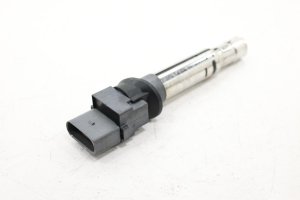
- Ignition Coil
(OEM #2.5L: 07K905715G (supersedes F, D, etc.) | 2.0T: 06H905115B (common revision))— This is the most common cause of a P0351 code on this platform due to a high failure rate. Always use the latest revision available.
Trusted brands: Bosch, NGK, Eldor, Beru
OEM price range: $40-$60
Aftermarket price range: $25-$45 - Spark Plug
(OEM #Varies by engine (e.g., 2.5L: 101905610C, 2.0T: 06K905601B))— A worn spark plug can cause this fault or be a contributing factor. It's good practice to replace them if their condition is unknown or they are due for service.
Trusted brands: NGK, Bosch, Denso
OEM price range: $15-$25
Aftermarket price range: $10-$20 - Ignition Coil Connector Pigtail
(OEM #1J0973724 / 4B0973724)— Needed if the original connector housing is cracked or the locking tab has broken off, causing a poor connection. This is a very common repair.
Trusted brands: Genuine VW/Audi, Uro Parts, Meyle
OEM price range: $25-$40
Aftermarket price range: $10-$20
Related Codes That Often Appear With This One
- P0301 — P0301 means 'Cylinder 1 Misfire Detected.' Since P0351 indicates a fault in the ignition circuit for cylinder 1, the cylinder will not fire correctly, directly causing a P0301 code to be stored as well. These two codes almost always appear together.
Technical Service Bulletins (TSBs) & Recalls
- While no specific TSB for P0351 is widely cited, VW TSB 15-12-01 regarding the failure-prone timing chain tensioner on 2.0T TSI engines (2008-2013) is a critical issue for owners of this platform to be aware of.
Platform-Specific Known Issues
- Volkswagen issued a service program (a voluntary recall) for ignition coils on some 2001-2007 models, which includes early Mk5 Golfs, due to high failure rates. While this program is long expired, it confirms that coil failure is a historically documented problem.
- On the 2.5L 5-cylinder engine, the coils are held down by the plastic engine cover. Over time, this can lead to a less-than-secure fit if the cover's grommets are worn, a situation which could increase vibration on the coils.
- The locking tabs on the ignition coil connectors are notoriously brittle and frequently break during service, making a secure connection difficult. Many owners use a zip tie as a temporary measure to hold the connector firmly in place if the tab is broken.
Mechanic-Grade Diagnostic Values
- Ignition Coil Primary Resistance — expected: 0.4 to 2.0 ohms is typical; a more specific range for the 2.5L engine is 0.58 - 0.72 ohms.. Failure: A reading of zero ohms (short circuit) or infinite/OL (open circuit) indicates a failed coil.
- Ignition Coil Secondary Resistance — expected: 6,000 to 10,000 ohms (6kΩ - 10kΩ) is typical; a more specific range for the 2.5L engine is 9.3kΩ - 11.3kΩ.. Failure: A reading significantly outside the specified range indicates a faulty secondary winding.
- Ignition Coil Connector - Power Supply Voltage (Pin 2) — expected: 12V+ (Battery Voltage) with Key On, Engine Off.. Failure: No voltage or significantly low voltage points to a wiring issue, fuse, or relay problem before the coil.
- Ignition Coil Connector - Ground (Pin 1 and Pin 4) — expected: Should have continuity to a known good chassis or engine ground (less than 1 ohm).. Failure: High resistance or an open circuit (OL) on the ground pin indicates a broken ground wire or corroded ground point.
- Ignition Coil Trigger Signal (Pin 3) — expected: A pulsing ground signal from the ECM when the engine is cranking or running. Can be observed as a 5-20 Hz signal on a multimeter with a frequency setting, or more accurately with an oscilloscope.. Failure: No signal or a constant signal (not pulsing) indicates a wiring problem between the ECM and coil, or a failed ECM driver.
Scan Tool Commands That Help
- VCDS (VAG-COM): Engine -> Measuring Blocks -> Groups 015, 016 — Use these groups to view live misfire counters for each cylinder. After swapping a coil, you can watch these counters to see if the misfire count moves to the new cylinder, confirming a bad coil without waiting for a new DTC to set.
- VCDS (VAG-COM): Engine -> Output Tests — This function can be used to command components to activate. While it may not specifically fire an individual coil, it cycles through various outputs (like injectors, fans, etc.). This can help verify the ECM is capable of sending commands, though a scope test on the trigger wire is more definitive for P0351.
Wiring & Ground Locations
- Ignition Coil Connector Pinout (4-Pin) — The connector on top of the ignition coil for cylinder 1.. Knowing the pinout is essential for testing power, ground, and the trigger signal directly at the component. Pin 1: Power Ground (from ECU), Pin 2: 12V+ Power Supply, Pin 3: Signal (from ECU), Pin 4: Engine Ground.
- Engine Block Ground — On Mk5/Mk6 models, a primary engine ground strap runs from the battery to the body, and another from the transmission to the chassis. There are also smaller ground points on the engine block itself, often near the driver's side under the battery tray.. A poor main engine ground can cause widespread electrical issues, including weak spark and ignition faults. It's a foundational check for any electrical diagnosis.
- Individual Coil Grounds (Mk7+) — On later models with the MQB platform (starting 2015), each ignition coil has its own small ground wire that attaches to the valve cover via the coil hold-down bolt stud.. These individual ground wires are notoriously fragile and the hold-down studs can strip, creating a poor ground connection that directly causes misfires and P035x codes. This is a major failure point, and aftermarket grounding kits that consolidate these grounds to a single, more robust point are a popular fix.
Real Owner Repair Stories
- Ross-Tech Forums user (Audi A4 2.0T (similar engine and electronics)) — P2310 - Control Circuit for Ignition Coil 4 - Short to Plus (equivalent to P035x)
❌ Tried (didn't work) Replaced spark plugs and ignition coils.
✅ What actually fixed it The user was advised to perform a 'load light test' on all wires going to the coils, implying a wiring issue or, if wiring is good, a potential ECU driver failure. While the final outcome wasn't posted by the original user, this points the diagnosis toward the ECU after common parts are replaced. - NHTSA ODI #10568066 (Volkswagen Owner) — An owner reported their vehicle had two dead cylinders with codes P0351 and P0353. A professional diagnosis determined the cause was a bad computer (ECU).
OEM Part Supersession History
06H905115A→06H905115B, and later revisions. Also cross-references with 06E905115 series (E, F, G).— Early versions of the 2.0T ignition coils had high failure rates. Revisions were made by VW and suppliers like Bosch to improve durability and performance.
Heads up: While most revisions are interchangeable, it is always best practice to replace all coils as a set with the latest available revision (e.g., all 'G' revision coils) to ensure balanced performance. The 'red top' coils (e.g., 06E905115G) are a popular OEM upgrade for performance and reliability.07K905715D / F→07K905715G— Improved durability and reliability for the 2.5L 5-cylinder engine coils.
Model Year Variations Within This Range
- 2015-2016 (Mk7 Golf, MQB Platform): The ignition coil grounding system changed significantly. Instead of an internal ground within the main harness, these models use a fragile, individual ground wire for each coil that attaches to the valve cover via the coil hold-down stud. These are known to break or have their mounting points strip, causing persistent misfires that won't be fixed by a new coil alone.
- 2005-2009 (Mk5 Golf/Rabbit): Early Mk5 models with the 2.0T FSI engine used different coil part numbers (e.g., starting with 06F) than the later 2.0T TSI engines (starting with 06H). While the failure mode is the same, the specific part number must match the engine type.
Diagnostic Flowchart
Other Known Issues on This Vehicle
Issues unrelated to this code that are worth knowing about as an owner of this generation:
- 2.0T TSI Timing Chain Tensioner Failure 🔴 High — Common on pre-2013 models with EA888 engines. Failure can occur with little warning, often between 60k-100k miles, leading to catastrophic engine damage. (Ref: VW TSB 15-12-01 applies to 2008-2013 models and a class-action lawsuit settlement exists for this issue.)
- DSG Mechatronic Unit Failure 🔴 High — Most prevalent on the 7-speed 'DQ200' dry-clutch DSG found in lower-powered models (approx. 2008-2014). Can cause jerky shifting, loss of drive, and require expensive replacement.
- 2.0T FSI High-Pressure Fuel Pump (HPFP) Cam Follower Wear 🔴 High — Affects early Mk5 models with the FSI (BPY) engine (approx. 2006-2008). The follower can wear through, destroying the HPFP and camshaft. Considered a maintenance item to be checked every 10k-20k miles.
- Water Pump & Thermostat Housing Leak 🟠 Medium — A very common issue across all engines, especially the Mk7 EA888 Gen 3 (2013+). The plastic housing cracks or the seal fails, causing a coolant leak. Failure typically occurs between 40,000 and 100,000 km.
- Carbon Buildup on Intake Valves (Direct Injection Engines) 🟠 Medium — Affects all direct-injection engines (FSI/TSI). Lack of fuel washing the valves leads to buildup over 50k-80k miles, causing misfires, rough idle, and power loss. Requires manual cleaning.
Used vs. New Parts: Buying Guide for This Vehicle
When a used part is the smart pick: For this repair, it rarely makes sense to buy a used ignition coil, as its remaining lifespan is unknown and they are a high-failure item. A used wiring harness pigtail from a junkyard can be a viable option if a new one is unavailable, provided the plastic is not brittle and the locking tab is intact.
Donor-vehicle mileage cap: roughly under 50000 miles for the part to have meaningful remaining life.
What to inspect on the donor part:
- For a pigtail, check that the connector body is not cracked.
- Ensure the locking tab is present and functional.
- Inspect the wires for any signs of fraying, melting, or previous repairs.
- Avoid connectors that are oily or show signs of corrosion on the pins.
OEM-only on this vehicle (don't cheap out):
- While not strictly 'OEM-only', it is highly recommended to use either Genuine VW/Audi coils or coils from a known OEM supplier like Bosch, NGK, Beru, or Eldor. Cheap, unbranded aftermarket coils are notorious for premature failure.
Aftermarket brands forum-validated for this vehicle:
- Bosch
- NGK
- Beru
- Eldor
- APR (performance upgrade)
Brands owners have reported issues with on this vehicle:
- Unbranded, 'no-name' coils often found on eBay or Amazon. Forum users frequently report these failing within weeks or months.
Real Owner Stories
Aggregated from forums and TSBs cited above. Mileages and costs reflect what owners reported in those sources.
2013 Volkswagen GTI 2.0T TSI — ~45000 miles
Symptoms: Real-world example of failure on a low-mileage car, highlighting the severity and prevalence of the issue on the 2.0T engine.
What fixed it: The source discusses timing chain tensioner failure as a critical platform issue alongside ignition concerns.
Source hint: GOLFMKV.com / '2.0T TSI VOLKSWAGEN GTI chain tensioner failure'
Volkswagen Owner — NHTSA ODI #10568066
Symptoms: The owner reported the vehicle was at 0 MPH while a professional diagnosis found two dead cylinders with codes P0351 and P0353.
What fixed it: The diagnosis determined the vehicle had a bad computer (PCM/ECU).
Related OBD-II Codes
Frequently Asked Questions
Is there a recall for ignition coil failures on my early Mk5 Golf?
Which cylinder is affected by code P0351 on my Golf?
My ignition coil connector tab is broken; do I need to replace the whole harness?
Should I replace just the one failed coil or all of them?
Does the 2.5L 5-cylinder engine have any specific issues that cause P0351?
Could a timing chain issue be related to my engine codes?
Helpful Videos
We Have This Part in Stock




The information in this article is provided for general reference and educational purposes only. Vehicle specifications, procedures, and part compatibility can vary by production date, trim level, and region. Always consult your vehicle's factory service manual and verify part numbers before purchasing or performing repairs. Safety-critical components such as airbags, seat belts, and braking systems should be installed by a qualified professional.
- Volkswagen Golf:
- 🎬 Helpful Videos
- 🛍️ Shop This Part
- What's Unique About the 2005-2016 Volkswagen Golf
- Symptoms You May Notice
- Most Likely Causes
- Rare But Worth Checking
- Diagnosis Steps
- Parts You'll Likely Need
- Related Codes That Often Appear With This One
- Technical Service Bulletins (TSBs) & Recalls
- Platform-Specific Known Issues
- Mechanic-Grade Diagnostic Values
- Scan Tool Commands That Help
- Wiring & Ground Locations
- Real Owner Repair Stories
- OEM Part Supersession History
- Model Year Variations Within This Range
- Diagnostic Flowchart
- Other Known Issues on This Vehicle
- Used vs. New Parts: Buying Guide for This Vehicle
- Real Owner Stories
- 2013 Volkswagen GTI 2.0T TSI — ~45000 miles
- Volkswagen Owner — NHTSA ODI #10568066
- Related OBD-II Codes
- Frequently Asked Questions
- 🎟️ Get 5% Off