

OBD-II Code P0353: Ignition Coil 'C' Circuit Malfunction
The Ultimate Guide to Diagnosing and Fixing P0353
- P0353 indicates an electrical failure in the cylinder #3 ignition coil circuit, requiring immediate attention if the check engine light flashes to prevent a $2,000+ catalytic converter replacement.
- Perform a 'swap test' by moving the cylinder #3 coil to cylinder #1; if the code changes to P0351, you have definitively proven the coil is bad and needs a $30-$110 replacement.
- Inspect the cylinder #3 spark plug well for pooled oil, as a leaking $40 valve cover gasket is a frequent underlying cause that quickly destroys brand-new ignition coils.
- If a new coil and spark plug do not clear the P0353 code, stop replacing parts and test the wiring harness for a broken connector locking tab, chafed wires, or a bad ground.
What Does P0353 Mean?

Your car's Powertrain Control Module (PCM) detected an electrical problem with the ignition coil for cylinder #3. This coil, designated as 'C', converts the battery's 12 volts into the thousands of volts needed to ignite the air-fuel mixture. When the computer detects a voltage or resistance signal outside the expected range on the coil's primary or secondary circuit, it triggers code P0353.
Technical definition: The SAE/OBD-II definition is "Ignition Coil 'C' Primary/Secondary Circuit Malfunction." The PCM detected an open circuit, a short circuit, or high resistance in the electrical path to the #3 cylinder's ignition coil. The PCM monitors the electrical feedback signature after commanding the coil to fire; an incorrect or absent signature sets the code.
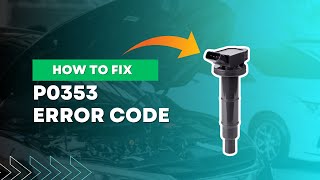
🎬 Watch: A clear explanation of the P0353 code and its causes.Can I Drive With P0353?
yes_but_caution. You can drive short distances to a repair shop, but we strongly advise against it. You will experience rough running, poor acceleration, and a 10-20% drop in fuel economy. A flashing check engine light signifies a severe misfire dumping unburned fuel into the exhaust, which destroys your catalytic converter in minutes and turns a $100 fix into a $2,000+ repair.
Common Causes

- Faulty Ignition Coil (Very Common) — The ignition coil for cylinder #3 failed internally. High heat and voltage break down the internal windings over time, making this the most frequent cause after 60,000 miles.
- Damaged Wiring or Connector (Common) — The wiring harness or connector leading to the coil is damaged, loose, or corroded. Brittle wires, broken locking tabs, or rodent damage create open or short circuits.
- Oil Contamination (Common) — A leaking valve cover gasket allows oil to seep into the spark plug tube. This oil saturates the coil boot, causing misfires and eventually destroying the coil.
- Worn Spark Plug (Common) — An old or incorrectly gapped spark plug creates excessive resistance. This overloads the ignition coil, causing it to overheat and fail prematurely.
- Poor Engine Ground (Less Common) — A corroded or loose engine ground strap causes erratic voltage across the ignition system, which the PCM interprets as a circuit fault.
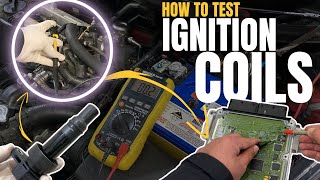
- Faulty Powertrain Control Module (PCM) (Rare) — The internal driver circuit within the PCM that controls the #3 coil failed. Consider this only after exhaustively testing all wiring and connections. 🎬 See how to test ignition coils, wiring, and PCM circuits.
Symptoms

- Engine Misfire or Rough Idle — The engine shakes or vibrates heavily at idle or during acceleration because cylinder #3 is not firing.
- Loss of Power and Hesitation — The vehicle feels sluggish and struggles to merge or climb hills while running on fewer cylinders.
- Reduced Fuel Economy — Fuel efficiency drops by 10-20% as the engine burns more fuel to compensate for the dead cylinder.
- Hard Starting or Stalling — The engine takes longer to start or stalls completely at low speeds.
- Smell of Unburned Fuel — Raw gasoline smell from the exhaust indicates unburned fuel from cylinder #3 passing through the system.
- Check Engine Light is On or Flashing (also visible on scanner) — The check engine light illuminates. A flashing light indicates a severe misfire actively damaging the catalytic converter.
Diagnostic Flowchart
Tap your situation to follow the diagnostic path that matches what you're seeing on this code.
Common Fixes & Costs
- Replace Ignition Coil
— Parts: $30-$110, Labor: $75-$150, ~0.8 hr book time
(DIY)
Ford F-150 (5.4L V8): OEM Motorcraft DG-511 (Alt: Denso 673-6003, Delphi GN10182)
Dodge Ram 1500 (5.7L V8): OEM Mopar 56029129AA (Alt: MSD 82558, Denso)
Hyundai Sonata (2.4L GDI): OEM Hyundai 27300-3F100 (Alt: Delphi GN10599) - Repair Wiring or Replace Connector Pigtail
— Parts: $15-$50, Labor: $100-$250, ~1.5 hr book time
(Intermediate)
Universal: OEM Vehicle-specific pigtail from dealer (Alt: Dorman, Standard Motor Products (SMP)) - Replace Spark Plug
— Parts: $10-$30, Labor: $25-$50, ~0.5 hr book time
(DIY)
Ford F-150 (5.4L V8): OEM Motorcraft SP-546 (Alt: NGK, Bosch)
Dodge Ram 1500 (5.7L V8): OEM Mopar SPLZFR5C11 (Alt: NGK, Champion)
Hyundai Sonata (2.4L GDI): OEM Hyundai SILZKR7B11 (Alt: NGK, Denso) - Replace Valve Cover Gasket
— Parts: $40-$150, Labor: $150-$400, ~2.5 hr book time
(Intermediate)
Ford F-150 (5.4L V8, 3V): OEM Ford 7L1Z-6584-B (Alt: Fel-Pro VS 50664 R)
Dodge Ram 1500 (5.7L V8): OEM Mopar 53021828AD (Alt: Fel-Pro, Victor Reinz)
Hyundai Sonata (2.4L): OEM Hyundai 22441-2G000 (Alt: Fel-Pro VS 50805 R) - Replace Powertrain Control Module (PCM)
— Parts: $600-$1200, Labor: $200-$300, ~1.5 hr book time
(Professional)
All: OEM Dealer sourced via VIN (Alt: Cardone, Blue Streak Electronics)
DIY vs Professional
- Replace Ignition Coil / Spark Plug — Beginner:
- Repair Wiring or Replace Connector Pigtail — Beginner:
- Replace Valve Cover Gasket — Beginner:
- Replace Powertrain Control Module (PCM) — Beginner:
Used vs. New Parts: Buying Guide
When a used part is worth it: Used OEM ignition coils from a low-mileage vehicle are cost-effective for older, high-mileage vehicles. Never use them if accessing the coil requires removing the intake manifold.
Donor-vehicle mileage cap: roughly under 60000 miles for the part to have meaningful remaining life.
Donor quality checklist:
- Verify the donor vehicle was not scrapped for engine or electrical issues.
- Visually inspect the coil for cracks, melting, or corrosion on the electrical pins.
- Match the part number exactly to ensure correct internal resistance.
Decision logic:
- If Vehicle is less than 8 years old or has under 80,000 miles → Buy a new OEM or high-quality aftermarket part (Bosch, Denso, NGK).
- If The ignition coil is difficult to access (labor exceeds 1.5 hours) → Always buy new. The risk of paying repeat labor for a failed used part is too high.
- If Vehicle is over 150,000 miles and budget is the primary concern → A used OEM coil is an acceptable risk. Avoid cheap, no-name aftermarket coils.
Warranty tradeoff: Salvage yard parts carry a 30-90 day warranty. New aftermarket parts offer 1-year to limited lifetime warranties. New OEM parts include a 12-month warranty.
Worst-case if a used part fails: $200-$500 if a used coil fails after installation, requiring repeat labor and a new part.
What Happens If You Wait — Timeline
- 0-1 month: Check Engine Light illuminates. Engine has a rough idle and slight hesitation on acceleration. Fuel economy drops. (MPG impact: 5-15%% · Added cost: $20-$80 in wasted fuel)
- 1-3 months (or immediately if misfire is severe): Check Engine Light flashes during acceleration. Raw, unburned fuel dumps into the exhaust, rapidly overheating the catalytic converter. (MPG impact: 15-25%% · Added cost: $50-$150 in wasted fuel. Catalytic converter damage actively occurs.)
- 3-6 months: The catalytic converter's internal honeycomb melts and clogs. The vehicle suffers severe power loss, and the exhaust glows red. (MPG impact: 20-30%+% · Added cost: $1,200 - $2,800 for catalytic converter replacement.)
- 6+ months: Prolonged engine vibration destroys engine mounts. Fuel washing causes cylinder wall scoring, requiring major internal engine work. (MPG impact: N/A (Vehicle undrivable)% · Added cost: $500 - $4,000+ for catalytic converter, engine mounts, and internal engine repairs.)
Cost of Not Fixing It
- Immediate (0-1 month): Significant drop in fuel economy (10-20%), rough idle, poor acceleration, and potential stalling. (Added cost: $50-$150 in wasted fuel)
- Short-Term (1-6 months): Unburned fuel overheats and destroys the catalytic converter substrate, leading to complete failure. (Added cost: $1200-$2800 for catalytic converter replacement)
- Long-Term (6+ months): Sustained misfires cause excessive engine vibration, destroying engine mounts. Unburned fuel washes oil from cylinder walls, accelerating piston ring wear. (Added cost: $500-$4000+ for engine mount or internal engine repairs)
Diagnosis Steps

- Read Codes and Freeze Frame Data
Use an OBD-II scanner to confirm P0353 is the active code. Note any other codes present, such as P0303 (Cylinder 3 Misfire). Review the freeze frame data to see the engine conditions (RPM, load, temperature) when the fault occurred.
Tools: OBD-II Scanner (Beginner) - Perform the 'Swap Test'
Swap the ignition coil from cylinder #3 with one from an adjacent cylinder (e.g., cylinder #1). Clear the codes and drive the car. If the code changes to P0351, you definitively proved the ignition coil is bad. If P0353 returns, the problem lies with the spark plug, wiring, or PCM.
Tools: Basic socket/wrench set (Beginner) - Perform a Detailed Visual Inspection
Inspect ignition coil 'C' (cylinder #3) for a loose electrical connector, broken locking tab, or cracked housing. Check for oil leaks from the valve cover gasket into the spark plug tube. Inspect the wiring harness for chafing, melting, or rodent damage.
Tools: Flashlight, Mirror (Beginner) - Inspect the Spark Plug
If the swap test proved the coil is good, remove the spark plug from cylinder #3. Check for wear, carbon fouling, oil contamination, or damage to the porcelain insulator. Replace it if its condition is questionable.
Tools: Spark plug socket, ratchet, extension (Intermediate) - Check the Wiring and Connector
Disconnect the ignition coil connector and inspect the pins for corrosion or spread terminals. Use a multimeter set to DC volts to verify battery voltage (12.0-12.6V) at the power wire with Key On, Engine Off. Check for continuity on the ground and signal wires between the connector and the PCM.
Tools: Multimeter, vehicle-specific wiring diagram (Intermediate) - [PRO TIP] Test Coil Primary/Secondary Resistance
Test the coil's internal windings with a multimeter set to Ohms (Ω). Primary resistance across the connector pins typically reads 0.5 to 2.0 ohms. Secondary resistance between the positive pin and the spark plug boot terminal reads 8,000 to 15,000 ohms. An infinite reading (OL) or zero indicates a failed coil.
Tools: Multimeter, service manual (Advanced) - [PRO TIP] Analyze Live Data with a Scan Tool
Monitor the live data stream for cylinder-specific misfire counts. If the 'Cylinder 3 Misfire Count' increases rapidly while running, it confirms a combustion issue. Cross-referencing this with P0353 strongly isolates the ignition coil circuit as the root cause.
Tools: Advanced OBD-II Scan Tool (Advanced) - [PRO TIP] Check for PCM Driver Signal
Unplug the coil connector and plug a noid light into the signal and ground terminals. Crank the engine; a flashing light indicates the PCM driver is working. Alternatively, use an oscilloscope to verify a clean 0V to ~5V square wave pattern from the PCM.
Tools: Ignition Noid Light or Oscilloscope, wiring diagram (Advanced) - Test the PCM
Perform this step only after proving all other components and wiring are good. If there is no signal from the PCM on the driver circuit for coil #3, and the wiring has integrity, the PCM failed. This requires professional replacement and programming.
Tools: Advanced scan tool, oscilloscope (Professional)
When This Code Triggers (Freeze-Frame Conditions)
- Engine Coolant Temp: 180-200°F (Fully warmed up, during steady operation.)
- RPM: 1500-2500 (Light acceleration or steady cruise.)
- Engine Load: 30-60% (Vehicle is under moderate load, such as climbing a slight incline or accelerating to merge.)
- Vehicle Speed: 35-55 mph (Occurs during city or highway driving, rarely at idle.)
Related Codes
- P0303 — Means 'Cylinder 3 Misfire Detected.' It almost always accompanies P0353 because the electrical fault directly causes the cylinder to misfire.
- P0350 — A general code for 'Ignition Coil Primary/Secondary Circuit Malfunction.' Appearing alongside P0353 points to a shared power/ground wire problem or a failing PCM.
- P0351, P0352, P0354, etc. — Indicates faults in other ignition coils. Multiple P035x codes signal a systemic problem, like a failing PCM, major wiring harness issue, or bad ground connection.
- P0203 — Means 'Injector Circuit Malfunction - Cylinder 3.' Some PCMs disable the fuel injector to protect the catalytic converter when a coil fault is detected. Diagnose P0353 first.
Climate & Environmental Factors
- High Humidity / Moisture: Moisture penetrates weathered coil housings or poor electrical connections, creating shorts that trigger P0353.
- Cold Starts: Electrical resistance changes with temperature. A marginal coil or wire fails to perform within spec during a cold start.
- High Engine Bay Heat: Heat breaks down the epoxy insulation inside the coil, causing internal shorts. Coils on the rear bank of a V-engine fail first due to restricted airflow.
How to Talk to a Mechanic About This Code
Say this: "I have an active P0353 code for the ignition coil circuit on cylinder 3. I performed a swap test, and the code remained on cylinder 3, so the coil is okay. I need a diagnostic to test the wiring harness, connector, and PCM driver signal for cylinder 3."
This signals you performed the basic diagnostic step. It focuses the mechanic on complex electrical diagnosis, saving you money on redundant labor and preventing unnecessary part replacements.
Avoid saying:
- 'My check engine light is on, can you look at it?'
- 'My car is shaking and running rough.'
- 'Just fix whatever is wrong with it.'
Questions to ask before authorizing the repair:
- If you recommend a wiring repair, can you show me the damaged section of the harness?
- If you recommend a PCM replacement, did you confirm with a noid light or oscilloscope that the driver signal for coil #3 is absent?
- What is the warranty on the parts and labor for this specific repair?
- Will you use an OEM part or an aftermarket part?
Where to Take It: Dealer vs Independent vs Chain
- Dealer:
Best for: Vehicles under a powertrain or emissions warranty., Known manufacturer-specific issues covered by a TSB or recall (e.g., Subaru WRE-21)., Complex electrical diagnostics on high-end European brands.
Downsides: Significantly higher labor rates compared to independent shops., Often recommend replacing an entire wiring harness when a spot repair is sufficient. (Typical cost: +50% vs. baseline) - Independent Shop:
Best fit. P0353 is a routine code for competent independent shops. They handle coil replacement, wiring tracing, and valve cover gaskets at a reasonable price.
Best for: Out-of-warranty vehicles where cost is a major factor., Common diagnostic trouble codes like P0353 which have well-understood causes.
Downsides: Quality and expertise vary widely; vet the shop through reviews and ASE certifications. (Typical cost: +0% vs. baseline) - Chain Shop:
Acceptable for a simple ignition coil replacement, but AVOID for deeper electrical diagnosis. They frequently misdiagnose wiring or PCM issues.
Best for: Simple part replacements when the diagnosis is already certain (e.g., you confirmed a bad coil with a swap test).
Downsides: Technician skill level is inconsistent., High pressure to upsell services; lack advanced diagnostic tools for complex wiring or PCM issues. (Typical cost: -10% vs. baseline)
When to Walk Away From the Repair
If the estimated repair cost exceeds 40-50% of the car's private-party value, seriously consider selling or trading in the vehicle instead of repairing it.
- Car worth $5000, fix is $350: Fix it. A standard coil replacement is a minor cost relative to the car's value.
- Car worth $4000, fix is $1800: Borderline. A PCM replacement at this price is 45% of the car's value. Get a second opinion and consider selling 'as-is'.
- Car worth $2000, fix is $1500: Walk away. The repair cost is 75% of the car's value and is not a sound investment.
What Scan Tool You Need for This Code
Minimum: A basic OBD-II code reader that reads and clears codes. Sufficient to perform the 'swap test' and confirm the fix.
A basic $20 reader cannot show live misfire data (Mode $06) to determine if the misfire is constant or intermittent, which is crucial for diagnosing tricky wiring issues.
Budget: BlueDriver Pro (~$90) — Connects to your smartphone via Bluetooth. Reads/clears codes, shows freeze frame data, and accesses Mode 6 to view live misfire counts per cylinder.
Mid-range: Innova 5610 or Foxwell NT604 Elite (~$140) — Handheld units offering faster live data graphing and a rugged form factor for workshop use, plus enhanced diagnostics for ABS and airbags.
Professional: Autel MaxiCOM MK808 / XTOOL D8S (~$500-800) — Tablet-based scanners offering full bidirectional control to command the coil to fire for testing. Provides OEM-level diagnostics and wiring diagrams.
How to Clear the Code After You Fix It
- Use an OBD-II scan tool to clear the P0353 code.
- Ensure the fuel tank is between 1/4 and 3/4 full.
- Perform a complete OBD-II drive cycle to allow readiness monitors to run.
Drive cycle (~30 minutes): Start with a cold engine (sit for 8+ hours). Idle for 2-3 minutes. Drive at a steady 55 mph for 10 minutes. Coast to a stop. Perform 15 minutes of mixed stop-and-go city driving.
Readiness monitors affected: Catalyst (CAT) monitor, Oxygen (O2) Sensor monitor, Misfire monitor
Before emissions retest: drive at least 100 miles to fully set monitors.
Watch out for:
- Disconnecting the battery clears the code but resets all readiness monitors, guaranteeing an emissions test failure.
- The code returns immediately if the underlying electrical fault remains unfixed.
Will This Fail Emissions / State Inspection?
Yes — this code typically fails an OBD-II emissions inspection.
- California: An active P0353 code is an automatic failure. After repair, all readiness monitors must be set to 'Ready'. Driving 100-200 miles is required to complete the drive cycle.
- New York: A vehicle automatically fails the NYS OBD-II inspection if the Check Engine Light is illuminated for P0353.
- Texas: An illuminated Check Engine Light is an automatic failure. After clearing the code, you must complete a drive cycle; too many 'Not Ready' monitors results in failure.
Most Commonly Affected Vehicles
- Ford F-150, Explorer, Fusion, Edge (2004-2015) — Extremely common on 5.4L V8 and 3.5L V6 engines. TSB 12-8-17 notes some 2006-2008 models require PCM replacement alongside coils due to heat damage.
- Dodge/Chrysler/Jeep Ram 1500, Grand Cherokee, Charger (2005-2016) — Frequent on V6 and V8 engines. Typically a straightforward coil failure, but wiring harness chafing near the firewall occurs.
- Hyundai/Kia Sonata, Optima, Santa Fe (2011-2017) — Prevalent on the 2.4L GDI engine. Frequently caused by oil from a leaking valve cover gasket destroying the coil.
- BMW 3 Series, 5 Series, X3, X5 (2005-2017) — Common as mileage increases. The cause is typically a worn-out ignition coil requiring replacement with an OEM Bosch or Delphi unit.
- Subaru Legacy, Forester, Impreza (2012-2019) — TSB 07-120-17R addresses poor coil connections requiring redesigned parts. Recall WRE-21 covers ECM software updates and coil replacements for 2017-2019 models.
- Chevrolet Silverado, Impala, Equinox (2006-2016) — High resistance in the ignition coil control circuit causes misfires before the DTC sets on V6 and V8 models.
- Toyota Camry, RAV4, Highlander (2005-2014) — Often presents as an intermittent issue resolved temporarily by restarting the car, pointing to a heat-sensitive failing coil.
- Honda Civic, CR-V, Pilot (2003-2015) — Appears due to excessive resistance from a worn spark plug overloading and damaging the ignition coil over time.
Manufacturer-Specific Notes
- Ford: Per TSB 12-8-17, 2006-2008 models with 3.0L/3.5L engines exhibit multiple P035x codes due to heat-damaged coils. The official repair involves replacing the PCM along with all six coils and spark plugs.
- Subaru: Safety Recall WRE-21 affects 2017-2019 Impreza and 2018-2019 Crosstrek vehicles. The ECM continues powering the ignition coil after engine shutoff, causing a short circuit. The dealer fixes this free of charge.
- Chrysler/Dodge: On V6/V8 engines, ignition coils on the rear bank (often including cylinder 3) fail more frequently due to higher heat exposure near the firewall.
- Hyundai/Kia: On 2.4L GDI engines, P0353 is frequently a secondary fault caused by a leaking valve cover gasket. Replacing the coil without fixing the oil leak guarantees repeat failure.
Real Owner Stories
2009 Ford F-150 - The Simple Fix
Owner experienced a rough idle after accelerating. A pending P0353 code was read with a scan tool.
What they tried:
- Planned to order and replace the #3 ignition coil.
Outcome: Before replacing the part, the owner discovered the spark plug for cylinder #3 was loose. Tightening the spark plug cleared the code permanently.
Lesson: Always start with simple physical checks. A loose spark plug or poorly seated connector mimics a completely failed part.
2002 Ford F-150 (260k miles) - The Wiring Nightmare
Truck misfired with a persistent P0353 code despite numerous expensive repairs.
What they tried:
- Replaced the PCM.
- Replaced all ignition coils and spark plugs.
- Replaced the intake manifold.
Outcome: The code remained. The owner found a cluster of wires near the A/C accumulator chafing, causing a short in the circuit for coil #3.
Lesson: If replacing the coil and plug fails, the problem is in the wiring. Thoroughly inspect the wiring harness for chafe points before replacing an expensive PCM.
2006 Toyota Corolla (188k miles) - The Intermittent Gremlin
Car intermittently ran rough and vibrated heavily, logging P0353. Symptoms disappeared after clearing the code.
What they tried:
- Swapped the ignition coil from cylinder #3 with coils from other cylinders.
Outcome: The P0353 code always returned to cylinder #3. This confirmed the coils were good and pointed to a wiring or grounding issue specific to the cylinder #3 circuit.
Lesson: When a fault code does not move with the component during a 'swap test,' the problem lies in the stationary parts: the connector, harness, or PCM.
2006 Ford F-150 (85k miles) - The Compound Failure
After driving through heavy rain, the truck ran rough, blew a fuse, and logged P0353.
What they tried:
- Replaced the blown fuse.
- Replaced the crankshaft position sensor.
- Replaced the entire coil pack twice.
Outcome: The owner had the PCM tested and found a bad coil driver output and damaged resistor. The original failing coil pack shorted out and destroyed the PCM driver.
Lesson: A single component failure causes chain reactions. A bad coil destroys the PCM driver, requiring both to be fixed simultaneously.
How to Prevent This Code From Triggering
- Replace Spark Plugs on Schedule (Every 60,000 to 100,000 miles) — Worn spark plugs require higher voltage to spark. This increased demand stresses the ignition coil, causing it to overheat and fail prematurely.
- Promptly Repair Engine Oil Leaks (During regular oil changes or inspections) — A leaking valve cover gasket allows oil to seep into the spark plug tubes, degrading the rubber boot and destroying the coil.
- Use Dielectric Grease on Coil Boots (When replacing spark plugs or coils) — Applying dielectric grease inside the boot seals out moisture, prevents high-voltage arcing, and stops the boot from heat-seizing to the spark plug.
- Keep Engine Bay Connectors Clean and Dry (Ongoing) — Avoid pressure washing the engine directly. Moisture intrusion causes short circuits and corrosion that trigger P0353.
- Use High-Quality Fuel and Ignition Parts (Every fill-up and repair) — Using OEM or reputable aftermarket coils ensures proper voltage output and longevity. Cheap parts guarantee repeat failures.
Frequently Asked Questions
What does the 'C' in P0353 mean?
The 'C' refers to the third cylinder in the engine's firing order. The letters correspond to numbers: 'A' for cylinder 1, 'B' for cylinder 2, and 'C' for cylinder 3.
I replaced the coil and plug, but P0353 came back. What now?
If a swap didn't fix it, the fault is in the electrical circuit. Meticulously inspect the coil's connector for loose pins and check the wiring harness for chafing. Finally, verify the engine has a solid ground connection.
My P0353 code is intermittent. What should I check first?
Intermittent faults usually stem from poor connections or heat-sensitive coils. Wiggle the coil connector with the engine running to see if it triggers a misfire. Inspect the connector for loose pins or slight corrosion.
Can a bad ground cause a P0353 code?
Yes. A corroded main engine ground strap creates unstable voltage across the ignition system. The PCM monitors the coil's voltage signature and flags erratic readings as a circuit fault.
Is it okay to keep driving with a P0353 code?
Short-term driving to a shop is possible but risky. A flashing check engine light means raw fuel is flooding the exhaust. This destroys your catalytic converter, turning a minor repair into a $2,500+ nightmare.
Should I replace all my ignition coils if one fails?
We highly recommend replacing all coils if your vehicle has over 80,000 miles. Ignition coils endure the same heat cycles and typically fail around the same time. Replacing them together saves future breakdown headaches and redundant labor costs.
Can bad gas cause a P0353 code?
No, bad gas causes random misfire codes (like P0300) across multiple cylinders. P0353 points specifically to an electrical circuit fault isolated to the cylinder #3 ignition coil.
Key Takeaways
- P0353 indicates an electrical failure in the cylinder #3 ignition coil circuit, requiring immediate attention if the check engine light flashes to prevent a $2,000+ catalytic converter replacement.
- Perform a 'swap test' by moving the cylinder #3 coil to cylinder #1; if the code changes to P0351, you have definitively proven the coil is bad and needs a $30-$110 replacement.
- Inspect the cylinder #3 spark plug well for pooled oil, as a leaking $40 valve cover gasket is a frequent underlying cause that quickly destroys brand-new ignition coils.
- If a new coil and spark plug do not clear the P0353 code, stop replacing parts and test the wiring harness for a broken connector locking tab, chafed wires, or a bad ground.
Helpful Videos
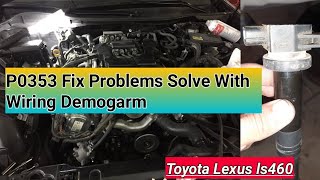

The information in this article is provided for general reference and educational purposes only. Vehicle specifications, procedures, and part compatibility can vary by production date, trim level, and region. Always consult your vehicle's factory service manual and verify part numbers before purchasing or performing repairs. Safety-critical components such as airbags, seat belts, and braking systems should be installed by a qualified professional.
- 🎬 Helpful Videos
- What Does P0353 Mean?
- Can I Drive With P0353?
- Common Causes
- Symptoms
- Diagnostic Flowchart
- Common Fixes & Costs
- DIY vs Professional
- Used vs. New Parts: Buying Guide
- What Happens If You Wait — Timeline
- Cost of Not Fixing It
- Diagnosis Steps
- When This Code Triggers (Freeze-Frame Conditions)
- Related Codes
- Climate & Environmental Factors
- How to Talk to a Mechanic About This Code
- Where to Take It: Dealer vs Independent vs Chain
- When to Walk Away From the Repair
- What Scan Tool You Need for This Code
- How to Clear the Code After You Fix It
- Will This Fail Emissions / State Inspection?
- Most Commonly Affected Vehicles
- Manufacturer-Specific Notes
- Real Owner Stories
- 2009 Ford F-150 - The Simple Fix
- 2002 Ford F-150 (260k miles) - The Wiring Nightmare
- 2006 Toyota Corolla (188k miles) - The Intermittent Gremlin
- 2006 Ford F-150 (85k miles) - The Compound Failure
- How to Prevent This Code From Triggering
- Frequently Asked Questions
- What does the 'C' in P0353 mean?
- I replaced the coil and plug, but P0353 came back. What now?
- My P0353 code is intermittent. What should I check first?
- Can a bad ground cause a P0353 code?
- Is it okay to keep driving with a P0353 code?
- Should I replace all my ignition coils if one fails?
- Can bad gas cause a P0353 code?
- Key Takeaways
- 🎟️ Get 5% Off