

P0306 on 2020-2025 Ford Explorer Hybrid: Cylinder 6 Misfire Causes and Fixes
P0306 indicates a misfire in cylinder #6. On the 2020-2025 Explorer Hybrid, this is most often caused by a faulty ignition coil or a worn-out spark plug. Cylinder 6 is located on the driver's side, closest to the firewall. Expect to pay $40-$80 for a DIY fix, or $150-$300 at a repair shop.
- P0306 means cylinder #6 is misfiring, which is the cylinder on the driver's side closest to the firewall.
- The most likely cause is a bad ignition coil, followed closely by a worn spark plug.
- A simple diagnostic test is to swap the ignition coil from cylinder 6 to another cylinder and see if the misfire code follows the coil.
- Do not ignore a flashing Check Engine Light, as it signals a severe misfire that can quickly destroy your catalytic converter.
- This is a common DIY repair with a difficulty of 2 out of 5.
What's Unique About the 2020-2025 Ford Explorer
The 2020-2025 Explorer uses the sixth-generation (U625) platform with the reliable 3.3L Cyclone V6 engine, which is part of a hybrid system. While the engine itself is generally durable, the coil-on-plug ignition system is a common point of failure, typical for many modern engines. The first model year (2020) was known for having numerous initial quality issues and recalls, though not specifically for misfires. The hybrid system itself doesn't typically complicate a simple misfire diagnosis, which usually traces back to standard ignition or fuel system components. This same 3.3L Hybrid powertrain is shared with the Ford Police Interceptor Utility, which also sees reports of P0306.
Symptoms You May Notice
- Rough or vibrating idle
- Hesitation or stumbling during acceleration.
- Noticeable loss of engine power.
- Flashing Check Engine Light (indicates a severe misfire).
- Reduced fuel economy
- Smell of gasoline from the exhaust.
- Replacing oxygen sensors. O2 sensors report on the air/fuel mixture but do not typically cause a single-cylinder misfire.
- Replacing the catalytic converter. A misfire can damage a catalytic converter, but a bad converter does not cause the misfire.
Most Likely Causes
- Faulty Ignition Coil 🔴 High Probability Coil-on-plug systems are a common failure point due to constant exposure to high heat and vibration in the engine bay. This is the most likely cause of a single-cylinder misfire on most modern engines.
How to confirm: The easiest way to confirm a bad coil is to swap the ignition coil from cylinder 6 with an adjacent cylinder (e.g., cylinder 5). Clear the code and drive the vehicle. If the code changes to P0305, the ignition coil is faulty. Cylinder 6 is on the driver's side, closest to the firewall.
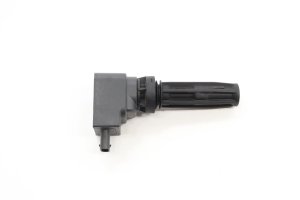
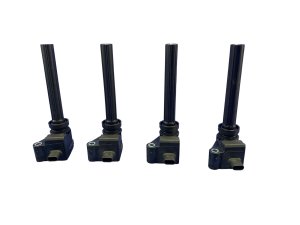
Typical fix: Replace the faulty ignition coil. It is often recommended to replace the corresponding spark plug at the same time. The OEM Motorcraft part number is PB5Z-12029-A.
Est. part cost: $30-$70 - Worn or Fouled Spark Plug 🔴 High Probability Spark plugs are a regular maintenance item. While modern iridium plugs can last 100,000 miles, they can fail prematurely due to carbon buildup, oil fouling, or a cracked insulator.
How to confirm: After ruling out the ignition coil, remove the spark plug from cylinder 6. Inspect it for wear (rounded electrode), heavy carbon deposits, oil, or coolant fouling. The correct spark plug gap for the 3.3L Cyclone Hybrid is 1.25–1.35 mm (0.049–0.053 in).
Typical fix: Replace the spark plug. It's best practice to replace all six spark plugs at once to ensure even performance. The OEM Motorcraft part is SP-589 (CYFS-12Y-PCT).
Est. part cost: $10-$25 per plug - Clogged or Faulty Fuel Injector 🟡 Medium Probability The 3.3L engine uses a Port Fuel Direct-Injection (PFDI) system. While this dual system helps prevent carbon buildup on intake valves, the injectors themselves can still become clogged or fail electronically, preventing the correct amount of fuel from reaching cylinder 6. A strong smell of unburnt gas from the exhaust can sometimes point to a stuck-open injector.
How to confirm: Listen to the injector with a mechanic's stethoscope; it should have a consistent ticking sound. You can also check the injector's resistance with a multimeter or swap the injector with another cylinder to see if the misfire code follows. A professional scan tool can perform a power balance test to help isolate the failing cylinder.
Typical fix: Clean or replace the faulty fuel injector.
Est. part cost: $50-$120 - Engine Harness Chafing ⚪ Low Probability A Technical Service Bulletin for F-150s (TSB 25-2569) notes that the engine harness can rub against other components, causing shorts or open circuits to coils and injectors. While not specific to the Explorer, it points to a potential issue on Ford V6 engines worth inspecting.
How to confirm: Visually inspect the wiring harness leading to the ignition coil and fuel injector on cylinder 6. Look for any signs of rubbing, melting, or exposed wires, particularly where the harness may contact brackets or hose clamps.
Typical fix: Repair the damaged section of the wiring harness and secure it away from any sharp edges or hot surfaces.
Est. part cost: $10-$50 for repair materials
Rare But Worth Checking
- Low Engine Compression: A mechanical engine issue like a burnt valve, worn piston rings, or a leaking head gasket can cause a loss of compression, leading to a misfire. This is less common but more serious. A compression test is needed to diagnose this.
- PCM Software Issue: TSB 22-2151, issued for F-150s with the 3.5L PowerBoost, indicates that PCM software parameters could cause misfire codes, including P0306. This is a rare possibility for the Explorer but worth considering if all mechanical and electrical checks pass.
- Faulty Purge Valve: On some Ford models, a stuck-open EVAP purge valve can create a vacuum leak large enough to cause misfires, often on multiple cylinders. If codes like P0300 or other cylinder misfires are present with P0306, this is a possibility.
Diagnosis Steps
- Read the code with an OBD-II scanner to confirm P0306 and check for any other codes.
- To locate cylinder 6, stand facing the engine. The cylinder bank closer to the radiator is the passenger side (Bank 1), containing cylinders 1, 2, and 3 (front to back). The bank closer to the firewall is the driver's side (Bank 2), containing cylinders 4, 5, and 6 (front to back). Cylinder 6 is on the driver's side, closest to the firewall.
- Swap the ignition coil from cylinder 6 with the coil from cylinder 5. Clear the codes and test drive.
- If the code returns as P0305, the ignition coil is bad and needs replacement.
- If the code remains P0306, remove and inspect the spark plug from cylinder 6. Check for wear, correct gap (1.25-1.35mm), and any fouling. Replace it if it's worn, fouled, or damaged.
- If the plug and coil are good, inspect the wiring and connector for the ignition coil and fuel injector on cylinder 6 for damage or corrosion.
- If wiring is intact, listen to the fuel injector with a stethoscope for a steady clicking. Consider swapping the injector with cylinder 5 if accessible.
- If all ignition and fuel components check out, perform a compression test on cylinder 6 to rule out mechanical engine problems.
Parts You'll Likely Need
- Ignition Coil
(OEM #PB5Z-12029-A)— This is the most common failure part for a single-cylinder misfire on modern engines.
Trusted brands: Motorcraft, NGK, Spectra Premium
OEM price range: $60-$90
Aftermarket price range: $30-$70 - Spark Plug
(OEM #SP-589)— Spark plugs are a maintenance item that wear out over time and are the second most likely cause of a misfire.
Trusted brands: Motorcraft, NGK, Bosch
OEM price range: $15-$25
Aftermarket price range: $10-$20
Related Codes That Often Appear With This One
- P0300 — If multiple cylinders are misfiring randomly, you will see P0300 (Random Misfire Detected) alongside the specific cylinder code. This could point to a systemic issue like a vacuum leak or fuel delivery problem.
- P0301-P0305 — If other specific cylinder misfire codes are present, it may point to a systemic issue like low fuel pressure, a vacuum leak, or a wiring problem affecting multiple cylinders.
- P0316 — Misfire Detected on Startup (First 1000 Revolutions). This code often appears with a specific cylinder misfire code and indicates the misfire is present immediately when the engine starts.
Technical Service Bulletins (TSBs) & Recalls
- TSB 25-2569: Notes that on some Ford vehicles, engine harness contact may cause DTCs P0301-P0306. (Note: This TSB is for the F-150 but provides relevant diagnostic context).
- TSB 21-2158: Mentions PCM software parameters can cause various misfire DTCs, including P0306, on some Ford models. (Note: This TSB is for the F-150 but provides relevant diagnostic context).
- TSB 19-2286: Cites an improperly assembled muffler as a rare cause for P0300-P0306 on some F-150s. (Note: This TSB is for the F-150 but provides relevant diagnostic context).
Platform-Specific Known Issues
- An owner of a 2023 model reported DTCs including P0306, which led to a dealer diagnosis, confirming this code appears on recent Explorers. (NHTSA ODI #11681823)
- While for the F-150, TSB 25-2569 warns that engine harness contact can cause misfire codes P0301-P0306, suggesting a potential area to inspect on related Ford V6 engines.
- Similarly, F-150 TSB 21-2158 points to PCM software as a potential cause for misfires including P0306, indicating a rare but possible root cause if mechanical/electrical checks are clear.
- A user on Ford Truck Enthusiasts forums with an older Explorer V6 reported a P0306 code accompanied by a strong gas smell, which ultimately pointed towards a fuel delivery issue rather than ignition.
Mechanic-Grade Diagnostic Values
- Spark Plug Gap — expected: 1.25–1.35 mm (0.049–0.053 in). Failure: A gap outside this range can lead to a weak or inconsistent spark.
- Ignition Coil Primary Resistance — expected: ~0.500 Ohms. Failure: A significantly higher or lower reading, or an open circuit (infinite resistance), indicates a failed coil.
- Ignition Coil Secondary Resistance — expected: ~11,300 Ohms. Failure: A reading far outside this value suggests an internal failure of the coil's secondary windings.
- Engine Compression Ratio (Reference) — expected: 12.0:1. Failure: A compression test showing significantly lower pressure in cylinder 6 compared to others indicates a mechanical engine problem.
Hidden / Shadow Codes Worth Checking
- Mode $06, TID $A2-$A7: These Test IDs (TIDs) correspond to misfire counts for each cylinder (A2 for Cyl 1, A7 for Cyl 6) during the last 10 driving cycles. A high count for TID $A7 confirms a persistent misfire on cylinder 6. (see via An advanced OBD-II scanner capable of displaying Mode $06 test results.)
- Mode $06, TID $53: This Test ID often relates to catalyst-damaging misfire rates. A failing value here indicates the misfire is severe enough to potentially damage the catalytic converter. (see via An advanced OBD-II scanner capable of displaying Mode $06 test results.)
Scan Tool Commands That Help
- Ford IDS (Integrated Diagnostic System): Power Balance Test — This function allows a technician to disable one cylinder at a time and observe the corresponding drop in engine RPM. If disabling cylinder 6 causes little or no change in RPM, it confirms that cylinder is not contributing power, pinpointing the misfire without swapping parts.
Wiring & Ground Locations
- Cylinder 6 Ignition Coil Connector — On the driver's side of the engine (Bank 2), at the rearmost cylinder closest to the firewall. The connector plugs directly onto the top of the ignition coil.. This connector and its pigtail wiring are a potential point of failure. Heat and vibration can make the wires brittle or cause the locking tab to break, leading to a poor connection and a misfire on cylinder 6.
- Cylinder 6 Fuel Injector Connector — On the driver's side of the engine (Bank 2), on the fuel rail near the intake port for the rearmost cylinder.. Similar to the coil connector, the wiring to the fuel injector can become damaged, causing an intermittent or total loss of fuel delivery to cylinder 6.
- PCM (Powertrain Control Module) — Typically located in the engine bay, often on the passenger side firewall.. The PCM sends the signal to fire the coil and injector for cylinder 6. A wiring fault between the PCM and the component, or a rare internal PCM driver failure, can cause P0306. A wiring diagram is needed to test continuity from the specific PCM pins.
Real Owner Repair Stories
- Ford Expedition Forum (2020 Ford Expedition (Uses similar engine architecture and components)) — P0306 misfire code.
❌ Tried (didn't work) Replacing the spark plug., Swapping the ignition coil to another cylinder (misfire did not follow the coil).
✅ What actually fixed it The connector pigtail to the ignition coil on cylinder 6 was damaged. Replacing the connector resolved the misfire. The owner noted the factory wiring harness was tight and the wires can become brittle from heat cycles. - Reddit r/FordExplorerST (2022 Ford Explorer ST (3.0L EcoBoost, but relevant diagnostic process)) — Flashing check engine light during hard acceleration, codes P0302 and P0306 stored.
❌ Tried (didn't work) The owner was in the initial diagnostic phase.
✅ What actually fixed it The user was advised by a Ford mechanic friend that this was a known issue. While the final fix isn't posted by the original author, the event (misfire under load) is a classic symptom of a failing ignition coil or spark plug unable to fire under high cylinder pressures.
OEM Part Supersession History
JT4Z-12029-A, KT4Z-12029-A→PB5Z-12029-A— Standard part evolution and supplier changes.SP-520, SP-544, CYFS-12YT5→SP-589 (CYFS-12Y-PCT)— Updates to plug design and materials for longevity and performance.
Heads up: While older numbers may fit, using the latest specified part (SP-589) is recommended to ensure compatibility with the ignition system and correct heat range.
Model Year Variations Within This Range
- 2024-2025: For the 2024 model year, Ford discontinued the consumer version of the 3.3L Hybrid Explorer, dedicating production to the Police Interceptor Utility. The consumer model returned for 2025 in some trims. This primarily affects vehicle availability, not the repair process for existing vehicles.
Diagnostic Flowchart
Other Known Issues on This Vehicle
Issues unrelated to this code that are worth knowing about as an owner of this generation:
- Rear Axle Bolt Fracture 🔴 High — Affects 2020-2022 models. Can cause loss of power and rollaway risk if park brake is not used. (Ref: Recall 22S27 / NHTSA 22V-255.)
- 10R60 Transmission Harsh/Jerky Shifting 🟠 Medium — Common complaint across 2020+ models. Symptoms include hard shifts, hesitation, and clunking. (Ref: Multiple TSBs exist for software updates (e.g., TSB 23-2176 for delayed reverse) and mechanical procedures.)
- 360-Degree Camera Failure (Blue Screen) 🟠 Medium — Widespread on 2020-2023 models, leading to loss of rear camera view. (Ref: Recall 23S23 / NHTSA 23V-342.)
- Slow Fuel Fill / Spit Back 🟡 Low — Reported on 2020-2021 models where the fuel pump nozzle clicks off before the tank is full. (Ref: TSB 21-2254.)
- Poor Interior Fit and Finish 🟡 Low — Common owner complaint regarding rattles, panel gaps, and premature wear on early 6th-gen models.
Used vs. New Parts: Buying Guide for This Vehicle
When a used part is the smart pick: Used parts are generally not recommended for the most common causes of P0306. Ignition coils and spark plugs are wear items with a finite lifespan, and a used part may have little life left. A used fuel injector could be a cost-saving option if it's from a low-mileage, reputable donor vehicle.
Donor-vehicle mileage cap: roughly under 40000 miles for the part to have meaningful remaining life.
What to inspect on the donor part:
- For a fuel injector, check for any physical damage, rust, or clogged nozzles.
- Verify the donor vehicle's mileage and ensure it was not in a severe front-end collision.
- Avoid parts from flood-damaged vehicles, as electrical components will be compromised.
OEM-only on this vehicle (don't cheap out):
- PCM/ECU: A used module would require professional reprogramming to match the vehicle's VIN and security system, often costing as much as a new, pre-programmed unit.
Aftermarket brands forum-validated for this vehicle:
- Ignition Coils: NGK, Denso, Spectra Premium
- Spark Plugs: NGK, Bosch
Brands owners have reported issues with on this vehicle:
- Unbranded, no-name ignition coils from online marketplaces are frequently reported by mechanics to have high premature failure rates.
Real Owner Stories
Aggregated from forums and TSBs cited above. Mileages and costs reflect what owners reported in those sources.
2023 Ford Explorer
Symptoms: Owner reported multiple DTCs including P0306, leading to a formal dealer diagnosis.
What fixed it: Dealer diagnosis confirmed the presence of the code on this recent model year.
Source hint: NHTSA ODI #11681823
2013 Explorer Limited V6
Symptoms: Sudden rough idle, P0306 code, and a strong smell of gas.
What fixed it: Investigation into a potential stuck fuel injector versus ignition components.
Source hint: Ford Truck Enthusiasts forum thread titled '2013 Explorer Limited V6 Rough Running, Then Check Engine and P0306'
Ford Explorer V6
Symptoms: P0306 code remained even after replacing the ignition coil and spark plug and swapping the injector.
What fixed it: Investigation of the wiring harness and PCM issues.
Source hint: Ford Truck Enthusiasts forum thread titled 'P0306 help!'
Related OBD-II Codes
Frequently Asked Questions
Where is cylinder 6 located on the 2020-2025 Ford Explorer 3.3L Cyclone V6?
Does TSB 25-2569 regarding engine harness chafing apply to my Explorer?
What are the specific spark plug requirements for the 3.3L Cyclone Hybrid engine?
Could a PCM software issue be causing my P0306 misfire code?
What is the specific Motorcraft part number for a replacement ignition coil?
I smell gasoline from my exhaust along with the P0306 code; what does this indicate?
Helpful Videos

Used OEM Parts in Stock


New Aftermarket Parts Available


The information in this article is provided for general reference and educational purposes only. Vehicle specifications, procedures, and part compatibility can vary by production date, trim level, and region. Always consult your vehicle's factory service manual and verify part numbers before purchasing or performing repairs. Safety-critical components such as airbags, seat belts, and braking systems should be installed by a qualified professional.
- Ford Explorer:
- 🎬 Helpful Videos
- 🛍️ Shop This Part
- What's Unique About the 2020-2025 Ford Explorer
- Symptoms You May Notice
- Most Likely Causes
- Rare But Worth Checking
- Diagnosis Steps
- Parts You'll Likely Need
- Related Codes That Often Appear With This One
- Technical Service Bulletins (TSBs) & Recalls
- Platform-Specific Known Issues
- Mechanic-Grade Diagnostic Values
- Hidden / Shadow Codes Worth Checking
- Scan Tool Commands That Help
- Wiring & Ground Locations
- Real Owner Repair Stories
- OEM Part Supersession History
- Model Year Variations Within This Range
- Diagnostic Flowchart
- Other Known Issues on This Vehicle
- Used vs. New Parts: Buying Guide for This Vehicle
- Real Owner Stories
- 2023 Ford Explorer
- 2013 Explorer Limited V6
- Ford Explorer V6
- Related OBD-II Codes
- Frequently Asked Questions
- 🎟️ Get 5% Off