

P0301 on 2011-2018 Ram 1500 5.7L HEMI: Cylinder 1 Misfire Causes and Fixes
P0301 on a 5.7L HEMI Ram 1500 is most often a bad ignition coil or spark plug on cylinder #1. However, if accompanied by a distinct engine ticking noise, this code is a strong warning sign of potential camshaft and lifter failure, a common and serious issue for this engine. Driving with a flashing check engine light can quickly destroy the catalytic converters.
- P0301 means cylinder #1 (front, driver's side) is misfiring.
- Always start diagnosis by swapping the ignition coil from cylinder #1 to another cylinder to see if the misfire code follows it. This is a fast, free, and effective test.
- Listen for a distinct ticking noise. A tick combined with a P0301 code on a 5.7L HEMI is a very strong indicator of a failed lifter and damaged camshaft, which is a common but expensive repair.
- Driving with a flashing check engine light can cause rapid and costly damage to your catalytic converter.
What's Unique About the 2011-2018 Ram 1500

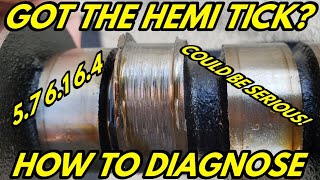
While any vehicle can have a misfire, the 2011-2018 Ram 1500 with the 5.7L HEMI has a specific, well-documented weakness that can cause this code. A persistent P0301, especially when paired with a ticking sound (the infamous 'HEMI tick'), often points to a failed lifter and a damaged camshaft lobe. This failure is frequently linked to the lifters used for the Multi-Displacement System (MDS). The roller bearing on an MDS lifter can seize, preventing it from rolling smoothly on the camshaft. This causes the cam lobe to be ground down, which prevents the valve from opening fully, leading to a loss of compression and a persistent misfire that a simple tune-up cannot fix.
Symptoms You May Notice
- Rough or shaky idle
- Hesitation or stumbling during acceleration
- Noticeable loss of engine power
- Flashing or solid Check Engine Light
- Engine ticking noise, especially when warm, which can be a sign of lifter failure
- Decreased fuel economy
- Smell of unburnt fuel from the exhaust
- Replacing only the spark plugs when the underlying cause is a failing camshaft. The misfire will persist or return quickly.
- Replacing an oxygen (O2) sensor. While a faulty O2 sensor can cause performance issues, it is very unlikely to cause a misfire isolated to a single cylinder.
- Assuming any ticking noise is a harmless 'Hemi tick' from an exhaust manifold leak. While manifold leaks are common, a tick accompanied by a P0301 should be investigated for cam/lifter failure immediately.
Most Likely Causes


- Faulty Ignition Coil 🔴 High Probability Ignition coils are a common wear item that can fail with age and heat cycles, leading to a lack of spark. Their quality has been noted by some as a point of failure.
How to confirm: Swap the ignition coil from cylinder #1 with another cylinder (e.g., cylinder #3). Clear the codes and run the engine. If the code changes to P0303, the coil is bad. 🎬 Watch: How to swap coils and change spark plugs Also inspect the coil boot for cracks or moisture.
Typical fix: Replace the faulty ignition coil. It is a simple, bolt-on part. While some owners replace all 8 coils preventatively, it is only necessary to replace the failed one.
Est. part cost: $30-$75 per coil - Worn or Fouled Spark Plugs 🔴 High Probability The 5.7L HEMI uses two spark plugs per cylinder (16 total), increasing the statistical chance of a single plug failing. They are a routine maintenance item with a finite lifespan, and failure to change them can lead to misfires.
How to confirm: Remove the spark plugs from cylinder #1 and inspect them for wear (worn electrode), carbon fouling, oil, or cracks in the porcelain. Check the spark plug gap to ensure it is within spec (typically 0.044 inches). A visual inspection is key.
Typical fix: Replace the spark plugs. It is best practice to replace all 16 spark plugs at the same time to ensure consistent performance and avoid future issues.
Est. part cost: $50-$150 for a full set of 16 - Failed Camshaft Lobe and Lifter 🟡 Medium Probability A well-known and serious issue on 5.7L HEMI engines, often related to the MDS lifters. The lifter's roller bearing can fail, destroying the corresponding lobe on the camshaft. This prevents the valve from opening fully, causing a loss of compression and a misfire. This is often accompanied by a distinct ticking noise.
How to confirm: This is diagnosed after ruling out ignition and fuel issues. A distinct ticking noise is a strong clue. A mechanic can confirm by removing the valve cover and visually inspecting valve movement or measuring valve lift. In-cylinder pressure analysis can also reveal a worn cam lobe.
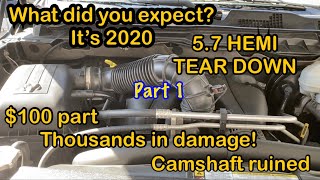
Typical fix: This is a major and expensive repair that involves replacing the camshaft, all 16 lifters (both MDS and standard), head gaskets, and other related components. Many owners opt to install a non-MDS camshaft and lifters to prevent recurrence. 🎬 See this walkthrough for a camshaft replacement and MDS delete
Est. part cost: $800-$2500 for a complete kit - Clogged or Faulty Fuel Injector ⚪ Low Probability
How to confirm: After ruling out ignition issues, swap the fuel injector from cylinder #1 with another cylinder. If the misfire code follows the injector, it is the cause. You can also test the injector's resistance with a multimeter or listen for its clicking operation with a mechanic's stethoscope.
Typical fix: Replace the faulty fuel injector. It's often recommended to replace them as a set on high-mileage vehicles to ensure balanced fuel delivery.
Est. part cost: $50-$120 per injector
Rare But Worth Checking
- Broken Valve Spring: Mentioned in owner forums as a possible, though less common, cause of a single-cylinder misfire, sometimes after a high-RPM event. This would be discovered during a compression test or visual inspection with the valve cover removed.
- Low Compression: Besides a worn cam, this can be caused by issues like a worn piston ring, a poor valve seal, or a leaking head gasket. A compression test and cylinder leak-down test are required to diagnose this.
- PCM Software Glitch: In some cases, particularly during cold starts, a misfire code can be falsely triggered. Technical Service Bulletins have been issued for similar models suggesting a PCM software update can resolve this.
Diagnosis Steps

- Read the fault code using an OBD-II scanner to confirm P0301 and check for any other codes.
- Identify cylinder #1 (front-most on the driver's side).
- Swap the ignition coil from cylinder #1 with another cylinder (e.g., #3). Clear the codes and drive the vehicle. If the code changes to P0303, the ignition coil is faulty and needs replacement.
- If the code remains P0301, remove and inspect the two spark plugs from cylinder #1. Look for wear, damage, or fouling. Even if they look okay, consider replacing all 16 if they are near their service interval.
- If the misfire persists, check the wiring and connector to the cylinder #1 ignition coil and fuel injector for any damage, corrosion, or loose connections.
- Listen carefully for a metallic ticking sound from the engine, especially when warm. This is a classic symptom of a failed lifter and worn camshaft.
- If ignition parts are ruled out, swap the fuel injector from cylinder #1 with another cylinder. If the misfire moves, the injector is the problem.
- Perform an engine compression test on cylinder #1. A healthy cylinder should have compression that is close to the other cylinders. Low compression points to a mechanical problem.
- If compression is low, a cylinder leak-down test can help pinpoint the source of the leak (valves vs. rings).
- If a mechanical fault like a worn cam is suspected, the final step is to remove the driver's side valve cover to visually inspect the valve springs and rocker arms, and to measure the lift of the intake and exhaust valves on cylinder #1 to confirm they are opening fully.
Parts You'll Likely Need

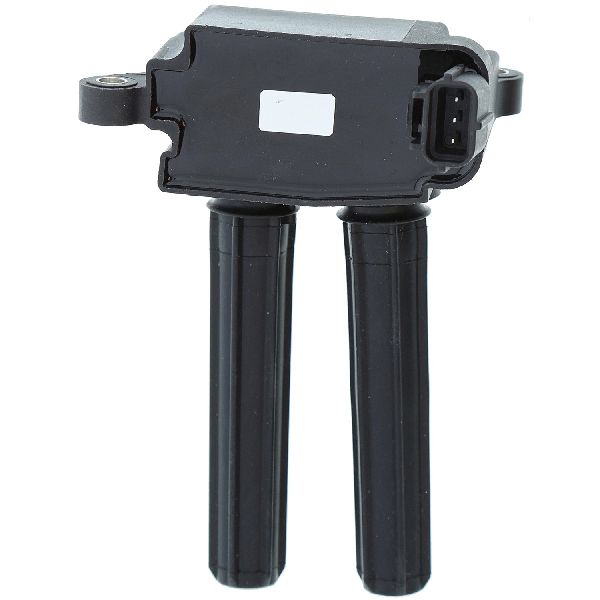
- Ignition Coil
(OEM #68238603AA)— This is one of the most common failure points for a single-cylinder misfire. They are wear-and-tear items.
Trusted brands: Mopar, NGK, Delphi
OEM price range: $50-$90
Aftermarket price range: $30-$75 - Spark Plugs (Set of 16)
(OEM #SP143877AB)— Spark plugs are a routine maintenance item and the most frequent cause of misfires. The HEMI uses 16, making failure more probable.
Trusted brands: NGK, Champion
OEM price range: $8-$15 per plug
Aftermarket price range: $4-$10 per plug - Camshaft and Lifter Kit
(OEM #53022263AF (Camshaft), 5038788AD (MDS Lifters))— Required to fix the notorious 'HEMI tick' issue where a failed lifter damages the camshaft. This is the definitive fix for a P0301 caused by this specific mechanical failure. 🎬 Watch: Step-by-step guide to replacing HEMI lifters and the camshaft Kits often include the camshaft, all 16 lifters, head gaskets, and bolts.
Trusted brands: Mopar, Melling, Sealed Power, COMP Cams
OEM price range: $1200-$2000
Aftermarket price range: $800-$1500
Related Codes That Often Appear With This One
- P0300 — If the condition causing the P0301 is severe or intermittent, or if other cylinders are also beginning to fail (e.g., multiple bad lifters), the PCM may also log a P0300 for 'Random/Multiple Cylinder Misfire'.
- P3401 — This code means 'Cylinder 1 Deactivation/Intake Valve Control Circuit/Open'. If there's an issue with the MDS solenoid or wiring for cylinder 1, it can cause both a misfire and a specific MDS fault code. This strongly points towards a problem in the MDS system for that cylinder.
Technical Service Bulletins (TSBs) & Recalls
- While no TSB is a direct match for 'P0301 on 2011-2018 Ram 1500', TSBs for similar platforms and engines exist. For example, TSB 18-033-26 for other models mentions misfire codes like P0301 being set during cold starts, suggesting a potential software calibration issue. This highlights that in some rare cases, the issue could be software-related.
- Manufacturer TSB #18-031-25 REV. C notes that P0301-00 (Cylinder 1 Misfire) can be set in active or stored status specifically during cold start catalyst heating.
- According to TSB #18-002-25, a vehicle may experience MIL illumination with P0301 set alongside other misfire codes and P3400 (Cylinder Deactivation System Bank 1).
- TSB #18-021-26 also describes P0301-00 as a code that can be set during the cold start catalyst heating phase.
- Bulletin #1814522 lists P0301 as a potential code alongside O2 sensor slow response (P0133, P0153) and fuel system lean codes (P0171, P0174).
- Manufacturer TSB #09-011-25 confirms that P0301 is among the Diagnostic Trouble Codes that may cause Malfunction Indicator Lamp (MIL) illumination.
Platform-Specific Known Issues
- The 'HEMI Tick': This refers to the sound of a failing hydraulic lifter, which is a very common problem in this engine. The roller on the lifter can seize, which then grinds down the camshaft lobe. This is often misdiagnosed as an exhaust manifold leak, which is also common but produces a different type of ticking sound.
- MDS Lifter Failure: The Multi-Displacement System (MDS) deactivates four cylinders under light load to save fuel. The specialized lifters used on these cylinders (1, 4, 6, and 7) are a known failure point. When a P0301 occurs, it's on an MDS cylinder, making this a primary suspect if ignition issues are ruled out.
- High-RPM Misfire: Some owners report the P0301 code only appears at high RPM (e.g., above 4500 RPM), especially under load. This can still point to a developing mechanical issue like a weak valve spring or failing lifter that cannot keep up with engine speed.
Mechanic-Grade Diagnostic Values
- Ignition Coil Primary Resistance — expected: 0.558 - 0.682 Ohms @ 70-80°F. Failure: A reading significantly outside this range indicates a faulty primary winding.
- Ignition Coil Secondary Resistance — expected: 6,000 - 10,000 Ohms. Failure: A reading outside this range suggests the coil's secondary winding has failed.
- Fuel Injector Resistance — expected: ~11.8 Ohms at room temperature. Failure: A significantly higher (open) or lower (shorted) reading indicates a bad injector coil.
- MDS Solenoid Resistance — expected: 10.3 Ohms ± 0.25 Ohms @ 68°F. Failure: Resistance outside this specific range points to a faulty MDS solenoid for the tested cylinder.
- Fuel Pressure (Key On, Engine Running) — expected: ~58 psi (400 kPa). Failure: Significantly lower pressure indicates a weak fuel pump or clogged filter.
Hidden / Shadow Codes Worth Checking
- P2320: Ignition Coil 7 Secondary Circuit-Insufficient Ionization (Example for another cylinder). A similar P23xx code for cylinder 1 would be P2302. These are more specific than P0301 and point directly to a secondary ignition circuit fault rather than just a misfire. (see via Professional scan tools like Mopar's wiTECH. Basic OBD-II readers may not display these manufacturer-specific codes.)
- Mode 6, Test ID $A2-$AB: Misfire counts for each cylinder. This is not a 'code' but live data accessible via Mode 6 on advanced scanners. It allows a technician to see small numbers of misfires on a specific cylinder even before they are frequent enough to trigger a P0301 code and illuminate the check engine light. (see via An OBD-II scanner with Mode 6 functionality.)
Scan Tool Commands That Help
- wiTECH or equivalent professional scan tool: Cylinder Power Balance Test — This is a primary diagnostic step to confirm which cylinder is misfiring without swapping parts. The tool deactivates each cylinder one by one and measures the RPM drop. A cylinder that causes little to no RPM drop is the one not contributing power.
- wiTECH or equivalent professional scan tool: Misfire Counter (Live Data) — While driving, monitor the live misfire count for each cylinder to confirm the misfire is isolated to cylinder 1 and under what conditions (load, RPM) it occurs.
- wiTECH: PCM Flash / Reprogramming — Used to resolve false misfire codes (P0300, P0301, etc.) caused by software glitches, as identified in Technical Service Bulletins (e.g., for issues related to block heater usage).
Wiring & Ground Locations
- Cylinder 1 MDS Solenoid Wire — At the main engine harness connector that houses the MDS solenoid wires. The wire for the cylinder 1 solenoid is Brown/White.. If a P0301 is accompanied by an MDS code like P3401, testing for resistance and voltage at this specific wire can quickly identify a wiring issue between the PCM and the cylinder 1 MDS solenoid without removing the intake manifold.
- Ignition Coil Capacitor — Located in the right-rear section of the engine compartment, with a ground strap to the chassis/engine.. This capacitor dampens electrical noise on the 12V supply wire shared by the ignition coils and fuel injectors. A failure or bad ground here could theoretically introduce electrical interference that might affect ignition performance, though it would typically cause random misfires (P0300) rather than an isolated P0301.
Real Owner Repair Stories
- YouTube channel 'Ram Truckers' (4th Gen Ram 1500 5.7L HEMI) — P0301 misfire code appeared immediately after the engine was pressure washed.
❌ Tried (didn't work) No parts were replaced.
✅ What actually fixed it The technician removed the cylinder 1 ignition coil and found significant moisture inside the spark plug boots. The fix was to thoroughly dry the coil, boots, and spark plug wells with compressed air and apply dielectric grease before reassembly. The code was cleared and did not return. - Go-Parts article citing a YouTube diagnostic case (2014 Ram 1500 5.7L HEMI) — Persistent P0301 code, rough running.
❌ Tried (didn't work) Replaced spark plugs, Replaced ignition coil on cylinder 1, Swapped fuel injectors between cylinders
✅ What actually fixed it Advanced diagnosis with a pressure transducer revealed insufficient intake valve opening. The root cause was a worn camshaft lobe for cylinder 1. The fix required replacing the camshaft and all lifters. - RamForum.com user 'SoCalLuke' (2012 Ram Power Wagon 5.7L HEMI, 92k miles) — P0301 and flashing check engine light only when the engine RPM exceeds 4500-5000, such as under heavy load or spirited driving.
❌ Tried (didn't work) Replaced all spark plugs, Replaced all ignition coils
✅ What actually fixed it The thread documents a thorough diagnostic process including vacuum tests and compression tests (which passed), but the user did not post the final resolution. The symptoms strongly point to a high-RPM-specific issue like weak valve springs (valve float) or a fuel delivery problem under high demand, which are valuable diagnostic paths for this specific symptom.
"I Checked Everything" — The Actual Cause
- A common 'everything checks out' scenario for a persistent P0301 on the 5.7L HEMI involves a worn camshaft lobe. A technician may find that the ignition coil, spark plug, and fuel injector are all good. They may even perform a static compression test and find it passes with good numbers. The misfire persists because the issue is dynamic: the roller on the lifter has failed and worn down the camshaft lobe for cylinder 1's intake or exhaust valve. While the valve still seals perfectly (passing the compression test), it doesn't open enough during operation to allow a full air/fuel charge in or exhaust out, causing a misfire under power. This can only be definitively diagnosed by measuring valve lift at the rocker arm or with an in-cylinder pressure transducer to analyze the valve events.
OEM Part Supersession History
53022263AE→53022263AF— Standard part revision and improvement by the manufacturer.53021726xx series, 68060714AA→5038785AD— Consolidation and revision of the MDS-specific lifter part number.
Heads up: This is the lifter for cylinders with MDS. Using a non-MDS lifter here without PCM tuning will cause further issues.5038784AC and others→5038784AD— Revision of the standard (non-MDS) lifter. This is the part used when performing an MDS-delete.
Heads up: To use these on an MDS cylinder, the MDS function must be disabled in the PCM.
Model Year Variations Within This Range
- 2011-2018: The core engine architecture, including the VVT and MDS systems and their associated potential for lifter failure, remained consistent throughout this period. There were no major engine redesigns within the 2011-2018 model years that would significantly alter the diagnosis of a P0301 code.
- 2011-2018 vs Pre-2009: Engines from the previous (3rd) generation (pre-2009) are not directly compatible for a swap. The 4th generation (2009+) 5.7L HEMI features Variable Valve Timing (VVT), which requires different internal block oil passages and different crank/cam tone rings than the earlier, non-VVT versions.
Diagnostic Flowchart
Real Owner Stories
Aggregated from forums and TSBs cited above. Mileages and costs reflect what owners reported in those sources.
Ram 1500 5.7L HEMI V8
Symptoms: Cylinder 1 misfire and Check Engine Light that only appeared at high RPMs, specifically between 4500 and 5000 RPM and above under load.
What fixed it: Mechanic confirmed a camshaft and lifter failure; required replacement of the camshaft and lifters.
Source hint: https://www.ramforum.com/threads/cylinder-1-misfire-p0301-and-cel-but-only-at-4500-5000-rpm-and-above.138543/
Related OBD-II Codes
Frequently Asked Questions
Is the ticking noise I hear with my P0301 code just an exhaust manifold leak?
Why does my 5.7L HEMI have two spark plugs for cylinder 1?
My Ram 1500 only misfires and throws P0301 at high RPMs (above 4500 RPM). What causes this?
Does cylinder 1 on my Ram 1500 use the Multi-Displacement System (MDS)?
Is there a software update or TSB for the P0301 code on the 2011-2018 5.7L HEMI?
How can I test if the ignition coil on cylinder 1 is causing my P0301?
Helpful Videos

Used OEM Parts in Stock


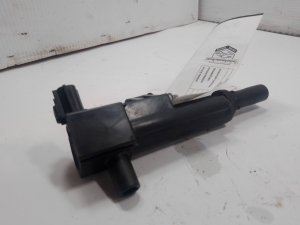
New Aftermarket Parts Available


The information in this article is provided for general reference and educational purposes only. Vehicle specifications, procedures, and part compatibility can vary by production date, trim level, and region. Always consult your vehicle's factory service manual and verify part numbers before purchasing or performing repairs. Safety-critical components such as airbags, seat belts, and braking systems should be installed by a qualified professional.
- Ram 1500:
- 🎬 Helpful Videos
- 🛍️ Shop This Part
- What's Unique About the 2011-2018 Ram 1500
- Symptoms You May Notice
- Most Likely Causes
- Rare But Worth Checking
- Diagnosis Steps
- Parts You'll Likely Need
- Related Codes That Often Appear With This One
- Technical Service Bulletins (TSBs) & Recalls
- Platform-Specific Known Issues
- Mechanic-Grade Diagnostic Values
- Hidden / Shadow Codes Worth Checking
- Scan Tool Commands That Help
- Wiring & Ground Locations
- Real Owner Repair Stories
- "I Checked Everything" — The Actual Cause
- OEM Part Supersession History
- Model Year Variations Within This Range
- Diagnostic Flowchart
- Real Owner Stories
- Ram 1500 5.7L HEMI V8
- Related OBD-II Codes
- Frequently Asked Questions
- 🎟️ Get 5% Off