

P0301 on 2019-2025 Genesis G70 3.3T: Cylinder 1 Misfire Causes and Fixes
P0301 on a Genesis G70 3.3T means cylinder 1 is misfiring. This is most often caused by a bad ignition coil or a worn spark plug. Because cylinder 1 is on the rear engine bank (driver's side) under the intake manifold, diagnosis and repair are difficult and labor-intensive. It is highly recommended to replace all rear bank coils (1, 3, 5) and all six spark plugs at the same time to avoid repeat labor costs.
- P0301 means cylinder 1 is misfiring, which is on the difficult-to-access rear bank of the engine.
- The most likely causes are a bad ignition coil or a worn spark plug.
- Due to the high labor cost of removing the intake manifold, it is highly recommended to replace all three rear coils, all six spark plugs, and the intake gaskets at the same time.
- A flashing check engine light indicates a severe misfire that can damage the catalytic converter; stop driving immediately.
- This is not a beginner-friendly DIY repair; professional service is strongly recommended.
What's Unique About the 2019-2025 Genesis G70
On the Genesis G70's 3.3L Twin-Turbo V6, the primary challenge with a P0301 code is physical access. The cylinders are numbered with 1, 3, and 5 on the rear bank (driver's side, against the firewall) and 2, 4, and 6 on the front bank (passenger's side). Cylinder 1 is located on the rear bank, tucked against the firewall and completely underneath the upper intake manifold. This makes a simple diagnosis, like swapping an ignition coil, a significantly more complex and labor-intensive job compared to a misfire on the easily accessible front cylinders. While the engine has both direct and port injection to help reduce carbon buildup, it remains a potential cause for misfires.
Symptoms You May Notice
- Rough or vibrating idle
- Engine hesitation or stumbling during acceleration
- Noticeable loss of power
- Flashing or solid Check Engine Light
- A smell of raw fuel from the exhaust
- Decreased fuel economy
- Engine may go into 'limp mode' with drastically reduced power, especially under hard acceleration.
- Replacing only the spark plug without testing the ignition coil. Since the labor to access cylinder 1 is high, it's best to diagnose thoroughly while the intake manifold is off.
- Assuming the issue is on the front bank of the engine. P0301 specifically points to the rear bank, which is much harder to access.
- Not replacing the intake manifold gasket after removal, leading to a vacuum leak which can cause other misfire codes.
Most Likely Causes
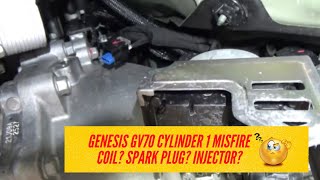
- Faulty Ignition Coil 🔴 High Probability Ignition coils are common wear items, and premature failures have been reported by owners of the 3.3T platform 🎬 Watch: Real-world diagnosis of an intermittent cylinder 1 misfire., sometimes at relatively low mileage.
How to confirm: The standard test is to swap the ignition coil from the misfiring cylinder (1) with one from a known good cylinder. However, due to cylinder 1's location under the intake manifold, this is a labor-intensive process. A professional shop will need to remove the intake manifold to perform this test. An oscilloscope can also be used to test the coil's firing pattern without removal.
Typical fix: Replace the faulty ignition coil for cylinder 1. Given the high labor cost to access the rear bank, it is strongly recommended to replace all three rear ignition coils (cylinders 1, 3, 5) and all six spark plugs at the same time. This is known as the 'while you're in there' (WYAIT) approach.
Est. part cost: $50-$100 per coil - Worn or Fouled Spark Plug 🔴 High Probability Spark plugs are a routine maintenance item. The manufacturer's recommended service interval for the 3.3T engine is 42,000 miles. If they are past this interval or fouled by fuel or carbon, they can fail to produce a strong spark.
How to confirm: After removing the intake manifold to gain access, remove the spark plug from cylinder 1. Inspect it for a worn electrode, heavy carbon deposits, oil/fuel fouling, or a cracked porcelain insulator. A fouled plug is a clear sign of a problem.
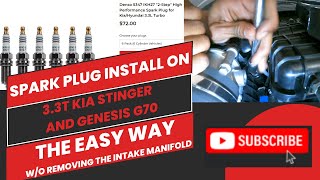
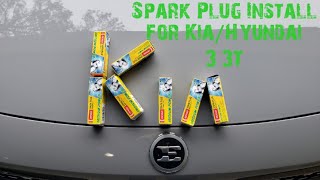
Typical fix: Replace the spark plug in cylinder 1. It is best practice to replace all six spark plugs as a set to ensure even performance and avoid repeating the labor-intensive intake manifold removal. 🎬 See this full walkthrough for replacing spark plugs and coils.
Est. part cost: $20-$40 per plug - Clogged or Faulty Fuel Injector 🟡 Medium Probability Gasoline Direct Injection (GDI) injectors operate under high pressure and can be susceptible to clogging or electronic failure. Some owners, particularly on the related GV70 platform, have reported P0301 being caused by a faulty injector, even at low mileage, which was fixed by replacing the injector(s) under warranty.
How to confirm: This is difficult to confirm for a DIYer. A professional can monitor fuel trims with a scan tool or perform a fuel injector balance test. A strong smell of gasoline on the oil dipstick can be a sign of a leaking injector. Some owner stories indicate the dealer diagnosed a faulty injector seal.
Typical fix: Replace the faulty fuel injector. This is also a labor-intensive job that should be performed by a professional. Some dealers have opted to replace all injectors on a bank if one fails under warranty.
Est. part cost: $100-$200 per injector
Rare But Worth Checking
- Carbon Buildup on Intake Valves: While this engine has a dual injection system (GDI and MPI) to help keep valves clean, heavy buildup is still possible, especially with frequent short trips or lower quality fuel. This can restrict airflow into the cylinder and cause misfires. The fix is a professional 'walnut blasting' or chemical cleaning service.
- High-Pressure Fuel Pump (HPFP) or Low-Pressure Fuel Pump (LPFP) Failure: While a pump issue usually causes multiple or random misfires (P0300), it's a known weak point on the platform. A failing pump can lead to fuel starvation under load, potentially triggering a misfire code for a single cylinder before others. One owner reported multiple misfire codes including P0301 that were traced to a failing HPFP.
- Low Compression: This is unlikely on a newer vehicle but possible. It indicates a mechanical engine problem like a bad valve, piston ring, or head gasket. A compression test is required to diagnose this after all other causes have been ruled out.
Diagnosis Steps
- Confirm the code P0301 with an OBD-II scanner. Note if the check engine light is flashing and if any other codes are present.
- Due to the difficulty of access, this code is best diagnosed by a professional mechanic.
- The mechanic will begin by removing the engine cover, strut tower brace, and intake piping.
- The upper intake manifold (surge tank) will be unbolted and removed to access the rear cylinder bank.
- Once accessed, the ignition coil from cylinder 1 will be swapped with the coil from cylinder 3 or 5.
- The intake manifold will be temporarily refitted and the engine run to see if the misfire code moves to the other cylinder (e.g., P0303 or P0305). If it does, the ignition coil is faulty.
- If the code remains P0301, the coil is likely good. The next step is to inspect and replace the spark plug for cylinder 1.
- While the manifold is off, it is wise to replace all three rear coils and all six spark plugs to prevent future labor costs.
- If the coil and plug are good, the mechanic will investigate the fuel injector, wiring, and check for carbon buildup.
- A new upper intake manifold gasket set must be used during reassembly to prevent vacuum leaks.
- If no issues are found, a compression test may be performed to check for mechanical engine problems.
Parts You'll Likely Need
- Ignition Coil (Rear Bank)
(OEM #27310-3L000)— This is a primary cause of single-cylinder misfires. Cylinder 1 is on the rear bank, which uses a different coil from the front bank. They are not interchangeable.
Trusted brands: Hyundai/Genesis (OEM), NGK, Delphi
OEM price range: $70-$100
Aftermarket price range: $50-$80 - Spark Plug
(OEM #18852-09070)— Spark plugs are a routine maintenance item with a 42k mile interval and the second most likely cause of a misfire. It is highly recommended to replace all six if accessing the rear bank.
Trusted brands: NGK (OEM supplier), Denso
OEM price range: $25-$40
Aftermarket price range: $15-$25 - Upper Intake Manifold Gasket Set
(OEM #29215-3L100 (Surge Tank Gasket))— This is required for reassembly whenever the upper intake manifold is removed to prevent vacuum leaks. It is a mandatory replacement part for this job.
Trusted brands: Hyundai/Genesis (OEM)
OEM price range: $40-$60
Aftermarket price range: $25-$40 - Ignition Coil (Front Bank)
(OEM #27310-3L030)— For reference, this is the coil for the front bank cylinders (2, 4, 6). It is physically different from the rear bank coil and cannot be used as a substitute.
Trusted brands: Hyundai/Genesis (OEM), NGK, Delphi
OEM price range: $70-$100
Aftermarket price range: $50-$80
Related Codes That Often Appear With This One
- P0300 — If the misfire is severe or affects other cylinders intermittently, a P0300 (Random/Multiple Cylinder Misfire) code may appear alongside P0301. This could point towards a systemic issue like a failing fuel pump or vacuum leak.
- P0303, P0305 — Misfire codes for other cylinders on the same bank (rear bank) could indicate a problem common to that side of the engine, such as a vacuum leak from the intake manifold gasket on that side, or a recommendation to replace all coils/plugs on that bank at once.
- P0201 — This code for 'Injector Circuit/Open - Cylinder 1' would strongly point to the fuel injector or its wiring as the root cause of the P0301 misfire.
Platform-Specific Known Issues
- Cylinder Numbering Convention: On the Lambda II 3.3T V6, the cylinders are numbered 1-3-5 on the rear bank (driver's side, against the firewall) and 2-4-6 on the front bank (passenger's side). P0301 always refers to the rearmost cylinder on the driver's side, which is the most difficult to access.
- The 'While You're In There' (WYAIT) Repair: Due to the 3-4 hours of labor required to remove and reinstall the intake manifold, the overwhelming consensus in owner forums and among mechanics is to replace all three ignition coils and all six spark plugs when addressing a misfire on cylinders 1, 3, or 5. The additional part cost is minimal compared to the potential of having to pay for the same labor again if another rear coil or plug fails.
Mechanic-Grade Diagnostic Values
- High-Pressure Fuel System (GDI) — expected: Up to 200 bar (2,900 psi). Failure: Significantly lower pressure readings under load can indicate a failing High-Pressure Fuel Pump (HPFP) and lead to misfires.
- Alternator Maximum Capacity — expected: 180 Amps. Failure: Low system voltage can cause a variety of electrical issues, though it is not a primary cause of a single-cylinder misfire.
Hidden / Shadow Codes Worth Checking
- Mode 6, Test ID $53 (example): Advanced scan tools can access Mode 6 data, which stores non-continuous monitor test results. This includes misfire counts for each specific cylinder over the current and previous 10 driving cycles. A technician can see if cylinder 1 has a higher count of misfire events than other cylinders, even if the threshold to trigger a P0301 code has not yet been met. This is invaluable for diagnosing intermittent misfires. (see via Advanced OBD-II Scan Tool with Mode 6 capability (e.g., Genesis GDS, Autel, Launch, Topdon).)
- P030100: Some owners have reported seeing this extended code format on their scanners. The additional '00' may indicate a specific fault type or status within the manufacturer's more detailed diagnostic system, though a public definition is not available. It confirms the misfire is on cylinder 1. (see via May be visible on some advanced consumer or professional-grade scan tools.)
Scan Tool Commands That Help
- Genesis GDS (or equivalent professional scanner): Power Balance Test — This is a critical diagnostic function to confirm a misfire when symptoms are present. The tool allows the technician to electronically disable the fuel injector to each cylinder one at a time. If disabling a cylinder causes a significant, consistent drop in engine RPM, that cylinder is working correctly. If disabling cylinder 1 causes little or no RPM drop, it confirms that cylinder 1 was not contributing power, pinpointing it as the source of the misfire.
Wiring & Ground Locations
- Cylinder 1 Injector Control Wire — At the Engine Control Module (ECM) connector. Based on available diagrams for the G6DP engine, the wire for 'Injector Control #1 (High)' is located at Pin 41.. A technician can use this pin to test for a proper signal from the ECM to the injector. A break or short in this wire between the ECM and the injector would cause a P0301 and/or a P0201 code. Rodent damage to the injector harness has been observed on these vehicles.
- Engine Ground (GC102) — Diagrams indicate this is a primary ground point for the engine control system, connected to pins 1, 2, and 4 of the ECM. The exact physical location on the chassis or engine block is not clearly documented in public sources but is a critical point to check for looseness or corrosion.. A poor ground connection can cause erratic behavior in sensors and actuators, including ignition coils and fuel injectors, potentially leading to intermittent misfires that are difficult to diagnose.
Real Owner Repair Stories
- Reddit user on r/GenesisGV70 (2023 Genesis GV70 with 13,000 miles (engine family shared with G70)) — Check engine light on, engine in safety (limp) mode, code P030100.
❌ Tried (didn't work) The user took the vehicle directly to the dealer for diagnosis.
✅ What actually fixed it The dealership diagnosed a faulty fuel injector on cylinder 1. The service advisor explained they had seen cases where the injector seal expands with temperature changes, causing irregular fuel flow. The dealer replaced all four injectors on the affected bank under warranty, which resolved the issue. - Reddit user on r/GenesisG70 (2021 CPO Genesis G70) — Popping noise, exhaust leak sound, multiple misfire codes with cylinder 2 being the main culprit (P0302).
❌ Tried (didn't work) Initial diagnosis focused on a wheel bearing and a missing exhaust manifold bolt.
✅ What actually fixed it The dealership discovered that aftermarket spark plugs had been installed in the vehicle prior to the CPO sale. These plugs were likely improperly gapped for the stock engine, causing the misfires. The fix involved replacing the incorrect aftermarket plugs with proper OEM-spec plugs. This highlights the importance of using correct parts, as even new but incorrect plugs can cause misfires.
"I Checked Everything" — The Actual Cause
- In a documented case, a P0301 was caused by a faulty fuel injector seal that would expand and contract with temperature changes, disrupting fuel flow. A standard smoke test for vacuum leaks would show no faults, as the leak is internal to the fuel delivery system and not part of the air intake path. This type of thermal-intermittent failure is often missed by standard procedures and requires targeted component testing or replacement based on pattern failures seen by dealerships.
When the Usual Fixes Don't Work
- While the most common causes for P0301 are ignition-related, there are documented cases where replacing the coil and spark plug does not fix the issue. One notable pattern failure is an intermittent fault with the fuel injector or its seal. An owner may experience a misfire that disappears and reappears with temperature changes. In one such case, a dealer identified a faulty injector seal that was expanding and causing irregular fuel flow. The final repair was the replacement of all injectors on the affected bank, not the ignition components. This highlights that if a coil and plug swap doesn't resolve the P0301, the fuel injector for cylinder 1 should be the next primary suspect.
OEM Part Supersession History
27310-3L000 (Rear Bank Coil)→27301-3L100 (May be a newer revision)— Standard part evolution and supplier changes. Reports indicate newer revisions are compatible with older ones and can be mixed.
Heads up: CRITICAL: This engine uses different ignition coils for the front and rear banks. 27310-3L000 is for the rear bank (Cylinders 1, 3, 5). The front bank uses 27310-3L030. They are not interchangeable due to physical shape differences.
Model Year Variations Within This Range
- 2019-2025: The 2022 model year introduced a significant facelift with new exterior styling and an updated interior infotainment system. For the 3.3T engine, a variable exhaust system was added which slightly increased horsepower. However, the core engine block, heads, fuel system, and ignition system architecture (G6DP) remained unchanged, meaning the causes and diagnostic procedures for a P0301 code are identical across the entire 2019-2025 range.
Diagnostic Flowchart
Real Owner Stories
Aggregated from forums and TSBs cited above. Mileages and costs reflect what owners reported in those sources.
Kia Stinger GT (3.3T) — ~44000 miles
Symptoms: Car drives perfectly fine in comfort and eco modes with no check engine lights. However, under hard acceleration in sport mode, the check engine light comes on with a P0301 code.
What fixed it: Community members identified spark plugs as the likely culprit, as the mileage was near the 42,000-mile service interval.
Source hint: Reddit: r/StingerGT - Check Engine P0301
Kia Stinger GT (3.3T)
Symptoms: Persistent P0301 code on a used vehicle that did not resolve after standard troubleshooting.
What fixed it: After a spark plug change didn't fix the misfire, the dealer (authorized by Kia) opted to replace the entire engine under warranty.
Source hint: Kia Stinger Forum - P0301
Genesis GV70 — ~15000 miles
Symptoms: Check engine light illuminated with an injector misfire code P030100 at low mileage.
What fixed it: Dealer diagnosed a faulty fuel injector seal and replaced all four injectors under warranty.
Source hint: Reddit: r/GenesisGV70 - Engine light - Injector misfire code P030100
Genesis G70 (3.3T) — 46000 miles
Symptoms: Intermittent limp mode on cold starts. OBD scan revealed multiple misfire codes across all cylinders (P0301-P0306) along with other fuel system codes.
What fixed it: Diagnosed as a failing high-pressure fuel pump (HPFP).
Source hint: Reddit: r/GenesisG70 - Engine troubles, help from the boys?
Related OBD-II Codes
Frequently Asked Questions
Why is a cylinder 1 misfire (P0301) so expensive to diagnose and fix on my 3.3T G70?
What is the 'WYAIT' repair I keep reading about for the Genesis 3.3T engine?
My G70 has around 42,000 miles and just threw a P0301 code. What is the most likely cause?
Can a bad fuel injector cause a P0301 on the 3.3L Twin-Turbo V6?
My G70 goes into limp mode and shows P0301 only under hard acceleration in Sport mode. Is this normal?
Do I need any special parts when reassembling the engine after checking the cylinder 1 coil?
Helpful Videos

Used OEM Parts in Stock




New Aftermarket Parts Available

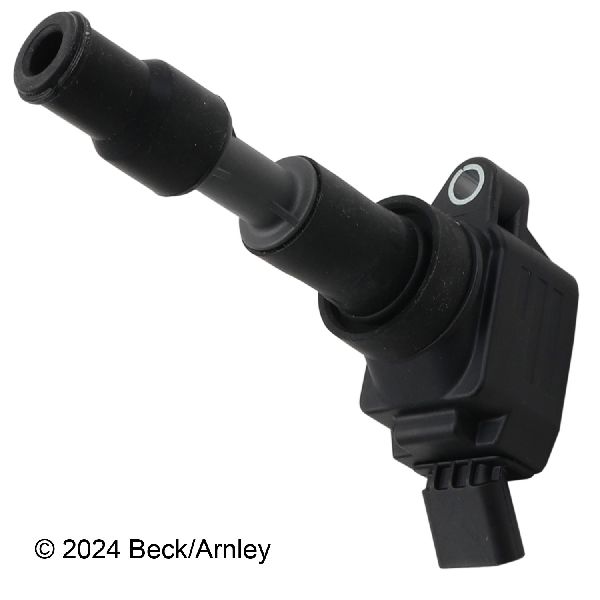
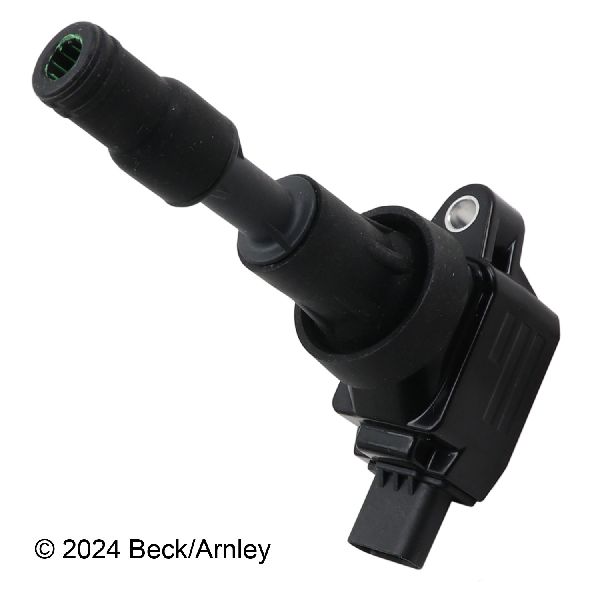

The information in this article is provided for general reference and educational purposes only. Vehicle specifications, procedures, and part compatibility can vary by production date, trim level, and region. Always consult your vehicle's factory service manual and verify part numbers before purchasing or performing repairs. Safety-critical components such as airbags, seat belts, and braking systems should be installed by a qualified professional.
- Genesis G70:
- 🎬 Helpful Videos
- 🛍️ Shop This Part
- What's Unique About the 2019-2025 Genesis G70
- Symptoms You May Notice
- Most Likely Causes
- Rare But Worth Checking
- Diagnosis Steps
- Parts You'll Likely Need
- Related Codes That Often Appear With This One
- Platform-Specific Known Issues
- Mechanic-Grade Diagnostic Values
- Hidden / Shadow Codes Worth Checking
- Scan Tool Commands That Help
- Wiring & Ground Locations
- Real Owner Repair Stories
- "I Checked Everything" — The Actual Cause
- When the Usual Fixes Don't Work
- OEM Part Supersession History
- Model Year Variations Within This Range
- Diagnostic Flowchart
- Real Owner Stories
- Kia Stinger GT (3.3T) — ~44000 miles
- Kia Stinger GT (3.3T)
- Genesis GV70 — ~15000 miles
- Genesis G70 (3.3T) — 46000 miles
- Related OBD-II Codes
- Frequently Asked Questions
- 🎟️ Get 5% Off