

P0299 on 2012-2023 Ford EcoSport 1.0L: EcoBoost Underboost Causes & Fixes
On a 1.0L EcoBoost engine, P0299 is very often caused by a failed one-way check valve on the engine's vacuum pump. The internal diaphragm ruptures, causing a loss of vacuum to the turbo wastegate. This is an inexpensive part (around $20-$40 aftermarket) and a relatively easy DIY fix that can save you from a misdiagnosis of a bad turbocharger.
- Before suspecting a bad turbo, test the engine's vacuum pump; a failed internal check valve is the most likely cause of P0299 on this engine.
- Verify the status of Ford Safety Recall 23S64 for the oil pump belt. A failure in this system can destroy the engine.
- A smoke test is the best way to find leaks in the charge air hoses and intercooler, which is another common cause.
- The fix is often inexpensive, requiring a small aftermarket valve or a new solenoid, and is generally DIY-friendly.
What's Unique About the 2012-2023 Ford EcoSport

The 1.0L EcoBoost engine uses a vacuum-controlled wastegate to regulate turbocharger boost. A very common failure point is not the expensive turbocharger itself, but a small, inexpensive one-way check valve integrated into the engine's vacuum pump. The diaphragm inside this valve can rupture, causing a loss of vacuum that prevents the wastegate from closing properly, leading to the underboost code. Additionally, this engine is subject to a critical recall (23S64) for a failing oil pump belt, which can cause sudden loss of oil pressure and catastrophic engine failure. A resulting damaged turbo can also trigger a P0299 code, making any engine-related code a cause for careful investigation.
Generation note: The 2012-2023 year range covers the second generation of the Ford EcoSport globally. This model was introduced to the North American market for the 2018 model year and the 1.0L engine was offered through 2021. The causes and fixes for P0299 on the 1.0L EcoBoost are consistent across these model years and also apply to other Ford models using the same engine, like the Fiesta and Focus.
Symptoms You May Notice
- Significant loss of engine power and sluggish acceleration.
- Check Engine Light (Malfunction Indicator Lamp) is on.
- Audible hissing or whistling sound from the engine bay during acceleration.
- Increased turbo lag (a delay in power delivery), with no boost until around 4,000 RPM.
- Poor fuel economy.
- White or blueish smoke from the exhaust (if the turbocharger seals have failed due to oil starvation or wear).
- Reduced-power "limp mode" events and potential engine stalling, as noted in NHTSA ODI #11715348.
- Replacing the entire turbocharger assembly without first diagnosing the vacuum system. The turbo itself is often not the root cause; the issue is typically a much cheaper component in the control system, like the vacuum pump valve or control solenoid.
Most Likely Causes

- Failed Vacuum Pump Check Valve 🔴 High Probability The diaphragm in the one-way valve on the vacuum pump is a known weak point on the 1.0L EcoBoost engine; it can rupture, break apart, and fail, causing a complete loss of vacuum to the turbo wastegate actuator. The broken pieces of the diaphragm can get stuck inside the pump.
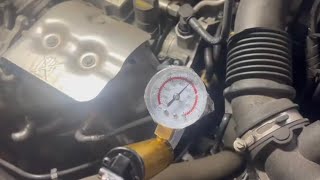
How to confirm: Connect a vacuum gauge to the port on the vacuum pump where the line to the turbo solenoid connects. With the engine running, the gauge needle will bounce erratically near zero if the valve has failed. A healthy pump shows a steady vacuum of at least 15-20 inHg. Alternatively, a scan tool monitoring the brake booster pressure sensor may show fluctuating or low vacuum readings.
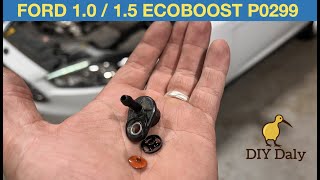
Typical fix: Replace the one-way check valve. Ford dealers typically only sell the entire vacuum pump assembly (Part # CM5G-2A451-GA or GB). However, the individual valve is widely available 🎬 Watch: How to diagnose and replace the vacuum pump valve. from aftermarket suppliers for a fraction of the cost and is a simple DIY replacement.
Est. part cost: $15-$40 (aftermarket valve), $150-$300 (OEM pump assembly) - Boost Leak in Charge Air System 🟡 Medium Probability The charge air system uses plastic and rubber components (hoses, intercooler end tanks) that can crack, become brittle, or have loose connections over time, allowing pressurized air to escape.
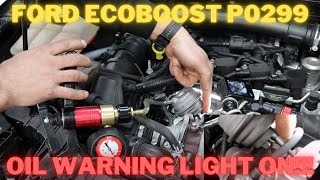
How to confirm: Perform a visual inspection of all hoses from the turbo to the throttle body, paying close attention to clamp connections. A smoke test is the most effective method, where low-pressure smoke is pumped into the system to reveal the location of any leaks. 🎬 See a walkthrough of fixing P0299 on the 1.0L engine.
Typical fix: Replace the cracked hose, tighten the loose clamp, or replace the leaking intercooler.
Est. part cost: $50-$300 - Faulty Turbocharger Wastegate Regulating Solenoid 🟡 Medium Probability This electronic solenoid controls the vacuum sent to the wastegate actuator. It can fail electrically or become clogged with contaminated oil, especially if the vacuum pump is failing and sending oil debris down the line.
How to confirm: Use a scan tool to command the solenoid on and off at idle. Check for vacuum at the outlet port with a gauge; it should switch between full engine vacuum and zero. Inspect the vacuum ports for oil residue, which indicates a larger problem upstream.
Typical fix: Replace the wastegate regulating solenoid (also called a boost control solenoid or transducer). If oil contamination is found, the vacuum pump and associated hoses should also be replaced. Potential OEM part numbers include CJ5Z-9K378-B and BL3Z-9K378-A.
Est. part cost: $40-$100 - Sticking or Damaged Wastegate Actuator ⚪ Low Probability
How to confirm: Visually inspect the actuator rod to ensure it is connected to the wastegate arm on the turbocharger. Use a handheld vacuum pump to apply vacuum to the actuator and verify that the rod moves freely through its full range of motion and holds vacuum.
Typical fix: If the actuator is faulty, it may require replacement. In some cases, the entire turbocharger assembly must be replaced as the actuator is integrated.
Est. part cost: $100-$1000+
Rare But Worth Checking
- Low Engine Oil Pressure / Failed Turbocharger: The 1.0L EcoBoost is under recall 23S64 for a failing oil pump belt, which leads to a sudden loss of oil pressure. This can starve the turbocharger of oil, causing catastrophic failure. A forum member on r/FordEcoSport reported getting a P0299 code and needing a new turbo shortly after the recall work was done, suggesting a link between the issues. 🎬 Watch: Why the oil pump recall can cause P0299 codes. Symptoms of a failed turbo include excessive shaft play and smoke from the exhaust. NHTSA ODI #11579824 describes a scenario where metal was found in the oil alongside codes P0299, P0012, and P0014.
- Clogged Air Filter or Intake Obstruction: A severely clogged air filter can restrict airflow enough to prevent the turbo from building the required boost. This is a simple but essential check before proceeding to more complex diagnostics.
Diagnosis Steps

- Read the fault codes with an OBD-II scanner to confirm P0299 is the primary code. Note if other codes like P051B, P0340, or P0365 are present, as seen in NHTSA ODI #11574165.
- Check the engine oil level and condition. Be aware of recall 23S64 regarding oil pump failure and its potential to cause turbo damage.
- Inspect the engine air filter to ensure it is clean and not restricting airflow.
- Perform a visual inspection of all vacuum lines and charge air pipes between the turbo, intercooler, and throttle body. Look for obvious cracks, loose connections, or signs of damage.
- Test the vacuum pump check valve. Disconnect the vacuum line going to the turbo solenoid and connect a vacuum gauge directly to the pump's outlet port. Start the engine. If the gauge needle bounces erratically near zero, the internal check valve has failed. The broken diaphragm may need to be fished out of the pump before installing the new valve.
- As an alternative to a vacuum gauge, use a scan tool to monitor the live data for the brake booster vacuum sensor. Unstable or low readings at idle can also point to a failed check valve.
- If vacuum supply is good, test the wastegate regulating solenoid. Inspect its ports for oil. Use a scan tool to command it on/off and verify with a vacuum gauge that it is correctly passing and blocking vacuum. If oil is present, the solenoid, vacuum pump, and hoses should be replaced as a set.
- Perform a smoke test on the entire charge air system to identify any hard-to-see leaks from hoses, clamps, or the intercooler.
- With a handheld vacuum pump, apply vacuum directly to the wastegate actuator to confirm it holds vacuum and moves the wastegate arm smoothly.
- If all other components test correctly, inspect the turbocharger for radial and axial shaft play or physical damage to the turbine wheels.
Parts You'll Likely Need
- Vacuum Pump Check Valve Repair Kit — This is the most common failure point for P0299 on the 1.0L EcoBoost. The internal diaphragm ruptures, causing a loss of vacuum to the wastegate actuator. This is an aftermarket-only part.
Trusted brands: URO Parts, Various eBay/Amazon sellers
OEM price range: $150-$300 (for full pump assembly)
Aftermarket price range: $15-$40 (for valve only) - Vacuum Pump Assembly
(OEM #CM5G-2A451-GA, CM5G-2A451-GB, 1867424)— This is the official Ford repair, as they do not sell the check valve separately. Required if the pump housing itself is damaged.
Trusted brands: Motorcraft, FoMoCo
OEM price range: $150-$300
Aftermarket price range: $80-$150 - Turbocharger Boost Control Solenoid
(OEM #CJ5Z-9K378-B (replaces CJ5Z-9K378-A))— This solenoid regulates the vacuum signal to the wastegate. It can fail electrically or become clogged with oil from a failing vacuum pump, leading to improper boost control.
Trusted brands: Motorcraft, Bosch, Dorman
OEM price range: $70-$120
Aftermarket price range: $40-$80 - Charge Air Cooler Hose (Intercooler Pipe) — These hoses can crack or develop leaks, allowing pressurized air from the turbo to escape before it reaches the engine.
Technical Service Bulletins (TSBs) & Recalls

- Recall 23S64 / 23V905000 - Engine Oil Pump Belt Failure
Platform-Specific Known Issues
- CRITICAL RECALL: This vehicle is affected by Ford Safety Recall 23S64 (NHTSA ID: 23V905000) for a failing oil pump drive belt or tensioner. This can cause a sudden and complete loss of engine oil pressure, leading to severe engine damage or failure. Before addressing any other repairs, ensure this recall has been performed by a Ford dealer.
Mechanic-Grade Diagnostic Values
- Vacuum Pump Output (at pump outlet) — expected: Steady 15-25 inHg at idle.. Failure: A reading near zero, or a needle that bounces erratically, indicates a failed internal check valve diaphragm.
- Manifold Absolute Pressure (MAP) Sensor Voltage Range — expected: Approximately 0.4V to 4.65V.. Failure: Voltage that is stuck, or does not correspond to pressure changes (e.g., low voltage like 0.5V or less can trigger a P0107, high voltage of 4.5V or more can trigger P0108).
- MAP Sensor 5V Reference Voltage — expected: A constant 4.8V to 5.2V with key on, engine off.. Failure: Voltage outside this range indicates a problem with the PCM or wiring, not the sensor itself.
Scan Tool Commands That Help
- Ford IDS / FORScan: Wastegate Control Solenoid (WGS) Duty Cycle Command — This bidirectional control allows a technician to command the wastegate solenoid to various duty cycles (e.g., 0%, 50%, 100%) while monitoring the vacuum at the wastegate actuator. This directly tests if the solenoid is responding to PCM commands and physically controlling vacuum flow, helping to isolate a faulty solenoid from a wiring or vacuum supply issue.
- Generic OBD-II Scanner with Live Data: Monitor 'Desired Boost Pressure' vs 'Actual Boost Pressure' PIDs — During a road test, graphing these two parameters is crucial. In an underboost condition, the 'Actual Boost Pressure' will consistently lag far behind the 'Desired Boost Pressure' as engine load increases, confirming the PCM's reason for setting the P0299 code.
Wiring & Ground Locations
- G300 — Under the driver's seat.. A wiring diagram for a 2019 EcoSport shows ground G300 is used by the Fuel Pump Control Module. While not directly tied to the turbo, intermittent ground issues can cause unpredictable behavior in related systems that share power or data lines with the PCM, which controls the turbo.
Real Owner Repair Stories
- NHTSA ODI #11715348 — An owner reported experiencing a loss of power, stalling, and reduced-power "limp mode" events. Upon diagnosis, the check engine light was found to be triggered by code P0299.
- NHTSA ODI #11574165 — A driver reported the vehicle losing power on the road; subsequent scanning revealed P0299 alongside several other codes including P051B, P0340, and P0365.
- YouTube channel 'DIYDaly' (2017 Ford Focus 1.0L EcoBoost) — Engine light on, car in limp mode, no boost.
❌ Tried (didn't work) The video focused directly on the most likely cause after reading the P0299 code.
✅ What actually fixed it The one-way check valve on the vacuum pump had failed. The internal diaphragm had completely collapsed and broken apart, with pieces found inside the pump housing. Replacing just the small aftermarket valve (not the entire pump) and clearing the codes resolved the issue. - YouTube channel 'Mels Motors Ltd' (Ford Fiesta 1.0L EcoBoost) — P0299 code, oil light on, no boost until ~4000 RPM, poor fuel economy.
❌ Tried (didn't work) Initial checks of the turbo system.
✅ What actually fixed it The diagnosis revealed multiple related issues. The primary cause of P0299 was a faulty vacuum pump (due to the internal check valve). Additionally, the oil pump was found to be blocked, causing the oil pressure light. This highlights how a vacuum pump failure can coexist with or be a symptom of the larger oil system issues known on these engines.
OEM Part Supersession History
CJ5Z-9K378-A→CJ5Z-9K378-B— Part revision/update by Ford.
Heads up: CJ5Z-9K378-B is the direct replacement for the older -A part number for the wastegate regulating solenoid. They are interchangeable.
Model Year Variations Within This Range
- 2012-2017: These earlier models use a wet timing belt for the camshaft drive. This belt is known to degrade, and particles can clog the oil pickup tube, leading to oil starvation, which can damage the turbo and trigger a P0299 code. The turbo is located at the front of the engine bay.
- 2018+: Ford introduced a revised 1.0L engine around 2018 (varying by market) that uses a more durable timing chain for the camshafts. These engines also feature a reversed-flow cylinder head, placing the turbo at the rear near the firewall. While the camshaft drive is improved, these engines still use a wet belt for the oil pump.
Diagnostic Flowchart
Real Owner Stories
Aggregated from forums and TSBs cited above. Mileages and costs reflect what owners reported in those sources.
2018 Ford EcoSport 1.0L EcoBoost
Symptoms: Vehicle threw a P0299 code shortly after having the engine replaced under the oil pump recall.
What fixed it: Required a full turbocharger replacement due to damage likely linked to the prior oiling issues.
Source hint: Reddit - r/FordEcoSport: '2018 EcoSport - Issues Never End'
2017 Ford Focus SE 1.0L EcoBoost
Symptoms: Experienced a P0299 underboost code on the shared 1.0L platform.
What fixed it: Diagnosed and addressed boost leaks and wastegate issues.
Source hint: Reddit - r/MechanicAdvice: 'P0299 - 2017 Ford Focus SE 1.0L Ecoboost'
2019 Ford Fiesta 1.0L EcoBoost
Symptoms: Triggered a P0299 underboost code on the shared 1.0L engine platform.
What fixed it: Investigated vacuum lines and sensors to restore proper boost control.
Source hint: Fiesta ST Forum: '2019 with p0299 underboost'
Ford EcoSport 1.0L EcoBoost
Symptoms: Vehicle exhibited underboost symptoms; diagnostic testing showed a bouncing vacuum gauge reading near zero.
What fixed it: Diagnosed and repaired a failed vacuum pump check valve.
Source hint: YouTube - Enka Motors: 'Fault Code P0299 Ford Ecoboost Diagnosis And Repair'
Related OBD-II Codes
Frequently Asked Questions
Is my 1.0L EcoBoost affected by any recalls that could cause the P0299 code?
Can I buy just the replacement vacuum pump check valve from a Ford dealer?
Why is my vacuum gauge needle bouncing erratically when testing the vacuum pump?
I have a P0299 code and found oil in the wastegate regulating solenoid. What should I do?
Why do I have no boost until around 4,000 RPM on my EcoSport?
Helpful Videos
We Have This Part in Stock



The information in this article is provided for general reference and educational purposes only. Vehicle specifications, procedures, and part compatibility can vary by production date, trim level, and region. Always consult your vehicle's factory service manual and verify part numbers before purchasing or performing repairs. Safety-critical components such as airbags, seat belts, and braking systems should be installed by a qualified professional.
- Ford EcoSport:
- 🎬 Helpful Videos
- 🛍️ Shop This Part
- What's Unique About the 2012-2023 Ford EcoSport
- Symptoms You May Notice
- Most Likely Causes
- Rare But Worth Checking
- Diagnosis Steps
- Parts You'll Likely Need
- Technical Service Bulletins (TSBs) & Recalls
- Platform-Specific Known Issues
- Mechanic-Grade Diagnostic Values
- Scan Tool Commands That Help
- Wiring & Ground Locations
- Real Owner Repair Stories
- OEM Part Supersession History
- Model Year Variations Within This Range
- Diagnostic Flowchart
- Real Owner Stories
- 2018 Ford EcoSport 1.0L EcoBoost
- 2017 Ford Focus SE 1.0L EcoBoost
- 2019 Ford Fiesta 1.0L EcoBoost
- Ford EcoSport 1.0L EcoBoost
- Related OBD-II Codes
- Frequently Asked Questions
- 🎟️ Get 5% Off