

OBD-II Code P0234: Engine Overboost Condition
The Ultimate Guide to Understanding, Diagnosing, and Fixing a P0234 Overboost Fault
- P0234 indicates your turbocharger is producing dangerously high pressure, requiring you to stop driving immediately to prevent engine failure.
- Over 80% of P0234 codes stem from control system failures—specifically a faulty $150 wastegate control solenoid or cracked vacuum hoses—rather than a blown turbocharger.
- Begin diagnosis by visually inspecting the 3-4 small vacuum hoses connected to the turbocharger and manually testing the wastegate actuator arm for smooth movement.
- On GM 1.4L engines operating below 0°F (-18°C), ice buildup in the charge air cooler or control solenoid is the primary trigger, documented in TSB 22-NA-007.
- Ignoring a P0234 code forces the turbocharger to overspin, frequently causing catastrophic internal engine damage that costs upwards of $5,000 to fix.
What Does P0234 Mean?

P0234 indicates the Powertrain Control Module (PCM) detects the turbocharger or supercharger is creating dangerously high air pressure (boost). To protect the engine, the computer cuts fuel and ignition, drastically reducing power and forcing the vehicle into a protective 'limp mode'.
Technical definition: The official SAE/OBD-II definition is "Turbocharger/Supercharger 'A' Overboost Condition." 🎬 Watch: A quick overview of P0234 causes and symptoms. This code sets when the PCM detects actual intake manifold boost pressure exceeds the manufacturer's specified maximum pressure (often by 4-5 psi) for more than 5 seconds.
Can I Drive With P0234?
No — Do Not Drive. Stop driving immediately. An overboost condition places extreme stress on internal engine components. Continuing to drive causes catastrophic failure, including blown head gaskets, damaged pistons, bent connecting rods, or complete turbocharger destruction, leading to engine replacement costs exceeding $5,000.
Common Causes

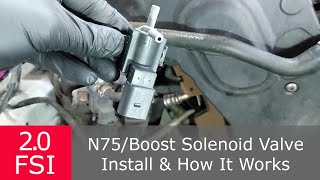
- Sticking or Faulty Wastegate Control Solenoid (N75 Valve) (Very Common) — This electronic valve is the most common failure point. It fails electronically, jams from internal debris, or freezes in cold weather, preventing the wastegate from opening to release excess pressure.
- Damaged, Leaking, or Clogged Vacuum/Boost Hoses (Common) — A cracked, split, disconnected, or internally clogged vacuum hose in the wastegate control system causes a total loss of boost regulation, preventing the wastegate from opening.
- Sticking, Binding, or Damaged Wastegate Actuator or Linkage (Common) — The wastegate actuator arm or internal flap seizes due to carbon buildup, corrosion, or mechanical failure, trapping exhaust gas and over-spinning the turbo.
- Sticking Variable Geometry Turbo (VGT) Vanes/Actuator (Common) — On modern diesels and some gasoline engines, carbon buildup jams the movable turbo vanes or their electronic actuator in the maximum boost position.
- Faulty Boost Pressure Sensor (MAP Sensor) (Less Common) — The MAP sensor measures boost pressure. If it fails and reads artificially low, the PCM commands excessive boost. If it reads artificially high, it falsely triggers the code.
- Faulty Diverter / Blow-Off Valve (Less Common) — A torn rubber diaphragm in the diverter valve disrupts the pressure balance in the control system, contributing to overboost conditions (especially on VW/Audi vehicles).
- Aftermarket Tuning or Modifications (Less Common) — Aggressive aftermarket tunes request boost levels exceeding stock component limits. Installing a stiffer aftermarket wastegate spring without a corresponding ECU tune also triggers this code.
- Exhaust Restriction (Rare) — A severely clogged catalytic converter creates high backpressure, preventing exhaust gases from exiting the turbocharger and disrupting wastegate regulation.
- Internal Turbocharger Failure (Rare) — The internal wastegate flap breaks off, bearings fail and bind the turbine, or the turbine housing cracks.
Symptoms

- Check Engine Light On — The check engine light illuminates and flashes in severe cases to indicate engine-damaging conditions.
- Drastic Loss of Power (Limp Mode) — The PCM cuts boost and fuel, forcing the vehicle into a sluggish 'limp mode' to prevent engine damage.
- Unusual Engine Noises — A loud whistling, hissing, or sudden 'whoosh' sound emits from the engine bay during acceleration as excess pressure builds or erratically releases.
- Engine Overheating — Extreme cylinder pressures and temperatures cause the engine to overheat.
- Black Smoke from Exhaust — The PCM compensates for high boost by injecting excess fuel, causing a rich condition and visible black smoke from the exhaust.
- Engine Pinging or Knocking — Excessive cylinder pressure causes pre-detonation (knock), producing a pinging sound under acceleration.
- Engine Misfiring or Running Rough (also visible on scanner) — The engine hesitates, stumbles, or misfires under acceleration due to incorrect air-fuel mixtures and extreme cylinder pressures.
Diagnostic Flowchart

Tap your situation to follow the diagnostic path that matches what you're seeing on this code.
Common Fixes & Costs
- Replace Wastegate Control Solenoid (N75 Valve)
— Parts: $50-$150, Labor: $100-$200, ~1.2 hr book time
(DIY)
Chevy Cruze/Sonic 1.4L: OEM 55503993 (early models), 12684144 (later models) (Alt: Dorman 911-082)
Ford F-150 EcoBoost: OEM BL3Z9K378A, HL3Z9G488B (Alt: Standard Motor Products WGS2)
VW/Audi 2.0T: OEM 06F906283F (replaces 06F906283D) (Alt: Pierburg 7.00470.07.0, Bosch 0906283) - Repair or Replace Vacuum/Boost Hoses — Parts: $10-$75, Labor: $50-$250, ~1.5 hr book time (DIY)
- Replace Wastegate Actuator
— Parts: $100-$500, Labor: $200-$600, ~2.5 hr book time
(Intermediate)
Ford 6.7L Power Stroke (2020-2022): OEM LC3Z-9G488-B (Alt: N/A (OEM-specific part)) - Replace Boost Pressure (MAP) Sensor
— Parts: $70-$200, Labor: $80-$120, ~0.6 hr book time
(DIY)
Chevy Cruze 1.4L: OEM 55567257 (replaces 12592525) (Alt: Bosch 261230262, Delphi PS10181)
Ford F-150 EcoBoost: OEM BB5Z-9F479-C, AA5Z-9F479-D (Alt: Motorcraft CX2401, Bosch 0261230280)
VW/Audi 2.0T: OEM 038906051C (Alt: Bosch 0281002401) - Replace Turbocharger Assembly — Parts: $1,200-$3,000+, Labor: $600-$1,200+, ~6.5 hr book time (Professional)
DIY vs Professional
- Replace Hoses — Beginner:
- Replace Solenoid or Sensor — Beginner:
- Replace Wastegate Actuator — Beginner:
- Replace Turbocharger — Beginner:
Used vs. New Parts: Buying Guide
When a used part is worth it: Never buy a used wastegate control solenoid (N75 valve). These are high-wear electronic components with finite lifespans; installing a junkyard part guarantees a repeat failure and doubled labor costs.
Donor-vehicle mileage cap: roughly under 30000 miles for the part to have meaningful remaining life.
Donor quality checklist:
- If considering used, only source from a very low-mileage vehicle wrecked for non-engine related reasons.
- Match the part number exactly, including any suffix letters (e.g., N75'F' vs N75'J' on VW/Audi), as they have different operational characteristics.
- Avoid parts with any signs of corrosion, cracked plastic, or damaged connectors.
Decision logic:
- If The part is an electronic solenoid or sensor. → Buy new. The minimal cost savings of a used sensor do not justify the high risk of premature failure.
- If The part is a complete turbocharger assembly. → Buy new or professionally remanufactured. Used turbochargers carry unknown histories of oil starvation and heat damage.
- If Budget is the absolute primary concern. → Purchase a new aftermarket part from a reputable OEM supplier (e.g., Pierburg, Bosch) rather than a used OEM part.
Warranty tradeoff: Used parts typically have a 30-90 day warranty at best, which may not cover labor. New aftermarket parts usually carry a 1-year or longer warranty. New OEM parts offer the best warranty but at the highest price.
Worst-case if a used part fails: $200 - $400. This represents the cost of repeat labor to install another part after a used one fails outside its short warranty period.
What Happens If You Wait — Timeline
- 0-1 month: Intermittent limp mode triggers during sustained highway driving or extreme cold. Cycling the ignition temporarily restores power. (MPG impact: 0-5%% · Added cost: $0)
- 1-3 months: Limp mode triggers easily. The sticking solenoid or actuator worsens, repeatedly subjecting the turbocharger to excessive rotational speeds. (MPG impact: 5-10%% · Added cost: $50-$100 in wasted fuel and potential tow bills.)
- 3-6 months: Sustained overboosting destroys the turbocharger's bearings and seals. Extreme exhaust gas temperatures begin melting the catalytic converter substrate. (MPG impact: 10-15%% · Added cost: $1,500 - $4,000 (potential cost if the turbocharger now requires replacement).)
- 6+ months: Catastrophic engine failure. Extreme cylinder pressures blow head gaskets, crack pistons, and shatter the turbocharger turbine wheel, sending metal shrapnel into the engine. (MPG impact: 15-25%+% · Added cost: $5,000 - $10,000+ (cost for a complete engine rebuild or replacement).)
Cost of Not Fixing It

- Immediate (0-1 Month): The PCM forces the vehicle into 'limp mode' with severely reduced power, making highway merging unsafe. Continued driving places extreme stress on internal engine components. (Added cost: Potential for a tow bill ($100-$300).)
- Short Term (1-6 Months): Sustained overboosting overheats and destroys the turbocharger's bearings and seals. Extreme exhaust temperatures melt the catalytic converter substrate. (Added cost: $1,800 - $4,200 (Turbocharger replacement) or $1,200 - $2,800 (Catalytic converter replacement).)
- Long Term (6+ Months): Catastrophic internal engine failure occurs. Excessive cylinder pressure blows head gaskets, cracks pistons, and bends connecting rods, requiring a complete engine replacement. (Added cost: $5,000 - $10,000+)
Diagnosis Steps
- Read Codes & Review Freeze Frame Data
Analyze freeze frame data for exact conditions (RPM, load, target vs. actual boost) when the code set. Check for related codes like P0299 (Underboost), P0236 (Boost Sensor Performance), or P0243 (Solenoid Malfunction).
Tools: OBD-II Scanner (Beginner) - Visual Inspection of Hoses and Wiring
Inspect all rubber and plastic hoses connected to the turbocharger, wastegate actuator, and boost solenoid for cracks, splits, or blockages. Check the solenoid and MAP sensor wiring for heat damage or chafing.
Tools: Flashlight, Inspection Mirror (Beginner) - Check Wastegate Actuator Mechanical Movement
With a cool engine, manually move the wastegate actuator arm. It must move smoothly through its full range with spring resistance. If it binds or seizes, the wastegate is stuck.
Tools: Gloves, Flashlight (Intermediate) - Live Data Scan Tool Analysis
View live data PIDs. At Key On, Engine Off (KOEO), the MAP sensor must match Barometric Pressure (BARO). During a test drive, compare 'Target Boost' to 'Actual Boost'. If actual consistently exceeds target, the control system is faulty.
Tools: Advanced OBD-II Scanner (Live Data) (Intermediate) - Test Wastegate Actuator Function (Pressure/Vacuum)
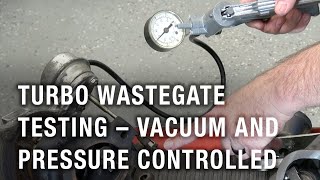
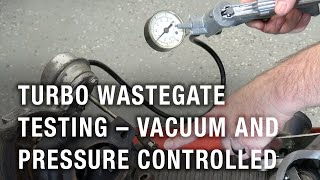
Apply vacuum (or regulated pressure for pressure-controlled units) to the actuator using a hand pump. The arm must move smoothly and hold pressure/vacuum without leaking. Do not exceed manufacturer limits (e.g., 13.6 psi).
Tools: Hand-held vacuum/pressure pump with gauge (Intermediate) - Advanced: Bi-Directional Test of the Wastegate Control Solenoid
Command the wastegate solenoid duty cycle from 0% to 100% at idle using a bi-directional scanner. Listen for clicking and verify vacuum/pressure changes at the output port. If duty cycle changes during a drive but boost ignores it, the solenoid or wastegate failed.
Tools: Advanced Bi-Directional Scanner, Vacuum/Pressure Gauge (Advanced) - Advanced: Wastegate Control Solenoid Electrical Tests
Test the solenoid's internal resistance with a multimeter (typically 20-30 Ohms). Infinity indicates an open circuit; zero indicates a short. Verify 12V power at the connector with the key on.
Tools: Multimeter, Manufacturer's Wiring Diagram (Advanced) - Advanced: MAP Sensor Voltage Test
Backprobe the MAP sensor signal wire. At KOEO, it reads ~4.5-5.0V. At idle, vacuum drops it to 1.0-2.0V. Voltage must rise smoothly as throttle/boost increases. Dropouts or static readings indicate a faulty sensor.
Tools: Multimeter, Backprobe Kit (Advanced) - Perform a Smoke Test
Inject smoke into the wastegate control vacuum lines using an automotive smoke machine to expose microscopic cracks or loose fittings causing the overboost.
Tools: Automotive Smoke Machine (Advanced) - Test for Exhaust Restrictions
Measure exhaust backpressure at the front oxygen sensor port. Readings exceeding 1.25 PSI at idle or 3.0 PSI at 2500 RPM confirm a downstream exhaust restriction.
Tools: Exhaust Backpressure Gauge (Advanced)
When This Code Triggers (Freeze-Frame Conditions)
- Engine Coolant Temp: 180-210°F (82-99°C) (The engine is fully warmed up and operating in closed-loop fuel control.)
- RPM: 1800-3000 RPM (The fault sets during steady-state cruising or moderate, sustained acceleration.)
- Engine Load: 40-70% (The engine is under moderate load, such as climbing a grade or maintaining highway speed.)
- Vehicle Speed: 45-70 mph (72-113 km/h) (Highway driving conditions where the turbo maintains a steady, controlled level of boost.)
Related Codes
- P0299 — The opposite code (Underboost). Intermittent P0234 and P0299 codes confirm a mechanical binding issue, such as a wastegate sticking randomly open and closed.
- P0236 — Indicates the MAP sensor reading is irrational or misaligned with the Barometric Pressure (BARO) sensor. Points directly to a faulty sensor or wiring, not a true overboost.
- P003A — Flags that an electronic wastegate actuator exceeded its physical learning limit. Confirms mechanical binding in the linkage or a failed actuator motor.
- P0243 — Identifies a specific electrical short or open circuit in the wastegate control solenoid. If present, replace the solenoid or repair its wiring harness.
Climate & Environmental Factors
- Extreme Cold Weather: At temperatures below 0°F (-18°C), PCV moisture freezes inside the Charge Air Cooler or wastegate solenoid (common on GM 1.4L). This ice blocks wastegate operation. The code often clears once the engine bay thaws.
- High Altitude: Lower air density at high altitudes forces the turbocharger to spin faster to hit target boost, exposing underlying control system weaknesses. The PCM automatically adjusts for altitude, so high elevation alone does not cause P0234.
How to Talk to a Mechanic About This Code
Say this: "I have a P0234 overboost code. Please start by testing the wastegate actuator for free movement, checking the control solenoid, and smoke testing the vacuum lines before quoting a full turbo replacement."
Directs the technician to follow a cost-effective diagnostic path, preventing the shop from immediately quoting a $2,500 turbo replacement without testing the $150 control components first.
Avoid saying:
- 'My car is making a weird noise and has no power.' (too vague)
- 'The internet said to replace the turbo.' (invites an expensive, and likely incorrect, repair)
- 'Just fix the check engine light.' (gives the shop a blank check to replace parts without proper diagnosis)
Questions to ask before authorizing the repair:
- Did the wastegate actuator arm move freely by hand, or was it stuck?
- Did the actuator hold vacuum/pressure when you tested it?
- What were the results of testing the boost control solenoid? Did it click when activated?
- Can you show me the failed part and explain why it needs to be replaced?
- What is the warranty on the parts and labor for this repair?
Where to Take It: Dealer vs Independent vs Chain
- Dealer:
Best for: Vehicles still under powertrain warranty., Complex issues on German or other specialty brands., Repairs related to a known manufacturer TSB (Technical Service Bulletin).
Downsides: Highest labor rates, often 1.5-2x more than an independent shop., May be quicker to recommend a full assembly replacement (e.g., entire turbo) rather than a smaller component repair. (Typical cost: +50% vs. baseline) - Independent Shop:
Best fit for out-of-warranty vehicles. A reputable independent shop experienced with turbochargers diagnoses and repairs the common control system failures far more affordably than a dealership.
Best for: Out-of-warranty vehicles where cost is a major factor., Shops that specialize in your vehicle's brand (e.g., a VW/Audi or Ford specialist)., Getting a second opinion after a dealer diagnosis.
Downsides: Shop quality and technician skill can vary widely; vetting through reviews and certifications (like ASE) is crucial., May not have access to the very latest TSBs or proprietary diagnostic software. (Typical cost: +0% vs. baseline) - Chain Shop:
Avoid for diagnosis. Chain shops lack the specialized equipment and training required to properly test turbocharger control systems, leading to high misdiagnosis rates.
Best for: Simple, routine maintenance like oil changes, tires, and brakes.
Downsides: Technician experience with complex diagnostics is often limited., High pressure to meet sales targets can lead to upselling unnecessary parts and services., Less likely to perform in-depth diagnosis of a turbo control system. (Typical cost: -10% vs. baseline)
When to Walk Away From the Repair
Sell or trade the vehicle if the estimated repair cost exceeds 50% of its private-party value.
- Car worth $8000, fix is $400: Fix it. This is a minor repair cost relative to the car's value and well below the threshold.
- Car worth $5000, fix is $2500: Borderline. The repair cost is 50% of the car's value. Get a second opinion and carefully consider the car's overall condition before proceeding.
- Car worth $3000, fix is $2800: Walk away. The repair cost is nearly the entire value of the car. It is not financially sensible to proceed.
What Scan Tool You Need for This Code
Minimum: A scanner capable of graphing live data to compare 'Target Boost Pressure' against 'Actual Boost Pressure' PIDs.
Basic $20 readers only display the code. Live data graphing is mandatory to determine if the sensor is lying or if the control system is physically failing to regulate pressure.
Budget: BlueDriver Pro (~$100) — Connects to your smartphone via Bluetooth and allows you to read freeze frame data and graph live data streams. You can watch the target and actual boost pressure in real-time on a test drive to confirm the overboost condition.
Mid-range: Foxwell NT510 Elite (~$200) — Includes all the features of the budget pick, but adds crucial bi-directional control. This allows you to command the wastegate control solenoid to open and close directly from the scan tool, letting you test its function without removing it from the vehicle.
Professional: Autel MaxiCOM MK808 / MaxiPRO MP900BT (~$500-900) — Offers full professional-level diagnostics, including advanced bi-directional controls, comprehensive live data graphing, and access to manufacturer-specific codes and data that cheaper scanners might miss.
Rent vs buy: Many auto parts stores (like AutoZone) will rent a basic code reader for free with a deposit, but these often lack live data capabilities. For P0234, viewing live data is essential. If you plan to do more than one diagnosis per year, buying a tool like the BlueDriver Pro is a worthwhile investment.
How to Clear the Code After You Fix It
- Clear the diagnostic trouble codes using an OBD-II scan tool.
- Never disconnect the battery to clear codes; this resets all readiness monitors and guarantees an emissions test failure.
- Execute a complete OBD-II drive cycle to force the PCM to re-run its self-tests and verify the repair.
Drive cycle (~30 minutes): 1) Cold start and idle for 5 minutes with A/C and defroster on. 2) Drive 15 minutes in mixed city/highway conditions with moderate acceleration and coasting. 3) Maintain a steady 55-60 mph for 10 minutes. 4) Let the vehicle cool down completely.
Readiness monitors affected: Catalyst Monitor, Evaporative System (EVAP) Monitor, Oxygen (O2) Sensor Monitor, Comprehensive Component Monitor (CCM)
Before emissions retest: drive at least 100 miles to fully set monitors.
Watch out for:
- Clearing the code without fixing the root cause results in the code returning almost immediately under boost.
- Taking the car for an emissions test right after clearing the code results in a 'Not Ready' failure.
- Highway-only driving is not enough; the computer needs varied conditions like coasting and idling to run all monitor tests.
Will This Fail Emissions / State Inspection?
Yes — this code typically fails an OBD-II emissions inspection.
- California: An active P0234 triggers an automatic failure. California allows exactly one 'Not Ready' monitor (excluding EVAP on newer cars) to pass after a repair.
- New York: An illuminated Check Engine Light guarantees failure. All required readiness monitors must read 'Ready' before passing a re-test.
- Texas: Vehicles in the 17 emissions-testing counties automatically fail with an active P0234. A complete drive cycle is mandatory to reset readiness monitors before re-inspection.
Most Commonly Affected Vehicles
- Chevrolet Cruze, Sonic, Trax (1.4L Turbo) (2011-2019) — A very common issue caused by a failing wastegate regulator solenoid valve (Part No. 55503993), especially in cold weather as noted in GM TSB 22-NA-007.
- Ford F-Series, Escape, Fusion (EcoBoost & Power Stroke) (2011-2022) — On EcoBoost engines, the wastegate control solenoid is a frequent cause. On 2020-2022 6.7L Power Stroke diesels, a faulty VGT turbocharger actuator (Part No. LC3Z-9G488-B) is a common cause addressed in Ford TSB SSM 53328.
- Ford Focus ST (2013-2018) — The wastegate control solenoid is a frequent failure point, causing intermittent limp mode. The wiring to the solenoid also becomes brittle from heat.
- Volkswagen / Audi GTI, Golf, Jetta, A3, A4 (TSI/TFSI engines) (2006-2016) — Frequently caused by a failed N75 valve (OEM P/N 06F906283F) or a torn diaphragm in the diverter valve. A seized wastegate actuator arm on the IHI turbocharger is also well-documented.
- Dodge Dart (1.4T) (2013-2016) — Issues with the wastegate actuator sticking or the vacuum lines controlling it becoming brittle trigger the P0234 code on these models.
- BMW 335i, 135i, 535i (N54 & N55 Engines) (2007-2015) — Caused by failing vacuum lines that become brittle with age, or by faulty pressure converters (wastegate solenoids). A stuck wastegate sometimes requires turbo replacement.
- Subaru WRX, Forester XT (2008-2021) — Commonly caused by a failed boost control solenoid or issues with the vacuum lines connected to it, including the small inline filter pill. Aftermarket modifications without proper tuning are a frequent trigger.
- Hyundai / Kia Sonata, Optima, Veloster (Turbo GDI) (2011-2020) — Caused by a faulty electronic wastegate actuator, a sticking wastegate rod, or a clogged catalytic converter creating excessive backpressure.
Manufacturer-Specific Notes
- General Motors (Chevrolet): GM TSB 22-NA-007 addresses Charge Air Cooler icing on 1.4L engines in freezing weather. Fixes include an ECM update and installing a winter grille cover (P/N 84529629) to retain heat.
- Ford: TSB SSM 53328 for 2020-2022 6.7L Power Strokes identifies a faulty VGT actuator (P/N LC3Z-9G488-B) replaceable separately from the turbo. EcoBoost models frequently require PCM software updates to refine boost logic.
- Volkswagen / Audi: The 'N75 valve' (wastegate solenoid) and a torn diverter valve diaphragm are primary culprits on 2.0T engines. Upgrading to the Revision 'D' piston-style diverter valve (P/N 06H145710D) prevents future failures.
- Honda: Electronic wastegate actuators on 1.5L engines frequently require mechanical recalibration. Adjusting the actuator arm's locknut to achieve a specific resting voltage clears the code.
Real Owner Stories
2015 Ford Escape 1.6L EcoBoost
Check Engine Light came on intermittently during winter, especially when accelerating to highway speeds (~3000 RPM for 5-10 seconds). No noticeable loss of power or other symptoms.
What they tried:
- Initial research pointed to the wastegate solenoid. The intermittent nature of the light made diagnosis difficult.
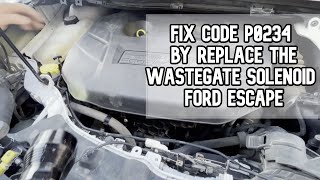
Outcome: Replacing the $60 wastegate solenoid permanently resolved the intermittent overboost condition.
Lesson: For intermittent P0234 codes that appear under specific load conditions, the wastegate control solenoid is a primary suspect and a common, successful DIY fix.
2014 Chevy Cruze 1.4L Turbo
Vehicle would suddenly lose power on the highway, especially when driving over 65mph for a few minutes, triggering limp mode. Turning the car off and on would temporarily resolve it. Code P0234 was present.
What they tried:
- Replaced the turbo boost sensor (MAP sensor) - the code returned.
- A mechanic diagnosed a cracked turbo and quoted $1900 for a replacement turbocharger and wastegate actuator.
Outcome: The owner declined the $1,900 turbo replacement and fixed the issue by replacing a $45 wastegate solenoid, highlighting how frequently shops misdiagnose control failures as mechanical turbo failures.
Lesson: Don't immediately accept a diagnosis of complete turbo failure. The control components (solenoid, hoses, actuator) are far more common failure points and are significantly cheaper to replace.
VW/Audi 2.0T Engine
Car enters limp mode, sometimes after an ECU tune/remap. Diagnostic scan reveals P0234.
What they tried:
- Checking for software issues with the tuner.
- Inspecting the MAP sensor and its wiring.
- Testing the N75 (wastegate control) valve.
Outcome: The root cause was a mechanically seized wastegate actuator arm binding against the turbine housing, preventing exhaust gas bypass.
Lesson: If P0234 appears after a tune or turbo-related repair, suspect a software mapping issue or incorrect mechanical adjustment of the wastegate rod before assuming a new part has failed.
How to Prevent This Code From Triggering
- Use high-quality fuel with detergents (Top Tier gasoline) (Every fill-up) — Reduces carbon deposits. Cleaner combustion minimizes soot buildup that jams variable geometry turbo (VGT) vanes and wastegate flaps.
- Perform regular oil changes with manufacturer-specified oil (Per vehicle's maintenance schedule (e.g., 5,000-7,500 miles)) — Fresh, correct-spec oil provides critical turbocharger bearing lubrication and cooling, preventing heat-induced component seizure.
- Allow for proper engine warm-up and cool-down (Daily habit) — Idle the engine for 30-60 seconds after hard driving before shutdown. This circulates oil to cool the turbocharger, preventing oil 'coking' in the bearings.
- Periodically exercise the engine through its full RPM range (Once or twice a month) — Sustained hard acceleration (e.g., highway on-ramps) burns off carbon deposits and forces the wastegate and VGT vanes through their full range of motion, preventing seizure.
- Install an oil catch can (especially on GDI engines) (One-time installation) — Intercepts PCV oil vapor before it enters the intake, preventing carbon sludge from coating turbocharger components and intake valves.
Frequently Asked Questions
Can I just clear the P0234 code and keep driving?
No. Clearing the code does not fix the underlying mechanical or electrical problem. The code returns immediately under load, forcing the vehicle back into limp mode. Ignoring it risks severe, expensive engine damage.
What is the most common misdiagnosis for P0234?
A common mistake is immediately replacing the Boost Pressure (MAP) sensor. While the sensor reports the overboost, the actual fault usually lies within the boost control system (wastegate, actuator, or solenoid). Always test the control system components before replacing the sensor.
How much does it cost to fix a P0234 code?
Repair costs depend entirely on the root cause. Replacing a cracked vacuum line or wastegate solenoid costs $100 to $400. A complete turbocharger replacement ranges from $1,800 to over $4,200.
What's the difference between P0234 (Overboost) and P0299 (Underboost)?
P0234 indicates the turbocharger is producing too much pressure, while P0299 means it is producing too little. They are opposite conditions but frequently share the same root cause. A mechanically sticking wastegate triggers both codes intermittently.
Can a boost leak cause P0234?
Generally, no. A boost leak in the charge pipes causes a loss of pressure, triggering an underboost code (P0299). However, a vacuum leak in the specific hose controlling the wastegate actuator prevents it from opening, causing P0234.
What happens if I ignore a P0234 code?
Ignoring P0234 is extremely risky and leads to catastrophic engine failure. Excessive cylinder pressure blows head gaskets, cracks pistons, and shatters turbocharger turbines. This turns a $200 sensor repair into a $5,000 engine replacement.
Will P0234 clear itself?
No. P0234 is a 'hard fault' indicating a mechanical or electrical issue that the vehicle cannot resolve on its own. The check engine light remains active until the underlying problem is diagnosed and repaired.
Can a clogged catalytic converter cause P0234?
Yes, though it is rare. A severely restricted catalytic converter creates massive exhaust backpressure. This traps exhaust gases inside the turbocharger, disrupting wastegate regulation and forcing an overboost condition.
Key Takeaways
- P0234 indicates your turbocharger is producing dangerously high pressure, requiring you to stop driving immediately to prevent engine failure.
- Over 80% of P0234 codes stem from control system failures—specifically a faulty $150 wastegate control solenoid or cracked vacuum hoses—rather than a blown turbocharger.
- Begin diagnosis by visually inspecting the 3-4 small vacuum hoses connected to the turbocharger and manually testing the wastegate actuator arm for smooth movement.
- On GM 1.4L engines operating below 0°F (-18°C), ice buildup in the charge air cooler or control solenoid is the primary trigger, documented in TSB 22-NA-007.
- Ignoring a P0234 code forces the turbocharger to overspin, frequently causing catastrophic internal engine damage that costs upwards of $5,000 to fix.
Helpful Videos

The information in this article is provided for general reference and educational purposes only. Vehicle specifications, procedures, and part compatibility can vary by production date, trim level, and region. Always consult your vehicle's factory service manual and verify part numbers before purchasing or performing repairs. Safety-critical components such as airbags, seat belts, and braking systems should be installed by a qualified professional.
- 🎬 Helpful Videos
- What Does P0234 Mean?
- Can I Drive With P0234?
- Common Causes
- Symptoms
- Diagnostic Flowchart
- Common Fixes & Costs
- DIY vs Professional
- Used vs. New Parts: Buying Guide
- What Happens If You Wait — Timeline
- Cost of Not Fixing It
- Diagnosis Steps
- When This Code Triggers (Freeze-Frame Conditions)
- Related Codes
- Climate & Environmental Factors
- How to Talk to a Mechanic About This Code
- Where to Take It: Dealer vs Independent vs Chain
- When to Walk Away From the Repair
- What Scan Tool You Need for This Code
- How to Clear the Code After You Fix It
- Will This Fail Emissions / State Inspection?
- Most Commonly Affected Vehicles
- Manufacturer-Specific Notes
- Real Owner Stories
- 2015 Ford Escape 1.6L EcoBoost
- 2014 Chevy Cruze 1.4L Turbo
- VW/Audi 2.0T Engine
- How to Prevent This Code From Triggering
- Frequently Asked Questions
- Can I just clear the P0234 code and keep driving?
- What is the most common misdiagnosis for P0234?
- How much does it cost to fix a P0234 code?
- What's the difference between P0234 (Overboost) and P0299 (Underboost)?
- Can a boost leak cause P0234?
- What happens if I ignore a P0234 code?
- Will P0234 clear itself?
- Can a clogged catalytic converter cause P0234?
- Key Takeaways
- 🎟️ Get 5% Off