

P0116 on 2017-2023 GMC Acadia 3.6L: Engine Coolant Temperature Sensor Causes and Fixes
On a 2017-2023 Acadia with the 3.6L V6, code P0116 is most often caused by a faulty thermostat that is stuck open or a failing engine coolant temperature (ECT) sensor. Due to the difficult location of these parts, professional replacement can be costly. This code is often seen with P0128, which more directly points to a thermostat issue.
- P0116 on the 2017-2023 Acadia 3.6L usually points to a stuck-open thermostat or a bad ECT sensor.
- A key diagnostic step is to compare ECT and IAT sensor readings on a completely cold engine; they should be nearly identical.
- The main difficulty with this repair is the poor accessibility of the thermostat and sensor, making it a labor-intensive job.
- Due to the high labor cost, it is wise to replace both the thermostat and the ECT sensor at the same time.
- For 2017-2018 models, verify that the ECM has the latest software, as a known bug can cause similar issues.
What's Unique About the 2017-2023 GMC Acadia

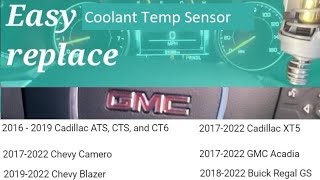
On the 3.6L V6 (LGX) engine in the second-generation Acadia, the primary challenge with a P0116 code is physical access to the components. Both the ECT sensor and the thermostat are located in a very tight spot under the intake manifold, near the firewall. This turns what is a simple part swap on many vehicles into a more labor-intensive job, often requiring removal of the upper intake manifold. Some experienced mechanics and DIYers have developed workarounds to replace the ECT sensor without removing the manifold, but it requires specific tools like a 1/4" drive 15mm socket and extensions, and considerable patience.
🎬 Watch: A clever workaround to replace the ECT sensor faster.Symptoms You May Notice
- Check Engine Light is on
- Temperature gauge on the dashboard is inaccurate (may stay on cold or fluctuate wildly)
- Engine cooling fans run continuously, even when the engine is cold
- Reduced fuel economy
- Heater may not blow hot air
- Engine may hesitate or run rough, especially when first started
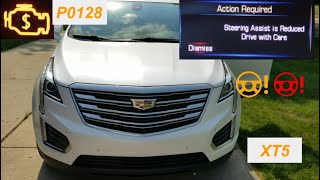
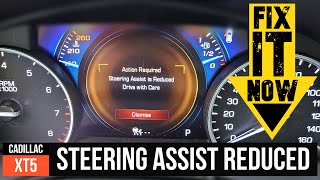
- "Service Steering" message and loss of power steering assist 🎬 See why a thermostat failure triggers the steering assist message.
- Replacing only the ECT sensor when the thermostat is the actual cause. Since the engine takes a long time to warm up, it can seem like the sensor is reading incorrectly when it's actually reporting the true (but too low) temperature accurately. This is why replacing both parts at once is often recommended due to the high labor cost to access them.
Most Likely Causes

- Thermostat stuck open 🔴 High Probability The thermostat failing in the open position is a very common failure mode for this part across many GM vehicles with the 3.6L engine. It directly causes the engine to warm up much slower than the ECM expects, triggering a P0116 or, more commonly, a P0128 code.
How to confirm: Use a scan tool to monitor the coolant temperature in real-time. If the engine takes an excessively long time (e.g., more than 15-20 minutes of driving) to reach operating temperature (around 195-220°F), the thermostat is almost certainly stuck open.
Typical fix: Replace the thermostat and thermostat housing. Due to the high labor involved, it is highly recommended to replace the ECT sensor at the same time. The system will also need to be drained and refilled with new DEX-COOL coolant.
Est. part cost: $450-$550 - Faulty Engine Coolant Temperature (ECT) Sensor 🟡 Medium Probability
How to confirm: On a cold engine (after sitting for several hours), use a scan tool to compare the ECT reading with the Intake Air Temperature (IAT) reading. They should be within a few degrees of each other. If the ECT reading is illogical (e.g., -40°F or 250°F), the sensor is bad or the circuit is open/shorted. You can also test the sensor's resistance with a multimeter; at 68°F (20°C), it should be between 2,000 and 3,000 ohms.
Typical fix: Replace the ECT sensor. Given its difficult location, it is often recommended to replace the thermostat at the same time, as the labor overlaps significantly.
Est. part cost: $20-$60 - Low Engine Coolant Level ⚪ Low Probability
How to confirm: Visually inspect the coolant reservoir and radiator (when the engine is cool) to ensure the coolant is at the proper level. An air pocket in the system, caused by a leak or improper filling, can cause the ECT sensor to give erratic readings.
Typical fix: Top off the coolant with the correct type (DEX-COOL) and bleed the system to remove any air pockets. Investigate and repair the source of the coolant leak.
Est. part cost: $20-$40 for coolant - Wiring or Connector Issue ⚪ Low Probability
How to confirm: Visually inspect the ECT sensor's electrical connector and wiring harness for signs of corrosion, damage, or loose pins. Wiggle the connector while monitoring the temperature reading on a scan tool to see if it fluctuates.
Typical fix: Repair the damaged wiring or clean/replace the connector pigtail. Apply dielectric grease to the new connection to prevent future corrosion.
Est. part cost: $15-$50
Rare But Worth Checking
- ECM Software Glitch: GM has issued technical service bulletins (e.g., 20-NA-167, 17-NA-374) for various models, including some related to the Acadia, where the ECM's diagnostic parameters for setting P0128 or related codes were too sensitive. The fix is to reprogram the ECM with an updated calibration, which must be done at a dealership or a properly equipped independent shop.
- Faulty Engine Control Module (ECM): This is extremely rare. The ECM should only be considered after all other possibilities, including sensor, thermostat, and wiring, have been exhaustively ruled out.
Diagnosis Steps

- Check for any other stored trouble codes, paying close attention to P0128, which strongly indicates a faulty thermostat.
- With the engine cold for several hours, use a scan tool to compare the Engine Coolant Temperature (ECT) reading and the Intake Air Temperature (IAT) reading. They should be within 5°F of each other.
- If the ECT reading is illogical (e.g., -40°F or 250°F), inspect the ECT sensor wiring and connector for damage. If the wiring is good, the sensor has failed.
- If the initial temperature readings are plausible, start the engine and monitor the ECT data on the scan tool.
- The temperature should rise steadily to about 195-220°F and then stabilize as the thermostat opens and closes.
- If the temperature rises very slowly and struggles to reach the normal operating range, the thermostat is almost certainly stuck open and needs to be replaced.
- If the temperature reading jumps around erratically, the ECT sensor is likely faulty or has a poor electrical connection.
- Before starting repairs, check the coolant level and condition. Low or contaminated coolant can also cause issues. Ensure there are no air pockets in the system.
Parts You'll Likely Need

- Engine Coolant Thermostat and Housing Assembly
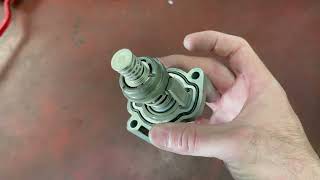
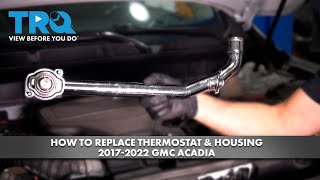
(OEM #12677895)— This is a very common cause of P0116 and P0128, as a stuck-open thermostat prevents the engine from warming up correctly. The part for the 3.6L V6 is typically an integrated housing assembly. 🎬 Watch: Step-by-step guide to replacing the thermostat and housing.
Trusted brands: ACDelco (OEM), Dorman, Gates
OEM price range: $450-$550
Aftermarket price range: $150-$300 - Engine Coolant Temperature (ECT) Sensor
(OEM #12691559 (Supersedes 12650595))— The sensor itself can fail, providing incorrect or erratic readings to the ECM. It's a common point of failure for this code and is often replaced with the thermostat as a preventative measure.
Trusted brands: ACDelco (OEM), Bosch, Delphi, NTK
OEM price range: $30-$50
Aftermarket price range: $15-$30
Related Codes That Often Appear With This One
- P0128 — This code specifically means 'Coolant Thermostat (Coolant Temperature Below Thermostat Regulating Temperature)', which points directly to a stuck-open thermostat. It is the most common companion code to P0116 on this platform.
- P0115 — This is a general circuit malfunction code for the ECT sensor, which can appear if there's a hard electrical fault.
- P0117 — Indicates the ECT sensor circuit is reading low (short to ground).
- P0118 — Indicates the ECT sensor circuit is reading high (open circuit).
Technical Service Bulletins (TSBs) & Recalls
- 17-NA-374: Power Steering Assist Reduced Message, MIL Illuminated, DTC P111E Set - This TSB notes that an ECM calibration issue can cause a false temperature plausibility code and recommends a software update. (Note: This TSB number is also used for an unrelated diesel emissions topic on other GM vehicles).
- 20-NA-167 / 20-NA-207: While not exclusively for the Acadia, these TSBs highlight a pattern where GM issues ECM software updates to correct overly sensitive diagnostic parameters for codes like P0128 and to address wiring harness interference issues.
Platform-Specific Known Issues
- The location of the thermostat and ECT sensor on the 3.6L V6 is notoriously difficult to access, being tucked under the intake manifold against the firewall. This significantly increases labor time and cost.
- A GM Technical Service Bulletin (17-NA-374) exists for 2017-2018 models for a related code (P111E), which could cause similar symptoms and is resolved with an ECM update.
- Failure to address P0116/P0128 can lead to a 'Service Steering' message and a loss of power steering assist, a documented issue on this platform and its mates.
Mechanic-Grade Diagnostic Values
- ECT Sensor Voltage (Key On, Engine Off, Cold Engine) — expected: ~2.0V - 3.5V. Failure: A reading of ~5.0V indicates an open circuit or unplugged sensor. A reading near 0V indicates a short to ground.
- ECT Sensor Voltage (Engine at Operating Temperature) — expected: ~0.5V - 1.0V. Failure: Voltage that does not decrease as the engine warms up, or decreases erratically.
- ECT Sensor Resistance at 20°C (68°F) — expected: 2000 - 3000 Ohms (Ω). Failure: Resistance significantly outside this range indicates a faulty sensor.
- ECT Sensor Resistance at 90°C (194°F) — expected: 200 - 300 Ohms (Ω). Failure: Resistance that does not drop to this range as the engine warms indicates a faulty sensor.
Scan Tool Commands That Help
- GDS2 (GM Dealer Tool): Compare ECT Sensor 1 data to other temperature sensors (if equipped) — On a cold-soaked engine, all temperature sensors (ECT, IAT, and others on some models) should read within a few degrees of each other. This is a quick plausibility check.
- GDS2 (GM Dealer Tool): Coolant Pump Bleed Procedure — This is a required step after replacing the thermostat or draining the coolant. It runs the necessary pumps and actuators to purge air from the system, which is critical for preventing future codes and overheating.
Wiring & Ground Locations
- ECT Sensor Connector — On the thermostat housing, at the rear of the engine against the firewall, under the intake manifold.. This is the primary connection point for the sensor. Damage, corrosion, or a loose connection here will directly cause P0116, P0117, or P0118.
- Engine Harness Chafe Points — Potential rub-through spots exist where the harness passes over the intake plenum, against valve cover bolts, on the side of the cylinder head, or against the transmission case.. A chafed wire can cause a short or open in the ECT sensor circuit, leading to a P0116 code even if the sensor and thermostat are good. This is a known issue in the GM 3.6L engine family.
- Engine Ground Straps (G103/G105/G108) — Key engine grounds are typically located on the engine block, cylinder heads, and chassis near the front wheel wells.. A poor or corroded engine ground can create a floating voltage reference for all sensors, including the ECT. This can cause skewed or erratic readings that trigger a performance code like P0116.
Real Owner Repair Stories
- YouTube - David Waltermyer (2017 Cadillac XT5 (same LGX engine and platform)) — Check Engine Light with P0128, "Steering Assist is Reduced, Drive with Care" message on the dash.
❌ Tried (didn't work) Took to the dealership who quoted $1300 for the repair.
✅ What actually fixed it Owner replaced the thermostat (GM #12678779) and ECT sensor (GM #12650595) himself. This cleared both the check engine light and the power steering warning message. - YouTube - DadsGarage Diagnostic Specialist (GMC Acadia (2nd Gen)) — P0128 code and "Steering Assist is Reduced" message. Temperature gauge reading at the bottom.
✅ What actually fixed it A scan tool confirmed the engine temperature would not rise above ~170°F, indicating a stuck-open thermostat. Replacing the thermostat assembly resolved the issue, with post-repair data showing the engine reaching 205°F and stabilizing correctly.
OEM Part Supersession History
12650595→12691559— Standard part revision and update by GM.
Model Year Variations Within This Range
- 2017-2018: A specific TSB (17-NA-374) for a related temperature plausibility code (P111E) that causes similar symptoms applies to these early model years and is fixed with an ECM software update.
Diagnostic Flowchart
Other Known Issues on This Vehicle
Issues unrelated to this code that are worth knowing about as an owner of this generation:
- Shift to Park Message / Shifter Assembly Failure 🔴 High — Very common on 2017-2019 models. A message 'Shift to Park' appears even when the vehicle is in park, preventing it from shutting off and draining the battery. (Ref: Multiple TSBs issued (e.g., PIT5616A, 23-NA-119), but no formal recall. Fix often involves replacing a microswitch, adding a jumper harness, or replacing the entire shifter assembly.)
- Transmission Shudder / Torque Converter Failure 🟠 Medium — Commonly reported around 50,000-80,000 miles. Owners experience shuddering or jerking during light acceleration or when shifting. (Ref: GM has issued TSBs recommending a specific fluid flush procedure. In many cases, the torque converter or entire transmission requires replacement.)
- Timing Chain Stretch (LGX Engine) 🟠 Medium — While significantly improved over the previous generation (LLT/LFX) engines, the LGX can still suffer from timing chain issues, typically at higher mileage (100k+ miles) or if oil change intervals are extended. (Ref: No specific recall for the LGX, but it's a well-documented issue on the GM High Feature V6 family.)
- Carbon Buildup on Intake Valves 🟡 Low — A consequence of Direct Injection (DI) engines. Becomes noticeable after 80,000-100,000 miles, causing reduced performance, rough idle, and potential misfire codes. (Ref: No TSB; this is a maintenance issue inherent to DI engine design. Requires periodic walnut blasting or chemical cleaning service.)
- A/C Condenser Leaks 🟠 Medium — The A/C condenser is susceptible to damage and leaks, leading to poor or no A/C performance.
Used vs. New Parts: Buying Guide for This Vehicle
When a used part is the smart pick: For this repair, using used parts is generally not recommended due to the high labor cost. However, if the ECM is diagnosed as the fault (which is rare), a used ECM from a reputable salvage yard can be a cost-effective option, but it will require professional programming to the vehicle's VIN.
Donor-vehicle mileage cap: roughly under 60000 miles for the part to have meaningful remaining life.
What to inspect on the donor part:
- For an ECM, ensure the donor vehicle was not in a flood or fire.
- Verify the part number on the used ECM exactly matches the original.
- Ask for a warranty or return period from the salvage yard.
OEM-only on this vehicle (don't cheap out):
- Engine Coolant Thermostat Assembly: Given the extremely high labor involved and the high failure rate of this part, using a new OEM (ACDelco) part is the safest bet to ensure you don't have to do the job again in the near future.
Aftermarket brands forum-validated for this vehicle:
- ECT Sensor: ACDelco (OEM), Bosch, Delphi, NTK.
- Thermostat Assembly: Dorman, Gates (if OEM is unavailable or cost-prohibitive).
- Connector Pigtail: Standard Motor Products (SMP).
Brands owners have reported issues with on this vehicle:
- No-name, unbranded electronic sensors or thermostat assemblies from online marketplaces. The risk of premature failure is too high for a repair this labor-intensive.
Real Owner Stories
Aggregated from forums and TSBs cited above. Mileages and costs reflect what owners reported in those sources.
2019 GMC Acadia 3.6L V6
Symptoms: The owner dealt with a P0128 code and noted the extremely difficult location of the Engine Coolant Temperature (ECT) sensor.
What fixed it: Replacement of the ECT sensor; the source demonstrates a method to replace it without removing the intake manifold despite the high degree of difficulty.
Source hint: YouTube - 'GMC 3.6 V6 LGX 2016 & above: Easy way to replace coolant temperature sensor (ECT): 2019 Acadia P0128'
2017-2023 GMC Acadia 3.6L V6
Symptoms: The vehicle displayed a 'Steering Assist Reduced' message and a P0128 code. A road test showed the engine failed to warm up past approximately 170°F.
What fixed it: Installation of a new thermostat, which resolved both the trouble code and the steering assist message.
Source hint: YouTube - 'Acadia "Steering Assist Reduced"... P0128 Thermostat'
Related OBD-II Codes
Frequently Asked Questions
Why is my 2017 GMC Acadia showing a 'Service Steering' message along with the P0116 code?
Is there a Technical Service Bulletin for temperature codes on the 2017-2018 Acadia?
Why is the labor cost so high to replace the thermostat on my 3.6L V6 Acadia?
Should I replace the ECT sensor and thermostat at the same time?
Can a low coolant level cause the P0116 code on my Acadia?
Are there other GM vehicles that have this same P0116/P0128 cooling issue?
Helpful Videos
Used OEM Parts in Stock


New Aftermarket Parts Available



The information in this article is provided for general reference and educational purposes only. Vehicle specifications, procedures, and part compatibility can vary by production date, trim level, and region. Always consult your vehicle's factory service manual and verify part numbers before purchasing or performing repairs. Safety-critical components such as airbags, seat belts, and braking systems should be installed by a qualified professional.
- GMC Acadia:
- 🎬 Helpful Videos
- 🛍️ Shop This Part
- What's Unique About the 2017-2023 GMC Acadia
- Symptoms You May Notice
- Most Likely Causes
- Rare But Worth Checking
- Diagnosis Steps
- Parts You'll Likely Need
- Related Codes That Often Appear With This One
- Technical Service Bulletins (TSBs) & Recalls
- Platform-Specific Known Issues
- Mechanic-Grade Diagnostic Values
- Scan Tool Commands That Help
- Wiring & Ground Locations
- Real Owner Repair Stories
- OEM Part Supersession History
- Model Year Variations Within This Range
- Diagnostic Flowchart
- Other Known Issues on This Vehicle
- Used vs. New Parts: Buying Guide for This Vehicle
- Real Owner Stories
- 2019 GMC Acadia 3.6L V6
- 2017-2023 GMC Acadia 3.6L V6
- Related OBD-II Codes
- Frequently Asked Questions
- 🎟️ Get 5% Off