

OBD-II Code P0128: Engine Is Running Too Cold — The Ultimate Guide
What P0128 means, why it triggers, and how to fix it for good
- P0128 indicates your engine is running below its 190-220°F operating temperature, usually due to a stuck-open thermostat.
- A mechanically stuck-open thermostat causes over 80% of P0128 codes and requires a $150-$400 replacement.
- Check for Technical Service Bulletins (TSBs) before buying parts; GM, Kia, and Hyundai frequently fix false P0128 triggers with a dealer software update.
- Driving with P0128 drops fuel economy by 10-15% and destroys your catalytic converter within 6 months, turning a $200 fix into a $2,000 disaster.
- Confirm the diagnosis immediately if your dashboard temperature gauge stays below the midpoint and your cabin heater blows lukewarm air.
What Does P0128 Mean?

Your Engine Control Module (ECM) detected the engine failed to reach its 190-220°F operating temperature within the expected timeframe. The engine is running colder than designed, which ruins fuel economy and increases emissions.
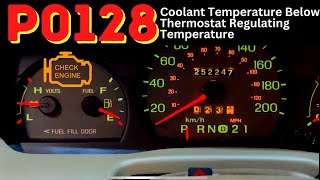
Technical definition: Coolant Thermostat (Coolant Temperature Below Thermostat Regulating Temperature). The Powertrain Control Module (PCM) compares the Engine Coolant Temperature (ECT) sensor reading against the Intake Air Temperature (IAT) sensor at startup. If the ECT warm-up rate is too slow based on engine run time and vehicle speed, the PCM sets this code. It typically requires two consecutive failing drive cycles to illuminate the Check Engine Light.
Can I Drive With P0128?

Yes, But With Caution. Yes, but fix it within a few weeks. Driving long-term forces the engine to run rich, fouling spark plugs and destroying the catalytic converter. This turns a $200 repair into a $2,000 expense. It also drops fuel economy by 10-15% and accelerates engine sludge buildup.
Common Causes

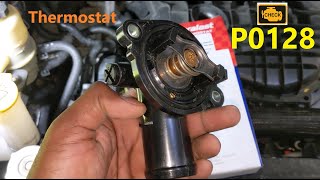
- Faulty or Stuck-Open Thermostat (Very Common) — This causes over 80% of P0128 codes. The thermostat valve sticks open, allowing constant coolant flow to the radiator and preventing the engine from warming up.
- Low Engine Coolant Level / Leaks (Common) — Low coolant creates air pockets. Air surrounding the ECT sensor causes artificially low readings. Leaking plastic thermostat housings (common on Chevy and Jeep) are frequent culprits.
- Engine Control Module (ECM) Software Issue (Common) — Factory software parameters are sometimes too sensitive in cold climates. Manufacturers issue Technical Service Bulletins (TSBs) to update the logic and prevent false codes.
- Faulty Engine Coolant Temperature (ECT) Sensor (Less Common) — The sensor's internal resistance drifts out of spec, sending a false low-temperature signal to the computer even when the engine is hot.
- Cooling Fan is Stuck On (Less Common) — A failed relay or control module forces the electric cooling fan to run constantly, over-cooling the radiator.
- Faulty Intake Air Temperature (IAT) Sensor (Rare) — The ECM uses the IAT sensor as a baseline. A false reading (e.g., -40°F on a warm day) disrupts the warm-up calculation.
Symptoms
- Check Engine Light is On — The primary and often only symptom noticed by the driver.
- Temperature Gauge Reads Low — The dashboard gauge fails to reach the middle, or drops toward cold when driving at highway speeds.
- Heater Blows Lukewarm Air — The cabin heater relies on hot engine coolant. If the engine runs cold, the heater cannot produce hot air.
- Decreased Fuel Economy — The engine remains in 'open-loop' warm-up mode, injecting extra fuel to generate heat and reducing MPG by 10-15%.
- Failed Emissions Test — An active P0128 code prevents the engine from entering 'closed-loop' operation, blocking emissions monitors from running.
Diagnostic Flowchart

Tap your situation to follow the diagnostic path that matches what you're seeing on this code.
Common Fixes & Costs
- Replace the Engine Thermostat (and Housing) 🎬 See this walkthrough for replacing a thermostat on Ford V8 engines. — Parts: $30-$150, Labor: $150-$350, ~1.5 hr book time (Intermediate)
- Top Off or Replace Engine Coolant — Parts: $25-$50, Labor: $100-$200, ~1.0 hr book time (DIY)
- Reprogram Engine Control Module (ECM) — Parts: $0, Labor: $100-$200, ~1.0 hr book time (Pro Only)
- Replace the Engine Coolant Temperature (ECT) Sensor — Parts: $25-$80, Labor: $80-$150, ~0.8 hr book time (DIY)
- Replace Cooling Fan Relay — Parts: $20-$50, Labor: $50-$100, ~0.5 hr book time (DIY)
DIY vs Professional
- Replace Thermostat/Housing — Beginner: False
Tools: ['Socket set', 'Hose clamp pliers', 'Torque wrench', 'Drain pan', 'Spill-free coolant funnel'] - Coolant Flush/Fill — Beginner: True
Tools: ['Drain pan', 'Spill-free coolant funnel', 'Pliers'] - Replace ECT Sensor — Beginner: True
Tools: ['Deep socket set', 'Ratchet with extension'] - Replace Cooling Fan Relay — Beginner: True
Tools: ['Pliers']
Used vs. New Parts: Buying Guide
When a used part is worth it: Never buy a used thermostat. The part is inexpensive new, and a used unit has a high risk of immediate failure.
Donor-vehicle mileage cap: roughly under 10000 miles for the part to have meaningful remaining life.
Donor quality checklist:
- Match the part number exactly for integrated thermostat housings.
- Avoid parts with any signs of corrosion, cracking, or previous leakage.
- Always buy new thermostats due to low cost and high importance.
Decision logic:
- If The part is a simple thermostat valve → Always buy new. Saving $10 is not worth the risk of repeat labor costs.
- If The part is an expensive integrated thermostat housing assembly (> $150) → A used part from a low-mileage vehicle is acceptable, but a new aftermarket part is safer.
- If The part has a known high failure rate (e.g., plastic housings) → Buy a new OEM part with the latest updated design or an aftermarket aluminum upgrade.
Warranty tradeoff: Used parts have a 30-day warranty. New aftermarket parts offer a 1-year to lifetime warranty. New OEM parts carry a 1-2 year warranty.
Worst-case if a used part fails: $250-$600 if a used thermostat fails, requiring a full repeat of the labor.
What Happens If You Wait — Timeline
- 0-1 month: Engine takes longer to warm up, heater performance is weak, and the temperature gauge reads low. (MPG impact: 5-10%% · Added cost: $20-$50 in wasted fuel)
- 1-4 months: The engine runs in 'open-loop' mode, causing a rich fuel mixture that fouls spark plugs and increases emissions. (MPG impact: 10-15%% · Added cost: $50-$200 in wasted fuel and spark plug replacement)
- 4-9 months: Low operating temperatures prevent moisture from burning off in the oil, forming engine sludge. The catalytic converter overheats from unburnt fuel. (MPG impact: 10-20%% · Added cost: $500+ for sludge-related engine issues)
- 9+ months: Catastrophic failure of the catalytic converter occurs. Severe engine sludge leads to major internal damage. (MPG impact: 15-25%% · Added cost: $2000-$4000+ for catalytic converter and engine repairs)
Cost of Not Fixing It
- 0-1 month: Reduced fuel economy (up to 15%), poor heater performance, and increased emissions. (Added cost: $20-$50 in wasted fuel)
- 1-6 months: The rich fuel mixture fouls spark plugs. The catalytic converter overheats as it works to burn off unburnt fuel. (Added cost: $1200-$2800 for catalytic converter replacement)
- 6+ months: Prolonged low temperatures cause engine sludge as oil and condensation mix, accelerating internal engine wear. (Added cost: $3000+ for engine repairs)
Diagnosis Steps
- Check for Technical Service Bulletins (TSBs)
Search online for TSBs related to P0128 for your specific year, make, and model. GM, Hyundai, and Kia frequently issue software updates to fix overly sensitive code triggers, saving you from unnecessary repairs.
Tools: ['Smartphone or Computer'] (DIY) - Check the Coolant Level
With the engine completely cool, check the coolant level in the reservoir and radiator. A low level indicates a leak that must be fixed. Top it off to see if the code clears.
Tools: ['Flashlight', 'Rag'] (DIY) - Analyze Live Data with a Scan Tool
With a cold engine, compare the ECT and IAT readings; they should be within 5°F. Start the engine and monitor the ECT. If it rises very slowly, never reaches 195°F, or drops at highway speeds, the thermostat is stuck open.
Tools: ['OBD-II Scanner with Live Data'] (Intermediate) - Scan for Accompanying Codes
Check for other codes. Codes for the ECT sensor (P0117, P0118) or cooling fan circuits (P0480) point to specific electrical faults. If P0128 appears alone, a faulty thermostat is the culprit 90% of the time.
Tools: ['OBD-II Scanner'] (DIY) - Feel the Radiator Hose
Start the cold engine and carefully feel the upper radiator hose. It should remain cool for several minutes. If it gets warm within the first 60 seconds, coolant is flowing prematurely, confirming a stuck-open thermostat.
Tools: ['None'] (DIY) - Check Cooling Fan Operation
Start the cold engine and verify the electric cooling fans are off. If they run constantly, diagnose a failed fan relay or control module.
Tools: ['None'] (DIY) - Verify Temperatures with an Infrared Thermometer
Point an IR thermometer at the thermostat housing. Watch the temperature rise. Then, point it at the radiator inlet hose. You should see a sudden jump in the hose's temperature when the thermostat opens. Gradual warming confirms a stuck thermostat.
Tools: ['Infrared Thermometer'] (Pro) - Test the ECT Sensor
Disconnect the ECT sensor and measure resistance (Ohms). At 68°F, it should read 2,000-3,000 Ohms. As the sensor warms up, resistance should drop smoothly. A reading of 0 or infinity indicates a dead sensor.
Tools: ['Multimeter'] (Pro) - ADVANCED: ECT Sensor Electrical Tests
Back-probe the signal wire with the key on. Voltage should be high when cold (approx. 3.0-3.5V) and drop smoothly to 0.5-1.3V at operating temperature. A reading of 5V indicates an open circuit; 0V indicates a short.
Tools: ['Digital Multimeter', 'Back-probe Kit', 'Wiring Diagram'] (Advanced) - ADVANCED: Analyze Advanced Scan Tool PIDs
Monitor the relationship between Engine Speed (RPM), Calculated Engine Load, and ECT. If the ECT rises at idle but suddenly drops when RPMs increase during highway driving, increased airflow is over-cooling the engine due to a stuck thermostat.
Tools: ['Advanced OBD-II Scan Tool'] (Advanced)
When This Code Triggers (Freeze-Frame Conditions)
- Engine Coolant Temp: 160-180°F (Below the target thermostat regulating temperature (e.g., <180°F when it should be 195°F+).)
- RPM: 1500-2500 (Cruise or steady throttle, not high-load or idle.)
- Engine Load: 20-50% (Light to moderate engine load, typical of steady driving.)
- Vehicle Speed: 40-65 mph (Highway or city cruise speeds where airflow over the radiator is consistent.)
Related Codes
- P0125 — Indicates 'Insufficient Coolant Temperature for Closed Loop Fuel Control'. This is a more severe version of P0128, meaning the engine is running so cold it cannot switch to efficient closed-loop mode.
- P0117 / P0118 — Circuit-specific codes for the ECT sensor (Low/High Input). If present alongside P0128, the problem is the ECT sensor or its wiring, not the thermostat.
- P0113 — Indicates an IAT sensor circuit issue. A false IAT reading causes the computer to miscalculate the expected warm-up time, falsely triggering P0128.
- P0480 — Indicates a cooling fan circuit malfunction. If this fault forces the fan to run continuously, it over-cools the engine and triggers P0128.
Climate & Environmental Factors
- Cold Climates: In sub-freezing temperatures, coasting downhill strips heat from the engine faster than it generates it. This prevents the engine from reaching the ECU's target temperature, triggering a false P0128 code even with a functional thermostat.
- High Altitude: Less dense air reduces radiator cooling efficiency. While this makes overheating more likely, it has no significant impact on triggering a P0128 code.
- Humidity: Humidity has no impact on the conditions that trigger a P0128 code.
How to Talk to a Mechanic About This Code
Say this: "I have a P0128 code and suspect the thermostat is stuck open. Can you check for any relevant TSBs and monitor the live engine coolant temperature data to confirm it fails to reach operating temperature?"
This guides the technician toward the most likely cause and focuses the diagnostic on a specific, testable hypothesis (watching live ECT data), preventing unnecessary part replacements.
Avoid saying:
- 'My check engine light is on, can you just look at it?'
- 'Just fix whatever is wrong with it.'
- 'A guy online said it's the thermostat, so just replace that.'
Questions to ask before authorizing the repair:
- Did you confirm with live data that the engine temperature doesn't reach 195-220°F?
- Did you check for Technical Service Bulletins (TSBs) for my vehicle?
- Does your quote include new coolant and bleeding the air from the system?
- What is the warranty on the parts and labor?
Where to Take It: Dealer vs Independent vs Chain
- Dealer:
Necessary if a TSB reflash is the confirmed fix. Otherwise, too expensive for a simple thermostat swap.
Best for: Vehicles under warranty, Fixes requiring a manufacturer-specific software update (TSB reflash), Complex, electronically controlled thermostats (BMW, Mercedes)
Downsides: Highest labor rates, often 1.5-2x more than independent shops., May recommend replacing an entire assembly when only a smaller part failed. (Typical cost: +50% vs. baseline) - Independent Shop:
Best fit for the most common P0128 repairs (thermostat or sensor replacement). Offers the best balance of cost and expertise.
Best for: Out-of-warranty vehicles, Standard thermostat and sensor replacements, Getting a second opinion on a high dealer quote
Downsides: Quality varies widely; check for ASE certifications., Cannot perform warranty work or proprietary software updates. (Typical cost: +0% vs. baseline) - Chain Shop:
Acceptable if you are confident you only need a specific part replaced. Be wary of diagnoses that escalate into major repairs.
Best for: Simple, clear-cut repairs with easily accessible parts.
Downsides: High pressure to upsell services like full coolant flushes., Technician skill and experience is inconsistent. (Typical cost: -10% vs. baseline)
When to Walk Away From the Repair
If the repair cost exceeds 50% of the car's private-party value, seriously consider not fixing it. For older, high-mileage cars, this threshold drops to 40%.
- Car worth $3500, fix is $400: Fix it. The repair cost is only 11% of the car's value.
- Car worth $2000, fix is $1300: Walk away. The repair cost is 65% of the car's value. Sell the car 'as-is'.
- Car worth $10000, fix is $400: Fix it. This is a routine repair cost.
What Scan Tool You Need for This Code
Minimum: An OBD-II scanner or Bluetooth adapter that supports 'Live Data' streaming.
A basic $20 code reader cannot show live Engine Coolant Temperature (ECT) data. Without live data, you cannot determine if the thermostat is actually stuck or if the sensor is faulty. Take it to a shop if you lack a scan tool with live data capabilities.
Budget: BlueDriver Pro or OBDLink MX+ (~$100-120) — Connects to your smartphone and graphs live Engine Coolant Temperature as it warms up. This is the single most important function for diagnosing P0128.
Mid-range: Innova 5610 or Autel MK808 (~$300-400) — Provides live data on a dedicated handheld device and offers bidirectional controls to test cooling fans.
Professional: Autel MaxiCOM MK906BT (~$500-1200) — Offers full professional-level diagnostics and ECU coding.
Rent vs buy: Auto parts stores read codes for free, but their basic readers do not show live data. Buying a budget-pick scanner with live data is a mandatory investment for DIY diagnosis of this code.
How to Clear the Code After You Fix It
- Use an OBD-II scan tool to clear the code.
- Perform a complete drive cycle to ensure the fix is verified.
- Check for pending codes after the drive cycle.
Drive cycle (~20 minutes): From a cold start, let the engine idle for 2-3 minutes. Drive in mixed city/highway conditions for 15-20 minutes, including steady-state cruising. Allow the engine to cool completely and repeat if readiness monitors are not set.
Readiness monitors affected: Catalyst Monitor, Evaporative System Monitor, Oxygen Sensor Monitor
Before emissions retest: drive at least 100 miles to fully set monitors.
Watch out for:
- Clearing the code resets all emissions readiness monitors, causing an automatic emissions test failure if not re-run.
- Disconnecting the battery does not clear the code from permanent memory on modern vehicles.
- The code returns within two drive cycles if the stuck thermostat was not replaced.
Will This Fail Emissions / State Inspection?
Yes — this code typically fails an OBD-II emissions inspection.
- California: An active P0128 code causes an automatic failure. All readiness monitors must be 'Ready' to pass, which is blocked by this code.
- New York: The NYS DMV inspection includes an OBD-II scan. A Check Engine Light on for P0128 results in an immediate failure.
- Texas: An illuminated Check Engine Light is an automatic fail. After repair, you may only have one 'Not Ready' monitor to pass.
Most Commonly Affected Vehicles
- Chevrolet Cruze, Sonic, Aveo (2011-2016) — Extremely common. The plastic thermostat housing assembly cracks and leaks coolant. Use the latest OEM part number or an aftermarket aluminum upgrade.
- Jeep Wrangler (JK/JL), Grand Cherokee (2012-2024) — Frequent on the 3.6L Pentastar V6 due to a stuck thermostat or leaking plastic housing. On 2018+ JL models, the ECT sensor is integrated into the housing.
- General Motors (GM) Silverado, Acadia, Equinox (2007-2020) — When P0128 sets, the ECM disables the A/C and drops the temperature gauge to zero as a default protection mode. TSB 20-NA-167 fixes false triggers on 2019-2020 trucks.
- Kia / Hyundai Soul, Elantra, Optima, Tucson (2012-2019) — Frequently triggered by overly sensitive ECU software. Always check for TSBs (like Campaign T3T or Recall 149) for a free ECM update before replacing parts.
- BMW 3-Series, 5-Series, X3, X5 (2006-2015) — Caused by a failed electronically controlled thermostat. The internal heating element used by the DME to open the valve early frequently burns out.
- Subaru Outback, Forester, Impreza (2010-2017) — A stuck-open thermostat is the usual culprit. Use an OEM thermostat, as aftermarket units have a high failure rate on Subarus.
- Ford Fusion, Focus, F-150, Escape (2010-2018) — Triggered by a worn thermostat opening too early. On the 2.5L Fusion, the thermostat is buried under the intake manifold, doubling labor costs.
- Honda Civic, Accord (2001-2011) — Almost always due to a stuck-open thermostat. On 2001-2002 models, TSB 03-002 provides a PCM software update to correct false triggers in cold weather.
Manufacturer-Specific Notes
- General Motors (Chevrolet, GMC): The ECM enters a default mode that disables the A/C, commands cooling fans to run constantly, and drops the temperature gauge to full cold to protect the engine.
- Hyundai / Kia: Known for overly sensitive P0128 logic. A dealership software update (reflash) is often the only repair needed. Check for TSBs before replacing a thermostat.
- Ford: On many V6 models, the thermostat housing is buried under the intake manifold, significantly increasing labor time and cost compared to other vehicles.
- Honda: Using non-OEM coolant causes premature thermostat failure. Early 2000s models require an ECM software update to fix false P0128 triggers in cold weather.
Real Owner Stories
2014 Dodge Caravan with P0128
Check engine light came on with code P0128.
What they tried:
- Took the vehicle to a corporate auto shop that quoted $3,650 for a bad head gasket and an internally open ECM.
Outcome: The owner was skeptical of the high quote for a code that points to a simple thermostat issue. They avoided a massive unnecessary repair bill.
Lesson: Be cautious of shops that escalate a simple P0128 code into a major repair like a head gasket. Always get a second opinion if the quote exceeds $500.
2017 Ford Mustang V6 at ~50k miles
Code P0128 appeared. All temperature gauges read lower than normal after 25 minutes of driving.
What they tried:
- Replaced the thermostat with a cheap aftermarket part from an auto parts store. The code returned immediately.
Outcome: The aftermarket thermostat failed prematurely or was rated for the wrong temperature. The owner had to replace it again with an OEM unit.
Lesson: Use quality OEM or equivalent thermostats. Cheap aftermarket parts fail quickly or open at the wrong temperature, causing the code to return.
2001 Honda Accord L4 with P0128
The computer determined the engine was taking too long to warm up.
What they tried:
- Checked coolant levels. Researched TSB #01-064, which indicated the original ECM software was too sensitive.
Outcome: The fix was a PCM software update, not a mechanical part replacement. The re-calibration adjusted the parameters for setting the code.
Lesson: Always check for TSBs before replacing parts. For many vehicles, P0128 is a software 'false positive' fixed with an ECM reflash.
How to Prevent This Code From Triggering
- Flush and replace engine coolant (Every 30,000 miles or 2-4 years) — Anti-corrosive additives break down over time, leading to rust and scale buildup that causes the thermostat to stick.
- Use only distilled water when mixing coolant (Every time coolant is mixed) — Tap water contains minerals that accelerate corrosion and damage the thermostat and water pump.
- Inspect and replace the radiator cap (Every 2-4 years) — A weak cap fails to hold pressure, lowering the coolant boiling point and stressing the thermostat.
- Preemptive thermostat replacement (Every 100,000 miles) — Thermostats are wear items. Replacing them preventively (often with the water pump) prevents unexpected failures.
- Clean debris from radiator fins (Annually) — Ensures efficient airflow and prevents temperature management issues that stress cooling components.
Frequently Asked Questions
What is the most common misdiagnosis for P0128?
Replacing the thermostat without checking for TSBs first. GM, Hyundai, and Kia frequently fix this code with a simple software update. Replacing the ECT sensor when live data proves the engine is actually cold is the second most common error.
Will the P0128 code clear itself?
Rarely. Unless triggered by extreme arctic weather and downhill coasting, P0128 indicates a mechanically failed part. You must replace the broken component and clear the code with a scanner.
Can using the wrong type of coolant cause a P0128 code?
Yes. Mixing incompatible coolant types causes gelling and sediment buildup. This debris forces the thermostat to stick open, triggering the code.
Will P0128 cause my car to fail an emissions test?
Yes. An active Check Engine Light is an automatic failure in all states. Furthermore, the cold engine prevents the emissions system from entering 'closed-loop' mode, blocking readiness monitors.
My temperature gauge looks normal, but I still have a P0128 code. Why?
The thermostat is likely opening just a few degrees too early (e.g., 185°F instead of 195°F). Dashboard temperature gauges are heavily buffered and will point to the middle even if the engine is 10-15 degrees below the strict ECM threshold.
Is it safe to drive with a P0128 code in the winter?
Yes, but your cabin heater will blow cold air, making windshield defrosting difficult and dangerous. Your fuel economy will also plummet as the engine dumps extra fuel to generate heat.
Could a really cold day cause a P0128 code?
Yes. Sub-zero temperatures combined with highway coasting strip heat from the engine faster than it generates it. If the code only appears during extreme cold snaps, it is likely a false trigger.
Key Takeaways
- P0128 indicates your engine is running below its 190-220°F operating temperature, usually due to a stuck-open thermostat.
- A mechanically stuck-open thermostat causes over 80% of P0128 codes and requires a $150-$400 replacement.
- Check for Technical Service Bulletins (TSBs) before buying parts; GM, Kia, and Hyundai frequently fix false P0128 triggers with a dealer software update.
- Driving with P0128 drops fuel economy by 10-15% and destroys your catalytic converter within 6 months, turning a $200 fix into a $2,000 disaster.
- Confirm the diagnosis immediately if your dashboard temperature gauge stays below the midpoint and your cabin heater blows lukewarm air.
Helpful Videos

The information in this article is provided for general reference and educational purposes only. Vehicle specifications, procedures, and part compatibility can vary by production date, trim level, and region. Always consult your vehicle's factory service manual and verify part numbers before purchasing or performing repairs. Safety-critical components such as airbags, seat belts, and braking systems should be installed by a qualified professional.
- 🎬 Helpful Videos
- What Does P0128 Mean?
- Can I Drive With P0128?
- Common Causes
- Symptoms
- Diagnostic Flowchart
- Common Fixes & Costs
- DIY vs Professional
- Used vs. New Parts: Buying Guide
- What Happens If You Wait — Timeline
- Cost of Not Fixing It
- Diagnosis Steps
- When This Code Triggers (Freeze-Frame Conditions)
- Related Codes
- Climate & Environmental Factors
- How to Talk to a Mechanic About This Code
- Where to Take It: Dealer vs Independent vs Chain
- When to Walk Away From the Repair
- What Scan Tool You Need for This Code
- How to Clear the Code After You Fix It
- Will This Fail Emissions / State Inspection?
- Most Commonly Affected Vehicles
- Manufacturer-Specific Notes
- Real Owner Stories
- 2014 Dodge Caravan with P0128
- 2017 Ford Mustang V6 at ~50k miles
- 2001 Honda Accord L4 with P0128
- How to Prevent This Code From Triggering
- Frequently Asked Questions
- What is the most common misdiagnosis for P0128?
- Will the P0128 code clear itself?
- Can using the wrong type of coolant cause a P0128 code?
- Will P0128 cause my car to fail an emissions test?
- My temperature gauge looks normal, but I still have a P0128 code. Why?
- Is it safe to drive with a P0128 code in the winter?
- Could a really cold day cause a P0128 code?
- Key Takeaways
- 🎟️ Get 5% Off