

P0012 on 2012-2026 Subaru Outback: Causes and Fixes for Over-Retarded Camshaft Timing
On a Subaru Outback with an FA or FB engine, code P0012 is most often caused by low or dirty engine oil. Start by checking your oil. If an oil change doesn't fix it, the next most likely culprit is a faulty passenger-side intake Oil Control Valve (OCV), which costs about $80-$140 for an OEM part and is a straightforward DIY replacement. Ignoring the code can lead to reduced performance, poor fuel economy, and potential long-term engine damage.
- Always check your engine oil level and condition first when you see code P0012. It's the most common and cheapest fix.
- If an oil change doesn't solve the problem, the passenger-side intake Oil Control Valve (OCV) is the next part to inspect and likely replace.
- When inspecting the OCV, check its electrical connector for any signs of oil, as this is a known failure point on Subaru engines that can lead to bigger problems.
- This code indicates a performance issue but is not typically critical, meaning you can drive the vehicle, but you should get it fixed soon to avoid poor performance and potential long-term damage.
What's Unique About the 2012-2026 Subaru Outback
Subaru's FA and FB boxer engines rely heavily on clean, correct-viscosity engine oil for the Active Valve Control System (AVCS) to function properly. These engines are known to be particularly sensitive to oil level and condition, making it the number one cause for timing codes like P0012. Furthermore, a known issue on these engines is the internal failure of the Oil Control Valve (OCV), which can cause oil to leak past the seals and 'wick' up into the engine wiring harness, potentially leading to a much more complex and expensive repair if not addressed.
Generation note: The 2012-2026 range covers the 4th (2012-2014), 5th (2015-2019), and 6th (2020-2026) generations of the Subaru Outback. The FB25 (2.5L non-turbo) is the primary engine across these generations. The FA24 (2.4L turbo) was introduced in the 6th generation. The causes and diagnostic principles for P0012 are consistent across these engines as they use a similar oil-pressure-driven AVCS design. TSB 02-170-17R specifically calls out 2013-2019 Outback models for the oil-wicking OCV issue.
Symptoms You May Notice
- Check Engine Light is on
- Rough or unstable idle
- Engine may stall, especially when warm or at low speeds
- Sluggish acceleration and loss of power
- Decreased fuel economy
- Rattling or knocking noise from the engine on startup or while running
- Replacing the camshaft position sensor. While a sensor can fail, it is much less common for this code than oil-related issues or a bad OCV. A failing sensor would likely trigger different or additional codes, and can be tested with an oscilloscope for a consistent square wave pattern.
Most Likely Causes
- Low, Dirty, or Incorrect Viscosity Engine Oil 🔴 High Probability The Subaru AVCS is a hydraulic system that is extremely sensitive to oil pressure and cleanliness. Small passages in the OCV and cam phasers can easily get clogged by sludge or debris from old or incorrect oil, preventing proper function. This is the most common cause, accounting for a majority of P0012 cases.
How to confirm: Check the engine oil dipstick. Note the level and the color/condition of the oil. If the level is low or the oil is dark, sludgy, or past its service interval, this is the likely cause.
Typical fix: Perform an engine oil and filter change using a high-quality filter and the manufacturer-recommended oil viscosity (e.g., 0W-20 for many FB engines). Clear the code and drive for 20-30 miles to see if it returns.
Est. part cost: $40-$80 - Faulty Intake Oil Control Valve (OCV) - Bank 1 🟡 Medium Probability The OCV (also called a VVT solenoid) can become clogged with oil sludge or fail electrically. There is also a known issue where they leak oil internally through the electrical connector, which can travel up the wiring harness, as detailed in TSB 02-170-17R. This failure is common in vehicles with 75,000-120,000 miles.
How to confirm: Locate the Bank 1 (passenger side) intake OCV. Disconnect its electrical connector and inspect for any signs of engine oil inside the connector or harness. You can also test the solenoid's resistance with a multimeter (typically 6.9-7.9 ohms is a good range, though 6-12 ohms is generally acceptable). Applying 12V power should produce an audible click.
Typical fix: Replace the Bank 1 intake OCV. It is typically held in by a single 10mm bolt and is accessible from the front of the engine. Always use a new O-ring and apply a light coat of fresh engine oil for installation.
Est. part cost: $80-$140
Rare But Worth Checking
- Stretched Timing Chain or Worn Guide/Tensioner: While less common than oil issues, a stretched timing chain can cause the base mechanical timing to be off, which the AVCS system cannot compensate for, triggering the code. This is usually accompanied by a rattling noise on cold starts.
- Clogged AVCS Oil Filter Screen (Banjo Bolt Filter): There are small, thimble-shaped filter screens in the oil supply lines (banjo bolts) for the AVCS system. These can become clogged with debris, starving the OCV and cam phaser of oil pressure. Many technicians and a Subaru TSB for older EJ engines recommend removing these filters entirely to prevent oil starvation, especially if they are found to be clogged or torn. 🎬 Watch: How to remove banjo screens to prevent engine failure
- Failing Camshaft Phaser / AVCS Actuator: The actuator gear on the end of the camshaft can fail mechanically, getting stuck in one position. This is a more involved and expensive repair that often requires removal of the timing cover.
Diagnosis Steps
- Read the code with an OBD-II scanner to confirm P0012 is present and check for any other codes.
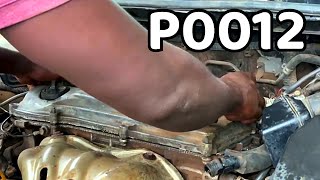
- Check Engine Oil: This is the most critical first step. Turn off the engine, wait a few minutes, and check the oil dipstick. Verify the level is correct and the oil is clean. If low, top it off. If dirty or overdue for a change, replace the oil and filter with the correct viscosity oil 🎬 See these two simple DIY methods to fix P0012 (e.g., 0W-20 synthetic).
- Clear the code and drive the vehicle for 20-30 miles to see if the code returns. If it does not, the issue was likely the oil.
- Inspect the Oil Control Valve (OCV): If the code returns, locate the intake OCV on Bank 1 (passenger side). Disconnect the electrical connector and carefully inspect for engine oil inside the connector pins or the harness side. Oil presence indicates a leaking OCV that must be replaced, per TSB 02-170-17R.
- Test the OCV: If no oil is visible, you can test the OCV. Use a multimeter to check the resistance between its two pins. A reading between 6.9 and 7.9 ohms is specified in some service literature, though a general range of 6-12 ohms is considered acceptable. You can also briefly apply a 12V source to the pins to listen for a distinct 'click', indicating the solenoid is actuating.
- Inspect Wiring: Check the wiring leading to the OCV for any signs of damage, fraying, or corrosion. If oil wicking is suspected, trace the harness back toward the main bulkhead connector to check for contamination.
- Consider Advanced Causes: If the oil is clean and the OCV tests good, the problem may be more complex. Inspect the banjo bolt filters for clogs. If rattling noises are present, investigate timing chain stretch. At this point, professional diagnosis with advanced tools may be required.
Parts You'll Likely Need
- Engine Oil and Filter — This is the most common cause. The AVCS system requires clean oil at the proper level and viscosity to function correctly.
Trusted brands: Subaru Genuine, Idemitsu, Mobil 1, Pennzoil
OEM price range: $50-$90
Aftermarket price range: $40-$70 - Intake Oil Control Valve (OCV) / VVT Solenoid
(OEM #10921AA231)— This is the second most common failure point. It can get stuck, fail electrically, or leak oil into the wiring harness. This part number supersedes older versions like 10921AA230 and 10921AA220.
Trusted brands: Subaru (OEM), Denso, Dorman
OEM price range: $90-$140
Aftermarket price range: $50-$100
Related Codes That Often Appear With This One
- P0011 — P0011 is for 'Timing Over-Advanced' on the same camshaft. Seeing both may indicate an erratic OCV or severe oil flow problem.
- P0022 — This is the same 'Over-Retarded' code but for Bank 2 (driver's side). If both codes appear, it strongly suggests a systemic issue like low or dirty engine oil affecting the entire engine.
- P000A — This code for 'Slow Response' on the same camshaft can be triggered by the same root causes, such as sludgy oil or a failing OCV.
Technical Service Bulletins (TSBs) & Recalls
- 02-170-17R: Describes a condition where oil leaks from the AVCS Oil Control Valve into the electrical connector and wicks through the wiring harness, affecting various FA/FB engine models including the 2013-2019 Outback. The fix is to replace the faulty OCV.
- 02-157-14R: An older bulletin related to excessive oil consumption on certain models, which could indirectly lead to P0012 if oil levels are not maintained.
- Bulletin #09-128-24R: While issued for the BRZ, this manufacturer bulletin notes that P0012 can be associated with "A" Camshaft Position - Timing Over-Advanced or System Performance Bank 2, often appearing alongside communication codes like U0100.
- Bulletin #09-128-24: A manufacturer service bulletin that links P0012 to electrical system performance issues and camshaft timing performance on Bank 2.
Platform-Specific Known Issues
- TSB 02-170-17R addresses a known issue where the OCV leaks oil internally through its electrical connector. This oil can then 'wick' through the wiring, contaminating the engine harness and potentially reaching the main bulkhead harness connector or the ECM, leading to more complex electrical issues if not caught early.
- Some FB/FA engines were subject to a warranty extension for excessive oil consumption (TSB 02-157-14R). While not directly causing P0012, a high rate of oil consumption can lead to low oil levels, which is a primary trigger for this code.
Mechanic-Grade Diagnostic Values
- Oil Control Valve (OCV) Solenoid Resistance — expected: 6.9 - 7.9 Ohms (specified); 5 - 15 Ohms (generally acceptable).. Failure: A reading of 0 ohms (short circuit), infinite/OL (open circuit), or a value significantly outside the expected range indicates a faulty solenoid.
- Live Data: AVCS Intake Angle vs. Target Angle (Bank 1) — expected: Using a scan tool, the 'AVCS Intake Right' (actual) value should closely track the 'AVCS Intake Target' (commanded) value as engine RPM changes.. Failure: If the 'AVCS Intake Right' value consistently lags behind the target value or does not change when commanded, it confirms a performance issue in the system.
- Live Data: Mechanical Timing Check (per TSB 02-163-16R) — expected: With the OCVs electrically disconnected, monitor the camshaft position sensor value at idle. The value should float close to 0°.. Failure: A value of approximately +10° or -10° indicates the timing chain has likely skipped one tooth on the 36-tooth cam sprocket, pointing to a mechanical timing issue rather than a hydraulic one.
Scan Tool Commands That Help
- Subaru Select Monitor (SSM) or equivalent professional scanner: Actuator Test / Bidirectional Control — This function allows a technician to directly command the OCV solenoid to activate. It is used to verify if the solenoid is mechanically responding (audible click) and to observe the corresponding change in camshaft angle on live data, isolating a faulty solenoid from a wiring or oil pressure issue.
- Subaru Select Monitor (SSM) or equivalent professional scanner: Current Data Display / Live Data Monitoring — Used to monitor specific PIDs like 'AVCS In Right' and 'AVCS In Target Final L' to compare the actual camshaft angle against the ECM's target. This is the primary method for confirming the 'Over-Retarded' condition in real-time.
Wiring & Ground Locations
- Engine Harness Ground — On top of the intake manifold, often secured by one or two 12mm bolts. These ground the main engine wiring loom.. A poor ground connection at this point can cause erratic signals for all engine sensors and actuators, including the OCVs and camshaft position sensors, potentially leading to incorrect fault codes.
- OCV Harness Solder Joint — Within the engine harness, located on top of the coolant crossover pipe where the ground wires for the OCVs are joined together.. This is a critical point mentioned in TSB 02-170-17R. If an OCV leaks oil into the harness, the oil can wick to this joint and cause an external oil leak or corrosion, disrupting the ground for the AVCS solenoids.
- Engine-to-Bulkhead Harness Connector — The main electrical connector that joins the engine wiring harness to the main body (bulkhead) harness.. If the OCV oil wicking issue is severe, oil can travel the entire length of the harness and contaminate this connector, causing multiple, difficult-to-diagnose electrical faults beyond just the P0012 code.
Real Owner Repair Stories
- Reddit user in r/MechanicAdvice (2013 Mazda 6 (demonstrates principle)) — Check Engine Light with code P0012 immediately after service.
❌ Tried (didn't work) A new aftermarket VVT solenoid (OCV) was installed.
✅ What actually fixed it The user had installed 5W-20 oil instead of the manufacturer-required 0W-20. The code was triggered by the incorrect oil viscosity, highlighting the system's sensitivity. The implied fix is to use the correct oil grade. - Reddit user in r/MechanicAdvice (Friend's car, model not specified) — Check Engine Light with code P0012.
❌ Tried (didn't work) Initial diagnosis was uncertain.
✅ What actually fixed it The engine oil level was found to be extremely low. Topping off the engine oil and clearing the code resolved the issue, with the code not returning after a week of driving. This is a direct confirmation of low oil as a primary cause. - LegacyGT.com forum user (2005 Subaru Legacy GT (EJ engine, but same banjo filter principle)) — Car bucked/stumbled, threw codes P0011 and P0021.
❌ Tried (didn't work) Replacing OCVs did not resolve the issue.
✅ What actually fixed it The user found the banjo bolt filter for the turbo/AVCS oil feed line was severely clogged. Removing the clogged filter restored proper oil flow and resolved the codes.
"I Checked Everything" — The Actual Cause
- For code P0012, the equivalent of a 'smoke test clean' scenario is when a mechanic confirms the engine oil is clean and full, and the OCV solenoid tests good both electrically (resistance check) and mechanically (clicks with 12V). When the code still persists, the root cause is often a clogged oil passage upstream of the OCV. The most common culprit is the tiny, thimble-shaped filter screen located inside the AVCS oil feed line banjo bolt. This filter can get clogged with sludge or debris, starving the entire Bank 1 AVCS system of oil pressure, even when the OCV is functioning perfectly. Many experienced Subaru technicians recommend removing these filters as a preventative measure.
OEM Part Supersession History
10921AA220, 10921AA230→10921AA231 (and 10921AA23A)— The updated part features a redesigned internal oil seal to prevent the common failure where engine oil leaks past the seal, through the electrical connector, and wicks into the engine wiring harness (as detailed in TSB 02-170-17R).
Model Year Variations Within This Range
- 2020-2026 (6th Gen): Models from 2020 onward may be equipped with the FA24 2.4L turbo engine. While the AVCS system operates on the same principles as the FB25, some specific components, sensor locations, and diagnostic procedures may vary slightly. The FA24, for instance, does not share the same thermo control valve design that was a point of failure on some FB25 engines.
- All (FA/FB Engines): The location and accessibility of the AVCS banjo bolt filters can vary. On some earlier engines (like the EJ series), Subaru issued TSBs recommending their removal. While these filters are known to exist on FA/FB engines, their exact location (e.g., behind the timing cover vs. externally accessible) can differ, impacting the difficulty of inspection or removal.
Diagnostic Flowchart
Real Owner Stories
Aggregated from forums and TSBs cited above. Mileages and costs reflect what owners reported in those sources.
2013-2019 Subaru Outback (FA/FB engine) — ~97500 miles
Symptoms: Oil leaking from the AVCS Oil Control Valve directly into the electrical connector and wicking through the engine wiring harness.
What fixed it: Replaced the faulty Oil Control Valve (OCV) to stop the internal leak before it could contaminate the main bulkhead harness connector.
Source hint: Reddit r/subaru - TSB Thursday: 02-170-17R: Oil Leaking from AVCS Oil Control Valve
Related OBD-II Codes
Frequently Asked Questions
Does TSB 02-170-17R apply to my Subaru Outback?
Can the excessive oil consumption issue on my FB engine cause a P0012 code?
What type of oil should I use to prevent AVCS clogging and P0012 in my Outback?
How do I test the Bank 1 intake Oil Control Valve (OCV) on my FA/FB engine?
What happens if I find oil inside the OCV wiring harness connector?
Helpful Videos
![How to Fix P0012 Engine Code in 4 Minutes [2 DIY Methods / Only $6.86]](https://img.youtube.com/vi/Pu-PR3uhV5Q/mqdefault.jpg)
We Have This Part in Stock



The information in this article is provided for general reference and educational purposes only. Vehicle specifications, procedures, and part compatibility can vary by production date, trim level, and region. Always consult your vehicle's factory service manual and verify part numbers before purchasing or performing repairs. Safety-critical components such as airbags, seat belts, and braking systems should be installed by a qualified professional.
- Subaru Outback:
- 🎬 Helpful Videos
- 🛍️ Shop This Part
- What's Unique About the 2012-2026 Subaru Outback
- Symptoms You May Notice
- Most Likely Causes
- Rare But Worth Checking
- Diagnosis Steps
- Parts You'll Likely Need
- Related Codes That Often Appear With This One
- Technical Service Bulletins (TSBs) & Recalls
- Platform-Specific Known Issues
- Mechanic-Grade Diagnostic Values
- Scan Tool Commands That Help
- Wiring & Ground Locations
- Real Owner Repair Stories
- "I Checked Everything" — The Actual Cause
- OEM Part Supersession History
- Model Year Variations Within This Range
- Diagnostic Flowchart
- Real Owner Stories
- 2013-2019 Subaru Outback (FA/FB engine) — ~97500 miles
- Related OBD-II Codes
- Frequently Asked Questions
- 🎟️ Get 5% Off