

OBD-II Code P0022: Intake Camshaft Position Timing - Over-Retarded (Bank 2)
The Ultimate 2026 Guide: What P0022 means, why it triggers, and how to fix it for good
- Check your engine oil first; low, dirty, or incorrect viscosity oil causes over 50% of P0022 codes.
- Do not drive more than 100 miles with an active P0022, as the retarded timing overheats and destroys the catalytic converter, adding $1,500+ to your repair bill.
- Replace the Bank 2 VVT solenoid ($120-$350 total cost) if an oil change fails to clear the code, as clogged solenoid screens are the second most common failure point.
- Avoid replacing the camshaft position sensor immediately; P0022 is a mechanical timing performance code, not an electrical sensor failure.
What Does P0022 Mean?

The Engine Control Module (ECM) detects the intake camshaft on Bank 2 is lagging behind its commanded position. The engine's valves open late, crippling performance, fuel economy, and emissions.
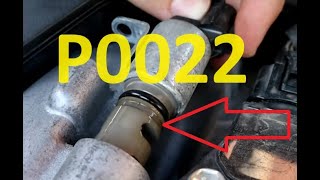
Technical definition: SAE/OBD-II defines P0022 as "'A' Camshaft Position - Timing Over-Retarded (Bank 2)". The ECM triggers this fault when the Bank 2 intake camshaft timing lags the commanded position 🎬 Watch: A breakdown of P0022 causes and common fixes. by more than 10 degrees for over 5 seconds.
Can I Drive With P0022?
Yes, But With Caution. You can drive short distances, but we highly discourage it. Ignoring P0022 causes poor fuel economy, rough idle, and stalling. Driving over 100 miles with this code overheats and destroys the catalytic converter, adding $1,500 to $3,000 to your repair bill. If a failing timing chain causes the code, continued driving risks catastrophic, non-repairable engine damage. Pull over immediately if the check engine light flashes.
Common Causes

- Low, Dirty, or Incorrect Engine Oil (Very Common) — The hydraulic VVT system relies on precise oil pressure. Low fluid, heavy sludge, incorrect viscosity, or restrictive aftermarket oil filters fail to generate the pressure needed to advance the camshaft.
- Faulty or Clogged VVT Solenoid (Very Common) — This solenoid directs oil to the cam phaser. Sludge clogs its microscopic screens, seizing the internal valve and blocking oil flow.
- Failing Camshaft Phaser (Common) — Internal seals blow out or the locking pin seizes inside this camshaft-mounted gear, preventing mechanical rotation.
- Worn Timing Chain or Guides (Common) — Stretched chains or shattered plastic guides create slack. This slack permanently alters the base mechanical timing between the crankshaft and camshaft.
- Clogged Oil Passages (Less Common) — Severe sludge completely blocks the engine block's oil galleries feeding the VVT system, starving the phaser of pressure even with a full oil pan.
- Faulty Camshaft Position Sensor (Rare) — The sensor fails and sends erratic data. This usually triggers dedicated circuit codes (P0345) rather than performance codes like P0022, but remains a rare possibility.
Symptoms

- Check Engine Light is On — The ECM illuminates the MIL immediately after detecting the persistent timing fault.
- Rough Idle and Stalling — The engine shakes, runs unevenly, or shuts off at stops due to inefficient combustion.
- Reduced Engine Power and Hesitation — The vehicle feels sluggish and hesitates during acceleration because the engine cannot draw in the optimal air-fuel mixture.
- Poor Fuel Economy — Inefficient valve timing forces the engine to consume significantly more fuel to maintain speed.
- Rattling or Ticking Noise — A distinct rattle on cold startup or at idle points directly to a failing cam phaser or loose timing chain.
- Failed Emissions Test (also visible on scanner) — Incorrect valve timing spikes harmful emissions, causing an automatic smog inspection failure.
Diagnostic Flowchart

Tap your situation to follow the diagnostic path that matches what you're seeing on this code.
Common Fixes & Costs
- Engine Oil and Filter Change — Parts: $40-$80, Labor: $30-$50, ~0.5 hr book time (DIY)
- Replace VVT Solenoid
— Parts: $40-$150, Labor: $80-$200, ~1.0 hr book time
(DIY)
Ford F-150 (5.4L 3V): OEM 8L3Z-6M280-B (Alt: Dorman 917-200)
Chevrolet Traverse (3.6L V6): OEM 12636175 (Alt: NTK VV0013)
Hyundai Santa Fe (3.3L V6): OEM 24355-3C100 (Alt: Dorman 918-008) - Repair Wiring or Connectors — Parts: $10-$50, Labor: $100-$250, ~1.5 hr book time (Intermediate)
- Replace Camshaft Position Sensor — Parts: $50-$150, Labor: $80-$150, ~0.8 hr book time (DIY)
- Replace Cam Phaser and Timing Chain Components
— Parts: $400-$1200, Labor: $1500-$4000, ~14.0 hr book time
(Professional)
Ford F-150 (5.4L 3V): OEM 3R2Z-6A257-DA (Phaser) (Alt: Cloyes 9-0391SBVVT (Kit))
Chevrolet Traverse (3.6L V6): OEM 12700436 (Kit) (Alt: Cloyes 9-0753SVVT (Kit))
DIY vs Professional
- Engine Oil and Filter Change — Beginner:
Tools: Wrench, oil filter wrench, drain pan, funnel. - Replace VVT Solenoid — Beginner:
Tools: Socket set, torque wrench, rags. - Repair Wiring or Connectors — Beginner:
Tools: Wire strippers, soldering iron, heat shrink, multimeter. - Replace Camshaft Position Sensor — Beginner:
Tools: Basic socket set. - Replace Cam Phaser and Timing Chain — Beginner:
Tools: Engine-specific timing tools, torque-to-yield sockets, pullers.
Used vs. New Parts: Buying Guide
When a used part is worth it: Buy a used OEM VVT solenoid from a low-mileage donor if you cannot afford a new OEM part. Never buy used timing chains, guides, or phasers due to the massive labor cost required to install them.
Donor-vehicle mileage cap: roughly under 80000 miles for the part to have meaningful remaining life.
Donor quality checklist:
- Verify the donor vehicle was not scrapped for engine failure or sludge.
- Match the OEM part number exactly.
- Ensure the solenoid screens are intact and free of varnish.
Decision logic:
- If The part is a VVT solenoid and the budget is tight. → A used OEM solenoid from a reputable recycler beats a cheap, no-name aftermarket part.
- If The part is a cam phaser, timing chain, or tensioner. → Always buy new OEM or premium aftermarket (Cloyes, Melling). The labor cost is too high to risk premature failure.
Warranty tradeoff: Salvage yards offer 30-90 day warranties. New OEM parts carry 1-2 year warranties. New aftermarket parts offer 1-year to limited lifetime warranties.
Worst-case if a used part fails: $1500-$4000 if a used timing component fails, requiring you to pay for the 14-hour labor job twice.
What Happens If You Wait — Timeline
- 0-1 month: Code P0022 sets. Driver notices a slightly rough warm idle or minor hesitation from a stop. (MPG impact: 3-8%% · Added cost: $0-$50 in wasted fuel)
- 1-4 months: Rough idle becomes frequent. The engine stalls at stoplights and loses noticeable power during acceleration. (MPG impact: 10-15%% · Added cost: $50-$200 in wasted fuel)
- 4-8 months: Constant retarded timing overheats the Bank 2 catalytic converter, melting the internal substrate. (MPG impact: 15-25%% · Added cost: $1,200-$2,800 for a new catalytic converter.)
- 8+ months: A stretched timing chain jumps a tooth or breaks. Pistons collide with valves, destroying the engine. (MPG impact: 100% (vehicle is inoperable)% · Added cost: $4,000-$10,000 for engine replacement.)
Cost of Not Fixing It
- 0-1 month: Fuel economy drops 10-15%. The engine idles roughly and risks stalling in traffic. (Added cost: $50-$150 in wasted fuel.)
- 1-6 months: Inefficient combustion overheats the catalytic converter, melting the internal substrate. (Added cost: $1,200-$2,800 for catalytic converter replacement.)
- 6+ months: A stretched timing chain jumps a tooth or breaks, causing pistons to smash into the valves. The engine is destroyed. (Added cost: $4,000-$10,000 for engine replacement.)
Diagnosis Steps

- Check Engine Oil Level and Condition
Pull the dipstick. Dark, thick, or low oil directly causes this code. Ensure the engine contains the exact viscosity specified in the owner's manual.
Tools: Rag or paper towel (Beginner) - Scan for Accompanying Codes
Confirm P0022 is the only code. Misfires (P0300-P0308), crankshaft correlation (P0018), or sensor circuits (P0345) dictate entirely different diagnostic paths.
Tools: OBD-II Scanner (Beginner) - Inspect VVT Solenoid Wiring
Locate the Bank 2 VVT solenoid. Inspect the electrical connector for frayed wires, oil intrusion, or loose pins. Damaged wiring perfectly mimics a failed solenoid.
Tools: Flashlight (Beginner) - Test the VVT Solenoid
Remove the solenoid and apply 12V power and ground to its terminals. You must hear a sharp 'click'. No click means the solenoid is seized. Inspect the screens for sludge.
Tools: Socket set, fused jumper wires, safety glasses (Intermediate) - Test Solenoid Circuit Power
With the solenoid disconnected and the ignition ON (engine off), probe the wiring harness. One pin must show battery voltage (approx. 12.6V). Zero voltage indicates a blown fuse or broken wire.
Tools: Multimeter (Intermediate) - Scan Tool Data & Bi-Directional Testing
Monitor 'Desired vs. Actual' camshaft position on a live data scanner. A consistent negative value confirms the retard. Use bi-directional controls to command the solenoid ON at idle; if the engine stumbles, the solenoid and phaser work. If nothing happens, the system is blocked or broken.
Tools: Bi-directional OBD-II Scanner (Advanced) - Test Engine Oil Pressure
Connect a mechanical gauge to the oil pressure port. Hot idle pressure below 15-20 PSI (varies by engine) confirms a failing oil pump or worn bearings, which starves the VVT system.
Tools: Mechanical Oil Pressure Gauge, Socket Set (Advanced) - Cam/Crank Correlation Scope Test
Graph the Bank 2 camshaft and crankshaft sensor signals simultaneously. Comparing this waveform to a known-good pattern instantly proves if the timing chain has jumped or stretched.
Tools: Automotive Oscilloscope, back-probes (Professional) - Inspect Mechanical Timing Components
Remove the valve covers and timing cover. Inspect the cam phaser for internal failure and check the timing chain and plastic guides for slack or breakage.
Tools: Extensive socket set, engine-specific timing tools, torque wrench (Professional)
When This Code Triggers (Freeze-Frame Conditions)
- Engine Coolant Temp: 180-210°F (82-99°C) (The engine has reached full operating temperature.)
- RPM: 1500-3000 RPM (The fault sets during steady-state cruise or light acceleration, rarely at idle.)
- Engine Load: 20-50% (Occurs under moderate load when the VVT system actively adjusts timing for efficiency.)
- Vehicle Speed: 40-65 mph (Triggered during highway or suburban cruising speeds.)
Related Codes
- P0012 — The identical 'over-retarded' code for Bank 1. Seeing both codes simultaneously proves a systemic issue like low oil pressure, severe sludge, or a jumped timing chain, rather than a single bad solenoid.
- P0021 — The opposite code ('Timing Over-Advanced') for Bank 2. Alternating between P0021 and P0022 indicates a VVT solenoid sticking erratically or a shattered cam phaser moving uncontrollably.
- P0018 — A 'Crank/Cam Correlation' error for Bank 2. P0022 with P0018 confirms a base mechanical timing failure, such as a stretched timing chain, rather than a simple hydraulic solenoid issue.
- P0345 / P0349 — Camshaft Position Sensor Circuit codes. Diagnose these first. The ECM cannot accurately measure timing if the sensor wiring is broken or shorted.
Climate & Environmental Factors
- Cold Climates / Short Trips: Frequent short trips in cold weather prevent oil from reaching operating temperature. Condensation mixes with the oil, rapidly forming sludge that clogs the VVT system.
- Hot Climates / Severe Duty: Towing or stop-and-go traffic in extreme heat accelerates oil oxidation. The oil breaks down, thickens, and forms varnish deposits that seize VVT solenoids.
How to Talk to a Mechanic About This Code
Say this: "I have a P0022 code. I've verified the oil level and condition are good. Please test the Bank 2 VVT solenoid and its wiring. If the solenoid passes, I need a quote for a mechanical oil pressure test before authorizing any engine teardown."
This proves you are informed. It directs the mechanic to the most likely culprits (solenoid, oil pressure) and prevents them from blindly replacing the camshaft sensor.
Avoid saying:
- 'My check engine light is on, can you look at it?'
- 'My car is running rough, just fix it.'
- 'I think it's the cam sensor, can you replace it?'
Questions to ask before authorizing the repair:
- Did you test the VVT solenoid electrically and inspect it for physical sludge?
- If you recommend a timing chain replacement, what specific evidence of wear did you find?
- Can you provide a printout of the live data showing the cam timing error?
- What is your warranty on parts and labor for this specific repair?
Where to Take It: Dealer vs Independent vs Chain
- Dealer:
Best for: Vehicles under powertrain warranty or covered by a specific TSB., Complex, vehicle-specific P0022 causes on German brands (BMW, Audi)., When an independent shop fails to diagnose the issue.
Downsides: Highest labor rates, often 1.5-2x an independent shop., Routinely recommends a complete $4,000 timing job when only a $150 solenoid failed. (Typical cost: +50% vs. baseline) - Independent Shop:
Best fit for most scenarios. A reputable independent shop offers the best balance of expertise and value for diagnosing P0022.
Best for: Out-of-warranty vehicles where cost is a major factor., Diagnosing common causes (oil pressure, VVT solenoid)., Performing complex but well-documented repairs like a Ford 5.4L timing job.
Downsides: Expertise varies. Look for ASE certifications and positive engine-repair reviews., May lack OEM diagnostic software for 2024+ models. (Typical cost: +0% vs. baseline) - Chain Shop:
Acceptable ONLY for an oil change. AVOID for any further diagnosis due to the high risk of misdiagnosis.
Best for: A basic oil and filter change.
Downsides: Technicians lack experience with advanced VVT diagnostics., High pressure to upsell unnecessary flushes and sensors., Not equipped for complex mechanical jobs like cam phaser replacement. (Typical cost: -10% vs. baseline)
When to Walk Away From the Repair
If the estimated repair cost for a full timing job exceeds 50% of the car's private-party value, walk away.
- Car worth $5000, fix is $3000: Walk away. A $3,000 repair on a $5,000 car is a poor investment (60% of value).
- Car worth $15000, fix is $3500: Fix it. The repair is 23% of the car's value. The vehicle has significant life left.
- Car worth $3000, fix is $300: Fix it. If the diagnosis points to a VVT solenoid, it is always worth doing.
What Scan Tool You Need for This Code
Minimum: A scanner that displays live data PIDs for 'Desired' vs. 'Actual' camshaft position.
A $20 code reader only confirms P0022 exists. It cannot show the live timing error causing the code, forcing you to guess at parts.
Budget: BlueDriver Pro (~$119) — Connects to your smartphone to display essential live data, including camshaft position, allowing you to see the timing deviation.
Mid-range: Autel MaxiCOM MK808S (~$150-350) — Offers bi-directional control. You can command the VVT solenoid to open while the engine runs. If the engine stumbles, the solenoid works.
Professional: Autel MaxiSYS Series (~$500-1200+) — Provides OEM-level diagnostics and pairs with an oscilloscope to visually compare crank/cam waveforms, definitively identifying stretched timing chains.
Rent vs buy: Auto parts stores loan basic scanners for free, but these lack live data. If you plan to diagnose P0022 yourself, buying a BlueDriver is mandatory.
How to Clear the Code After You Fix It
- Use an OBD-II scan tool to clear the diagnostic trouble codes.
- Ensure the fuel tank is between 30% and 70% full.
- Perform a complete drive cycle to allow the vehicle's readiness monitors to run.
Drive cycle (~30 minutes): 1) Cold start (engine off for 8+ hours). 2) Idle for 3 minutes. 3) Drive in city traffic for 15 minutes with smooth acceleration. 4) Drive at a steady 55-60 mph for 10 minutes. 5) Allow the vehicle to cool down.
Readiness monitors affected: Catalyst Monitor, Evaporative System Monitor, Oxygen Sensor Monitor
Before emissions retest: drive at least 100 miles to fully set monitors.
Watch out for:
- Disconnecting the battery clears the code but resets all readiness monitors to 'Not Ready', guaranteeing an emissions failure.
- The code returns immediately if the underlying oil pressure or mechanical issue remains unfixed.
Will This Fail Emissions / State Inspection?
Yes — this code typically fails an OBD-II emissions inspection.
- California: An active Check Engine Light is an automatic Smog Check failure. You must complete a full drive cycle to set all monitors to 'Ready' before re-testing.
- New York: The NYVIP3 inspection fails any vehicle with an illuminated MIL for a code like P0022.
- Texas: In emissions-testing counties, an active P0022 fails the OBD portion of the state inspection.
Most Commonly Affected Vehicles
- Ford F-150, Explorer, Mustang (2004-2021) — Extremely common on 5.4L 3V, 5.0L Coyote, and 3.5L EcoBoost engines due to failing cam phasers and VCT solenoids.
- Chevrolet / GMC Traverse, Equinox, Acadia (2008-2019) — Frequently plagues the 3.6L V6 (LLT/LFX) engine due to stretched timing chains. GM issued special warranty coverages for early models.
- Hyundai / Kia Santa Fe, Sorento, Genesis (2007-2017) — Common on 3.3L and 3.8L Lambda V6 engines. Faulty Oil Control Valves (OCV) or sludge buildup are the primary culprits.
- Nissan / Infiniti Altima, Maxima, Pathfinder (2002-2015) — Affects the VQ35DE 3.5L V6 engine. Clogged VVT solenoids from oil contamination are the standard failure point.
- Toyota / Lexus Highlander, Sienna, Camry (2005-2016) — Seen in the 2GR-FE 3.5L V6. Early models suffered from rupturing rubber VVT-i oil lines that caused catastrophic oil loss.
- Subaru Outback, Forester, Legacy (2005-2022) — Affects EJ and FA/FB engines. Failed AVCS oil control solenoids or restrictive aftermarket oil filters trigger the code.
- BMW 5 Series, 7 Series, X5 (2004-2016) — Common on N62/N63 V8 engines. Sludge clogs the VANOS solenoids, or leaking valve covers contaminate the electrical connectors.
- Dodge / Chrysler / Jeep Grand Caravan, Charger, Wrangler (2011-2021) — Affects the 3.6L Pentastar V6. Failing oil pumps cause low pressure, or cam phasers fail mechanically on early 2011-2013 models.
Manufacturer-Specific Notes
- Ford: Ford TSBs recommend using a bi-directional scan tool to cycle the VCT solenoid 10+ times to clear microscopic debris before replacing the part.
- General Motors: GM issued Special Coverage Adjustment #11340C for premature timing chain wear on 2007-2009 3.6L V6 engines, extending warranties and reprogramming the ECM to demand more frequent oil changes.
- Nissan: When one VVT solenoid fails on the VQ35DE engine, mechanics strongly recommend replacing both Bank 1 and Bank 2 simultaneously to prevent a return visit.
- Subaru: Subaru AVCS systems are highly sensitive to oil filter flow rates. Non-OEM filters frequently cause pressure drops that trigger P0022.
- Toyota: Toyota utilizes '2-trip logic' for P0022. The ECM must detect the fault in two consecutive driving cycles before illuminating the check engine light.
- Hyundai / Kia: Dealers routinely deny engine warranty claims for P0022 if they discover oil sludge under the valve cover, citing owner maintenance neglect.
Real Owner Stories
2004 Ford F-150 5.4L with 107k miles - The Wrong Oil
Truck sputtered at idle immediately after a dealership oil change, throwing code P0022.
What they tried:
- Replaced both camshaft position sensors, which smoothed the idle slightly but the code returned.
Outcome: The owner discovered the dealership used 5W-40 oil instead of the required 5W-20. Changing back to 5W-20 resolved the issue permanently.
Lesson: Always verify the correct oil viscosity. Thicker oil slows the hydraulic VVT actuators, triggering timing codes even if the oil is brand new.
2005 Ford Mustang GT 4.6L with 135k miles - The Money Pit
Engine shuddered at warm idle, throwing P0022. Revving the engine temporarily cleared the shudder.
What they tried:
- Replaced the VVT solenoid and camshaft position sensor.
- Replaced the cam phaser, lifters, and rollers.
- Verified base oil pressure with a mechanical gauge (40 PSI at warm idle).
Outcome: Despite replacing every VVT component on Bank 2, the problem persisted. The root cause was a clogged oil gallery deep in the cylinder head.
Lesson: Throwing parts at P0022 is expensive. If a new solenoid and phaser fail to fix it, suspect clogged oil passages or wiring faults before replacing more hardware.
2005 Ford Expedition 5.4L with 130k miles - The Walk Away
Persistent P0022 code returned despite multiple attempted fixes. The truck ran decently but suffered poor fuel economy.
What they tried:
- Replaced the camshaft position sensor and both VCT solenoids.
- Performed a fresh oil change with 5W-20 synthetic.
Outcome: The mechanic advised that further diagnosis required a major teardown to check the oil pump and timing chains. The owner drove the vehicle 'as-is' for 9 months before selling it.
Lesson: On high-mileage engines, persistent P0022 indicates deep mechanical wear. A $3,000+ timing job is rarely a wise investment on a vehicle worth less than $5,000.
How to Prevent This Code From Triggering
- Perform regular oil changes with full synthetic oil (Every 5,000 miles or 6 months) — Full synthetic oil resists thermal breakdown. Clean oil prevents the sludge that seizes VVT solenoids and blocks oil passages.
- Use only the manufacturer-specified oil viscosity (Every oil change) — VVT systems require specific viscosity (e.g., 5W-20) to actuate hydraulically. Thicker oil slows response times, triggering timing codes.
- Use high-quality OEM or equivalent oil filters (Every oil change) — Premium filters feature robust anti-drain-back valves that keep oil in the VVT system when the engine is off, ensuring immediate pressure on startup.
- Avoid excessive short trips (Daily habit) — Short drives prevent oil from burning off moisture. Drive on the highway for 20 minutes weekly to reach full operating temperature and prevent sludge.
Frequently Asked Questions
What does 'Bank 2' mean?
Bank 2 is the side of the engine that does not contain the #1 cylinder. On V-shaped engines, this is typically the driver's side for Ford and GM, but the passenger side for Nissan and Toyota. Always verify the convention for your specific vehicle.
Will an oil change really fix a P0022 code?
Yes, if the code stems from low or dirty oil. The variable valve timing system requires clean oil at the correct pressure to function. Starting with an oil and filter change is the smartest, most cost-effective first step.
What is the most common misdiagnosis for P0022?
Mechanics frequently misdiagnose P0022 as a failed Camshaft Position Sensor. This code indicates a mechanical timing performance issue, not an electrical sensor failure. Always diagnose the oil, VVT solenoid, and wiring before replacing the sensor.
Can I pass an emissions test with code P0022?
No. An active P0022 code triggers the check engine light, resulting in an automatic emissions test failure. The incorrect valve timing also drastically increases harmful exhaust emissions.
My mechanic replaced the VVT solenoid, but the code came back. What's next?
The problem lies deeper in the hydraulic or mechanical system. Next steps include a mechanical oil pressure test to check for a worn oil pump, or a cam/crank scope test to identify a stretched timing chain. Clogged oil passages leading to the phaser are also a primary suspect.
What's the difference between P0022 and P0021?
P0022 (over-retarded) means the camshaft lags behind the ECM's commanded position, usually due to low oil pressure or a stuck solenoid. P0021 (over-advanced) means the camshaft is further ahead than commanded. Advanced timing typically results from a solenoid stuck open, flooding the phaser with too much oil pressure.
Can a weak battery cause a P0022 code?
No. P0022 is a mechanical performance code driven by oil pressure and timing components. While a weak battery causes electrical gremlins, it does not alter the hydraulic operation of the VVT system.
Key Takeaways
- Check your engine oil first; low, dirty, or incorrect viscosity oil causes over 50% of P0022 codes.
- Do not drive more than 100 miles with an active P0022, as the retarded timing overheats and destroys the catalytic converter, adding $1,500+ to your repair bill.
- Replace the Bank 2 VVT solenoid ($120-$350 total cost) if an oil change fails to clear the code, as clogged solenoid screens are the second most common failure point.
- Avoid replacing the camshaft position sensor immediately; P0022 is a mechanical timing performance code, not an electrical sensor failure.
Helpful Videos
![How to Fix P0022 Engine Code in 4 Minutes [2 DIY Methods / Only $6.53]](https://img.youtube.com/vi/BO7HzbeFxqo/mqdefault.jpg)

The information in this article is provided for general reference and educational purposes only. Vehicle specifications, procedures, and part compatibility can vary by production date, trim level, and region. Always consult your vehicle's factory service manual and verify part numbers before purchasing or performing repairs. Safety-critical components such as airbags, seat belts, and braking systems should be installed by a qualified professional.
- 🎬 Helpful Videos
- What Does P0022 Mean?
- Can I Drive With P0022?
- Common Causes
- Symptoms
- Diagnostic Flowchart
- Common Fixes & Costs
- DIY vs Professional
- Used vs. New Parts: Buying Guide
- What Happens If You Wait — Timeline
- Cost of Not Fixing It
- Diagnosis Steps
- When This Code Triggers (Freeze-Frame Conditions)
- Related Codes
- Climate & Environmental Factors
- How to Talk to a Mechanic About This Code
- Where to Take It: Dealer vs Independent vs Chain
- When to Walk Away From the Repair
- What Scan Tool You Need for This Code
- How to Clear the Code After You Fix It
- Will This Fail Emissions / State Inspection?
- Most Commonly Affected Vehicles
- Manufacturer-Specific Notes
- Real Owner Stories
- 2004 Ford F-150 5.4L with 107k miles - The Wrong Oil
- 2005 Ford Mustang GT 4.6L with 135k miles - The Money Pit
- 2005 Ford Expedition 5.4L with 130k miles - The Walk Away
- How to Prevent This Code From Triggering
- Frequently Asked Questions
- What does 'Bank 2' mean?
- Will an oil change really fix a P0022 code?
- What is the most common misdiagnosis for P0022?
- Can I pass an emissions test with code P0022?
- My mechanic replaced the VVT solenoid, but the code came back. What's next?
- What's the difference between P0022 and P0021?
- Can a weak battery cause a P0022 code?
- Key Takeaways
- 🎟️ Get 5% Off