

P0012 on 2003-2024 Honda Civic: Causes for Over-Retarded Camshaft Timing
On a Honda Civic, code P0012 is most often caused by low or dirty engine oil, or a faulty Variable Timing Control (VTC) oil control solenoid. An oil change and/or replacing the VTC solenoid (around $40-$120 for the part) is the most likely fix.
- Before buying any parts, check your engine oil. A simple oil change with the correct viscosity oil is the most common and cheapest fix for P0012.
- The second most likely cause is a faulty VTC oil control solenoid, which is relatively inexpensive and accessible for DIY replacement.
- If you hear a loud rattle from the engine for a couple of seconds on cold starts, the problem is likely the more expensive VTC actuator.
- Ignoring this code can lead to stalling, poor performance, and potentially expensive engine damage over time.
What's Unique About the 2003-2024 Honda Civic
Honda's VTC systems, particularly in the K-series (found in many 2002-2011 Si models) and R-series engines, are very sensitive to oil level and cleanliness. The small oil passages in the VTC solenoid and actuator are easily clogged by sludge or debris from old oil. Sludge or low oil pressure directly impacts the VTC solenoid and actuator's ability to function. While the solenoid is a common failure point across many brands, on these Civics, neglecting oil changes with the correct 0W-20 viscosity is a very frequent trigger for P0012.
Generation note: This code applies to all VTC-equipped Civics from the 7th generation (2001-2005, primarily Si models with the K20 engine) through the 11th generation (2022-present). While the core meaning is the same, the specific location and part numbers for the VTC solenoid and actuator will vary. The 8th generation Civic (2006-2011) with the K20Z3 engine (Si) and R18A engine are particularly noted for VTC-related issues. The K-series engines, in particular, are known for the VTC actuator failing and causing a distinct rattle on cold starts.
Symptoms You May Notice
- Check Engine Light is on
- Rough or unstable idle
- Engine stalling, especially at low speeds
- Reduced engine power and poor acceleration
- Decreased fuel economy
- Hard starting
- Rattling noise from the engine on cold starts (a classic symptom of a failing VTC actuator, especially on K-series engines)
- Replacing the camshaft position sensor when the issue is actually oil-related.
- Replacing the VTC actuator (a more expensive part) when only the VTC solenoid (cheaper and easier) is faulty or clogged.
- Assuming the timing chain is stretched without first thoroughly investigating the VTC solenoid and actuator.
Most Likely Causes
- Low or Dirty Engine Oil 🔴 High Probability The VTC system is hydraulically operated and extremely sensitive to oil pressure and cleanliness. Low levels, incorrect viscosity (e.g., not using 0W-20 where specified), or sludge from delayed oil changes can clog the small passages in the VTC solenoid and actuator, impeding their function.
How to confirm: Check the engine oil dipstick for level and inspect the oil's color and consistency. If it's low, black, or thick, it needs changing.
Typical fix: Perform an oil and filter change using the manufacturer-recommended oil viscosity (typically 0W-20 for modern Civics). This is the first and most important diagnostic step. 🎬 See how to fix the P0012 code with this simple method.
Est. part cost: $20-$60 - Faulty VTC Oil Control Solenoid 🔴 High Probability The solenoid can get clogged with debris from dirty oil or fail electrically over time. It's a very common failure point for this code and is often replaced alongside an oil change.
How to confirm: Remove the solenoid and inspect its screen for sludge or debris. Test its resistance with a multimeter; for many Honda models, the specification is between 6.9 and 7.9 ohms at 68°F (20°C). You can also apply 12V power to see if the internal plunger actuates with a click.
Typical fix: Clean the solenoid and its passages with brake cleaner if dirty. If cleaning doesn't work or if it fails the electrical test, replace the VTC solenoid.
Est. part cost: $40-$120 - Failing VTC Actuator (Cam Phaser) 🟡 Medium Probability The actuator is a mechanical gear on the end of the camshaft that can wear out or get stuck, especially at higher mileage. A cold start rattle is a classic symptom of a failing VTC actuator on K-series engines (K20, K24). Honda has issued TSBs for this issue on other models with related engines.
How to confirm: This is harder to diagnose. It often requires a scan tool to command actuator movement and observe the response. A persistent, loud rattle from the engine for about 2 seconds on cold startup is a very strong indicator of a failing VTC actuator.
Typical fix: Replacement of the VTC actuator. This is a more involved job as it requires removing the valve cover and potentially the timing chain cover.
Est. part cost: $150-$350 - Stretched Timing Chain ⚪ Low Probability Over many miles (typically 150k+), the timing chain can stretch, causing the base mechanical timing to be retarded. The VTC system cannot compensate for this, triggering the code.
How to confirm: Listen for a consistent rattling noise from the timing chain area of the engine. A mechanic can verify by removing the valve cover and checking chain slack against specifications.
Typical fix: Replacement of the timing chain, tensioners, and guides. This is a significant and costly repair.
Est. part cost: $200-$500
Rare But Worth Checking
- Faulty Camshaft Position Sensor: While possible, it's less common for the sensor itself to fail in a way that causes this specific code. Usually, a bad sensor would trigger its own specific code, such as P0340 or P0341.
- Clogged Oil Passages: In cases of severe engine sludge due to extreme maintenance neglect, the small oil passages in the cylinder head leading to the VTC components can become blocked, starving them of the oil pressure needed to operate.
- Incorrect Oil Viscosity: Using oil that is too thick or too thin can affect the VTC system's ability to respond quickly and accurately, potentially triggering timing codes.
Diagnosis Steps
- Check the engine oil level and condition. If low or dirty, perform an oil and filter change with the correct viscosity oil (e.g., 0W-20). Clear the codes and test drive. This resolves the issue a significant amount of the time.
- If the code returns, locate and remove the VTC oil control solenoid. Inspect the mesh screen for any sludge or debris. Clean it with brake cleaner if necessary.
- Test the VTC solenoid's function. Apply 12V from the battery to its terminals and listen for a distinct click. Check its resistance with a multimeter. For many Hondas, the spec is between 6.9 and 7.9 ohms. Replace if it fails either test.
- Inspect the wiring and connector for the VTC solenoid for any damage, corrosion, or oil contamination.
- If the solenoid and oil are good, listen carefully during a cold start (engine off for at least 6 hours) for a brief, loud rattle lasting about 2 seconds. If this noise is present, the VTC actuator (cam phaser) is the most likely culprit.
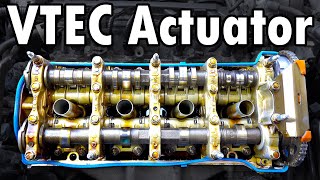
- If the VTC actuator is suspected, replacement is the next step. This is a more advanced 🎬 Watch: A complete DIY guide to replacing the VTC actuator. diagnosis and repair.
- If none of the above solve the issue, the timing chain may be stretched. This typically requires professional diagnosis to measure chain slack.
Parts You'll Likely Need
- VTC Oil Control Solenoid
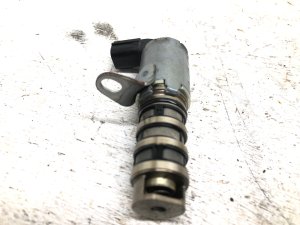
(OEM #15810-R70-A04 (Varies by engine, e.g., R18) or 15810-PRB-A03 (K-series))— This solenoid is the most common failure point. It gets clogged by dirty oil or fails electrically, preventing it from controlling oil flow to the actuator.
Trusted brands: Denso, Hitachi, Standard Motor Products, Honda (OEM)
OEM price range: $90-$180
Aftermarket price range: $40-$120 - VTC Actuator (Cam Phaser)
(OEM #14310-RBC-003)— This is the mechanical gear that actually changes the cam timing. It can wear out and get stuck, often causing a startup rattle. This part number fits many 2.0L K-series engines (e.g., 2006-2011 Civic Si). Another common part for K24 engines is 14310-R44-A01.
Trusted brands: Honda (OEM)
OEM price range: $250-$400
Aftermarket price range: $150-$250
Related Codes That Often Appear With This One
- P0011 — P0011 is for 'Timing Over-Advanced'. It's common to see these codes together or intermittently as a faulty VTC solenoid or actuator may stick in either direction or have an erratic response.
- P0340/P0341 — These codes relate to the Camshaft Position Sensor circuit. If the timing is erratic enough due to a mechanical VTC issue, it can sometimes trigger faults related to the sensor that reads the camshaft's position.
Technical Service Bulletins (TSBs) & Recalls
- TSB 09-010: Addresses 'Engine Rattles at Cold Start-Up' due to a defective VTC actuator on various Honda models with K-series engines, such as the Accord and CR-V. While not explicitly for the Civic, it describes the exact same failure mechanism seen in Civics with these engines.
- TSB 16-012: A similar TSB to 09-010, also for 'Engine Rattles at Cold Start-Up', but for different model years and adding a condition that the rattle may be intermittent and occur below 40°F.
Platform-Specific Known Issues
- On Honda K-series engines (e.g., 2006-2011 Civic Si), a brief, loud rattle on a cold startup is a classic sign of a failing VTC actuator, which will often be accompanied by P0012 or P0011. This issue is so common that multiple TSBs (e.g., 09-010) were issued for other Honda models using the same family of engines.
Mechanic-Grade Diagnostic Values
- VTC Oil Control Solenoid Resistance — expected: 6.9 to 7.9 ohms at 68°F (20°C). Failure: A reading of infinite resistance (OL) indicates an open coil, while a very low reading (under 2 ohms) suggests an internal short. A reading outside the 6.9-7.9 ohm range indicates a faulty solenoid.
- VTEC Solenoid Resistance (related system) — expected: 14 to 30 ohms. Failure: A reading outside this range indicates a problem with the VTEC solenoid, which can sometimes be confused with the VTC solenoid.
- VTC Solenoid Connector Voltage — expected: One pin should have battery voltage with Key On, Engine Off (KOEO).. Failure: No voltage suggests a wiring or ECU issue upstream of the solenoid.
Scan Tool Commands That Help
- Honda Diagnostic System (HDS): VTC Test — This is a bidirectional test that allows a technician to command the VTC system to activate through three stages while monitoring the camshaft sensor input. It is used to functionally test the VTC solenoid and actuator's response without having to remove parts, confirming if the system is mechanically capable of adjusting timing as commanded by the ECU.
- Honda Diagnostic System (HDS): Crank Pattern Clear/Learn — This function should be used after replacing the timing chain, crankshaft sensor, or ECU. While not a direct fix for P0012, failing to perform the CKP pattern learn procedure after major work can cause timing-related codes and running issues because the ECU has not learned the minor variations of the new components.
Wiring & Ground Locations
- Engine/Transmission Grounds — Key grounds include a strap from the transmission case to the chassis, and from the timing chain case to the chassis. On many D/B/K series engines, a primary ground is located on or near the thermostat housing.. A poor engine or transmission ground can cause electrical noise and voltage drops, affecting the accuracy of sensor readings from the camshaft and crankshaft position sensors. The ECU relies on these precise signals to calculate timing, and a bad ground can lead to erroneous timing codes like P0012.
- VTC Solenoid Connector — A 2-pin connector attached directly to the VTC solenoid, typically on the front or side of the cylinder head near the timing chain cover.. This is the direct connection for testing voltage and resistance of the solenoid. One pin receives power, and the other is a pulsed ground controlled by the ECU. The connector itself or its wiring can become damaged or oil-soaked, causing a poor connection that mimics a solenoid failure.
Real Owner Repair Stories
- Honda-Tech forum user (2001 Honda Civic LX, 211,000 miles) — No-start or hard-start condition after a major timing service.
❌ Tried (didn't work) Replaced timing belt, water pump, tensioner, and OEM camshaft sensor., Replaced a faulty Engine Coolant Temperature sensor that coded after the job.
✅ What actually fixed it The user had installed a non-OEM (Duralast) crankshaft position sensor during the timing belt job. The hard starting and running issues were resolved after replacing the new, faulty aftermarket sensor with a Denso (a known OEM supplier) crankshaft position sensor. This highlights the sensitivity of Honda's timing systems to non-OEM sensor quality.
OEM Part Supersession History
14310-PND-003→14310-RBC-003— The original VTC actuator on early K-series engines was prone to failure, causing the well-known cold start rattle. The 14310-RBC-003 is an updated, more robust design.
Heads up: The -RBC-003 part is a direct replacement and upgrade for the older -PND-003 part.
Model Year Variations Within This Range
- 2006-2015 (Primarily 8th & 9th Gen): The primary engine distinction is between the economy-focused R-series (e.g., R18 in non-Si models) and the performance-focused K-series (e.g., K20 in Si models). The R-series is a Single Overhead Cam (SOHC) engine designed for efficiency, while the K-series is a Dual Overhead Cam (DOHC) engine designed for performance. While both use VTC and can get a P0012 code, the K-series is far more known for the specific failure of the VTC actuator causing a startup rattle. Diagnosis on an R18 is more likely to end at the oil or solenoid, whereas on a K20, the actuator is a much more common suspect.
Diagnostic Flowchart
Real Owner Stories
Aggregated from forums and TSBs cited above. Mileages and costs reflect what owners reported in those sources.
2006-2011 Honda Civic Si
Symptoms: Brief, loud rattle on a cold startup accompanied by a P0012 code.
What fixed it: Replaced the VTC actuator.
Source hint: 8thcivic.com - Multiple threads discuss P0012
Honda Civic (K-series engine)
Symptoms: Engine rattles at cold start-up, sometimes intermittently and specifically when temperatures drop below 40°F.
What fixed it: Replaced the defective VTC actuator.
Source hint: TSB 16-012
Honda Civic
Symptoms: Check engine light on with code P0012.
What fixed it: Performed an oil change and cleaned/replaced the VTC solenoid.
Source hint: 8thcivic.com - Multiple threads discuss P0012
Related OBD-II Codes
Frequently Asked Questions
Does TSB 09-010 or TSB 16-012 apply to my Civic?
I have a 2006-2011 Civic Si and hear a loud rattle on cold starts. Is this related to P0012?
What oil viscosity should I use to prevent VTC issues in my modern Civic?
How can I test the VTC oil control solenoid on my Civic?
My Civic has over 150,000 miles and P0012 won't go away after an oil change and new solenoid. What's next?
Helpful Videos
![How to Fix HONDA P0012 Engine Code in 4 Minutes [1 DIY Method / Only $19.45]](https://img.youtube.com/vi/3pm4dNodT-g/mqdefault.jpg)
We Have This Part in Stock

The information in this article is provided for general reference and educational purposes only. Vehicle specifications, procedures, and part compatibility can vary by production date, trim level, and region. Always consult your vehicle's factory service manual and verify part numbers before purchasing or performing repairs. Safety-critical components such as airbags, seat belts, and braking systems should be installed by a qualified professional.
- Honda Civic:
- 🎬 Helpful Videos
- 🛍️ Shop This Part
- What's Unique About the 2003-2024 Honda Civic
- Symptoms You May Notice
- Most Likely Causes
- Rare But Worth Checking
- Diagnosis Steps
- Parts You'll Likely Need
- Related Codes That Often Appear With This One
- Technical Service Bulletins (TSBs) & Recalls
- Platform-Specific Known Issues
- Mechanic-Grade Diagnostic Values
- Scan Tool Commands That Help
- Wiring & Ground Locations
- Real Owner Repair Stories
- OEM Part Supersession History
- Model Year Variations Within This Range
- Diagnostic Flowchart
- Real Owner Stories
- 2006-2011 Honda Civic Si
- Honda Civic (K-series engine)
- Honda Civic
- Related OBD-II Codes
- Frequently Asked Questions
- 🎟️ Get 5% Off