

P0010 on 2003-2012 Honda Accord: VTC Solenoid Causes and Fixes
For a 2003-2012 Honda Accord, code P0010 almost always points to a faulty VTC oil control solenoid or low/dirty engine oil. First, check your oil level and condition. If the oil is fine, the VTC solenoid is the most likely culprit, costing around $40-$100 for an aftermarket part. The code indicates an electrical circuit fault, but it's often triggered by mechanical issues like sludge clogging the solenoid's screen.
- P0010 on a 2003-2012 Accord indicates an electrical problem with the VTC oil control solenoid circuit.
- The most common fix is replacing the VTC oil control solenoid.
- Always check engine oil level and condition first, as dirty oil is a primary cause of the solenoid failing.
- For 4-cylinder models, inspect and clean the secondary VTC strainer behind the power steering pump.
- Ensure the electrical connector is clean and securely fastened, especially after a replacement.
What's Unique About the 2003-2012 Honda Accord

The 2003-2012 Accord spans two generations with different engines (K-series 4-cylinder and J-series V6), but the root cause of P0010 is consistently tied to the VTC system. Honda's VTEC/VTC systems are highly sensitive to oil pressure and cleanliness. While the code is electrical, the underlying cause is often mechanical or maintenance-related, like old, sludgy oil clogging the solenoid's small passages and integrated filter screen, which can impede function or cause the solenoid to burn out. On high-mileage vehicles, oil-related issues are the primary suspect.
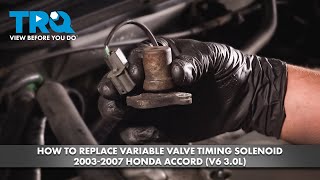
Generation note: This range covers the 7th generation (2003-2007) and 8th generation (2008-2012) Honda Accord. The 7th gen used K24A (4-cyl) and J30A (V6) engines, while the 8th gen used K24Z (4-cyl) and J35Z (V6) engines. While the P0010 code has the same meaning for both, the exact location and part number for the VTC oil control solenoid will differ between these engine families. The K-series engines have the solenoid on the passenger side of the cylinder head, near the timing chain cover.
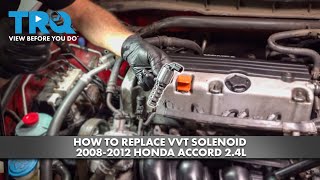
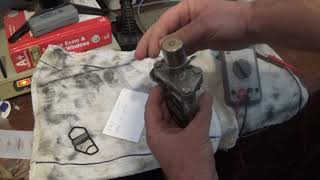
🎬 Watch: How to replace the VVT solenoid on 2.4L engines.Symptoms You May Notice
- Check Engine Light is on
- Rough or unstable idle
- Reduced engine power and sluggish acceleration
- Decreased fuel economy
- Engine may hesitate or stall in some cases
- Rattling noises from the engine bay
- Replacing the camshaft position sensor. The P0010 code is for the actuator circuit, not the position sensor itself. While they work together, the fault lies with the control solenoid or its circuit.
- Replacing timing components without diagnosis. While a stretched timing chain can cause performance issues, P0010 is specifically an electrical circuit code and is unlikely to be caused by mechanical timing wear alone.
Most Likely Causes

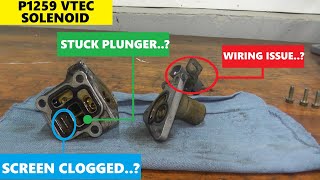
- Faulty VTC Oil Control Solenoid 🔴 High Probability The solenoid contains a small coil that can fail electrically over time. More commonly, its fine mesh screen becomes clogged with oil sludge from infrequent oil changes, causing the internal plunger to stick or the solenoid to burn out.
How to confirm: Disconnect the solenoid's electrical connector and measure the resistance between the two pins using a multimeter. For 8th gen Accords (2008-2012), the reading should be between 6.75 and 8.25 ohms. For other models, a range of 6.9 to 7.9 ohms is also cited. A reading of 14-30 ohms may apply to some VTEC solenoids, but the VTC solenoid is typically lower. An open circuit (OL) or a reading far outside the specification indicates a bad solenoid. You can also apply 12V directly to the solenoid to see if it clicks, confirming mechanical operation. 🎬 See this video for a quick VTEC solenoid test.
Typical fix: Replace the VTC oil control solenoid and its gasket/O-ring. It is highly recommended to perform an oil and filter change at the same time.
Est. part cost: $40-$180 - Low or Dirty Engine Oil 🟡 Medium Probability The VTC system is hydraulically operated by engine oil. Infrequent oil changes lead to sludge buildup, which is a very common cause for clogging the narrow passages and filter screen of the VTC solenoid, impeding its function.
How to confirm: Check the engine oil dipstick for level and inspect the oil's color and consistency. If the oil is below the minimum mark or appears thick, black, and sludgy, this is a likely contributor. Also, inspect the VTC solenoid screen and the separate VTC strainer (if equipped) for sludge.
Typical fix: Perform an engine oil and filter change using the manufacturer-specified grade of oil. In some cases, cleaning the VTC solenoid screen and VTC strainer can resolve the issue temporarily, but replacement is often necessary if the code returns.
Est. part cost: $30-$70 - Wiring or Connector Issue ⚪ Low Probability Engine vibration and heat can cause wiring to become brittle, frayed, or damaged over time. The connector itself can also develop corrosion or a loose connection, which is a known issue after replacing the solenoid.
How to confirm: Visually inspect the wiring harness leading to the VTC solenoid for any signs of damage, melting, or corrosion. Check that the connector is securely plugged in and the pins are clean and straight. A user on r/AskMechanics reported a P0010 on their Acura TSX (with the same K24A engine) was resolved by ensuring the connector was fully seated. Use a multimeter to check for battery voltage at the harness connector with the key on, engine off.
Typical fix: Repair the damaged wiring or clean/replace the electrical connector.
Est. part cost: $5-$50
Rare But Worth Checking
- Faulty Powertrain Control Module (PCM): This is extremely rare. Before condemning the PCM, all other possibilities, including the solenoid, oil condition, and wiring, must be exhaustively ruled out. A forum user on Honda-Tech considered this after extensive troubleshooting. A faulty PCM driver can sometimes be identified if the PCM is sending a 100% duty cycle signal to the solenoid at all times.
- Stretched Timing Chain or Failed Actuator: While P0010 is an electrical code, in very rare cases a mechanically stuck VTC actuator (phaser) on the camshaft could cause the solenoid to operate outside its expected parameters, triggering a circuit code. This is uncommon and would likely be accompanied by other timing-related codes or significant engine noise.
Diagnosis Steps

- Check Engine Oil: Before anything else, verify the engine oil level is correct and the oil is clean. If low or dirty, perform an oil change and clear the code to see if it returns.
- Inspect Wiring: Visually inspect the electrical connector and wiring going to the VTC oil control solenoid for any obvious damage, corrosion, or loose connections. Ensure the connector is fully seated.
- Test the Solenoid: Disconnect the solenoid connector. Use a multimeter set to Ohms (Ω) to measure the resistance across the two pins on the solenoid itself. Compare the reading to the manufacturer's specification (typically 6.75-8.25 ohms for 2008-2012 models). An 'OL' or infinite reading means the solenoid is open and must be replaced.
- Test the Circuit: With the connector still unplugged and the ignition ON (engine OFF), use a multimeter set to DC Volts to check for power at the harness connector. One pin should show battery voltage (~12V).
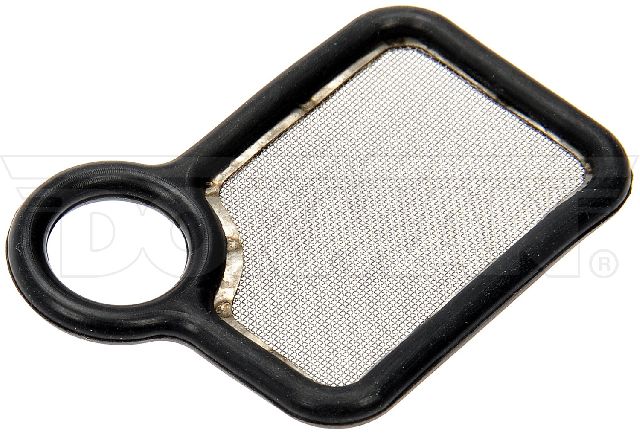
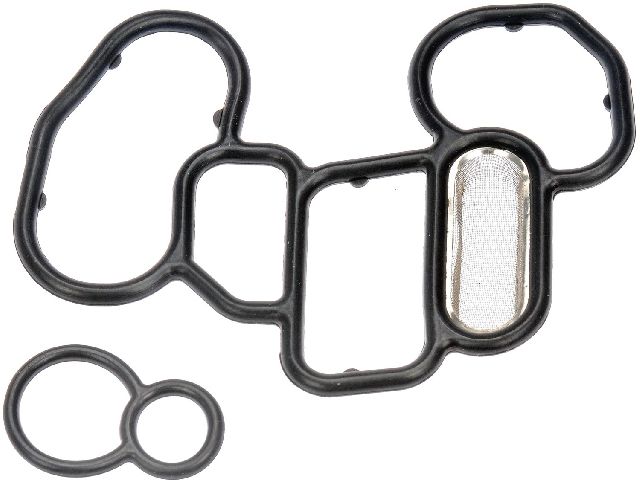
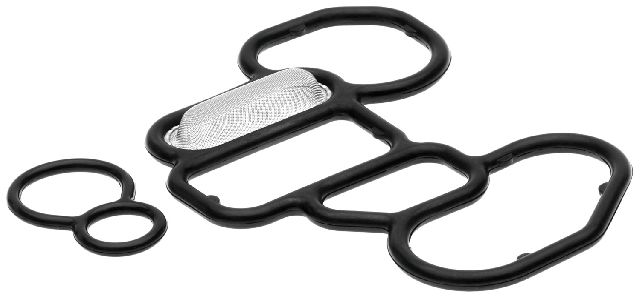
- Inspect and Clean Screens: Remove the VTC solenoid to inspect its integrated screen for sludge or debris. On K24 engines, there is also a separate VTC strainer gasket located behind the power steering pump that can become clogged and should be inspected or replaced.
- Replace the Solenoid: If the solenoid fails the resistance test or its screen is heavily clogged and cannot be cleaned, replace the VTC oil control solenoid and the associated gasket/O-ring.
- Clear Codes and Test Drive: After any repairs, clear the DTC with a scan tool and perform a test drive, holding the engine at 3,000 RPM for a short period, to ensure the code does not return.
Parts You'll Likely Need

- VTC Oil Control Solenoid (VTEC Solenoid)
(OEM #15810-RAA-A03 (Common for 7th Gen K24A engines), 15810-R40-A03 (Common for 8th Gen K24Z engines))— This is the component that most frequently fails electrically or becomes clogged, directly causing the P0010 circuit fault.
Trusted brands: Honda (OEM), Denso, Hitachi, Dorman
OEM price range: $120-$180
Aftermarket price range: $40-$100 - VTC Strainer Gasket (for K24 engines)
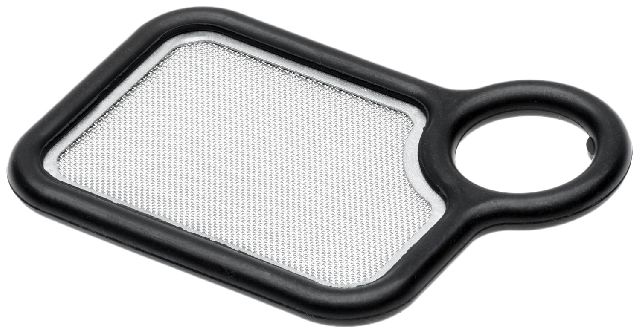
(OEM #15845-RAA-A01)— This secondary screen, located behind the power steering pump on 4-cylinder models, can get clogged with sludge and cause oil pressure issues for the VTC system, leading to codes like P0010 or P2646.
Trusted brands: Honda (OEM)
OEM price range: $10-$20
Aftermarket price range: $5-$15
Platform-Specific Known Issues
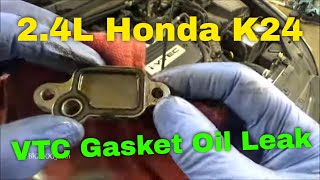
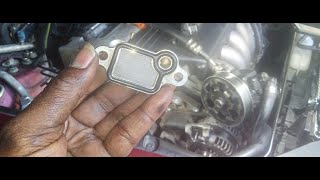
- Clogged VTC Strainer on K24 Engines: The 4-cylinder (K24) engines have a secondary VTC oil strainer located behind the power steering pump. 🎬 Watch: How to replace the VTC strainer gasket on K24 engines. This screen can become clogged with sludge, restricting oil flow to the VTC system. This can cause P0010 or related VTEC codes like P2646. Cleaning or replacing this strainer is a common repair step.
- Code Appears After Hard Acceleration: Some owners report the P0010 code only appears after driving the car hard or at higher RPMs. This can happen because the VTC system is most active under these conditions, and a sluggish or failing solenoid is unable to respond to the PCM's commands quickly enough, triggering the fault.
Technical Service Bulletins (TSBs) & Recalls
While specific to newer Honda models, several manufacturer bulletins highlight that P0010 is a persistent issue within the Honda VTC architecture. TSB Bulletin #A18-079 and Bulletin #A18-090 note that the MIL may come on with DTC P0010 (variable valve timing control [VTC] malfunction), sometimes requiring software updates to the PCM to correct how the system monitors the VTC motor speed signal circuit. Additionally, TSB Bulletin #ABOM10042018901 indicates that PCM software issues can lead to incorrect operation of the EVTC, triggering the P0010 code.
Mechanic-Grade Diagnostic Values
- VTC Oil Control Solenoid Resistance (2008-2012 K24Z engines) — expected: 6.75 to 8.25 Ohms at room temperature.. Failure: A reading outside this range, or an open circuit (OL), indicates a faulty solenoid.
- VTC Oil Control Solenoid Resistance (2003-2007 K24A engines) — expected: 6.9 to 7.9 Ohms at 20°C (68°F).. Failure: A reading outside this range points to a bad solenoid.
- PCM Malfunction Threshold (VTC Current vs. Duty Cycle) — expected: Current should be proportional to the commanded duty cycle.. Failure: DTC is set if: 1) Duty cycle is >40% and current is <200 mA for 5 seconds, OR 2) Duty cycle is <5% and current is >800 mA for 5 seconds.
- VTC Solenoid Harness Continuity to Ground (PG1 wire) — expected: Continuity should exist between terminal 1 of the harness connector and body ground (G101).. Failure: No continuity indicates an open circuit in the ground wire.
Scan Tool Commands That Help
- Honda HDS (Honda Diagnostic System) or equivalent advanced scanner: VTC TEST (in INSPECTION MENU or ACTIVE TEST) — This bidirectional test commands the VTC solenoid to operate. A technician can observe changes in engine RPM or listen for the solenoid to click. If the engine stalls or RPM fluctuates, it confirms the solenoid, oil passages, and VTC actuator are mechanically functional, pointing the diagnosis toward an intermittent electrical issue or a faulty PCM.
Wiring & Ground Locations
- G101 — On the driver's side of the engine bay. For some models, it is located on the intake manifold, while on others it may be on the cylinder head or near the transmission housing.. G101 is a primary ground point for the engine harness and the PCM. A poor connection at this ground can cause erratic voltage and unpredictable behavior for various sensors and actuators, including the VTC oil control solenoid, potentially triggering a P0010 code.
- VTC Oil Control Solenoid 2-Pin Connector — On the VTC solenoid itself, located on the passenger side of the cylinder head near the timing chain cover on K-series engines.. This is the direct connection point for testing the solenoid's resistance and checking for voltage/ground from the PCM. Pin 1 is typically the ground wire (continuity to G101), and Pin 2 receives the duty-cycled power signal from the PCM.
Real Owner Repair Stories
- Reddit user lowresolution666 (2003 Honda Accord (CL7) with 75,000 km) — P0010 code present on OBD-II scan. The car ran and drove fine with good fuel economy.
❌ Tried (didn't work) Clearing the code with a scanner (it would return randomly)., Replacing the VVT (VTC) solenoid with a spare part.
✅ What actually fixed it After replacing the VTC solenoid, the scanner returned a "VTEC Solenoid Error Code". The user then replaced the VTEC solenoid as well. The P0010 code still appeared but would now stay cleared for longer periods before returning randomly. The final resolution was not posted, but the experience shows how a fault in one part of the VTEC/VTC system can sometimes manifest as a code for another, suggesting a possible wiring or oil pressure issue affecting both components.
OEM Part Supersession History
15810-RAA-A01, 15810-RAA-A02→15810-RAA-A03— Standard part revision and consolidation for K-series (2.4L) engines.
Heads up: The -A03 part number is the correct and most current replacement for the earlier versions used on 2003-2007 Accords and other K24-equipped Hondas.
Model Year Variations Within This Range
- 2003-2007 (7th Gen): Primarily uses the K24A (4-cyl) and J30A (V6) engines. The VTC solenoid for the K24A is part number 15810-RAA-A03 (or its predecessors). The specified resistance is often cited as 6.9-7.9 ohms.
- 2008-2012 (8th Gen): Uses the updated K24Z (4-cyl) and J35Z (V6) engines. The VTC solenoid for the K24Z is commonly part number 15810-R40-A03. The specified resistance for this part is slightly different, at 6.75-8.25 ohms.
Diagnostic Flowchart
Used vs. New Parts: Buying Guide for This Vehicle
When a used part is the smart pick: A used VTC solenoid is generally NOT recommended. The primary failure mode is internal clogging from oil sludge or electrical failure from heat cycles. A used part from a junkyard carries a high risk of having the same or other sludge-related problems, offering minimal cost savings for a high probability of repeat failure.
Donor-vehicle mileage cap: roughly under 50000 miles for the part to have meaningful remaining life.
What to inspect on the donor part:
- If considering a used part, insist on seeing the integrated filter screen. It must be perfectly clean with no signs of dark, baked-on varnish or sludge.
- Check the electrical connector for any signs of corrosion, brittleness, or heat damage.
- Test the resistance with a multimeter before purchase; it must be within the specified range for the vehicle's generation (e.g., 6.75-8.25 ohms for 8th gen).
OEM-only on this vehicle (don't cheap out):
- While not strictly OEM-only, using a genuine Honda VTC solenoid or one from a known OEM supplier like Denso or Hitachi is highly recommended for longevity and correct electrical specifications.
Aftermarket brands forum-validated for this vehicle:
- Denso (often the original equipment manufacturer)
- Hitachi
- Dorman (offers a cost-effective alternative, but OEM is preferred by many technicians)
Brands owners have reported issues with on this vehicle:
- No-name, unbranded solenoids from online marketplaces (e.g., eBay, Amazon) are frequently cited in forums as failing quickly or being out-of-spec from the factory, leading to the code returning immediately.
Real Owner Stories
Aggregated from forums and TSBs cited above. Mileages and costs reflect what owners reported in those sources.
2003 Honda Accord 4 cylinder
Symptoms: The P0010 code would not appear at idle, but would trigger consistently once driving at about 10 mph.
What fixed it: The owner was still in the process of diagnosis after confirming the oil control solenoid, VTC filter screen, and wiring appeared to be okay.
Source hint: Honda Accord Forum
Acura TSX (K24A engine)
Symptoms: A P0010 code appeared immediately after replacing the VTC solenoid/actuator.
What fixed it: The problem was a loose electrical connector. Ensuring the connector was fully seated resolved the code.
Source hint: r/AskMechanics - Replaced VTC... now getting a P0010?
2003 4-cylinder Accord
Symptoms: The P0010 code would appear consistently as soon as the car was started.
What fixed it: The forum post described the initial symptom and did not specify the final repair.
Source hint: Honda Accord Forum - 2003 Accord P0010 code
Related OBD-II Codes
Frequently Asked Questions
What is the correct resistance for the VTC oil control solenoid on my 2003-2012 Honda Accord?
My P0010 code only appears after I accelerate hard. Is this a known issue?
I have a 4-cylinder Accord. Is there a specific part I should check for P0010 besides the solenoid?
Can low or dirty engine oil really cause a P0010 code on this car?
I just replaced the VTC solenoid and the P0010 code appeared immediately. What could be wrong?
What other vehicles share this same P0010 issue with the Honda Accord?
Helpful Videos
We Have This Part in Stock


The information in this article is provided for general reference and educational purposes only. Vehicle specifications, procedures, and part compatibility can vary by production date, trim level, and region. Always consult your vehicle's factory service manual and verify part numbers before purchasing or performing repairs. Safety-critical components such as airbags, seat belts, and braking systems should be installed by a qualified professional.
- Honda Accord:
- 🎬 Helpful Videos
- 🛍️ Shop This Part
- What's Unique About the 2003-2012 Honda Accord
- Symptoms You May Notice
- Most Likely Causes
- Rare But Worth Checking
- Diagnosis Steps
- Parts You'll Likely Need
- Platform-Specific Known Issues
- Technical Service Bulletins (TSBs) & Recalls
- Mechanic-Grade Diagnostic Values
- Scan Tool Commands That Help
- Wiring & Ground Locations
- Real Owner Repair Stories
- OEM Part Supersession History
- Model Year Variations Within This Range
- Diagnostic Flowchart
- Used vs. New Parts: Buying Guide for This Vehicle
- Real Owner Stories
- 2003 Honda Accord 4 cylinder
- Acura TSX (K24A engine)
- 2003 4-cylinder Accord
- Related OBD-II Codes
- Frequently Asked Questions
- 🎟️ Get 5% Off