

U0121 on 2011-2015 Chevrolet Cruze: Lost Communication With ABS Module Causes and Fixes
On a 2011-2015 Cruze, code U0121 is most often caused by a faulty negative battery cable, a known issue covered by GM Special Coverage 14311B. This simple part costs $25-$50 and is an easy DIY fix that resolves numerous electrical issues, including the loss of ABS and StabiliTrak.
- U0121 disables critical safety systems (ABS, StabiliTrak) and should be addressed immediately.
- The most likely cause on a 2011-2015 Cruze is a faulty negative battery cable, a known issue covered by GM TSB 14311B.
- Always start diagnosis by checking the battery and replacing the negative battery cable before considering more expensive repairs.
- Do not replace the expensive EBCM/ABS module unless you have 100% confirmed it has proper power, ground, and the CAN network wiring is intact.
- A faulty wheel speed sensor will not typically cause a U0121 code; look for 'C' codes instead.
What's Unique About the 2011-2015 Chevrolet Cruze

The first-generation Chevrolet Cruze is highly susceptible to electrical issues caused by a poorly designed negative battery cable. An insufficient crimp on the terminal leads to high internal resistance, starving various modules of stable voltage and ground. GM acknowledged this with Special Coverage bulletin 14311B, which directly links this faulty cable to a cascade of symptoms including ABS and StabiliTrak warning messages, flickering displays, and loss of power steering. Unlike other vehicles where U0121 might point to complex wiring or module failures, on the Cruze, the investigation should always start with this inexpensive and easy-to-replace cable.
Symptoms You May Notice

- ABS warning light is on
- Traction Control (TC) or StabiliTrak/Electronic Stability Control (ESC) warning light is on
- "Service StabiliTrak" or "Service Traction Control" message on the instrument cluster
- Brakes may lock up during hard braking
- Loss of power steering assist, making the wheel hard to turn at low speeds
- Radio or HVAC display flickering or turning off and on
- "Battery Saver Active" message in the Driver Information Center (DIC)
- Turn signal clicking sound may be inaudible
- Cruise control may be disabled
- Replacing the EBCM/ABS module first. The module is expensive and rarely the root cause on this vehicle. The problem is almost always a power supply issue, most commonly the negative battery cable.
- Replacing wheel speed sensors. A faulty wheel speed sensor will typically set a specific 'C' code (e.g., C0035) related to that sensor's circuit and will not usually cause a global U0121 communication code by itself.
Most Likely Causes

- Defective Negative Battery Cable 🔴 High Probability A well-documented factory defect. GM Special Coverage bulletin 14311B was issued for an insufficient crimp on the cable terminal, causing high internal resistance and widespread electrical faults.
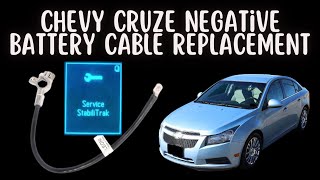
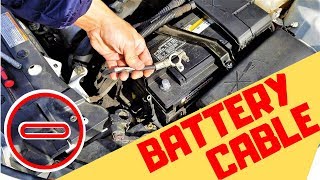
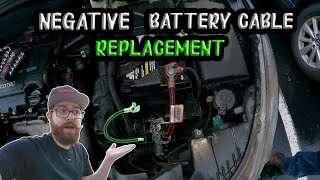
How to confirm: Visually inspect the negative battery cable for corrosion or swelling at the terminal crimp. However, the failure is internal and often not visible. A voltage drop test from the battery post to the chassis ground point is the definitive test. With the engine off and a high electrical load (headlights, fan on high), a reading of more than 200-300mV (0.2-0.3V) indicates a bad cable. Given the low cost ($25-$50) and extremely high probability, many owners 🎬 See this step-by-step walkthrough for replacing the negative cable. choose to replace the cable as the first step.
Typical fix: Replace the entire negative battery cable assembly. The updated OEM part or aftermarket equivalent resolves the poor crimp issue. The revised GM cable design requires a separate M6 bolt (P/N 11561025) for the small secondary wire, as the original stud is eliminated.
Est. part cost: $25-$50 - Poor Battery Health or Connections 🟡 Medium Probability
How to confirm: Test the battery voltage with a multimeter. It should be approximately 12.6V with the engine off and 13.8-14.5V when running. A load test is the best way to confirm battery health. Check for corrosion on the battery terminals and ensure all connections are clean and tight.
Typical fix: Clean the battery terminals and cable ends with a wire brush. If the battery is weak or fails a load test, replace it.
Est. part cost: $0 (cleaning) - $200 (new battery) - Blown ABS/EBCM Fuse ⚪ Low Probability
How to confirm: Locate the underhood fuse box. Check the owner's manual for fuses labeled 'ABS' or 'EBCM'. On a 2012 Cruze, for example, this may involve checking multiple fuses such as F2, F3, F28, and F33. Visually inspect the fuse or test for continuity with a multimeter.
Typical fix: Replace the blown fuse with a new one of the same amperage. If the new fuse blows immediately, there is a short circuit that needs to be diagnosed.
Est. part cost: $1-$5 - Damaged Wiring or Connector at EBCM ⚪ Low Probability The EBCM is located in the engine bay, mounted to the ABS hydraulic block, and can be exposed to heat, moisture, and vibration, which can degrade wiring over time.
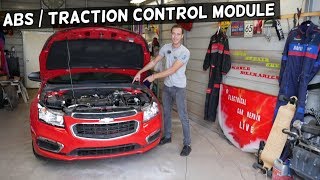
How to confirm: Locate the EBCM under the hood, typically below the brake fluid reservoir. 🎬 Watch: How to locate and access the ABS module and pump. Disconnect the large electrical connector and inspect for corrosion (green crust), moisture, or bent/damaged pins. Trace the wiring harness leading to the module for any signs of chafing, melting, or breaks.
Typical fix: Clean the connector pins with an electrical contact cleaner. Repair any damaged sections of the wiring harness using appropriate splicing techniques and heat shrink.
Est. part cost: $10-$100
Rare But Worth Checking
- Shorted Wheel Speed Sensor (WSS): A short circuit within a wheel speed sensor or its wiring can sometimes disrupt the entire EBCM, causing it to stop communicating. GM TSB PIT4056H describes this issue on similar platforms. If you've checked all power/ground issues, try unplugging one WSS at a time to see if communication with the EBCM is restored.
- Failed Electronic Brake Control Module (EBCM): The module itself can fail, but this is rare compared to the power supply and wiring issues. This should be the last item to consider after all other possibilities have been thoroughly ruled out with proper testing. A replacement will require programming by a dealer or a well-equipped independent shop.
Diagnosis Steps

- Check for GM Special Coverage 14311B. Contact a GM dealer with your VIN to see if the negative battery cable was ever replaced under this program. Note that this coverage was for 10 years/120,000 miles from the original in-service date and may have expired.
- Inspect and Test Battery System: Start here regardless of the TSB. Test the battery to ensure it's healthy. Clean any corrosion from the terminals. Replace the negative battery cable assembly. This is the most likely cause, an inexpensive part, and a straightforward DIY job.
- Check ABS Fuses: Inspect all fuses related to the ABS and EBCM in the underhood fuse panel. Check the owner's manual for your specific year, but these are often large 30A or 40A fuses.
- Inspect EBCM Connector: Locate the EBCM under the hood, attached to the ABS pump. Disconnect its main electrical harness (you may need to slide a locking tab first) and inspect for any green corrosion, moisture, or damaged pins.
- Check for Power and Ground at the EBCM: Using a multimeter and a wiring diagram for your specific year, verify that the EBCM connector is receiving proper battery voltage on the appropriate pins and has a solid ground connection on its ground pins. A poor ground here is the second most likely cause after the main battery cable.
- Check CAN Bus Wires: Inspect the twisted pair of CAN bus wires (often Green and White/Green) going to the EBCM for any signs of damage. With the battery disconnected, you can check for 60 ohms of resistance across the two CAN lines at the OBD-II port (pins 6 and 14).
- Isolate Wheel Speed Sensors: As a final step before condemning the module, disconnect each wheel speed sensor one by one and see if communication with the EBCM returns after each one is disconnected. A shorted sensor can bring down the module.
- Suspect EBCM: If all wiring, power, and grounds are confirmed to be good, the EBCM itself may have failed. This is the least likely scenario.
Parts You'll Likely Need

- Negative Battery Cable
(OEM #22754271 (supersedes 95959013))— This is the most common cause of U0121 on the 2011-2015 Cruze due to a factory defect covered in Special Coverage 14311B.
Trusted brands: ACDelco (GM Genuine), Dorman
OEM price range: $40-$60
Aftermarket price range: $25-$40 - Negative Battery Cable Secondary Wire Bolt
(OEM #11561025)— The revised, updated negative battery cable (22754271) does not have an integrated stud for the small ground wire. This M6 bolt is required to fasten it to the new cable terminal.
Trusted brands: GM Genuine
OEM price range: $3-$8
Aftermarket price range: $1 - Electronic Brake Control Module (EBCM) — This is the part to replace ONLY after all power, ground, and wiring issues have been completely ruled out. A replacement module requires programming with GM's GDS2 software.
Trusted brands: ACDelco (GM Genuine), Bosch
OEM price range: $400-$800
Aftermarket price range: $250-$500
Related Codes That Often Appear With This One
- U0100 — Lost Communication with ECM/PCM. If the negative battery cable issue is severe, it can disrupt communication with multiple critical modules simultaneously.
- U0140 — Lost Communication with Body Control Module (BCM). This is another common code to see alongside U0121 when the negative battery cable is failing, as it controls many of the systems that exhibit flickering or intermittent behavior.
- U0101 — Lost Communication with TCM. The failing ground from the battery cable can also affect the Transmission Control Module, leading to shifting issues in addition to the ABS/Stabilitrak warnings.
Technical Service Bulletins (TSBs) & Recalls
- 14311B: Special Coverage Adjustment – Negative Battery Cable Loose. Covers the primary cause of this issue.
- PIT4056H: Describes how a shorted wheel speed sensor can cause a loss of communication with the EBCM on similar GM platforms.
- 14371A: Special Coverage for leaking water pump on 1.4L engines.
- N202299080: Special Coverage for PCV valve cover failure.
Platform-Specific Known Issues
- Special Coverage 14311B - The Smoking Gun: GM issued this bulletin to address a faulty crimp on the negative battery cable, which causes widespread electrical issues, including communication codes like U0121. The coverage was for 10 years or 120,000 miles from the vehicle's original in-service date. Symptoms listed in the bulletin perfectly match owner complaints: flickering displays, loss of power steering, and 'Service StabiliTrak' messages.
- DIY Repair Story: A Simple Fix for a Scary Problem: Numerous owners on forums like CruzeTalk and in YouTube comments share the same story: their dashboard lit up with ABS, StabiliTrak, and power steering warnings. Some were quoted over $1000 for a new EBCM or radio by dealerships. After finding information online, they replaced the ~$30 negative battery cable themselves in under 30 minutes, which completely resolved all the issues.
Mechanic-Grade Diagnostic Values
- Negative Battery Cable Voltage Drop — expected: < 0.2 Volts (200 mV). Failure: A reading > 0.2V - 0.3V with high electrical load (headlights, fan on) indicates high internal resistance in the cable.
- CAN Bus Resistance at OBD-II Port — expected: 58-64 Ohms. Failure: A reading of ~120 Ohms indicates an open in the bus or one of the terminating resistors is not seen. A reading of ~0 Ohms indicates a short between the CAN High and CAN Low wires.
- EBCM Battery Positive Voltage (Pin 1 and Pin 25) — expected: Approx. 12.6V (engine off), 13.5-14.8V (engine on). Failure: Voltage significantly lower than battery voltage indicates high resistance in the power feed circuit.
- EBCM Ground (Pin 13) — expected: Continuity to chassis ground (< 1.0 Ohm). Failure: High resistance or an open circuit (OL) indicates a bad ground connection, which is a common cause of module communication failure.
Scan Tool Commands That Help
- GDS2 (GM Global Diagnostic System 2): Module Setup / Programming — This function is required after replacing the Electronic Brake Control Module (EBCM). The new module must be programmed to the vehicle's VIN and configuration to function and communicate with other modules.
- GDS2 (GM Global Diagnostic System 2): View All Modules / Network Scan — This is a primary step to see which modules are online and which are offline. If only the EBCM is offline, it points towards a specific issue with that module or its wiring. If multiple modules are offline, it suggests a wider network or power/ground problem, like the negative battery cable.
Wiring & Ground Locations
- EBCM Connector (X184) — Attached to the ABS hydraulic unit under the hood, typically below the brake fluid reservoir.. This is the main data and power connector for the module. Pin 1 (RD/VT) and Pin 25 (RD/D-GN) are battery positive voltage feeds. Pin 13 (BK) is the main ground. The high-speed CAN bus wires also terminate here. Corrosion or loose pins at this connector will cause a U0121 code.
- G105 — Located at the left front of the engine compartment, sometimes behind the cooling fan relays.. This is a primary engine compartment ground point. While the EBCM has its own dedicated ground wire, a poor G105 can contribute to overall electrical noise and instability that can affect module communication.
- G103 — Located on the left shock tower in the engine compartment.. This ground point serves multiple critical components, including the BCM and Instrument Panel Cluster. A fault here can cause widespread communication issues that may appear alongside U0121.
- OBD-II Port (DLC) — Under the driver's side dashboard, to the left of the steering column.. Pins 6 (CAN High) and 14 (CAN Low) are used to test the resistance of the entire high-speed data network. A reading of ~60 ohms here confirms the integrity of the main bus wiring and terminating resistors.
Real Owner Repair Stories
- YouTube user comment section (2012 Chevrolet Cruze) — Service Stabilitrak light, ABS light, Traction Control light, radio cutting out, power steering loss.
❌ Tried (didn't work) Initial diagnosis pointed towards various expensive modules.
✅ What actually fixed it Replacing the negative battery cable. The owner reported all symptoms disappeared immediately after replacing the cable, which was a ~30 minute job. - YouTube video by 'Repairs and Reviews' (Chevrolet Cruze (year not specified, but first generation)) — No crank, no communication with multiple modules, including ABS.
❌ Tried (didn't work) Checking fuses.
✅ What actually fixed it The technician found a poor ground connection for the ABS module itself. After locating the ground point on the chassis, visually inspecting it, and finding it loose, simply tightening the 13mm nut restored communication and fixed the problem.
OEM Part Supersession History
95959013, 95970350→22754271— The original negative battery cables had a faulty crimp design that led to high internal resistance. The updated part number 22754271 resolves this manufacturing defect.
Heads up: The updated cable 22754271 eliminates the small stud for the secondary ground wire. A separate M6x1.0 bolt (GM P/N 11561025) must be purchased to attach the secondary wire to the new cable terminal.
Model Year Variations Within This Range
- 2011-2015: The EBCM part number may vary based on whether the vehicle is equipped with rear disc brakes (common on LT, LTZ, RS trims) or rear drum brakes (common on LS trim). Using the incorrect module will cause programming to fail. Always verify the part number with the vehicle's VIN.
- 2015: The 2015 model year received a cosmetic facelift. While the core electrical architecture and common U0121 causes (like the battery cable) are the same, some module part numbers (like the EBCM) may have changed. Always confirm with the VIN.
Diagnostic Flowchart
Other Known Issues on This Vehicle
Issues unrelated to this code that are worth knowing about as an owner of this generation:
- PCV System Failure (1.4L Turbo) 🔴 High — Extremely common. A failed check valve in the intake manifold pressurizes the crankcase, rupturing the diaphragm in the valve cover. Often presents as a hissing/whistling noise, rough idle, and oil leaks. (Ref: N202299080 (Special Coverage for valve cover), SB-10070046-0335 (Describes intake manifold check valve failure))
- Coolant Leaks (Water Pump, Thermostat Housing, Oil Cooler) 🔴 High — Very common across all engines. Plastic components in the cooling system become brittle and crack. The water pump, in particular, was subject to a warranty extension. (Ref: 14371A / SB-10079524-0335 (Special Coverage for 1.4L water pump for 10 years/150,000 miles))
- Automatic Transmission (6T40) Failures 🔴 High — Common in earlier models (2011-2012). Issues include broken 3-5-R wave plates, solenoid failures, and harsh shifting, often requiring a rebuild.
- Oil Leaks from Oil Cooler Assembly 🟠 Medium — Common on both 1.4L and 1.8L engines. Gaskets between the oil cooler and engine block degrade, causing oil to leak onto the hot exhaust manifold, creating a burning smell and smoke.
Used vs. New Parts: Buying Guide for This Vehicle
When a used part is the smart pick: A used EBCM/ABS module from a reputable salvage yard can be a cost-effective option, but ONLY if it comes with the VIN of the donor car and a return policy. It is a poor choice for the primary suspect, the negative battery cable.
Donor-vehicle mileage cap: roughly under 80000 miles for the part to have meaningful remaining life.
What to inspect on the donor part:
- For an EBCM, inspect the connector pins for any signs of corrosion or damage.
- Ensure the donor vehicle was not involved in a front-end collision that could have damaged the module or pump.
- Verify the part number on the used module matches your original module exactly.
- Obtain the VIN of the donor vehicle, as this may be required for programming.
OEM-only on this vehicle (don't cheap out):
- Negative Battery Cable: While aftermarket is available, the ACDelco/GM Genuine part is proven, inexpensive, and directly addresses the known factory defect. The cost difference is minimal for the guaranteed fix.
Aftermarket brands forum-validated for this vehicle:
- Dorman (for Negative Battery Cable)
- Bosch (often the OEM supplier for the EBCM)
Brands owners have reported issues with on this vehicle:
- Unknown, no-name online marketplace brands for the EBCM, as they are often un-programmable or fail quickly.
Real Owner Stories
Aggregated from forums and TSBs cited above. Mileages and costs reflect what owners reported in those sources.
2012 Chevrolet Cruze
Symptoms: The dashboard lit up with ABS, StabiliTrak, and power steering warnings. Some owners were quoted over $1000 for a new EBCM or radio.
What fixed it: Replacing the negative battery cable completely resolved all the issues.
Cost: $25-$50
Source hint: vehicle_specific_issues: 'DIY Repair Story: A Simple Fix for a Scary Problem'
2014 Chevrolet Cruze
Symptoms: The instrument cluster displayed 'Service Stabilitak and Service Traction Control' messages.
What fixed it: Owners were advised that the first and most common fix is to check and replace the negative battery cable.
Source hint: Reddit r/cruze - 'Service Stabilitak and Service Traction Control'
2013 Chevrolet Cruze
Symptoms: A 'Stabilitrack Error' message appeared on the dash.
What fixed it: The problem was resolved by performing a negative battery cable replacement.
Source hint: YouTube - 'Chevy Cruze Negative Battery Cable Replacement Walk Through | Stabilitrack Error'
Related OBD-II Codes
Frequently Asked Questions
I heard there was a special program for electrical issues on my Cruze. Does GM's Special Coverage 14311B apply to my U0121 code?
My radio display is flickering and the power steering is heavy. Is this related to the 'Service StabiliTrak' message and U0121 code?
I'm replacing the negative battery cable myself. Is there a special part I need besides the cable?
How can I be 100% sure the negative battery cable is bad before replacing it?
My mechanic wants to replace the whole ABS module (EBCM) for over $1000. Should I do it?
Besides the battery cable, what's the next most likely thing to check for code U0121?
Helpful Videos
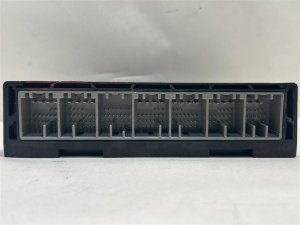
Used OEM Parts in Stock


New Aftermarket Parts Available


The information in this article is provided for general reference and educational purposes only. Vehicle specifications, procedures, and part compatibility can vary by production date, trim level, and region. Always consult your vehicle's factory service manual and verify part numbers before purchasing or performing repairs. Safety-critical components such as airbags, seat belts, and braking systems should be installed by a qualified professional.
- Chevrolet Cruze:
- 🎬 Helpful Videos
- 🛍️ Shop This Part
- What's Unique About the 2011-2015 Chevrolet Cruze
- Symptoms You May Notice
- Most Likely Causes
- Rare But Worth Checking
- Diagnosis Steps
- Parts You'll Likely Need
- Related Codes That Often Appear With This One
- Technical Service Bulletins (TSBs) & Recalls
- Platform-Specific Known Issues
- Mechanic-Grade Diagnostic Values
- Scan Tool Commands That Help
- Wiring & Ground Locations
- Real Owner Repair Stories
- OEM Part Supersession History
- Model Year Variations Within This Range
- Diagnostic Flowchart
- Other Known Issues on This Vehicle
- Used vs. New Parts: Buying Guide for This Vehicle
- Real Owner Stories
- 2012 Chevrolet Cruze
- 2014 Chevrolet Cruze
- 2013 Chevrolet Cruze
- Related OBD-II Codes
- Frequently Asked Questions
- 🎟️ Get 5% Off