

OBD-II Code U0073: Control Module Communication Bus 'A' Off
The Ultimate 2026 Guide to Diagnosing and Fixing U0073
- U0073 indicates a total failure of the CAN Bus 'A' network, severing communication between critical computers like the ECM and TCM.
- Never drive with a U0073 code; the sudden loss of communication instantly disables power steering, ABS, and stalls the engine.
- Always test the battery first; a voltage drop below 12.4V during startup is the leading cause of false U0073 module failure codes.
- Measure the OBD-II port resistance between pins 6 and 14; a healthy network reads exactly 60 ohms, while 120 ohms indicates a broken wire.
- Never replace a $1,000+ control module without first verifying the physical wiring harness and ground connections are intact.
What Does U0073 Mean?

U0073 means your car's primary Controller Area Network (CAN Bus 'A') has shut down. This high-speed network acts as the central nervous system, allowing the engine, transmission, and brake modules to coordinate. When Bus A goes offline, these computers cannot share data, triggering a cascade of secondary 'U' codes and shutting down vehicle integration.
Technical definition: The SAE/ISO definition is "Control Module Communication Bus 'A' Off". This indicates the primary high-speed CAN network (operating at 500 kbps) has ceased all data transmission, preventing essential electronic control modules from exchanging data.
Can I Drive With U0073?
No — Do Not Drive. Do not drive with this code. The communication failure instantly disables critical systems like the engine, transmission, ABS, and power steering. Operating the vehicle risks unpredictable stalling or a complete loss of vehicle control at speed.
Common Causes

- Damaged or Corroded CAN Bus Wiring (Very Common) — Wires in the CAN bus harness break, fray, or short out from vibrations, rubbing against metal, or rodent damage. Connectors corrode rapidly from moisture intrusion, especially those located under the carpet, near door sills, or in the engine bay.
- Low Battery Voltage or Failing Alternator (Common) — Control modules require a stable 12V supply to operate. A weak battery, loose terminals, or a failing alternator causes voltage drops during startup that force modules to shut down or communicate erratically.
- Intermittent Ground Faults (Common) — A loose or corroded ground strap for a control module severs its electrical circuit. This frequently happens when driving over bumps, leading to symptoms that appear and disappear instantly.
- Failing Control Module (ECM, TCM, BCM) (Common) — Any single control module on the network can fail internally. A faulty module stops communicating or broadcasts corrupted data that crashes the entire network.
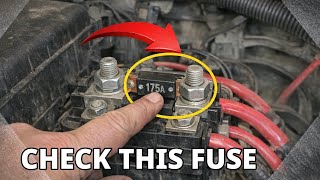
- Blown Control Module Fuse or Voltage Spike (Less Common) — A voltage spike from an improper jump start blows main fuses (like a 175-Amp Mega Fuse). When a fuse protecting a critical module blows, that module drops offline and takes the bus down with it.
- Faulty Terminating Resistors (Less Common) — The CAN bus network relies on two 120-ohm resistors (usually inside the ECM and BCM) to prevent signal reflection. If a resistor fails, the circuit's total resistance changes from 60 ohms to 120 ohms, corrupting all data signals.
- Software Glitch / "Logic Lock" (Less Common) — Modules sometimes freeze due to a software glitch without failing electrically. A 'hard reset' by disconnecting the battery for 15 minutes forces a reboot and temporarily restores communication.
- Aftermarket Accessory Interference (Rare) — Improperly installed aftermarket alarms, remote starters, or trailer brake controllers tap into the CAN bus and cause short circuits or signal interference.
Symptoms

- Vehicle Won't Start or Stalls While Driving — The engine fails to crank, refuses to start, or stalls unexpectedly while driving due to lost powertrain communication.
- Erratic Transmission Shifting or Limp Mode — The transmission shifts harshly or locks into a single gear (limp mode) because it receives no commands from the engine computer.
- Instrument Cluster Malfunction — The speedometer, tachometer, and gear indicator freeze, drop to zero, or display dashes.
- Loss of Power Steering Assist — Electric power steering systems disable entirely, making the steering wheel extremely heavy and difficult to turn.
- Check Engine Light and Multiple Warning Lights (also visible on scanner) — The Check Engine Light illuminates alongside ABS, Traction Control, StabiliTrak, Airbag, and security lights.
Diagnostic Flowchart
Tap your situation to follow the diagnostic path that matches what you're seeing on this code.
Common Fixes & Costs
- Repairing Damaged Wiring or Connectors — Parts: $10 - $50, Labor: $150 - $600, ~2.5 hr book time (Intermediate)
- Replacing a Weak or Dead Battery — Parts: $150 - $350, Labor: $50 - $100, ~0.5 hr book time (DIY)
- Repairing/Replacing Main Ground Connections — Parts: $5 - $20, Labor: $100 - $300, ~1.0 hr book time (DIY)
- Replacing a Blown Fuse — Parts: $5 - $25, Labor: $0 - $100, ~0.5 hr book time (DIY)
- Replacing a Faulty Control Module — Parts: $300 - $1200, Labor: $150 - $400, ~1.5 hr book time (Professional)
Used vs. New Parts: Buying Guide
When a used part is worth it: A used module makes sense only if the vehicle is older than 10 years, the budget is tight, and you use a specialist who can clone your original module's data to the used one.
Donor-vehicle mileage cap: roughly under 100000 miles for the part to have meaningful remaining life.
Donor quality checklist:
- Verify the exact part number matches, as multiple versions exist for the same model year.
- Source from a reputable salvage yard with a return policy.
- Avoid modules from vehicles with flood or fire damage.
Decision logic:
- If The original module is physically destroyed (burnt, water-damaged) and its data cannot be cloned → You must buy a new or professionally remanufactured, programmable module.
- If The original module is electronically faulty but readable → A used module is a possibility if you find a service to clone the VIN and configuration data.
- If The part is a high-failure item with known defects (e.g., TIPMs) → Favor a professionally remanufactured unit over a used one, as remanufacturers correct original design flaws.
Warranty tradeoff: Used parts typically have a 30-day warranty covering only the part. New OEM and remanufactured modules often come with a 1-year or lifetime warranty.
Worst-case if a used part fails: $400 - $1000 if a used module fails, including the cost of a second replacement part and repeat programming labor.
What Happens If You Wait — Timeline
- 0-2 weeks: Intermittent fault. Code appears but clears on restart. Warning lights flicker, or a feature briefly stops working. No major drivability issues. (MPG impact: 0%% · Added cost: $0)
- 2 weeks - 2 months: Fault becomes frequent. Check Engine Light stays on. Vehicle occasionally enters 'limp mode' or exhibits harsh shifting. Stalling or no-start becomes a possibility. (MPG impact: 0-5%% · Added cost: $150 - $400 for a potential tow and initial diagnostic fee.)
- 2-6 months: Hard fault established. Vehicle is unreliable, frequently stalling. Safety systems like ABS and power steering are consistently disabled. (MPG impact: N/A% · Added cost: $500 - $2000. The initial fault causes electrical stress that damages a secondary control module.)
- 6+ months: Cascading failure. Ignoring water intrusion allows corrosion to spread from a single connector to the entire wiring harness. Multiple modules are damaged. (MPG impact: N/A% · Added cost: $2000 - $5000. Represents the cost of a new wiring harness and replacement of multiple control modules.)
Cost of Not Fixing It
- Immediate: Vehicle fails to start, stalls while driving, or loses power steering and braking assists, creating a severe safety hazard. (Added cost: $150 - $400 for a tow truck and emergency diagnostic fee.)
- 1-7 Days: Continued attempts to drive with an intermittent fault causes voltage spikes or data corruption, damaging sensitive control modules. (Added cost: $500 - $2000 to replace a secondary module (e.g., ABS, TCM) damaged by the initial fault.)
- 1+ Week: Ignoring water intrusion allows corrosion to spread, turning a simple connector cleaning into a full wiring harness replacement. (Added cost: $1500 - $3000 for a new harness and the extensive labor to install it.)
Diagnosis Steps

- Check Battery, Grounds, and Fuses
Verify the battery reads above 12.4 volts with the engine off. Clean and tighten the battery terminals. Inspect the main engine and body ground straps for corrosion. Visually check all fuses related to the powertrain, body, and ABS modules.
Tools: Multimeter, Wire Brush, Basic Hand Tools (Beginner) - Scan All Modules for Communication Codes
Use a bi-directional scanner to read codes from every module (ECM, BCM, ABS, TCM). Document which modules report 'no communication' (like U0100, U0121) to confirm a bus-wide failure rather than a single isolated module.
Tools: Advanced Bi-Directional OBD-II Scanner (Beginner) - Visually Inspect Wiring and Connectors
Inspect the wiring harnesses connected to the main control modules. Look for chafing, melting, or rodent damage. Check harnesses near the battery, firewall pass-throughs, and transmission housing. Look for water intrusion in the footwells.
Tools: Flashlight, Inspection Mirror (Intermediate) - Disconnect Aftermarket Accessories
Disconnect any aftermarket remote starts, alarms, or trailer brake controllers. Poor installations cause network interference. Check if communication is restored after removal.
Tools: Basic Hand Tools (Intermediate) - Test CAN Bus Resistance (Key Off)
Disconnect the battery. Measure resistance between Pin 6 (CAN High) and Pin 14 (CAN Low) on the OBD-II port. A healthy network reads exactly 60 ohms. A reading of 120 ohms indicates an open circuit or offline module. A reading near 0 ohms indicates a dead short.
Tools: Multimeter (Advanced) - Test CAN Bus Voltages (Key On)
Reconnect the battery and turn the key on (engine off). Measure voltages at the OBD-II port. Pin 6 (CAN High) should read between 2.5V and 3.5V. Pin 14 (CAN Low) should read between 1.5V and 2.5V. A flatlined 0V or static 12V indicates a short to ground or power.
Tools: Multimeter (Advanced) - Isolate the Faulty Module (Divide and Conquer)
If resistance or voltage tests fail, unplug modules one at a time and re-test the OBD-II port. Start with accessible modules like the ABS unit. When the resistance returns to 60 ohms after unplugging a specific module, you have isolated the faulty component or its immediate wiring.
Tools: Multimeter, Basic Hand Tools, Wiring Diagram (Professional) - Analyze CAN Bus Waveform (Oscilloscope)
Connect an oscilloscope to CAN High and CAN Low. A healthy bus shows a clean, mirror-image square wave. Look for distorted or flatlined signals. Wiggle the wiring harness while watching the scope to pinpoint hidden breaks in the wires.
Tools: Automotive Oscilloscope, Breakout Leads (Professional)
When This Code Triggers (Freeze-Frame Conditions)
- Vehicle Speed: 0 mph or Any (The fault occurs at key-on, during steady driving, or when hitting a bump. It is not specific to a certain speed.)
- RPM: 0 or Any (Triggers during cranking, at idle, or while cruising. The freeze frame captures the exact moment of network failure.)
- System Voltage: < 11.5V or > 15.0V (Frequently triggers during a low voltage event (cranking with a weak battery) or a high voltage spike (improper jump start).)
- Time Since Engine Start: 0 seconds to Any (A value of 0 seconds indicates a failure at startup. A longer time suggests an intermittent wiring fault that occurred while driving.)
Related Codes
- U0100 — Means "Lost Communication With ECM/PCM." If you have U0073, you will almost certainly have U0100 because the entire bus is down. U0073 is the root cause; U0100 is the symptom.
- U0121 — Means "Lost Communication With Anti-Lock Brake System (ABS) Module." If it appears with U0073, the bus itself is the primary fault. If it appears alone, the problem is isolated to the ABS module.
- U0140 — Means "Lost Communication With Body Control Module (BCM)." A U0073 fault causes a U0140. However, a failing BCM can also be the root cause of the U0073 by crashing the network.
- U0074 — Means "Control Module Communication Bus 'B' Off." U0073 refers to Bus 'A' (high-speed), while U0074 refers to a secondary bus. Seeing one but not the other narrows down the wiring fault location.
Climate & Environmental Factors
- High Humidity and Road Salt: In regions where road salt is used, corrosion accelerates rapidly. Saltwater attacks wiring connectors, ground points, and module internals, making it a leading cause of U0073 in these climates.
- Cold Weather: Extreme cold slows a battery's chemical reaction, reducing cranking power. This causes system voltage to drop low enough during startup to disrupt module communication. Cold also makes wire insulation brittle and prone to cracking.
How to Talk to a Mechanic About This Code
Say this: "I have a U0073 'Control Module Communication Bus A Off' code, and my scanner shows a loss of communication with multiple modules. Please start by checking the CAN bus resistance at the OBD-II port and verifying power and grounds to the main modules before assuming a module has failed."
This signals you understand U0073 is a network problem, directing the technician to perform fundamental electrical checks first and preventing them from immediately replacing an expensive computer.
Avoid saying:
- 'My car is acting weird and has a check engine light.'
- 'Just replace the computer.'
- 'I have a bunch of U codes.'
Questions to ask before authorizing the repair:
- What was the CAN bus resistance reading between pins 6 and 14?
- What were the voltage readings on the CAN High and CAN Low lines?
- Did you perform a 'wiggle test' on the main harnesses to check for intermittent shorts?
- Can you show me the damaged wire or corroded connector you found?
- If recommending a module replacement, how did you prove the module itself is the cause?
Where to Take It: Dealer vs Independent vs Chain
- Dealer:
A strong option if a known TSB exists or if module programming is definitely required. Otherwise, an independent shop is more cost-effective.
Best for: Vehicles under warranty, Known manufacturer-specific issues covered by a TSB, Complex module programming required after repair
Downsides: Highest labor rates, May default to replacing expensive modules rather than repairing wiring (Typical cost: +50% vs. baseline) - Independent Shop:
Best fit. An independent shop with a strong electrical diagnostician is ideal for tackling wiring, grounds, and connectors without dealership costs.
Best for: Out-of-warranty vehicles, Shops specializing in electrical diagnostics, Cost-effective diagnosis and wiring repair
Downsides: Diagnostic skill varies widely; look for ASE certifications., May lack the latest manufacturer software for programming new modules. (Typical cost: +0% vs. baseline) - Chain Shop:
AVOID for diagnosis. This code requires specialized electrical troubleshooting beyond the scope of a chain repair shop.
Best for: Simple fixes like a battery replacement AFTER a proper diagnosis is made elsewhere.
Downsides: Technicians are rarely specialized in complex network diagnostics., High pressure to sell parts leads to misdiagnosis. (Typical cost: -10% vs. baseline)
When to Walk Away From the Repair
If the estimated repair cost for an electrical issue like U0073 exceeds 50-60% of the car's private-party value, seriously consider selling the vehicle as-is.
- Car worth $5000, fix is $2500: Borderline. This is a significant percentage of the car's value. Get a second opinion before proceeding.
- Car worth $15000, fix is $1200: Fix it. The repair cost is well below the threshold and preserves the vehicle's value.
- Car worth $3000, fix is $2000: Walk away. The repair cost is too high relative to the vehicle's worth.
What Scan Tool You Need for This Code

Minimum: A scanner that reads codes from ALL vehicle modules (ABS, BCM, TCM), not just the engine computer.
A basic $20 code reader only pulls generic engine codes and cannot see which modules are offline, making U0073 diagnosis impossible.
Budget: BlueDriver Pro (~$100) — Performs a full system scan to see which modules report communication loss and provides live data to monitor system voltage.
Mid-range: XTOOL D7 or Foxwell NT series (~$350) — Offers bi-directional controls to command modules to perform self-tests and displays network topology maps showing offline modules.
Professional: Autel MaxiCOM MK808 / MS906BT (~$500-1200) — Provides dealer-level diagnostics, advanced network topology mapping, and integrates with oscilloscopes for direct CAN bus testing.
Rent vs buy: Renting is not a good option. Free rental scanners at auto parts stores are basic code readers insufficient for network-level problems. A purchase is necessary for DIY diagnosis.
How to Clear the Code After You Fix It
- Reconnect battery if it was disconnected for testing.
- Use an OBD-II scan tool to perform a 'Clear All Codes' command.
- Perform a 'hard reset' by disconnecting the negative battery terminal for 15 minutes to reset all modules if codes immediately return.
- Start the vehicle and let it idle to confirm basic communication is restored.
Drive cycle (~20 minutes): A specific drive cycle is not required for U0073, as it is a hard fault. However, a general drive cycle (cold start, 5 mins idle, 10 mins mixed driving, 5 mins highway) is needed to reset emissions monitors.
Readiness monitors affected: This code prevents ALL engine and emissions-related readiness monitors from running because the PCM cannot communicate.
Before emissions retest: drive at least 50 miles to fully set monitors.
Watch out for:
- Clearing the code with a scanner does not fix the problem; the code returns instantly if the physical fault exists.
- Disconnecting the battery erases all readiness monitors, guaranteeing an emissions test failure until a drive cycle is completed.
- Fixing the U0073 cause does not automatically clear associated codes (U0100, U0121); a manual clear is required.
Will This Fail Emissions / State Inspection?
Yes — this code typically fails an OBD-II emissions inspection.
- California: Automatic failure. The vehicle cannot be tested until the communication issue is repaired and a full drive cycle is completed.
- New York: Automatic failure. NYS inspection explicitly requires communication with the OBD-II system.
- Texas: Automatic failure in emissions counties. The inspector's equipment will be unable to establish a connection.
Most Commonly Affected Vehicles
- Chevrolet/GMC Silverado, Sierra, Suburban, Tahoe (2007-2014) — Extremely common. Caused by backed-out terminals in the transmission harness connector (TSB #08-07-30-021H) or a poor BCM ground at G218 under the driver's dash (TSB #PIT5405C).
- Chevrolet/GMC Suburban, Tahoe, Traverse (2015-2020) — Frequently caused by a 'logic lock' of the Serial Data Gateway Module (SDGM), detailed in GM TSBs #PIT5586G and #20-NA-212. A battery disconnect provides a temporary fix.
- Ford Focus (2012-2018) — Prone to Body Control Module (BCM) failures caused by water leaking into the cabin from a clogged sunroof drain or bad cowl seal, corroding the footwell connectors.
- Ford F-150 (2009-2014) — Wiring harness chafing near the frame rails or emergency brake pedal is common. Rusted-off frame-to-body ground wires frequently trigger this code.
- Dodge/Chrysler/Jeep Ram 1500, Grand Cherokee (2008-2016) — The Totally Integrated Power Module (TIPM) is a notorious failure point. Internal TIPM faults disrupt the CAN bus and trigger U0073 alongside multiple electrical gremlins.
- Subaru Forester, Outback (2014-2018) — Intermittent U0073 codes appear with ABS and traction control lights. Often traced to a failing VDC (Vehicle Dynamics Control) module or its wiring harness.
- BMW 3-Series (F30) (2012-2019) — Vibration damages the plastic connector housing at the DME (Digital Motor Electronics) module, leading to intermittent pin contact and network failure.
- Volkswagen Golf, Jetta (2010-2015) — The CAN Gateway module, located above the pedals, fails internally or suffers from connector corrosion, dropping the entire network offline.
Manufacturer-Specific Notes
- General Motors (Chevy/GMC): On 2007-2014 trucks, check the 16-way transmission harness connector for backed-out terminals and the G218 ground stud under the dash. After a jump start, always check the 175A Mega Fuse before any other diagnosis.
- Ford: On Focus and Fusion models, check for damp carpets in the passenger footwell, indicating a water leak that corrodes the BCM connector. On F-150s, inspect for rusted-off body-to-frame ground straps.
- Dodge/Chrysler/Jeep: The Totally Integrated Power Module (TIPM) is a frequent cause of network communication codes. Specialists offer TIPM repair services as a more affordable alternative to full replacement.
- Mazda: On CX-7 and CX-9 models, an intermittent U0073 code is frequently caused by a corroded main grounding point located on the driver's side strut tower in the engine bay.
Real Owner Stories
2014 GMC Sierra with intermittent no-start
Truck intermittently failed to start, with a dead instrument cluster and 'Service Stabilitrak' messages. A shop suggested replacing the BCM.
What they tried:
- Multiple expensive diagnostic sessions at a shop.
- Considered replacing the Body Control Module (BCM).
Outcome: Owner found a forum post about the G218 ground. He removed the driver's side kick panel and found the ground nut loose with insulation caught underneath. He cleaned and tightened the connection, fixing the problem for $0.
Lesson: A loose ground connection mimics a catastrophic module failure. Always check well-documented ground points like G218 on GM trucks before replacing computers.
2010 Ford F-150 with sudden no-crank
Truck suddenly failed to start. Dash lights flickered, and it entered limp mode with a U0073 code. It eventually became a hard no-crank, no-communication issue.
What they tried:
- Checked all fuses and swapped relays.
- Tested battery.
- Replaced fuel pump driver module.
- Swapped instrument cluster with a junkyard part.
Outcome: The owner discovered a body-to-frame ground wire on the passenger side had rusted and broken off completely. Sanding the connection points and reattaching the ground resolved the issue.
Lesson: A single critical ground wire failure takes down the entire vehicle network. Visually inspect all major ground straps, especially in rust-prone areas.
2007 Chevy Silverado with multiple 'U' codes
Dashboard full of warning lights and communication codes including U0073, U0100, U0101, U0121, and U0140.
What they tried:
- Checked all fuses.
- Checked multiple ground points (G218, G103, G104).
Outcome: The problem was a faulty Trailer Brake Control Module (TBCM) containing a 120-ohm terminating resistor. Unplugging the faulty module restored communication to the rest of the network. Replacing the TBCM fixed the issue permanently.
Lesson: A single faulty module brings down the entire network. Use the 'divide and conquer' method: unplug suspected modules to see if communication is restored.
How to Prevent This Code From Triggering
- Perform regular battery maintenance (Every 6 months) — A weak battery is a top cause of communication codes. Clean terminals and test voltage to prevent low-voltage conditions that cause modules to malfunction.
- Apply dielectric grease to critical connectors (During any related repair) — Dielectric grease blocks moisture and oxygen from reaching connector pins, preventing the corrosion that causes high resistance and network failures.
- Inspect and secure wiring harnesses (Annually or during oil changes) — Vibration causes wiring harnesses to rub against sharp metal edges. Visually inspect harnesses and use zip ties to secure loose sections.
- Keep vehicle cabin and undercarriage clean (Seasonally) — Washing the undercarriage removes corrosive road salt. Clearing sunroof drains prevents water from leaking onto and corroding modules like the BCM.
Frequently Asked Questions
Can a weak battery really cause this U0073 code?
Yes. Control modules require stable voltage to function. A weak battery causes voltage drops during startup that disrupt communication and trigger a U0073 code. Always load test the battery before assuming a module has failed.
What is the difference between U0073 and U0100?
U0073 means the entire communication network has shut down due to a physical fault. U0100 means other modules specifically lost contact with the engine computer. U0073 is the root cause, while U0100 is just one of its symptoms.
What are common misdiagnosis mistakes with U0073?
The biggest mistake is replacing an expensive control module without confirming the network's physical integrity. U0073 is a bus failure, most often caused by wiring, connectors, or power supply issues. Always test network resistance and voltage first.
The code disappeared after I restarted the car. Am I okay?
No. The underlying fault is intermittent and caused by a loose wire, poor ground, or failing module. Vibrations temporarily restored the connection, but the issue will return and potentially leave you stranded.
My car started fine after the code appeared, what should I do?
Limit driving to short, essential trips to a repair shop. The fault is intermittent and causes sudden engine stalling or disables safety systems while driving. Stop DIY and tow to a shop if you experience any loss of power steering or braking assist.
How much does it cost to diagnose a U0073 code?
Electrical diagnostics require specialized tools and time. Expect a diagnostic fee of $150 to $400, covering the first 1-3 hours of labor. Complex wiring issues hidden deep in the harness increase this cost significantly.
Can I fix U0073 myself?
You can easily check the battery, fuses, and grounds yourself. However, diagnosing the CAN bus requires a multimeter, advanced scanner, and wiring diagrams. Stop DIY and consult a professional if basic power and ground checks do not resolve the issue.
Key Takeaways
- U0073 indicates a total failure of the CAN Bus 'A' network, severing communication between critical computers like the ECM and TCM.
- Never drive with a U0073 code; the sudden loss of communication instantly disables power steering, ABS, and stalls the engine.
- Always test the battery first; a voltage drop below 12.4V during startup is the leading cause of false U0073 module failure codes.
- Measure the OBD-II port resistance between pins 6 and 14; a healthy network reads exactly 60 ohms, while 120 ohms indicates a broken wire.
- Never replace a $1,000+ control module without first verifying the physical wiring harness and ground connections are intact.
Helpful Videos


The information in this article is provided for general reference and educational purposes only. Vehicle specifications, procedures, and part compatibility can vary by production date, trim level, and region. Always consult your vehicle's factory service manual and verify part numbers before purchasing or performing repairs. Safety-critical components such as airbags, seat belts, and braking systems should be installed by a qualified professional.
- 🎬 Helpful Videos
- What Does U0073 Mean?
- Can I Drive With U0073?
- Common Causes
- Symptoms
- Diagnostic Flowchart
- Common Fixes & Costs
- Used vs. New Parts: Buying Guide
- What Happens If You Wait — Timeline
- Cost of Not Fixing It
- Diagnosis Steps
- When This Code Triggers (Freeze-Frame Conditions)
- Related Codes
- Climate & Environmental Factors
- How to Talk to a Mechanic About This Code
- Where to Take It: Dealer vs Independent vs Chain
- When to Walk Away From the Repair
- What Scan Tool You Need for This Code
- How to Clear the Code After You Fix It
- Will This Fail Emissions / State Inspection?
- Most Commonly Affected Vehicles
- Manufacturer-Specific Notes
- Real Owner Stories
- 2014 GMC Sierra with intermittent no-start
- 2010 Ford F-150 with sudden no-crank
- 2007 Chevy Silverado with multiple 'U' codes
- How to Prevent This Code From Triggering
- Frequently Asked Questions
- Can a weak battery really cause this U0073 code?
- What is the difference between U0073 and U0100?
- What are common misdiagnosis mistakes with U0073?
- The code disappeared after I restarted the car. Am I okay?
- My car started fine after the code appeared, what should I do?
- How much does it cost to diagnose a U0073 code?
- Can I fix U0073 myself?
- Key Takeaways
- 🎟️ Get 5% Off