

P2701 on 2023-2025 Ford Explorer: Transmission Clutch 'B' Apply Time Fault Explained
On a 2023-2025 Ford Explorer, code P2701 is a serious transmission fault indicating the 'B' clutch is not engaging at the correct speed. It most often points to a damaged one-way clutch (OWC) or issues with the main control valve body, as cited in multiple Ford TSBs. This is a complex, expensive repair requiring a transmission specialist and can cost several thousand dollars. Driving is not recommended.
- P2701 on a 2023-2025 Explorer is a critical trouble code indicating a serious internal transmission failure.
- The most likely causes are a damaged one-way clutch (OWC) or a faulty main control valve body, both documented in Ford TSBs.
- Do not continue to drive the vehicle. It is unsafe and risks causing complete transmission failure.
- This is not a DIY repair. It requires a professional transmission specialist with Ford-specific diagnostic tools.
- Expect a high repair cost, likely ranging from $2,000 for a valve body replacement to over $7,000 for a full transmission overhaul or replacement.
What's Unique About the 2023-2025 Ford EXPLORER
The 2023-2025 Explorer uses a 10-speed automatic transmission (10R60 for the 2.3L EcoBoost or 10R80 for the 3.0L EcoBoost/3.3L Hybrid). This transmission family is known for specific, widespread issues. Ford has issued several Technical Service Bulletins (TSBs) that directly address the causes of P2701. The issues are well-documented and often point to specific internal mechanical or hydraulic failures, such as a damaged one-way clutch (TSB 26-2112), sticking valves in the main control valve body (TSB 22-2428), or a failing CDF clutch drum (TSB 22-2428), rather than simple sensor or fluid problems.
Diagnostic Flowchart
Tap your situation to follow the diagnostic path that matches what you're seeing on this vehicle.
Symptoms You May Notice
- Vehicle will not upshift past second gear. [TSB 26-2112]
- Unable to achieve third gear ratio. [TSB 26-2112]
- Harsh, jerky, or erratic shifting, especially at low speeds.
- Transmission slipping (engine RPMs rise without an increase in speed).
- Illuminated Malfunction Indicator Lamp (MIL) or Check Engine Light. [TSB 26-2112]
- Vehicle enters 'limp mode', stuck in a single gear.
- Delayed engagement when shifting from Park to Drive. 🎬 Watch: A professional diagnosis of delayed engagement and shifting issues.
- Replacing a single shift solenoid when the issue is a sticking valve within the valve body or a larger mechanical failure like the OWC.
- Assuming the problem is purely electronic (TCM) without first ruling out the more common hydraulic and mechanical failures documented in TSBs.
- Performing a fluid change and expecting it to fix a mechanical or hydraulic fault. While correct fluid is critical, it's often not the root cause of P2701.
Most Likely Causes
- Damaged One-Way Clutch (OWC) 🔴 High Probability Ford TSB 26-2112 specifically identifies a damaged OWC as a cause for P2701, particularly when the vehicle is stuck in low gears and code P0757 is also present. [TSB 26-2112]
How to confirm: Diagnosis requires a professional. It involves confirming symptoms and codes against the TSB. Definitive confirmation requires transmission disassembly and visual inspection.
Typical fix: This is a major repair that involves removing and overhauling the transmission to replace the failed one-way clutch and any related damaged components.
Est. part cost: $1500-$2500 for a full rebuild kit including the OWC. - Faulty Main Control Valve Body 🔴 High Probability This is the most common cause. Multiple TSBs (including 25-2302, 24-2252, 22-2428) indicate that sticking valves in the main control are a common cause for a wide range of transmission codes, including P2701, on the 10-speed transmission. [TSB 25-2302, TSB 24-2252, TSB 22-2428] Debris in the fluid can cause the intricate valves to bind.
How to confirm: A technician can use a Ford diagnostic tool (FDRS) to run a 'Transmission Accelerated Main Control Break-In' routine to attempt to free the valves. If this fails, or if the issue returns, the valve body is deemed faulty.
Typical fix: Replacement of the main control valve body assembly. This can be done by removing the transmission pan but is still a complex job that requires programming the new unit to the vehicle.
Est. part cost: $800-$1500 - Low or Degraded Transmission Fluid ⚪ Low Probability While not usually the root cause, the 10R60/10R80 transmission is highly sensitive to fluid level and condition. Incorrect fluid level can cause or worsen shifting problems. The correct fluid is Motorcraft MERCON ULV.
How to confirm: The fluid level must be checked by a professional, as there is no traditional dipstick. The check is performed via a plug on the transmission case at a specific operating temperature (typically 206-215°F or 96-101°C).
Typical fix: Perform a transmission fluid and filter change using only the specified Motorcraft MERCON ULV fluid (Ford Spec XT-12-QULV). This is a good first step but will not fix an internal mechanical failure.
Est. part cost: $150-$250
Rare But Worth Checking
- Failing CDF Clutch Drum Assembly: A well-documented design defect in 10R80/10R60 transmissions, particularly those built before mid-August 2022, involves a 🎬 Watch: See how a failing CDF drum causes internal damage. bushing/sleeve inside the C-D-F (Clutch D-F) drum migrating out of position. This causes a major internal hydraulic leak, leading to multiple clutch apply codes like P2701, P2702, etc. This requires a full transmission teardown to repair.
- TCM Software Fault: Outdated or corrupt software in the Transmission Control Module (TCM) can cause incorrect commands or misinterpretation of sensor data. Many TSB diagnostic procedures begin with a software update to rule this out.
- Wiring Harness Damage: Damage to the wiring between the TCM and the transmission solenoids can cause intermittent signals. This should be checked after ruling out more common mechanical and hydraulic issues.
Diagnosis Steps
- Verify the transmission fluid level and condition. Use only Motorcraft MERCON ULV fluid.
- Use a professional scan tool (like Ford's FDRS) to read all codes from the TCM and PCM. Note all codes present.
- Cross-reference the stored codes and vehicle symptoms with known Ford Technical Service Bulletins (TSBs). Pay special attention to TSB 26-2112, TSB 22-2428, and others.
- If symptoms match TSB 26-2112 (stuck in 2nd gear with P0757), suspect a damaged one-way clutch. [TSB 26-2112]
- If multiple transmission codes are present, follow the diagnostic path for a faulty main control valve body, which may include a software update and a 'Transmission Accelerated Main Control Break-In' procedure.
- Inspect for a failing CDF clutch drum, especially on models built before mid-August 2022, if multiple clutch codes are present.
- Perform transmission fluid pressure tests to check for internal hydraulic leaks.
- If mechanical failure (OWC, CDF Drum) is suspected, the transmission must be removed and disassembled for inspection of the clutch packs and other internal components.
Parts You'll Likely Need
- Main Control Valve Body
(OEM #L1MZ-7A100-C (For 3.3L Hybrid 10R80, verify with VIN))— A very common failure point on the 10-speed transmission, causing a wide range of shifting issues and codes, including P2701.
Trusted brands: Motorcraft
OEM price range: $800-$1500
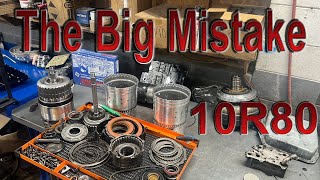
Aftermarket price range: $600-$1200 - Transmission Overhaul Kit — Required if internal mechanical failure, such as the one-way clutch (OWC) or CDF drum, is diagnosed. The kit includes all necessary seals, gaskets, and clutches for a rebuild. 🎬 See this walkthrough of common failures and clutch kit upgrades.
Trusted brands: Motorcraft, Suncoast Performance
OEM price range: $1500-$2500
Aftermarket price range: $800-$1500 - One-Way Clutch (OWC) — Specifically cited in TSB 26-2112 as a cause for P2701. It is typically replaced as part of a full transmission overhaul. [TSB 26-2112]
Trusted brands: Motorcraft
OEM price range: $200-$400
Aftermarket price range: $150-$300 - Transmission Filter
(OEM #LP5Z-7A098-A (10R60))— Should always be replaced when the transmission pan is removed for service, such as a valve body replacement.
Trusted brands: Motorcraft
OEM price range: $30-$50
Aftermarket price range: $20-$40
Related Codes That Often Appear With This One
- P0757 — Shift Solenoid 'B' Stuck On. TSB 26-2112 explicitly links this code with P2701 when a damaged one-way clutch is the cause. [TSB 26-2112]
- P2700, P2702, P2703, P2704, P2705 — These are apply time faults for the other friction elements ('A', 'C', 'D', 'E', 'F'). The presence of multiple codes from this group often points towards a systemic issue like a faulty main control valve body or a failing CDF drum affecting multiple circuits.
- P0729, P0731-P0736 — These are all various gear ratio error codes. Their presence alongside P2701 indicates the clutch apply fault is causing detectable transmission slippage in specific gears.
Technical Service Bulletins (TSBs) & Recalls
- TSB 26-2112: Links P2701 and P0757 to a damaged one-way clutch (OWC) causing the vehicle to be stuck in low gears.
- TSB 25-2302: Lists P2701 as one of many potential DTCs related to powertrain issues, often pointing to the valve body or software.
- TSB 24-2252: Also lists P2701 among many DTCs related to powertrain faults, superseded by newer bulletins.
- TSB 22-2428: A key TSB that groups P2701 with many other codes, pointing to sticking valves in the main control or a failing CDF clutch drum as potential causes.
- TSB 24-2046: A comprehensive TSB for the 10R80 that addresses harsh/delayed shifts due to solenoid strategy, sticking valves, and/or CDF clutch cylinder sleeve movement.
Platform-Specific Known Issues
- TSB 26-2112 notes that on some 2024 models, conditions like being unable to upshift past second gear with codes P0757 and P2701 may be due to a damaged one-way clutch (OWC). [TSB 26-2112]
- TSBs 25-2302, 24-2252, and 22-2428 list P2701 among a large group of transmission DTCs that can be stored due to issues within the powertrain, often related to the valve body on 2023 models. [TSB 25-2302, TSB 24-2252, TSB 22-2428]
- The 10R60/10R80 transmission has an adaptive learning strategy. After a repair or battery disconnect, the computer relearns shift points, which can cause firm or unusual shifting for several days. This is normal and should not be confused with a persistent fault.
Mechanic-Grade Diagnostic Values
- Shift Solenoid Resistance — expected: 5.0 - 5.4 ohms at 20°C (68°F). Failure: A reading outside this range indicates a faulty solenoid coil.
- Transmission Fluid Level Check Temperature — expected: 96°C - 101°C (206°F - 215°F). Failure: Checking the fluid outside this temperature range will result in an inaccurate level reading, which can cause shifting problems on its own.
Scan Tool Commands That Help
- Ford Diagnostic & Repair System (FDRS): Transmission Accelerated Main Control Break-In — This procedure is used when a sticking valve in the main control body is suspected. It rapidly cycles the solenoids with the vehicle on a lift to attempt to dislodge debris and free the valves, potentially avoiding a valve body replacement.
- Ford Diagnostic & Repair System (FDRS) with VCMM: CDF Drum Leakage Test (per TSB 25-2018) — This is a new diagnostic procedure that uses a pressure transducer (VCMM) to measure hydraulic pressure and calculate a leakage percentage for the CDF drum. It provides a definitive diagnosis of a failed CDF drum without requiring transmission removal, preventing unnecessary repairs.
Wiring & Ground Locations
- C168A — Main transmission electrical connector on the transmission case.. This is the primary connector for all electronic signals going to the transmission's internal solenoids and sensors. A poor connection, corrosion, or damage at this connector or its wiring can interrupt the signal to the Clutch 'B' solenoid, causing P2701.
- TCM/PCM Ground — The Powertrain Control Module (PCM), which incorporates the TCM functions, is grounded to the chassis/body at various points. A common issue on some Explorer platforms is a poor ground for the AWD module under the driver's seat, which can cause network communication issues affecting the transmission.. A poor ground can cause erratic behavior and communication faults between modules. While not a direct cause of P2701, verifying major control module grounds is a crucial step when diagnosing complex electronic faults.
Real Owner Repair Stories
- Ford F150 Forum (2017 Ford F-150 3.5L, 101,000 miles (Uses the same 10R80 transmission)) — Hard shifts and eventual transmission failure.
❌ Tried (didn't work) The owner was quoted for a replacement with a Jasper remanufactured transmission but was concerned it could have the same inherent defect.
✅ What actually fixed it A complete transmission rebuild by a specialty transmission shop that specifically addressed the CDF drum failure. The owner paid $7,000 for the rebuild, which resolved the issue. - Reddit r/fordexpedition (Ford Expedition with 10R80 transmission) — Recurring hard shifting between 3rd and 4th gear.
❌ Tried (didn't work) Trip 1: PCM and TCM reprogram., Trip 2: Dealership found C clutch catching, replaced CDF drum and valve body., The problem returned 4 months after the second repair.
✅ What actually fixed it The final, successful repair involved replacing the CDF drum again, along with the F clutch outer shell, ring gear, and other components that appeared burned. The user suspected the previous repair may have failed due to other damaged parts being overlooked or an incorrect fluid level after service.
OEM Part Supersession History
L1MZ-7A100-A, L1MZ-7A100-E→L1MZ-7A100-K— Internal revisions to the valve body to improve durability and address shifting concerns.
Heads up: L1MZ-7A100-C is listed for the 2020-2023 Explorer 3.3L Hybrid. It is critical to verify the correct part number with the vehicle's VIN, as multiple versions exist for different engine and drivetrain combinations.JL3Z-7A100-A→JL3Z-7A100-C— Updated main control valve body for 10R80 transmissions in F-150 and Expedition models, often to address issues like sticking TCC valves.
Heads up: This part is typically for column-shift models like the F-150/Expedition and may not be correct for the Explorer. Always verify by VIN.
Model Year Variations Within This Range
- Pre-August 16, 2022: Vehicles built before this date may have the original CDF clutch drum design, which is prone to the bushing 'walking' out of place. Vehicles built after this date should have an updated 'stepped' drum from the factory that prevents this failure. When repairing an older transmission, only the updated part should be used.
Helpful Videos
Used OEM Parts in Stock


New Aftermarket Parts Available

The information in this article is provided for general reference and educational purposes only. Vehicle specifications, procedures, and part compatibility can vary by production date, trim level, and region. Always consult your vehicle's factory service manual and verify part numbers before purchasing or performing repairs. Safety-critical components such as airbags, seat belts, and braking systems should be installed by a qualified professional.
- Ford EXPLORER:
- 🎬 Helpful Videos
- 🛍️ Shop This Part
- What's Unique About the 2023-2025 Ford EXPLORER
- Diagnostic Flowchart
- Symptoms You May Notice
- Most Likely Causes
- Rare But Worth Checking
- Diagnosis Steps
- Parts You'll Likely Need
- Related Codes That Often Appear With This One
- Technical Service Bulletins (TSBs) & Recalls
- Platform-Specific Known Issues
- Mechanic-Grade Diagnostic Values
- Scan Tool Commands That Help
- Wiring & Ground Locations
- Real Owner Repair Stories
- OEM Part Supersession History
- Model Year Variations Within This Range
- 🎟️ Get 5% Off