

P2135 on 2009-2013 Subaru Forester 2.5L: Throttle Sensor Failure Causes and Fixes
On a 2009-2013 Forester, P2135 is almost always caused by a failed throttle position sensor, which is part of the throttle body assembly. The fix is to replace the entire throttle body. Expect to pay $100-$250 for an aftermarket part or over $700 for OEM. It's a straightforward DIY job for many, but a detailed throttle relearn procedure is required after replacement.
- P2135 on your Forester means you likely need a new throttle body assembly; the sensor inside has failed.
- Before replacing parts, check simple things: ensure your floor mat isn't blocking the pedal and inspect the throttle body wiring connector and engine ground straps.
- Symptoms are serious and include 'limp mode,' making the car unsafe to drive in traffic.
- Do not replace the gas pedal sensor; the problem is almost always at the engine's throttle body.
- An aftermarket throttle body can save you hundreds of dollars, but a detailed 'relearn' procedure is mandatory after replacement for the car to idle and drive correctly.
What's Unique About the 2009-2013 Subaru Forester
For this generation of Subaru Forester, the throttle position sensor (TPS) is not sold as a separate, replaceable part. It is integrated into the electronic throttle body assembly. While on some other vehicles (like certain GM models) a sensor repair kit or cover is available under a TSB, for the Forester, a P2135 code almost always necessitates the replacement of the entire throttle body unit. A critical difference exists within this generation: 2009-2010 models use the EJ253 engine, while 2011-2013 models use the FB25 engine, which utilize different throttle body part numbers.
Symptoms You May Notice
- Check Engine Light is on
- Flashing 'Cruise Control' light (common Subaru behavior with a CEL)
- Vehicle enters 'limp mode' with severely reduced engine power
- Hesitation or surging when accelerating
- Poor or no throttle response
- Engine may stall when coming to a stop
- Rough or high idle, potentially sticking around 1500-2000 RPM
- Replacing the Accelerator Pedal Position (APP) Sensor. P2135 specifically refers to a correlation issue between the two sensors on the throttle body itself, not the pedal sensor. A faulty pedal sensor would typically set a different code, such as P2138.
Most Likely Causes
- Failing Throttle Body Assembly (Integrated Throttle Position Sensor) 🔴 High Probability The throttle position sensor is an electronic component with internal carbon wipers that wear out over time, leading to erratic signals or dead spots. On this platform, the sensor is integrated into the throttle body and not serviced separately. Cold weather can sometimes worsen the symptoms as the worn internal contacts shrink and make poorer connection.
How to confirm: Use an OBD-II scan tool to monitor live data for TP Sensor 1 and TP Sensor 2. As the accelerator is slowly pressed, the voltage readings should be smooth and track each other (one is typically half the voltage of the other). If one sensor shows erratic jumps, dropouts, or doesn't follow the other, the throttle body has failed.
Typical fix: Replace the entire electronic throttle body assembly. After installation, perform a detailed throttle relearn procedure.
Est. part cost: $100-$400 - Damaged Wiring or Poor Connection ⚪ Low Probability The wiring harness connector at the throttle body is exposed to engine heat and vibration, which can cause wires to break inside the insulation or terminal crimps to loosen over time. Ground connections, particularly on the intake manifold, can also corrode and cause issues.
How to confirm: With the key off, disconnect the throttle body connector and inspect for corrosion, moisture, or bent/backed-out pins. Tug gently on each wire to ensure it's secure in the connector; breaks often occur within 1-4 inches of the connector. Perform a wiggle test on the harness while monitoring live sensor data. Also, locate and inspect the main engine ground straps, especially any connected to the intake manifold. As a simple first step, some owners have fixed the issue by just unplugging, cleaning with compressed air, and firmly reseating the connectors at the throttle body, accelerator pedal, and ECM.
Typical fix: Repair the damaged section of wiring, replace the connector pigtail, or clean and tighten a corroded ground connection. Apply dielectric grease to the connector to prevent future moisture intrusion.
Est. part cost: $15-$50
Rare But Worth Checking
- Faulty Powertrain Control Module (PCM/ECM): This is extremely rare. The PCM should only be considered after definitively ruling out the throttle body and its wiring with proper testing.
- Physical Obstruction: In rare cases, a foreign object can interfere with sensor readings. A dislodged floor mat can prevent the accelerator pedal from achieving its full range of motion, causing a discrepancy with the throttle plate's expected position. Even more rarely, debris like a small pebble could enter the intake and physically jam the throttle plate.
Diagnosis Steps
- Check battery voltage. Low voltage can cause various electronic issues, so ensure the battery is healthy (12.4V+ with key off) and fully charged before proceeding.
- Connect an OBD-II scanner and confirm P2135 is the primary code. Note any other codes present.
- Check for physical obstructions. Ensure the floor mat is properly secured and not interfering with the accelerator pedal's movement.
- Using the scanner's live data function, graph the voltage for 'Throttle Position Sensor 1' and 'Throttle Position Sensor 2'.
- With the key on and engine off, slowly press the accelerator pedal to the floor and release it. The two voltage readings should mirror each other smoothly. One should read about half of the other at all times. If one signal is erratic, drops to zero, or is flat, the throttle body assembly is almost certainly faulty.
- If the signals seem normal, turn the vehicle off and inspect the wiring harness and connector at the throttle body. Look for corrosion, loose pins, or damaged wires. Perform a 'wiggle test' on the harness while watching the live data to see if you can induce the fault.
- Inspect engine ground connections, paying close attention to any grounds attached to the intake manifold, as a poor ground was a confirmed fix in one case.
- If wiring and grounds appear solid, and the sensor data is confirmed to be faulty, replace the throttle body assembly.
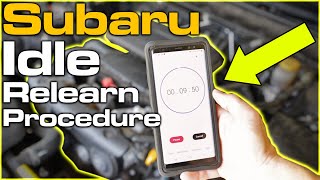
- After replacement, perform the full 🎬 Watch: How to perform the Subaru idle relearn procedure Idle Relearn Procedure (see Parts section for details). Do not skip this step.
Parts You'll Likely Need
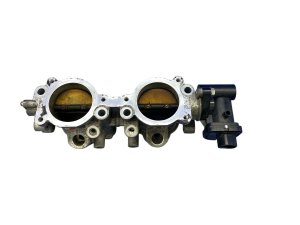
- Electronic Throttle Body Assembly
(OEM #16112AA380 (2011-2013), 16112AA180 (superseded by 16112AA300 for 2009-2010). Part 16112AA380 may also be superseded by 16112AA38A.)— This is the most common cause of P2135, as the internal non-serviceable throttle position sensor fails. Some sources suggest a used OEM part may be more reliable than a new aftermarket one due to better software compatibility.
Trusted brands: Subaru (OEM), Hitachi (Often the OEM supplier), Standard Motor Products (SMP), Dorman, Cardone
OEM price range: $700-$800
Aftermarket price range: $100-$400
Technical Service Bulletins (TSBs) & Recalls
- No specific Subaru TSB for P2135 on this model was found in searches. However, GM issued TSB 11-06-04-007B for a similar issue on their vehicles, which involved replacing a TPS cover and reprogramming the ECM instead of replacing the entire throttle body, indicating this is a known failure pattern across the auto industry. In some cases, GM also issued a software update to increase the time delay before flagging the fault, as the original 2-second threshold was too sensitive.
Platform-Specific Known Issues
- Owner Experience: Faulty Ground on Intake Manifold: In a documented case on a German Subaru forum for a Forester SH (same generation), a user with code P2135 ultimately traced the problem to a poor ground connection on the intake manifold. After cleaning and re-securing the ground cable, the code was resolved. This suggests checking engine grounds as a key diagnostic step before replacing expensive parts.
- Owner Experience: Floor Mat Obstruction: A user on LegacyGT.com reported getting a P2135 code because their unsecured floor mat was sliding forward and physically preventing the accelerator pedal from returning to its idle position or achieving full travel. The ECM saw a discrepancy between the pedal sensor reading and the throttle sensor reading, triggering the code. Securing the floor mat fixed the issue.
- Owner Experience: Simple Connector Reseating: A YouTube user commented that after struggling with P2135 for years and spending thousands, the final fix was to simply disconnect, blow out with compressed air, and firmly reseat every related wire harness: the one at the throttle body, the one at the gas pedal, and both plugs on the ECM. This took 10 minutes and solved the problem, highlighting the importance of checking simple connections first.
- Owner Experience: Debris in Throttle Body: While diagnosing a related code (P2109), a user on i-club.com found a tiny pebble wedged in the throttle body, preventing the plate from moving correctly. Such a physical blockage could easily cause the sensor correlation error of P2135. This is more likely to occur after work has been done on the air intake system.
Mechanic-Grade Diagnostic Values
- Throttle Position Sensor 1 (Main) Voltage — expected: Approx. 0.5V - 0.7V at idle (closed throttle), sweeping smoothly up to approx. 4.5V at wide-open throttle (WOT).. Failure: Voltage is erratic, jumps, or has dead spots when the throttle is opened slowly. Does not correlate with Sensor 2.
- Throttle Position Sensor 2 (Sub) Voltage — expected: Sweeps smoothly in correlation with Sensor 1. Often operates in an inverse relationship or at a different voltage ratio (e.g., one sensor sweeps 0.5-4.5V while the other sweeps 4.5-0.5V).. Failure: Voltage is erratic, jumps, or has dead spots. Does not correlate with Sensor 1.
- ECM Fault Trigger Time (2010 Model) — expected: Signal correlation must be maintained continuously.. Failure: The ECM flags P2135 if the difference between Sensor 1 and Sensor 2 signals persists for more than 212 milliseconds.
- 5V Sensor Reference Voltage — expected: Steady 5.0V at the throttle body connector (Pin 5 to Pin 3).. Failure: Voltage is low, high, or unstable, indicating a wiring or ECM issue.
Scan Tool Commands That Help
- Subaru Select Monitor (SSM): Current Data Display / Save — This is the primary function used to view and graph the live data streams for 'Throttle Opening Angle %' and 'Throttle Sensor Voltage V' from both sensors simultaneously to check for correlation issues.
- Subaru Select Monitor (SSM): Clear Memory — Used after the repair is complete to clear the P2135 code from the ECM's memory. This is a necessary step before performing the idle relearn procedure.
Wiring & Ground Locations
- E57 (Throttle Body Connector) — The 6-pin electrical connector that plugs directly into the electronic throttle body assembly.. This is the single point of failure for all throttle body electrical signals. Corrosion, moisture, or loose pins here will directly cause a P2135 code. A 'wiggle test' of this connector is a key diagnostic step.
- E57 Pinout — Pin assignments on the throttle body connector. A likely configuration is: Pin 1: Motor (+), Pin 2: Motor (-), Pin 3: Sensor Ground (0V), Pin 4: TPS Sub-signal, Pin 5: 5V Reference, Pin 6: TPS Main-signal.. Knowing the pinout allows a technician to perform targeted voltage and ground tests with a multimeter directly at the component, definitively confirming if the throttle body or the wiring is at fault.
- Intake Manifold Ground — A primary engine ground point typically bolted directly to the metal intake manifold.. The throttle body is mounted to the intake manifold. A poor or corroded ground at this location can create a floating ground or voltage offset, causing the sensor readings to become unreliable and trigger a correlation fault.
- B21 (Engine to Bulkhead Connector) — A large, 54-pin connector that joins the main engine wiring harness to the bulkhead (firewall) harness.. This is a major junction for all engine sensor signals going to the ECM. While a failure here is less common, a poor connection at this passthrough could also cause the P2135 code.
Real Owner Repair Stories
- Reddit user in r/350z (different vehicle, same code logic) (Nissan 350Z) — P2135 code, limp mode.
❌ Tried (didn't work) Chasing wiring issues from ECM through harness., Replacing one of the two throttle position sensors.
✅ What actually fixed it The problem was a new, but cheap, aftermarket throttle position sensor. Its signal was erratic and could not properly synchronize with the other OEM sensor. Replacing the entire throttle body assembly with a quality OEM part resolved the issue instantly, highlighting that poor quality replacement parts can be the root cause. - Comment on HVAC Mechanic YouTube video (General Motors application) (GM Vehicle) — Recurring P2135 code over several years, limp mode.
❌ Tried (didn't work) Spending thousands of dollars on various part replacements.
✅ What actually fixed it The final fix was to systematically disconnect, clean with compressed air, and firmly re-seat the electrical connectors at the throttle body, the accelerator pedal, and the ECM. This simple 10-minute procedure solved a multi-year problem, indicating a persistent but minor connection issue (fretting corrosion) was the cause.
OEM Part Supersession History
16112AA180→16112AA300— Standard part revision/update.16112AA380→16112AA38A— Standard part revision/update.
Heads up: This part is not backwards compatible with 2009-2010 models due to the engine change.
Model Year Variations Within This Range
- 2009-2010: These models use the SOHC EJ253 engine. The correct throttle body is part number 16112AA180 or its successor, 16112AA300. This engine uses a timing belt.
- 2011-2013: These models use the newer DOHC FB25 engine. The correct throttle body is part number 16112AA380 or its successor, 16112AA38A. This engine uses a timing chain. The parts are not interchangeable with the earlier models.
Diagnostic Flowchart
Used vs. New Parts: Buying Guide for This Vehicle
When a used part is the smart pick: A used OEM throttle body from a low-mileage donor vehicle can be a very smart choice. Forum and technician experience suggests that a genuine Subaru/Hitachi part, even used, is often more reliable and less likely to have software or calibration issues than a brand-new, non-OEM aftermarket part.
Donor-vehicle mileage cap: roughly under 80000 miles for the part to have meaningful remaining life.
What to inspect on the donor part:
- Verify the part number matches your specific model year (EJ253 vs. FB25 engine).
- Inspect the electrical connector pins for any signs of corrosion, bending, or moisture.
- Look at the throttle plate; it should be relatively clean with minimal carbon buildup.
- Ask for the donor vehicle's mileage if possible; lower is always better.
Aftermarket brands forum-validated for this vehicle:
- Hitachi (often the original equipment manufacturer for Subaru)
Brands owners have reported issues with on this vehicle:
- Unnamed or 'white-box' brands from online marketplaces have been reported by owners to be faulty out of the box or fail prematurely, sometimes causing the same P2135 code to return due to an inability to sync properly.
Real Owner Stories
Aggregated from forums and TSBs cited above. Mileages and costs reflect what owners reported in those sources.
2009-2013 Subaru Forester EJ253 2.5L
Symptoms: Vehicle was triggering a P2135 trouble code.
What fixed it: The problem was traced to a poor ground connection on the intake manifold. Cleaning and re-securing the ground cable resolved the code.
Source hint: German Subaru forum for a Forester SH
2006-2012 Subaru Legacy 2.5L (EJ253)
Symptoms: The vehicle's computer logged a P2135 code because it detected a discrepancy between the accelerator pedal sensor and the throttle position sensor readings.
What fixed it: Securing an unsecured floor mat that was physically preventing the accelerator pedal from moving through its full range of motion.
Source hint: LegacyGT.com
2009-2013 Subaru Forester EJ253 2.5L
Symptoms: Owner struggled with a persistent P2135 code for years.
What fixed it: The final fix was to simply disconnect, blow out with compressed air, and firmly reseat the wire harness connectors at the throttle body, the gas pedal, and both plugs on the ECM.
Source hint: YouTube user comment
2006-2011 Subaru Impreza 2.5L (EJ253)
Symptoms: A throttle-related code was set because the throttle plate was not moving correctly.
What fixed it: A tiny pebble was found wedged in the throttle body, preventing the plate from moving freely. Removing the debris fixed the issue.
Source hint: i-club.com
Related OBD-II Codes
Frequently Asked Questions
Is the throttle position sensor (TPS) on my 2011 Forester replaceable by itself, or do I need the whole assembly?
My Forester started showing P2135 and a flashing cruise light, especially in cold weather. Is this a known issue?
After I replace the throttle body on my Forester, is there any special procedure I need to follow?
Are there any official Subaru recalls or Technical Service Bulletins (TSBs) for code P2135 on this Forester model?
Before spending hundreds on a new throttle body, what are some simple, cheap things I should check first?
Is it a bad idea to buy a used throttle body from a junkyard for my Forester?
Helpful Videos
Used OEM Parts in Stock


New Aftermarket Parts Available


The information in this article is provided for general reference and educational purposes only. Vehicle specifications, procedures, and part compatibility can vary by production date, trim level, and region. Always consult your vehicle's factory service manual and verify part numbers before purchasing or performing repairs. Safety-critical components such as airbags, seat belts, and braking systems should be installed by a qualified professional.
- Subaru Forester:
- 🎬 Helpful Videos
- 🛍️ Shop This Part
- What's Unique About the 2009-2013 Subaru Forester
- Symptoms You May Notice
- Most Likely Causes
- Rare But Worth Checking
- Diagnosis Steps
- Parts You'll Likely Need
- Technical Service Bulletins (TSBs) & Recalls
- Platform-Specific Known Issues
- Mechanic-Grade Diagnostic Values
- Scan Tool Commands That Help
- Wiring & Ground Locations
- Real Owner Repair Stories
- OEM Part Supersession History
- Model Year Variations Within This Range
- Diagnostic Flowchart
- Used vs. New Parts: Buying Guide for This Vehicle
- Real Owner Stories
- 2009-2013 Subaru Forester EJ253 2.5L
- 2006-2012 Subaru Legacy 2.5L (EJ253)
- 2009-2013 Subaru Forester EJ253 2.5L
- 2006-2011 Subaru Impreza 2.5L (EJ253)
- Related OBD-II Codes
- Frequently Asked Questions
- 🎟️ Get 5% Off