

OBD-II Code P0122: Throttle Position Sensor 'A' Circuit Low
The Ultimate Guide to What P0122 Means, Why It Triggers, and How to Fix It for Good
- Test the 5-volt reference and ground wires at the sensor connector before buying parts; a $10 wiring short causes the exact same P0122 code as a $150 failed sensor.
- Do not drive with an active P0122 code for more than a few days, as the resulting rich fuel mixture will permanently destroy a $1,500 catalytic converter.
- On most vehicles built after 2005, the TPS is permanently integrated into the electronic throttle body, requiring a full $300-$800 assembly replacement rather than a simple sensor swap.
- Always perform a manufacturer-specific throttle relearn procedure after replacing the sensor or throttle body to calibrate the new 0.5V idle baseline and prevent the code from returning.
What Does P0122 Mean?

The P0122 code means the Powertrain Control Module (PCM) detects a voltage signal from the 'A' throttle position sensor (TPS) below the normal operating range. The computer expects around 0.5 volts when your foot is off the gas pedal; a drop below 0.2 volts triggers the code. This deprives the computer of the accurate throttle data needed to precisely manage the air-fuel mixture, ignition timing, and transmission shift points.
Technical definition: The official SAE/OBD-II definition is "Throttle/Pedal Position Sensor/Switch 'A' Circuit Low Input." The PCM detects that the TPS 'A' circuit voltage is below the manufacturer's specified baseline, indicating an internal sensor failure, 🎬 Watch: A breakdown of P0122 causes and diagnostic steps. an open circuit, or a short to ground in the signal wire.
Can I Drive With P0122?
Yes, But With Caution. You can drive short distances, but it is a safety hazard. Unpredictable engine behavior like hesitation and stalling occurs frequently in traffic. Continuing to drive forces the Powertrain Control Module (PCM) to run a rich fuel mixture, which overheats the catalytic converter and turns a $100 sensor fix into a $2,000 exhaust repair.
Common Causes

- Faulty Throttle Position Sensor (TPS) (Very Common) — The mechanical wiper inside potentiometer-type sensors wears out from constant throttle movement, creating dead spots or internal shorts. These sensors typically fail between 60,000 and 100,000 miles.
- Wiring and Connector Issues (Common) — Engine bay heat and vibration make wiring harnesses brittle, causing breaks or chafing that shorts the signal wire to ground. Connector pins also loosen or corrode, dropping the signal entirely.
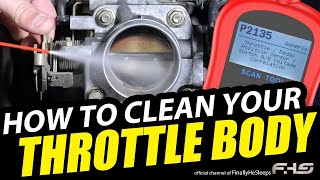
- Dirty or Malfunctioning Throttle Body (Less Common) — Heavy carbon buildup prevents the throttle plate from closing completely. 🎬 See how to clean your throttle body to fix sensor codes. This blocks the sensor from returning to its proper 0.5V idle baseline, confusing the PCM.
- Improperly Mounted or Adjusted Sensor (Less Common) — A loose sensor or one installed without proper base voltage calibration sends an inaccurate signal. This often happens immediately after a DIY replacement.
- Physical Pedal or Cable Obstruction (Rare) — A bunched-up floor mat or a slack mechanical throttle cable prevents the pedal or throttle plate from returning to the fully closed position, creating a signal mismatch.
- Faulty Powertrain Control Module (PCM) (Very Rare) — The main computer fails to process the TPS signal or drops the 5-volt reference signal. Suspect this only after exhausting all wiring and sensor tests.
Symptoms

- Hesitation or Stumbling on Acceleration — The car has a 'dead spot' when pressing the gas pedal, causing a noticeable delay before power kicks in.
- Engine Stalling — The engine shuts off unexpectedly when coming to a stop, driving at low speeds, or immediately after starting.
- Reduced Engine Power ('Limp Mode') — The computer intentionally limits engine speed and power to prevent damage, making the car sluggish and unable to accelerate past 30-40 mph.
- Erratic Transmission Shifting — The transmission shifts harshly, at the wrong times, or refuses to downshift because the control module lacks accurate throttle data.
- Rough, Low, or High Idle — Engine RPMs bounce erratically, idle excessively high, or drop low enough to shake the vehicle.
- Poor Fuel Economy — Lacking correct throttle data, the computer injects excessive fuel, dropping MPG by up to 30% and causing a raw fuel smell from the exhaust.
- Check Engine Light On — The Malfunction Indicator Lamp (MIL) illuminates immediately upon detecting the low voltage condition.
Diagnostic Flowchart

Tap your situation to follow the diagnostic path that matches what you're seeing on this code.
Common Fixes & Costs
- Replace Throttle Position Sensor (TPS)
— Parts: $30-$120, Labor: $80-$200, ~1 hr book time
(DIY)
2004 Jeep Grand Cherokee (4.0L): OEM - Replace Throttle Body Assembly
— Parts: $250-$700, Labor: $100-$200, ~1.2 hr book time
(Professional)
2005 Ford F-150 (5.4L): OEM - Repair or Replace Wiring/Connector — Parts: $10-$50, Labor: $100-$250, ~1.5 hr book time (Intermediate)
- Clean Throttle Body — Parts: $5-$15, Labor: $75-$150, ~0.8 hr book time (DIY)
- Perform Throttle Body Relearn/Calibration — Parts: $0, Labor: $0-$100, ~0.3 hr book time (DIY)
Used vs. New Parts: Buying Guide
When a used part is worth it: For older vehicles with a standalone TPS, a used OEM sensor is cost-effective. For integrated throttle bodies, a used assembly from a rear-end collision vehicle saves significant money but carries risk.
Donor-vehicle mileage cap: roughly under 60000 miles for the part to have meaningful remaining life.
Donor quality checklist:
- Verify the part number matches exactly.
- Inspect the connector for corrosion, cracks, or brittle wiring.
- For throttle bodies, ensure the butterfly valve moves smoothly without binding.
Decision logic:
- If Part is a standalone TPS and new OEM is < $100 → Buy new for warranty and reliability; savings on a used part are minimal.
- If Part is an expensive integrated throttle body and budget is tight → A used part is viable, but accept the risk of a shorter lifespan and no warranty.
- If The vehicle is critical for daily use → Favor a new OEM or reputable aftermarket part to avoid repeat labor costs.
Warranty tradeoff: Used parts offer a 30-90 day warranty. New aftermarket parts offer 1-year to limited lifetime. New OEM parts carry a 12-month/12,000-mile warranty.
Worst-case if a used part fails: 300-800 if a used throttle body fails after installation, requiring repeat labor and parts.
What Happens If You Wait — Timeline
- 0-1 month: Check Engine Light is on. Vehicle has a slightly rough idle or minor hesitation on acceleration. (MPG impact: 0-5%% · Added cost: $0-25 in wasted fuel)
- 1-3 months: Drivability issues become pronounced. Engine stalls when stopping, hesitates badly, or enters 'limp mode'. Transmission shifts harshly. (MPG impact: 10-20%% · Added cost: $50-100 in wasted fuel)
- 3-6 months: The PCM commands a consistently rich fuel mixture. The catalytic converter begins overheating, and spark plugs show carbon fouling. (MPG impact: 20-30%% · Added cost: $200-400 (fouled plugs, O2 sensor damage) + $100-250 in wasted fuel)
- 6+ months: Sustained high temperatures melt the internal substrate of the catalytic converter, causing complete failure and exhaust blockage. (MPG impact: 25%+% · Added cost: $1200-2800+)
Cost of Not Fixing It
- 0-1 month: Significant drop in fuel economy (up to 30%), poor drivability (hesitation, stalling), and unsafe driving conditions. (Added cost: 50-150 in wasted fuel)
- 1-6 months: The consistently rich fuel mixture overheats and damages the catalytic converter, leading to complete failure. (Added cost: 1200-2800)
- 6+ months: Prolonged rich conditions foul spark plugs and oxygen sensors. Chronic engine knock from incorrect timing leads to piston damage. (Added cost: 300-1500+)
Diagnosis Steps
- Read the Trouble Codes
Use an OBD-II scanner to confirm P0122. Note accompanying codes (like P0123 or P2135) and document freeze frame data to see exact engine conditions when the fault occurred.
Tools: OBD-II Scanner (Beginner) - Visually Inspect the Sensor and Wiring
Locate the TPS on the throttle body. Check for cracked wiring, loose connector pins, or oil contamination. Ensure the sensor mounts securely and the connector clicks into place.
Tools: Flashlight (Beginner) - Check Live Data with a Scanner
With key on, engine off, view TPS voltage on a scanner. It must read ~0.5V at closed throttle and smoothly increase to ~4.5V at wide-open throttle. A value stuck below 0.2V confirms the fault.
Tools: OBD-II Scanner with Live Data (Intermediate) - Test the Sensor Circuit with a Multimeter
Unplug the sensor. With key on, engine off, probe the harness connector. You must find a 5-volt reference wire from the PCM and a ground wire (near 0V). Missing voltage indicates a wiring or PCM fault.
Tools: Digital Multimeter (Intermediate) - Back-Probe the Signal Wire
Reconnect the sensor and back-probe the signal wire. Slowly open the throttle by hand. Voltage must sweep smoothly from 0.5V to 4.5V without dropping out. Drops to 0V indicate a dead spot inside the sensor.
Tools: Digital Multimeter, T-pins or back-probe kit (Intermediate) - PRO TIP: Perform a 'Wiggle Test'
While watching live data or listening to the idling engine, carefully wiggle the TPS wiring harness. Wild voltage fluctuations or engine stumbling pinpoints an intermittent short or open wire.
Tools: OBD-II Scanner or listening ear (Advanced) - Check for a Short to Ground
If the signal wire shows 0V consistently, disconnect the TPS and PCM. Test the signal wire for continuity to ground. Continuity confirms a shorted harness that requires repair.
Tools: Digital Multimeter, Vehicle-specific wiring diagram (Advanced) - Test Sensor Resistance
With the sensor unplugged, measure resistance between the signal and ground pins. Slowly actuate the sensor; resistance must sweep smoothly. A jump to infinite or zero ohms confirms internal failure.
Tools: Digital Multimeter (Advanced)
When This Code Triggers (Freeze-Frame Conditions)
- Engine Coolant Temp: 175-210°F (Fully warmed up)
- RPM: 650-850 (At idle, or just off-idle)
- Engine Load: 15-30% (Low load, steady state or deceleration)
- Vehicle Speed: 0-10 mph (Vehicle stopped or at very low speed)
Related Codes
- P0120 — A generic malfunction code for the TPS 'A' circuit. It appears with P0122 if the sensor signal is missing entirely during a PCM self-test.
- P0121 — Indicates the TPS signal is erratic or not correlating with the MAP sensor. A failing sensor causes both codes.
- P0123 — The direct opposite of P0122, indicating the signal voltage is too high (short to power).
- P2135 — Indicates a voltage mismatch between two different throttle position sensors ('A' and 'B') on an electronic throttle body.
Climate & Environmental Factors
- Cold Weather: Cold temperatures contract materials, turning a marginal electrical connection into an open circuit. This triggers P0122 on startup, which sometimes resolves once the engine bay warms up.
- High Humidity / Moisture: Moisture penetrates weathered connector seals, leading to corrosion on the pins or a short circuit to ground. This causes intermittent P0122 codes after driving through heavy rain or car washes.
How to Talk to a Mechanic About This Code
Say this: "I have a P0122 code. Please ensure the technician tests the throttle position sensor's 5-volt reference, ground, and signal wire sweep before recommending a part. I'd also like them to perform a wiggle test on the harness."
This signals you understand the fault could be the sensor, wiring, or connector. It directs the shop to perform a comprehensive diagnosis rather than just replacing the most common part.
Avoid saying:
- 'Just fix whatever's wrong'
- 'My check engine light is on, can you look at it?'
- 'Whatever you recommend'
Questions to ask before authorizing the repair:
- What were the results of the voltage tests on the sensor's reference, ground, and signal wires?
- If recommending a new sensor, what specific failure did you find with the old one?
- If recommending a new throttle body, can you confirm the sensor is not sold separately for my car?
- Will you perform a throttle relearn procedure after the repair?
- What is the warranty on this repair, including parts and labor?
Where to Take It: Dealer vs Independent vs Chain
- Dealer:
Best for: Vehicles under powertrain or emissions warranty, Complex electronic throttle body issues on newer vehicles, Repairs where a manufacturer TSB exists
Downsides: Highest labor rates, often 1.5x to 2x an independent shop., More likely to replace an entire assembly rather than perform a component-level repair. (Typical cost: +50% vs. baseline) - Independent Shop:
Best fit. A reputable independent shop offers the best balance of cost and expertise for a common code like P0122.
Best for: Most out-of-warranty P0122 repairs, Diagnosing and repairing common wiring and connector issues, Vehicles where the TPS is a well-known failure item
Downsides: Diagnostic skill and equipment quality vary widely; vet shops by checking for ASE certifications. (Typical cost: +0% vs. baseline) - Chain Shop:
Use with caution. Acceptable for a straightforward TPS replacement, but AVOID for initial diagnosis of drivability problems or wiring issues.
Best for: If you have already performed the diagnosis yourself and only need a standalone TPS sensor installed
Downsides: Technician skill varies dramatically., Lacks advanced diagnostic tools to trace intermittent electrical faults., Business model pressures technicians to upsell. (Typical cost: -10% vs. baseline)
When to Walk Away From the Repair
If the estimated repair cost exceeds 40-50% of the car's private-party value, seriously consider selling or trading in the vehicle instead of repairing it.
- Car worth $3500, fix is $450: Fix it. The repair cost is low compared to the car's value.
- Car worth $12000, fix is $950: Fix it. This is a reasonable cost for a vehicle of this value requiring a full throttle body assembly.
- Car worth $2500, fix is $1200: Walk away. The repair cost is nearly 50% of the car's value. Put this money toward a replacement vehicle.
What Scan Tool You Need for This Code

Minimum: An OBD-II scanner that displays live data, specifically the throttle position sensor voltage or percentage.
A basic $20 code reader only tells you P0122 is present. It cannot show the live sensor signal, forcing you to guess and replace parts blindly.
Budget: BlueDriver Pro Bluetooth Scanner (~$100) — Connects to your smartphone and graphs the live TPS voltage. This is sufficient to see if the signal is stuck low or has dropouts.
Mid-range: Innova 5610 or Foxwell NT604 Elite (~$150) — Offers live data graphing plus the ability to read codes from ABS and Transmission modules. Includes the special function needed for electronic throttle relearns on some vehicles.
Professional: Autel MaxiCOM MK808S or Topdon ArtiDiag800 BT (~$400-600) — Tablet-based tools offering full bidirectional control. They perform OEM-level diagnostics and throttle calibrations for almost any vehicle.
Rent vs buy: If this is a one-time diagnosis, major auto parts stores loan scanners for free. Buy a scanner only if you diagnose issues multiple times a year.
How to Clear the Code After You Fix It
- Use an OBD-II scan tool to clear codes
- Perform a throttle relearn procedure if applicable
- Complete a full drive cycle to reset readiness monitors
Drive cycle (~30 minutes): Cold start after sitting 8+ hours. Idle for 2-3 minutes with electrical loads on. Drive for 15 minutes with mixed city/stop-and-go conditions. Drive for 10 minutes at a steady highway speed (55-60 mph). Allow vehicle to cool down.
Readiness monitors affected: Catalyst Monitor, Evaporative System (EVAP) Monitor, Oxygen (O2) Sensor Monitor
Before emissions retest: drive at least 100 miles to fully set monitors.
Watch out for:
- Clearing the code resets all readiness monitors to 'Not Ready', causing an automatic emissions test failure.
- The code returns immediately if the underlying electrical fault has not been properly fixed.
- Not performing a manufacturer-specific drive cycle results in monitors taking weeks to set.
Will This Fail Emissions / State Inspection?
Yes — this code typically fails an OBD-II emissions inspection.
- California: An active P0122 code is an automatic failure. After repair, all OBD-II readiness monitors must be 'Ready' to pass the smog check.
- New York: A Check Engine Light on for P0122 results in an immediate test failure.
- Texas: An illuminated Check Engine Light is an automatic failure. After clearing the code, you can have at most one monitor 'Not Ready' to pass.
Most Commonly Affected Vehicles
- Jeep Grand Cherokee, Wrangler (TJ) (1997-2006) — The wiring harness near the sensor becomes brittle and cracks from engine heat, causing intermittent shorts. Wiggling the harness during diagnosis confirms this.
- Chevrolet / GMC Silverado, Blazer, S-10, Sierra (1998-2007) — A P0122 code is frequently accompanied by harsh transmission shifting, as the 4L60E/4L80E transmissions rely heavily on the TPS signal for shift control.
- Ford F-150, Explorer, Ranger (1996-2005) — Older Ford trucks frequently experience TPS failures. An OEM part is mandatory to avoid repeat failures from cheap aftermarket sensors.
- Dodge Ram, Dakota (1998-2007) — Known for TPS and wiring harness problems. Always inspect the wiring for internal breaks, even if the insulation looks intact.
- Volkswagen Golf, Jetta, Passat, Polo (2008-2015) — Common on 1.2L and 1.4L TSI engines. P0122 often appears with P0221 and P0222, indicating a failure of the entire Magneti Marelli throttle body unit.
- Kia / Hyundai Sorento, Optima, Santa Fe, Picanto (2004-2016) — A failing TPS causes severe hesitation and stalling. On some models, the sensor is a simple replacement; others require a full throttle body.
- Toyota Camry, Tundra, Tacoma (2000-2007) — A dirty throttle body causing the throttle plate to stick is a highly common culprit on these models and must be checked before replacing parts.
- Honda / Acura Civic, Accord, CR-V, RSX (K-series) (2001-2015) — The original TPS is riveted to the throttle body. Aftermarket sensors require drilling out the rivets and careful adjustment with a multimeter to set the 0.50V base idle voltage.
Manufacturer-Specific Notes
- General Motors (Chevy, GMC): A faulty TPS causes severe transmission shifting problems because the transmission control module (TCM) uses the TPS signal for shift logic. TSBs exist for wiring harnesses chafing near the engine block.
- Ford: On models 2005 and newer, the sensor is integrated into the electronic throttle body, requiring a full assembly replacement. Ford issued Customer Satisfaction Program 13N03 extending the warranty on the throttle body for some 2009-2013 models due to contamination.
- Volkswagen/Audi: On 1.2L and 1.4L TSI engines, codes P0122 and P0222 appear together. This combination almost always points to an internal failure of the entire Magneti Marelli throttle body unit.
- Chrysler/Jeep/Dodge: Notorious for wiring harness issues near the TPS connector. The wires become brittle from heat and break internally, causing an intermittent open circuit. A 'wiggle test' is mandatory.
Real Owner Stories
2004 Jeep Wrangler Unlimited at 179K miles - The Intermittent Fault
Check Engine Light came on with code P0122, causing the engine to enter 'limp mode' specifically in cold, damp weather.
What they tried:
- Replaced the TPS and coil pack.
- Reset the PCM.
- Fixed a vacuum leak.
Outcome: The problem persisted. This points strongly to a wiring or connector issue where moisture ingress or temperature changes cause an intermittent short. The owner had to meticulously inspect the wiring harness for cracks.
Lesson: If P0122 appears only in specific weather, it is a wiring or connector problem, not the sensor. Perform a 'wiggle test' on the harness while the engine is running.
1996 Ford F-150 5.0L - The Misdiagnosis Chain
Vehicle had code P0122, poor acceleration, and would not shift out of first gear.
What they tried:
- Replaced the TPS.
- Took it to a shop, which found no wiring breaks.
- Replaced the Engine Control Module (ECM).
Outcome: The owner was left with a non-shifting truck and the original P0122 code. The new ECM from a parts store was incorrect for the vehicle, causing the transmission issue. The root cause of P0122 was never found.
Lesson: Never replace the PCM/ECM unless it is definitively proven to be the failure point. Using an incorrect ECM introduces new, severe problems.
2013 Ford F-150 3.5L - The Wiring Rabbit Hole
Vehicle lost all power while driving and threw codes P0122, P0222 (TPS 'B' circuit low), and P06A8.
What they tried:
- Replaced the throttle body.
- Replaced the throttle body connector pigtail.
- Replaced the accelerator pedal position sensor.
- Replaced the PCM.
Outcome: Despite replacing nearly every component, the fault remained. An oscilloscope showed no signal change from the electronic throttle control. The final suspicion was a fault in the main PCM connector itself.
Lesson: When multiple circuit codes appear at once (P0122 and P0222), it points to a shared failure point like the throttle body assembly, a connector, or the PCM. Advanced tools prevent unnecessary parts replacement.
How to Prevent This Code From Triggering
- Clean the throttle body (Every 30,000-50,000 miles) — Removes carbon buildup that causes the throttle plate to stick, ensuring the TPS accurately tracks movement and prevents false readings.
- Inspect and protect engine wiring harnesses (During any under-hood maintenance) — Engine heat makes wiring insulation brittle. Securing harnesses away from hot engine parts prevents chafing and shorts.
- Apply dielectric grease to connector seals (When replacing a sensor or disconnecting a connector) — Seals the connector's rubber gasket from moisture, preventing corrosion on the electrical pins.
- Perform a periodic 'pedal dance' relearn (Annually or if idle issues develop) — Recalibrates the PCM to the sensor's current values, smoothing out minor performance issues before they trigger a code.
Frequently Asked Questions
What is the most common mistake when diagnosing P0122?
Immediately replacing the TPS without testing the wiring is the biggest mistake. A short to ground or corroded connector produces the exact same symptoms as a failed sensor. Always verify the 5V reference and ground first.
What's the difference between a potentiometer and Hall effect TPS?
A potentiometer uses a mechanical wiper that physically wears out over time, causing dead spots. A Hall effect sensor uses magnets to detect position without physical contact. Hall effect sensors are far more durable and rarely fail mechanically.
Can I just clean the throttle position sensor?
No, the sensor itself is a sealed electronic unit. However, cleaning the throttle body bore where the sensor mounts is highly recommended. Removing carbon buildup ensures the throttle plate closes fully, which resolves incorrect baseline readings.
Why did the P0122 code come back after I replaced the sensor?
A returning code usually points to an intermittent wiring short, a bad connector, or a cheap aftermarket sensor failing out of the box. It also happens if you skip the mandatory throttle relearn procedure. The PCM must be calibrated to the new sensor's baseline voltage.
What is a throttle 'relearn' procedure?
It is a calibration process that teaches the PCM the new sensor's exact voltage at closed and wide-open throttle. This usually involves a specific sequence of key turns and pedal presses, or using a bidirectional scan tool. Skipping this step guarantees poor idle and returning codes.
Can a bad TPS cause my transmission to act weird?
Yes, severely. The Transmission Control Module relies on the TPS signal to schedule gear shifts and control line pressure. A low voltage signal causes harsh shifting, delayed shifts, or a refusal to downshift.
Can a vacuum leak cause a P0122 code?
No. A vacuum leak introduces unmetered air, causing high idle and lean codes like P0171. It does not cause the TPS electrical circuit to drop below 0.2 volts, which is the specific trigger for P0122.
Key Takeaways
- Test the 5-volt reference and ground wires at the sensor connector before buying parts; a $10 wiring short causes the exact same P0122 code as a $150 failed sensor.
- Do not drive with an active P0122 code for more than a few days, as the resulting rich fuel mixture will permanently destroy a $1,500 catalytic converter.
- On most vehicles built after 2005, the TPS is permanently integrated into the electronic throttle body, requiring a full $300-$800 assembly replacement rather than a simple sensor swap.
- Always perform a manufacturer-specific throttle relearn procedure after replacing the sensor or throttle body to calibrate the new 0.5V idle baseline and prevent the code from returning.
Helpful Videos

The information in this article is provided for general reference and educational purposes only. Vehicle specifications, procedures, and part compatibility can vary by production date, trim level, and region. Always consult your vehicle's factory service manual and verify part numbers before purchasing or performing repairs. Safety-critical components such as airbags, seat belts, and braking systems should be installed by a qualified professional.
- 🎬 Helpful Videos
- What Does P0122 Mean?
- Can I Drive With P0122?
- Common Causes
- Symptoms
- Diagnostic Flowchart
- Common Fixes & Costs
- Used vs. New Parts: Buying Guide
- What Happens If You Wait — Timeline
- Cost of Not Fixing It
- Diagnosis Steps
- When This Code Triggers (Freeze-Frame Conditions)
- Related Codes
- Climate & Environmental Factors
- How to Talk to a Mechanic About This Code
- Where to Take It: Dealer vs Independent vs Chain
- When to Walk Away From the Repair
- What Scan Tool You Need for This Code
- How to Clear the Code After You Fix It
- Will This Fail Emissions / State Inspection?
- Most Commonly Affected Vehicles
- Manufacturer-Specific Notes
- Real Owner Stories
- 2004 Jeep Wrangler Unlimited at 179K miles - The Intermittent Fault
- 1996 Ford F-150 5.0L - The Misdiagnosis Chain
- 2013 Ford F-150 3.5L - The Wiring Rabbit Hole
- How to Prevent This Code From Triggering
- Frequently Asked Questions
- What is the most common mistake when diagnosing P0122?
- What's the difference between a potentiometer and Hall effect TPS?
- Can I just clean the throttle position sensor?
- Why did the P0122 code come back after I replaced the sensor?
- What is a throttle 'relearn' procedure?
- Can a bad TPS cause my transmission to act weird?
- Can a vacuum leak cause a P0122 code?
- Key Takeaways
- 🎟️ Get 5% Off