

P2111 on 2010-2019 Ford Taurus SHO: Throttle Stuck Open Causes & Fixes
This code almost always points to a faulty electronic throttle body (ETB). The vehicle may enter a reduced-power 'limp mode' with a wrench light on the dash. Replacing the ETB is the most common fix. Ford acknowledged this issue with Customer Satisfaction Program 16B32, which provided free replacements for a time. The Motorcraft replacement part is generally recommended, and the job is considered DIY-friendly.
- P2111 on a Ford Taurus SHO almost always means the electronic throttle body is failing.
- Symptoms include a wrench light, loss of power, and the car entering 'limp mode'.
- While cleaning the throttle body might help temporarily, replacement is the definitive fix.
- This is a common DIY repair that requires basic tools and a simple 'relearn' procedure afterward, which involves slowly pressing and releasing the accelerator pedal with the key on.
- Always check the electrical connector for damage or corrosion before replacing parts.
What's Unique About the 2010-2019 Ford Taurus

The 3.5L EcoBoost engine, along with other Ford engines of this era, is known for issues with the electronic throttle body. The problem became so widespread that Ford issued Customer Satisfaction Program 16B32 for many vehicles, including the 2016 Taurus, to replace the ETB free of charge. The root cause was identified as contamination of the electronic throttle body's internal motor contacts, which increases electrical resistance and leads to erratic behavior or failure. This issue is also documented in TSB 16-0139 and TSB 10-21-6.
Symptoms You May Notice
- Intermittent loss of power
- Illuminated Powertrain Malfunction (Wrench) light
- Check Engine Light is on
- Vehicle enters 'limp mode' with reduced engine power
- Rough or fluctuating idle.
- Vehicle may stall
- Unresponsive throttle pedal
- Dash messages such as "See Manual", "Service AdvanceTrac", and "Hill Start Assist Not Available".
- Replacing the accelerator pedal position (APP) sensor. While related to throttle control, a faulty APP sensor typically generates its own specific codes (e.g., P2135). However, P2135 can sometimes appear with P2111 if the throttle position sensor (part of the ETB) is failing.
Most Likely Causes

- Defective Electronic Throttle Body (ETB) 🔴 High Probability A widely known issue on many Ford platforms from this era, documented in TSBs and a Customer Satisfaction Program (16B32). Internal motor contacts get contaminated, or the internal plastic gears and actuator bearing can bind or fail. Moisture intrusion can also cause rust on internal components.
How to confirm: After removing the air intake hose, check if the throttle plate moves smoothly by hand (with the engine off). If it's sticky, binding, or makes gritty noises, the ETB is likely faulty. A scan tool can also monitor commanded vs. actual throttle position to look for discrepancies. In some cases, the failure is purely electronic and the plate may move freely.
Typical fix: Replacement of the entire electronic throttle body assembly. Cleaning is often a temporary fix at best, as the internal electronics are the primary failure point. Aftermarket and OEM (Motorcraft) parts are available. No special programming is typically required after replacement on this platform.
Est. part cost: $90-$250 - Dirty Throttle Body 🟡 Medium Probability PCV (Positive Crankcase Ventilation) systems can introduce oil vapor and carbon into the intake, which builds up around the throttle plate, causing it to stick. This is a common issue on all direct-injected engines.
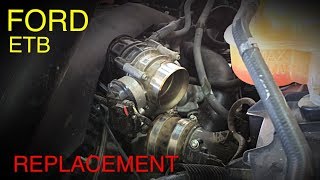
How to confirm: Visually inspect the throttle bore and plate for significant carbon and oil buildup after removing the air intake duct. 🎬 See this step-by-step replacement and calibration walkthrough. A thick ring of gunk can physically prevent the plate from closing fully.
Typical fix: Clean the throttle body thoroughly with a dedicated throttle body cleaner and a soft cloth or brush. This may resolve the issue if the buildup is the sole cause and the electronics are not yet damaged. Many owners report cleaning provides only temporary relief before the code returns, indicating the underlying electronic failure.
Est. part cost: $5-$15 - Wiring or Connector Issue ⚪ Low Probability Engine vibration and heat can degrade the wiring or connector over time. A poor connection at the throttle body can cause intermittent signals and trigger the code.
How to confirm: Inspect the wiring harness and connector going to the throttle body for any signs of damage, corrosion, or loose pins. Wiggle the connector with the engine running to see if it induces the fault. Check for chewed wires.
Typical fix: Repair the damaged wiring or clean/replace the connector pigtail.
Est. part cost: $15-$50
Rare But Worth Checking
- Powertrain Control Module (PCM) Fault: This is extremely rare. Before condemning the PCM, all other possibilities, especially the throttle body itself and its wiring, must be exhaustively ruled out. A damaged PCM is listed as a possible, but least likely, cause by Ford.
Diagnosis Steps

- Scan the PCM for any other stored trouble codes. Note codes P2112, P2119, and P2135 if present, as they strongly indicate a throttle body issue.
- With the engine off, remove the air intake duct from the throttle body. This typically involves loosening an 8mm hose clamp.
- Inspect the throttle body bore and plate for heavy carbon or oil buildup.
- Gently push the throttle plate open and let it snap shut. It should move smoothly without sticking or binding. Any grittiness or binding points to an internal mechanical failure.
- Inspect the electrical connector and wiring harness at the throttle body for any damage, corrosion, or loose pins. Ensure the connector is fully seated.
- If the throttle body is dirty, clean it thoroughly with throttle body cleaner and a rag. Clear the codes and perform a test drive. If the code returns, the electronic components are likely the cause.
- If the problem persists, the throttle body assembly is the most probable cause and should be replaced.
- After replacement, perform a throttle body relearn procedure. For many Fords, this can be done by turning the key to the 'ON' position for a minute, then 'OFF', then starting the engine and letting it idle to stabilize. Some sources suggest a more specific pedal-press sequence may be needed.
Parts You'll Likely Need

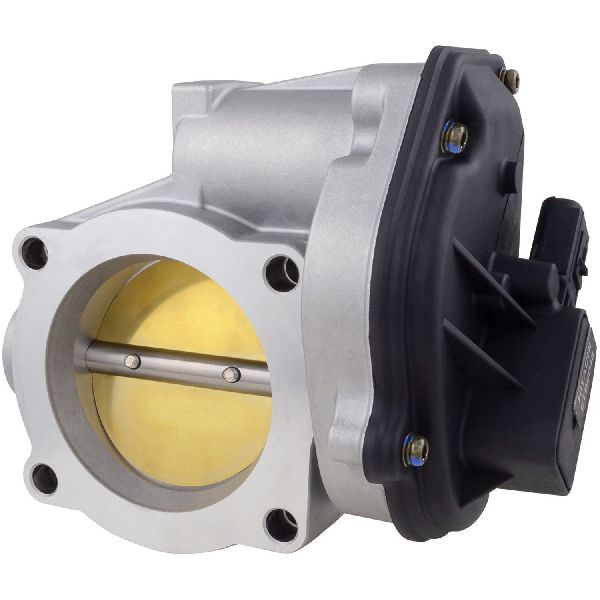
- Electronic Throttle Body
(OEM #Motorcraft TB-1 (supersedes BL3Z-9E926-B, BL3Z-9E926-A))— This is the component that fails, causing the P2111 code. The internal motor, position sensor, or gears wear out or become contaminated.
Trusted brands: Motorcraft, SKP, Hitachi, Dorman
OEM price range: $180-$250
Aftermarket price range: $90-$170
Related Codes That Often Appear With This One
- P2112 — This code means 'Throttle Actuator Control System - Stuck Closed' and is often seen with P2111 as the throttle body fails and exhibits both stuck open and stuck closed behavior at different times. Both are mentioned in TSB 16-0139 and Customer Satisfaction Program 16B32.
- P2119 — This code relates to 'Throttle Actuator Control Throttle Body Range/Performance' and is also cited in TSB 16-0139 as part of the same common throttle body failure.
- P2135 — This code for 'Throttle/Pedal Position Sensor/Switch A/B Voltage Correlation' can appear alongside P2111. It points to a fault in the Throttle Position Sensor (TPS), which is integrated into the throttle body assembly, further confirming a bad ETB.
Technical Service Bulletins (TSBs) & Recalls
- TSB 16-0139: Addresses intermittent loss of power and wrench light with DTCs P2111, P2112, and/or P2119 on various 2015-2016 Ford vehicles.
- TSB 10-21-6: Addresses DTCs P2111, P2112, and idle speed fluctuations on various 2010-2011 Ford vehicles, including the Taurus.
- Customer Satisfaction Program 16B32: Acknowledged the widespread ETB failure due to internal contamination and authorized dealers to replace the ETB free of charge on affected vehicles, including the 2016 Taurus, through September 30, 2017.
Platform-Specific Known Issues
- Ford issued Technical Service Bulletin (TSB) 16-0139 for 2015-2016 models (including the Taurus) that may exhibit an intermittent loss of power with DTCs P2111, P2112, and/or P2119.
- An earlier TSB (10-21-6) also covered the 2010-2011 Taurus for DTCs P2111 and P2112, recommending throttle body replacement for affected vehicles.
- Ford's Customer Satisfaction Program 16B32 extended warranty coverage for the ETB on certain 2016 Taurus models, among others. It provided a free replacement, even outside of the standard warranty period, until September 30, 2017.
- An owner of a 2013 Taurus reported a P2111 code and had a dealer attempt a fix by servicing the connector, highlighting that wiring can be a potential cause.
- Another 2013 Taurus owner reported code P2111 and a rough idle, confirming the common symptoms on this platform.
Mechanic-Grade Diagnostic Values
- Throttle Actuator Control Motor (TACM) resistance — expected: Between 2 and 25 Ohms. Failure: A reading of zero or infinite resistance indicates a failed motor.
Scan Tool Commands That Help
- Ford IDS (Integrated Diagnostic System): All CMDTCs (Continuous Memory Diagnostic Trouble Codes) — To initially ping all vehicle controllers and display any recorded faults, including P2111 and related codes.
- Ford IDS (Integrated Diagnostic System): Datalogger - Throttle Pedal and Throttle Body PIDs — To measure and graph the voltage and angle of the throttle pedal sensors (APP) and throttle body sensors (TP) simultaneously. This helps identify glitches, dropouts, or lack of correlation that confirms a component failure.
- Ford IDS (Integrated Diagnostic System) or compatible high-end scanner: Actuator Test Mode / Throttle Body Relearn — After replacing the throttle body, a relearn or calibration procedure should be performed. The IDS can command the throttle through its full range to verify operation and reset learned values.
Wiring & Ground Locations
- G105 — Rear of the engine compartment.. This is a primary ground point for the engine control system. A corroded or loose G105 ground can cause erratic sensor readings and intermittent issues across the engine management system, potentially contributing to or mimicking a throttle body failure.
- C134 — Main engine harness connector, often located near the battery junction box or firewall.. This is a major junction for the engine wiring. The circuits for the electronic throttle control pass through this connector. Corrosion or a pin-fit issue at C134 can cause intermittent throttle control problems.
Real Owner Repair Stories
- CarComplaints.com user Juan T. (2013 Ford Taurus SEL 3.5L V6) — Intermittent loss of power while driving, P2111 code stored.
❌ Tried (didn't work) Initially suspected and checked transmission fluid and oil level.
✅ What actually fixed it Replaced the electronic throttle body. The user also described a manual relearn procedure: key on, press accelerator down slowly over 10 seconds, then release slowly over 10 seconds. - YouTube user 'The Adventures of Falcopilot' (2013 Ford Taurus) — Stumbling under load and misfiring with no codes stored. The user had previously replaced the throttle body five years prior for a TPS failure.
❌ Tried (didn't work) Replaced spark plugs, Replaced ignition coils, Replaced fuel injectors
✅ What actually fixed it Replaced the entire electronic throttle body assembly, suspecting the integrated, non-serviceable Throttle Position Sensor (TPS) had failed again.
OEM Part Supersession History
BL3Z-9E926-A→BL3Z-9E926-B— Part revision and improvement by the manufacturer.BL3Z-9E926-B→Motorcraft TB-1— Part number consolidation into the standard Motorcraft service part number.
Heads up: TB-1 is the current correct service part for this application.
Model Year Variations Within This Range
- 2013-2019: The Ford Taurus received a major facelift for the 2013 model year, which included updates to the powertrain and electronics. While the fundamental P2111 issue is the same, wiring diagrams and connector locations may differ slightly between the 2010-2012 and 2013-2019 models. Always verify diagrams for your specific year.
Diagnostic Flowchart
Other Known Issues on This Vehicle
Issues unrelated to this code that are worth knowing about as an owner of this generation:
- Internal Water Pump Failure 🔴 High — Can occur around 100,000 miles. Failure allows coolant to mix with engine oil, leading to catastrophic engine damage if not caught immediately. (Ref: No specific recall, but a widely documented failure mode for the transverse Ford 3.5L/3.7L engine family.)
- Power Transfer Unit (PTU) Overheating/Failure 🔴 High — Common on AWD models. The PTU fluid overheats due to proximity to the exhaust, leading to seal failure, fluid breakdown, and eventual gear failure. (Ref: No recall, but frequent fluid changes (every 30k miles) are recommended by owners as a preventative measure.)
- Timing Chain Rattle / VCT Phaser Issues 🟠 Medium — More common on earlier EcoBoost models. Can cause a rattling noise on cold starts for a few seconds. If ignored, can lead to timing chain stretch and performance issues. (Ref: TSB 23-2143 (supersedes earlier versions) addresses this for some 3.5L EcoBoost applications, though not specifically the Taurus.)
- Undersized Brakes (2010-2012 models) 🟡 Low — Owners of 2010-2012 models frequently complain of premature brake wear and warping rotors. Ford upgraded the brakes for the 2013 model year refresh.
Used vs. New Parts: Buying Guide for This Vehicle
When a used part is the smart pick: A used throttle body is a high-risk purchase for this specific failure. Because the failure is electronic and wear-related, a used part carries a high probability of failing again soon. It should only be considered as a temporary, emergency fix if the donor vehicle is known to be very low mileage and the part is visually clean with no corrosion.
Donor-vehicle mileage cap: roughly under 40000 miles for the part to have meaningful remaining life.
What to inspect on the donor part:
- Verify the part number is a later revision if possible (e.g., BL3Z-9E926-B or TB-1).
- Inspect the electrical connector pins for any green or white corrosion.
- Check that the throttle plate is clean and moves smoothly without any gritty feeling.
- Ask for the VIN of the donor car to verify low mileage if possible.
OEM-only on this vehicle (don't cheap out):
- Electronic Throttle Body (ETB)
Aftermarket brands forum-validated for this vehicle:
- Motorcraft (OEM)
- Hitachi
Brands owners have reported issues with on this vehicle:
- Unbranded, no-name parts from online marketplaces should be avoided. While some users report success with brands like Dorman or SKP, the OEM Motorcraft part is the most consistently recommended fix by professional mechanics for long-term reliability on this platform.
Real Owner Stories
Aggregated from forums and TSBs cited above. Mileages and costs reflect what owners reported in those sources.
2013 Ford Taurus 3.5L
Symptoms: The vehicle experienced a P2111 code and a rough idle.
What fixed it: The owner confirmed the common symptoms on the platform, though the specific fix followed the common pattern of throttle body issues.
Source hint: vehicle_specific_issues
2013 Ford Taurus 3.5L
Symptoms: Reported a P2111 code; the dealer attempted a repair by servicing the electrical connector.
What fixed it: Servicing the connector (wiring/connector issue).
Source hint: vehicle_specific_issues
2010-2016 Lincoln MKS 3.5L EcoBoost
Symptoms: Reported codes P2111 and P2135; found moisture and rust inside the component.
What fixed it: Replacing just the throttle position sensor component on the throttle body.
Source hint: SHO Forum (shoforum.com)
2015 Ford Explorer 3.5L
Symptoms: Experienced P2111 and loss of power.
What fixed it: Replacing the throttle body with an OEM part for reliability.
Source hint: Reddit (r/FordExplorer)
2011-2019 Ford F-150 3.7L
Symptoms: Experienced P2111 symptoms; attempted to fix by cleaning the unit first.
What fixed it: Cleaning provided only temporary relief; ultimately resolved by replacing the throttle body.
Source hint: Ford F150 Forum (f150forum.com)
Related OBD-II Codes
Frequently Asked Questions
Does Ford TSB 16-0139 apply to my 2015 Taurus SHO?
Is there a recall or extended warranty for the throttle body on my 2016 Taurus?
Can I just clean the throttle body on my 3.5L EcoBoost to fix P2111?
Do I need to program the new throttle body after replacing it on my 2013 Taurus?
My 2010 Taurus has P2111 and the idle is fluctuating; is there a specific bulletin for older models?
Could the 'Service AdvanceTrac' and 'Hill Start Assist Not Available' messages be related to P2111?
Helpful Videos

Used OEM Parts in Stock


New Aftermarket Parts Available


The information in this article is provided for general reference and educational purposes only. Vehicle specifications, procedures, and part compatibility can vary by production date, trim level, and region. Always consult your vehicle's factory service manual and verify part numbers before purchasing or performing repairs. Safety-critical components such as airbags, seat belts, and braking systems should be installed by a qualified professional.
- Ford Taurus:
- 🎬 Helpful Videos
- 🛍️ Shop This Part
- What's Unique About the 2010-2019 Ford Taurus
- Symptoms You May Notice
- Most Likely Causes
- Rare But Worth Checking
- Diagnosis Steps
- Parts You'll Likely Need
- Related Codes That Often Appear With This One
- Technical Service Bulletins (TSBs) & Recalls
- Platform-Specific Known Issues
- Mechanic-Grade Diagnostic Values
- Scan Tool Commands That Help
- Wiring & Ground Locations
- Real Owner Repair Stories
- OEM Part Supersession History
- Model Year Variations Within This Range
- Diagnostic Flowchart
- Other Known Issues on This Vehicle
- Used vs. New Parts: Buying Guide for This Vehicle
- Real Owner Stories
- 2013 Ford Taurus 3.5L
- 2013 Ford Taurus 3.5L
- 2010-2016 Lincoln MKS 3.5L EcoBoost
- 2015 Ford Explorer 3.5L
- 2011-2019 Ford F-150 3.7L
- Related OBD-II Codes
- Frequently Asked Questions
- 🎟️ Get 5% Off