

OBD-II Code P2112: Throttle Actuator Control System - Stuck Closed
The Ultimate 2026 Guide to Causes, Diagnosis, and Repair for P2112
- Code P2112 indicates a throttle plate stuck in the closed position, which immediately forces the engine into a 10-20 mph 'limp mode' or causes stalling.
- Carbon buildup causes 70% of P2112 codes; fix this by cleaning the throttle bore with a $10 dedicated solvent and performing a mandatory idle relearn.
- Do not drive with an active P2112 code, as the vehicle lacks the acceleration required to merge safely and requires an immediate $100-$250 tow.
- If cleaning fails, replace the entire electronic throttle body assembly, which costs between $300 and $650 for parts and labor.
What Does P2112 Mean?

The Powertrain Control Module (PCM) detects the throttle plate is stuck closed. The engine cannot get the air required to run or accelerate. The computer immediately triggers 'limp mode' to prevent damage, severely reducing power, or shuts the engine down entirely.
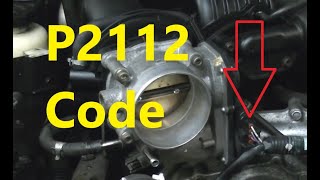
Technical definition: SAE/OBD-II defines P2112 as "Throttle Actuator Control System - Stuck Closed." The PCM sets this code when the throttle plate's actual position is ≥10% more closed than commanded, or physically jammed. 🎬 Watch: A quick breakdown of P2112 causes and common fixes. On Ford vehicles, this triggers if the measured angle is >6 degrees lower than commanded.
Can I Drive With P2112?
No — Do Not Drive. Driving with this code is unsafe. The engine stalls unexpectedly or enters a severely limited 'limp mode' capping speeds around 10-20 mph. Towing is the only safe option.
Common Causes

- Dirty Throttle Body (Carbon Buildup) (Very Common) — Carbon and oil residue build up around the throttle plate and bore, physically gluing it in the closed position. This causes 70% of P2112 codes on vehicles over 80,000 miles.
- Failed Throttle Body Assembly (Actuator Motor or TPS) (Common) — The internal electric motor wears out, plastic gears strip, or the integrated Throttle Position Sensor (TPS) fails. The entire assembly requires replacement when these internal electronics break. 🎬 See how easy it is to change the throttle body yourself.
- Wiring or Connector Damage (Common) — Corroded pins, broken wires, or a blown Electronic Throttle Control System (ETCS) fuse interrupt power between the PCM and the throttle body.
- Low System Voltage (Less Common) — A weak battery or bad ground drops voltage below the 12.4V threshold required at idle. The PCM misinterprets this voltage drop as a stuck actuator.
- Foreign Object or Ice Obstruction (Less Common) — Broken intake plastic, debris, or ice buildup from PCV system moisture (common in sub-freezing temperatures) physically jams the plate closed.
- PCM Malfunction or Software Error (Rare) — A hardware failure in the PCM's driver circuit or corrupted software sends incorrect commands to the throttle actuator.
Symptoms

- Engine Won't Start or Stalls Immediately — The engine cranks but refuses to start, or starts and immediately dies due to complete air starvation.
- No Throttle Response — Pressing the gas pedal does nothing; the engine remains at a rough idle.
- Check Engine Light On — The Malfunction Indicator Lamp illuminates immediately upon the PCM detecting the fault.
- Reduced Engine Power ('Limp Mode') (also visible on scanner) — The vehicle caps speed at 10-20 mph and disables acceleration to protect the engine. A wrench or 'Electronic Throttle Control' light illuminates. 🎬 Watch: Fixing no throttle response and the wrench light on Fords.
- Rough or Unstable Idle (also visible on scanner) — The idle surges up and down erratically as the PCM struggles to control airflow.
Diagnostic Flowchart
Tap your situation to follow the diagnostic path that matches what you're seeing on this code.
Common Fixes & Costs
- Cleaning the Throttle Body — Parts: $10-$20, Labor: $100-$150, ~0.8 hr book time (DIY)
- Replacing the Throttle Body Assembly
— Parts: $150-$400, Labor: $150-$250, ~1.2 hr book time
(Intermediate)
: OEM BR3Z-9E926-B (Alt: Motorcraft TB-2, Dorman 977-328)
: OEM 53034251AD (Alt: Cardone 67-7012, Dorman 977-794)
: OEM 12670839 (Alt: AC Delco 217-3428, Dorman 977-300) - Performing a Throttle Relearn Procedure — Parts: $0, Labor: $50-$150, ~0.5 hr book time (DIY)
- Replacing the ETCS Fuse — Parts: $1-$5, Labor: $0-$50, ~0.1 hr book time (Beginner)
- Repairing Damaged Wiring or Connectors — Parts: $10-$50, Labor: $150-$400, ~1.5 hr book time (Professional)
DIY vs Professional
- Cleaning the Throttle Body — Beginner:
Tools: Socket set, screwdrivers, throttle body cleaner, rags, flashlight. - Replacing the Throttle Body Assembly — Beginner:
Tools: Socket set, Torx drivers, pliers, new gasket, bi-directional scan tool. - Repairing Damaged Wiring or Connectors — Beginner:
Tools: Multimeter, wiring diagrams, wire strippers, crimpers, soldering iron.
Used vs. New Parts: Buying Guide
When a used part is worth it: Only for vehicles over 150,000 miles where a $400 new OEM part exceeds 20% of the car's value.
Donor-vehicle mileage cap: roughly under 80000 miles for the part to have meaningful remaining life.
Donor quality checklist:
- Verify the donor vehicle was salvaged for an accident, not engine/electrical failure.
- Match the part number suffix exactly.
- Reject units with deep bore scoring or corroded connector pins.
Decision logic:
- If Vehicle is under warranty or covered by a recall → Use a new OEM part installed by a dealer for free.
- If Vehicle has under 100,000 miles → Buy a new OEM or premium aftermarket part for maximum reliability.
- If Budget is strict on a high-mileage vehicle → Buy a used OEM unit, accepting the risk of premature failure.
Warranty tradeoff: Used parts offer 30 days. New aftermarket parts offer 1 year. New OEM parts offer 2 years.
Worst-case if a used part fails: $300-$500 (Repeat labor and replacement part costs).
What Happens If You Wait — Timeline
- First Occurrence (Intermittent): Vehicle enters limp mode. Restarting the engine temporarily restores normal function. P2112 stores as a pending code. (MPG impact: 0%% · Added cost: $0)
- Days to Weeks: Limp mode events occur daily. The Check Engine Light remains illuminated permanently. (MPG impact: 5%% · Added cost: $150 (Tow cost risk))
- Weeks to Month (Hard Failure): Restarting no longer clears limp mode. The engine refuses to start or idles roughly with zero throttle response. The vehicle is undrivable. (MPG impact: N/A% · Added cost: $450 (Tow plus throttle body replacement))
- Ignored Hard Failure: The vehicle cannot be driven. No further cascading damage occurs because the engine cannot operate. (MPG impact: N/A% · Added cost: $0)
Cost of Not Fixing It
- Immediate: The vehicle is completely undrivable. The engine stalls in traffic or caps speed at 10-20 mph. (Added cost: $100-$250 (Towing))
- Short Term: Intermittent faults cause sudden, dangerous loss of acceleration on the highway. (Added cost: $0)
- Long Term: Ignoring P2112 is impossible because the vehicle remains inoperable. (Added cost: $0)
Diagnosis Steps

- Read Codes and Freeze Frame Data
Scan for P2112 and related codes (P2111, P2101, P2135). Analyze freeze frame data to pinpoint the exact RPM and engine load when the fault occurred.
Tools: OBD-II Scanner (Beginner) - Visually Inspect the Throttle Body
Remove the air intake hose. Inspect for heavy carbon buildup, ice, or debris jamming the plate. Gently push the plate to verify it moves without binding.
Tools: Screwdriver, Flashlight (Beginner) - Clean the Throttle Body
Spray throttle body cleaner onto a rag and wipe away carbon from the bore and plate edges. Never spray directly into an electronic throttle body.
Tools: Throttle Body Cleaner, Rags, Toothbrush (Intermediate) - Inspect Wiring and ETCS Fuse
Check the throttle body electrical connector for corrosion or loose pins. Verify the Electronic Throttle Control System (ETCS) fuse in the under-hood fuse box is intact.
Tools: Flashlight, Multimeter (Beginner) - Test Actuator Motor Function
Use a bi-directional scan tool to command the throttle plate open and closed (key on, engine off). Listen for grinding noises or hesitation.
Tools: Bi-Directional Scan Tool (Intermediate) - Analyze Live Data and Sensor Voltages
Graph Commanded vs. Actual Throttle Position. A discrepancy of 10% or more indicates a failing throttle body. TPS voltages must sweep smoothly from 0.5V to 4.5V.
Tools: Advanced Scan Tool (Advanced) - Check Power, Ground, and Resistance
Disconnect the connector. Verify 12V at the power pin and <0.1V at the ground pin. Measure motor resistance; 5-10 ohms is typical. Infinite resistance means an open circuit.
Tools: Multimeter, Wiring Diagram (Advanced)
When This Code Triggers (Freeze-Frame Conditions)
- Engine Coolant Temp: Varies (Occurs cold (ice buildup) or fully warmed up (electronic failure).)
- RPM: 700-1200 RPM (Triggers just off-idle during attempted light acceleration.)
- Engine Load: 15-30% (Low load, occurring when the PCM initially commands the plate to open.)
- Vehicle Speed: 0-5 mph (Occurs at or near a complete stop when trying to accelerate.)
Related Codes
- P2111 — Indicates 'Stuck Open.' If the plate fails to return to its closed idle position, it triggers P2111. P2112 triggers when it fails to open.
- P2101 — Indicates an electrical circuit fault. P2101 requires multimeter testing on the motor circuit, whereas P2112 is often a physical jam.
- P2135 — Indicates the two internal throttle position sensors disagree. If P2112 and P2135 appear together, the internal electronics are dead and the assembly requires replacement.
- P2110 — An informational code confirming the PCM intentionally forced the engine into limp mode due to the P2112 fault. It clears automatically when P2112 is fixed.
Climate & Environmental Factors
- Sub-Freezing Temperatures: Moisture from the PCV system freezes behind the throttle plate, physically jamming it closed. This triggers P2112 on 2019-2021 Ford Rangers (TSB SSM 50597).
- High Humidity: Accelerates corrosion on wiring harness pins, degrading the 12V signal required to operate the throttle actuator motor.
How to Talk to a Mechanic About This Code
Say this: "I have a P2112 code and the car is in limp mode. Please inspect the throttle body for carbon buildup and clean it first. If it requires a full replacement, please confirm the actuator motor failed testing before proceeding."
Directs the technician to attempt the $150 cleaning fix before jumping to the $500 replacement fix, while proving you understand the diagnostic process.
Avoid saying:
- 'Just fix whatever's wrong.'
- 'My check engine light is on, can you look at it?'
- 'Replace the throttle body.' (Never authorize parts without diagnosis)
Questions to ask before authorizing the repair:
- Did you find heavy carbon buildup, and can you send a photo?
- Did you test the actuator motor and verify 12V at the connector?
- Does the replacement quote include the mandatory throttle relearn procedure?
Where to Take It: Dealer vs Independent vs Chain
- Dealer:
Use only for warranty work or if an independent shop fails the relearn procedure.
Best for: Vehicles under warranty or covered by Ford Customer Satisfaction Program 13N03., Complex PCM software updates.
Downsides: Charges a 50% premium on parts and labor., Refuses to clean throttle bodies, opting only for full replacement. (Typical cost: +50% vs. baseline) - Independent Shop:
The best option. They handle P2112 diagnosis, cleaning, and relearns efficiently at a fair price.
Best for: Out-of-warranty vehicles., Cost-effective cleaning and diagnosis.
Downsides: May lack the specific scan tool required for relearns on obscure European models. (Typical cost: +0% vs. baseline) - Chain Shop:
Avoid. They frequently fail to perform the mandatory relearn procedure, leaving you with a high idle.
Best for: Routine fluid changes.
Downsides: Lacks advanced bi-directional scan tools required for throttle relearns., High turnover leads to misdiagnosis. (Typical cost: -10% vs. baseline)
When to Walk Away From the Repair
If the $400-$650 repair cost exceeds 40% of your car's Kelley Blue Book value, consider selling the vehicle.
- Car worth $4000, fix is $600: Fix it. The repair is 15% of the car's value.
- Car worth $2000, fix is $650: Borderline. The repair is 32% of the value. Attempt a DIY cleaning first.
- Car worth $1200, fix is $700: Walk away. The repair exceeds 50% of the value.
What Scan Tool You Need for This Code

Minimum: A scanner with Live Data to view 'Commanded Throttle Actuator' and 'Relative Throttle Position'.
A $20 code reader cannot perform the mandatory throttle relearn procedure required after cleaning or replacing the unit.
Budget: BlueDriver Pro Scan Tool (~$100) — Reads codes and displays live throttle data graphing. It lacks the bi-directional control needed for a relearn.
Mid-range: Foxwell NT510 Elite (~$150) — Provides bi-directional control to test the actuator motor and executes the mandatory throttle relearn procedure.
Professional: Autel MaxiCOM MK808Z (~$400) — Offers OE-level diagnostics with dedicated, one-touch menus for throttle body resets across all vehicle makes.
Rent vs buy: Buy a mid-range scanner. Free auto parts store loaners cannot perform the essential throttle relearn procedure.
How to Clear the Code After You Fix It
- Reconnect battery.
- Clear all diagnostic trouble codes with a scanner.
- Perform a mandatory throttle body relearn procedure.
- Complete a full OBD-II drive cycle.
Drive cycle (~30 minutes): Cold start (sit 8+ hours). Idle 3 minutes with A/C on. Drive 15 minutes in stop-and-go traffic. Drive 10 minutes at a steady 60 mph. Coast to a stop without braking.
Readiness monitors affected: Catalyst Monitor, Evaporative System Monitor, Oxygen Sensor Monitor
Before emissions retest: drive at least 100 miles to fully set monitors.
Watch out for:
- Failing to perform a throttle relearn procedure causes a permanent high idle.
- Clearing the code without fixing the physical jam causes immediate limp mode upon restart.
- Disconnecting the battery resets all readiness monitors, guaranteeing an emissions test failure until a drive cycle is completed.
Will This Fail Emissions / State Inspection?
Yes — this code typically fails an OBD-II emissions inspection.
- California: An active P2112 code triggers an automatic smog check failure. All monitors must read 'Ready' post-repair.
- New York: NYS DMV inspections fail any vehicle with an active P2112 code.
- Texas: Vehicles fail inspection immediately if the Check Engine Light is illuminated for P2112.
Most Commonly Affected Vehicles
- Ford F-150, Focus, Fusion, Escape (2008-2018) — Extremely common failure. F-150 throttle body replacements cost $300-$650 total.
- Dodge/Jeep/Chrysler Ram 1500, Challenger, Charger, Grand Cherokee (2012-2024) — Presents with a red 'lightning bolt' ETC warning light. Test the battery first; low voltage triggers false ETC faults.
- Chevrolet/GMC Silverado, Sierra, Tahoe, Suburban (2007-2014) — Triggers a 'Reduced Engine Power' message. Replacing the entire assembly is the only reliable fix.
- Toyota Camry, Corolla (2004-2009) — Subject to TSB T-SB-0187-09 requiring a modified throttle body hose. The ETCS fuse frequently blows.
- Hyundai/Kia Elantra, Sonata, Optima (2011-2018) — Carbon buildup is the primary culprit. Cleaning resolves 80% of cases.
- Subaru Outback, Forester, Impreza (2013-2018) — Internal electronics fail more often than carbon buildup occurs. Requires full assembly replacement.
- Volvo XC60, S60, XC90 (2005-2017) — Highly sensitive drive-by-wire systems trigger P2112 at the first sign of carbon buildup.
- Honda Accord, Civic, CR-V (2008-2015) — Typically caused by a failing actuator motor or a corroded connection at the throttle body.
Manufacturer-Specific Notes
- Ford: Customer Satisfaction Program 13N03 extended the throttle body warranty to 10 years/150,000 miles for 2009-2013 Fusion/Escape models due to internal motor contact contamination.
- Toyota: Requires a strict 'relearn' procedure after cleaning or replacing the throttle body to restore normal idle, often necessitating a bi-directional scan tool.
- General Motors (GM): Displays a 'Reduced Engine Power' message on the dash. Cleaning rarely works on GM trucks; full assembly replacement is standard protocol.
- Dodge/Jeep/Chrysler: Illuminates a red 'lightning bolt' light. Always load-test the battery before replacing parts, as low voltage mimics a failed throttle body.
Real Owner Stories
2016 Ford F-150 3.5L EcoBoost at 48K miles
Sudden loss of power in traffic, wrench light illuminated, engine stuck in limp mode. Scanned code P2112.
What they tried:
- Purchased a new OEM throttle body assembly for $78 and a gasket for $3.
Outcome: Replaced the assembly in 15 minutes. The DIY repair saved $400 over the dealer quote and permanently fixed the issue.
Lesson: Replacing a Ford throttle body is a fast, inexpensive DIY fix. Do not assume electronic parts require expensive dealer labor.
2015 Ford F-150 3.5L EcoBoost with intermittent failure
Truck entered limp mode intermittently. Restarting temporarily cleared it until P2112 permanently set.
What they tried:
- Replaced the throttle body with a cheap aftermarket part.
- Truck developed a severe rough idle and lost all throttle response.
- Attempted manual relearn procedures failed.
Outcome: A secondary P2135 code revealed the aftermarket part was defective out of the box. Installing an OEM unit resolved all issues.
Lesson: Cheap aftermarket electronic throttle bodies frequently fail or cause sensor correlation codes. Always buy OEM or premium aftermarket brands.
2019 Ford Ranger in sub-freezing weather
Vehicle entered limp mode with P2112 during a 15°F winter storm.
What they tried:
- Checked Ford TSB SSM 50597 regarding cold weather icing.
Outcome: Found solid ice blocking the throttle plate. Thawing and cleaning the intake resolved the code without replacing any parts.
Lesson: Always check Technical Service Bulletins (TSBs). Environmental factors like freezing temperatures cause physical jams that mimic electronic failures.
How to Prevent This Code From Triggering
- Clean the throttle body. (Every 40,000 miles.) — Removes the carbon and oil deposits that physically glue the throttle plate shut.
- Replace the PCV valve. (Every 50,000 miles.) — Prevents excess crankcase pressure from forcing oil vapor into the intake, which bakes onto the throttle body as carbon.
- Install an oil catch can. (One-time installation.) — Intercepts oil vapors before they reach the air intake, drastically reducing throttle body deposits on direct-injection engines.
Frequently Asked Questions
Can I just clean the throttle body to fix P2112?
Yes, cleaning carbon buildup resolves the issue in many cases. If the code returns after cleaning and a relearn procedure, the internal motor has failed. You must then replace the entire throttle body assembly.
What is a common misdiagnosis for P2112?
Mechanics frequently misdiagnose this by replacing the accelerator pedal position (APP) sensor. P2112 specifically isolates the failure to the throttle body itself. Always test the throttle body physically and electronically before replacing the pedal.
Does clearing the code with a scanner fix the problem?
No. Clearing the code only turns off the check engine light until the next drive cycle. The PCM immediately detects the physical or electrical fault again and triggers limp mode.
What is a 'throttle relearn' and is it always necessary?
A throttle relearn calibrates the PCM to the throttle plate's new closed and open positions. It is mandatory after cleaning or replacing the throttle body to prevent high or erratic idle. You need a bi-directional scan tool or a specific key-turn sequence to complete it.
Is replacing a throttle body a DIY job?
Yes, intermediate DIYers can replace it using basic hand tools in under an hour. However, you must perform a throttle relearn procedure afterward. Stop and take the vehicle to a shop if you lack the required scan tool for the relearn.
Can a bad battery cause a P2112 code?
Yes. A weak battery causes system voltage drops that the PCM misinterprets as a throttle actuator failure. Always test the battery and alternator before replacing expensive electronic throttle components.
Why did the car go into 'limp mode'?
The PCM restricts engine power to prevent unintended acceleration when it loses control of the throttle plate. This fail-safe mode caps your speed around 10-20 mph so you can pull over safely.
Key Takeaways
- Code P2112 indicates a throttle plate stuck in the closed position, which immediately forces the engine into a 10-20 mph 'limp mode' or causes stalling.
- Carbon buildup causes 70% of P2112 codes; fix this by cleaning the throttle bore with a $10 dedicated solvent and performing a mandatory idle relearn.
- Do not drive with an active P2112 code, as the vehicle lacks the acceleration required to merge safely and requires an immediate $100-$250 tow.
- If cleaning fails, replace the entire electronic throttle body assembly, which costs between $300 and $650 for parts and labor.
Helpful Videos

The information in this article is provided for general reference and educational purposes only. Vehicle specifications, procedures, and part compatibility can vary by production date, trim level, and region. Always consult your vehicle's factory service manual and verify part numbers before purchasing or performing repairs. Safety-critical components such as airbags, seat belts, and braking systems should be installed by a qualified professional.
- 🎬 Helpful Videos
- What Does P2112 Mean?
- Can I Drive With P2112?
- Common Causes
- Symptoms
- Diagnostic Flowchart
- Common Fixes & Costs
- DIY vs Professional
- Used vs. New Parts: Buying Guide
- What Happens If You Wait — Timeline
- Cost of Not Fixing It
- Diagnosis Steps
- When This Code Triggers (Freeze-Frame Conditions)
- Related Codes
- Climate & Environmental Factors
- How to Talk to a Mechanic About This Code
- Where to Take It: Dealer vs Independent vs Chain
- When to Walk Away From the Repair
- What Scan Tool You Need for This Code
- How to Clear the Code After You Fix It
- Will This Fail Emissions / State Inspection?
- Most Commonly Affected Vehicles
- Manufacturer-Specific Notes
- Real Owner Stories
- 2016 Ford F-150 3.5L EcoBoost at 48K miles
- 2015 Ford F-150 3.5L EcoBoost with intermittent failure
- 2019 Ford Ranger in sub-freezing weather
- How to Prevent This Code From Triggering
- Frequently Asked Questions
- Can I just clean the throttle body to fix P2112?
- What is a common misdiagnosis for P2112?
- Does clearing the code with a scanner fix the problem?
- What is a 'throttle relearn' and is it always necessary?
- Is replacing a throttle body a DIY job?
- Can a bad battery cause a P2112 code?
- Why did the car go into 'limp mode'?
- Key Takeaways
- 🎟️ Get 5% Off