

P1776 on 2007-2012 Ram 1500 3.7L: Solenoid Switch Valve Causes and Fixes
This code means the transmission is in 'limp mode' because a valve is stuck. On the Ram 1500 with the 42RLE transmission, this is almost always caused by a worn-out valve body, not the solenoid pack. The correct fix is typically replacing the entire valve body assembly, which costs around $400-$800 for a remanufactured part plus labor. Continuing to drive can quickly turn this into a $4,000+ transmission rebuild.
- P1776 on this Ram almost always means the transmission is in 'limp mode' and requires immediate attention to prevent further damage.
- The most likely cause is a worn-out transmission valve body, causing a mechanical valve to stick. Do not assume the fix is the electronic solenoid pack.
- The correct, long-term repair is to replace the entire valve body assembly with a remanufactured unit.
- Driving with this code active will cause excessive heat and can quickly lead to a much more expensive full transmission rebuild.
- Always use licensed Mopar ATF+4 fluid during this repair; the transmission is very sensitive to the wrong fluid type.
What's Unique About the 2007-2012 Ram 1500
The 3.7L V6 in this generation of Ram 1500 is paired with the 42RLE automatic transmission, which is known for this specific issue. The critical detail, confirmed by Chrysler technical service bulletins and numerous technician accounts, is that the fault almost always lies with the mechanical Solenoid Switch Valve sticking inside the aluminum valve body, not an electrical failure of the solenoid pack. The steel valve wears the aluminum bore over time, allowing it to jam. Many owners and shops mistakenly replace the more accessible solenoid pack, only for the problem to return because the worn valve body bore was the true cause.
Generation note: The 2007-2012 year range covers the end of the 3rd generation (2007-2008) and the beginning of the 4th generation (2009-2012). However, for the 3.7L V6 powertrain, both generations used the same 42RLE transmission, so the causes and fixes for P1776 are consistent across this entire year span.
Symptoms You May Notice
- Check Engine Light is on
- Transmission is stuck in one gear (limp mode, usually 2nd gear)
- Harsh or delayed shifting, sometimes with a noticeable 'bang' into gear.
- Vehicle has very poor acceleration from a stop
- Engine RPMs are much higher than usual at moderate speeds
- Inability to use Overdrive
- Replacing only the solenoid pack. Chrysler technical documents and technician forums specifically warn against this, as the root cause is almost always the mechanical valve sticking in the valve body bore, not an electrical issue with the solenoid.
Most Likely Causes
- Sticking Solenoid Switch Valve (SSV) in a Worn Valve Body 🔴 High Probability The steel SSV constantly moves within an un-bushed aluminum bore in the valve body. Over time, this wears the bore, allowing the valve to tilt and jam. Debris in old or contaminated fluid accelerates this wear.
How to confirm: This is the default diagnosis per Chrysler TSB 21-001-13 when a scan tool shows the 'TRS Code' as 'OD'. Physical confirmation requires removing the valve body and inspecting the valve; it should slide freely in its bore without any binding.
Typical fix: Replace the entire valve body assembly with a quality remanufactured unit. A more advanced, specialist repair involves reaming the bore and installing an oversized valve kit, such as the Sonnax 92835-18K.
Est. part cost: $400-$800 for a remanufactured valve body with solenoids. - Defective Transmission Solenoid/Pressure Switch Assembly (Solenoid Pack) 🟡 Medium Probability The solenoid pack is an electronic component living in hot transmission fluid, and internal failure is possible. TSB 21-008-04 noted this as a potential cause, though this TSB was later superseded by 21-001-13 which points more strongly to the valve body.
How to confirm: This is typically diagnosed by exclusion after confirming the valve body is functioning correctly. A professional can test the solenoid circuits for proper resistance and function. This is often replaced in error when the valve body is the true cause.
Typical fix: Replace the solenoid pack. This part bolts to the valve body.
Est. part cost: $180-$260 for an OEM Mopar part. - Improperly Adjusted Shifter Cable ⚪ Low Probability If the cable is stretched or misadjusted, the manual valve inside the transmission may not be fully aligned with the gear selector position (e.g., halfway between Neutral and Drive), causing a logic error.
How to confirm: A scan tool's event data for P1776 will show a 'TRS Code' of 'TR2', as specified in Chrysler diagnostic procedures. This indicates the computer detected the fault while the transmission range sensor was in an invalid state.
Typical fix: Inspect the shifter cable and linkage for binding or damage and perform the factory adjustment procedure.
Est. part cost: $0
Rare But Worth Checking
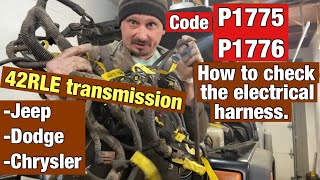
- Wiring Harness Issue: A short to ground or open in the L/R pressure switch sense circuit (T50 circuit) can mimic an internal failure. This should be ruled out with a multimeter before replacing 🎬 Watch: How to test the wiring harness for electrical faults. expensive internal parts.
- Failed Powertrain Control Module (PCM): This is extremely rare. The PCM should only be considered after all other possibilities, including wiring and all internal transmission components, have been definitively ruled out.
Diagnosis Steps
- Check the transmission fluid level and condition. Burnt or dark fluid indicates excessive heat and internal wear, which can cause valves to stick.
- Connect a scan tool capable of reading Chrysler-specific data.
- Check for P1776 and any other codes. If P1776 is present, access the 'Event Data' or 'Freeze Frame' screen.
- Look for the 'TRS Code' value, per Chrysler tech tips.
- If TRS Code is 'TR2', inspect and adjust the shifter cable and linkage. Clear codes and re-test.
- If TRS Code is 'OD', the fault is internal to the transmission. Proceed with dropping the transmission pan.
- Inspect the pan magnet for excessive metal debris. Fine gray paste is normal wear, but large metal chunks indicate severe internal damage.
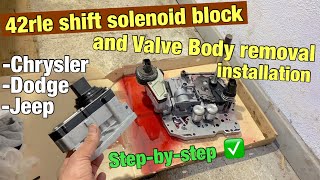
- Remove the valve body assembly following the service manual procedure. This involves disconnecting wiring, the shift lever, and a specific sequence of bolts. A detailed video guide shows this process. 🎬 Watch: Step-by-step 42RLE valve body removal and installation guide.
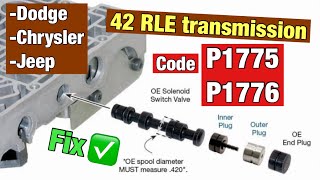
- With the valve body on a bench, manually actuate the Solenoid Switch Valve (SSV) in its bore to check for any signs of scoring, debris, or sticking. 🎬 See how a sticking solenoid switch valve causes these codes. It must move freely.
- The most reliable repair is to replace the entire valve body assembly with a quality remanufactured unit.
- Install the new valve body, new filter, and pan with a new gasket. Refill with the correct amount of Mopar ATF+4 fluid.
- Perform a 'Quick Learn' or 'Relearn' procedure with a compatible scan tool to adapt the new components.
Parts You'll Likely Need
- Transmission Valve Body with Solenoid Pack
(OEM #RL051180AA (Remanufactured, example))— This is the most common and most reliable fix, as it replaces both the worn valve body bore and the solenoid pack in one assembly.
Trusted brands: Mopar (Remanufactured), ATS Diesel (Performance)., Sonnax (Provides repair kits for the original valve body).
OEM price range: $600-$900 (Remanufactured)
Aftermarket price range: $400-$700 - Transmission Solenoid/Pressure Switch Assembly
(OEM #5143151AA (superseded by 04800171AA))— This is sometimes replaced alone, but it is often a misdiagnosis. It should only be replaced if it has been specifically tested and found faulty.
Trusted brands: Mopar
OEM price range: $200-$260
Aftermarket price range: $120-$180 - Transmission Filter and Pan Gasket
(OEM #52854001AA)— These must be replaced any time the transmission pan is removed for service.
Trusted brands: Mopar, Wix, ATP
OEM price range: $30-$50
Aftermarket price range: $15-$30 - Mopar ATF+4 Automatic Transmission Fluid
(OEM #68218057AC (Quart))— The 42RLE transmission is specifically designed for ATF+4 fluid. Using other fluid types can cause shifting problems and damage.
Trusted brands: Mopar, Valvoline ATF+4, Castrol Transmax ATF+4
OEM price range: $10-$15 per quart
Aftermarket price range: $7-$12 per quart
Related Codes That Often Appear With This One
- P0700 — P0700 is a generic code that simply means the Transmission Control Module (TCM) has stored a fault code. It is a general 'flag' that will always appear alongside a specific transmission code like P1776.
- P0841 — This code relates to 'Transmission Fluid Pressure Sensor/Switch 'A' Circuit Range/Performance'. Since P1776 is set based on an illogical pressure reading from the Low/Reverse pressure switch, a fault in that same circuit can trigger P0841.
- P1775 — This is the sister code, 'Solenoid Switch Valve Latched in TCC Position'. It points to the exact same valve, just stuck at the opposite end of its travel. Seeing either code strongly suggests a worn valve/bore.
Technical Service Bulletins (TSBs) & Recalls
- TSB 21-001-13: The primary technical service bulletin for diagnosing P1776. It instructs technicians to check the 'TRS Code' in the scan tool data to differentiate between a shifter cable issue and an internal transmission fault.
Mechanic-Grade Diagnostic Values
- Solenoid Coil Resistance (L/R, OD, UD, 2/4) — expected: 1.7 Ohms (varies with temperature). Failure: A reading significantly higher or lower than 1.7 Ohms, or an open/infinite reading.
- Pressure Switch Resistance (L/R, OD, 2/4) — expected: 299 Ohms (varies with temperature). Failure: A reading significantly outside the 270-330 Ohm range, or an open/infinite reading.
- L/R Pressure Switch Sense Circuit (T50) to Ground — expected: Above 5.0 Ohms. Failure: Resistance below 5.0 Ohms indicates a short to ground in the wiring harness or PCM.
- 2/4 Clutch Hydraulic Pressure — expected: 75 to 95 psi. Failure: Pressure significantly lower or higher than the specified range during the test.
Hidden / Shadow Codes Worth Checking
- TRS Code 'TR2': This is not a DTC, but event data logged with P1776. 'TR2' indicates the fault occurred when the shifter was in a transition zone between gears (e.g., between Neutral and Overdrive), pointing to a misadjusted shifter cable. (see via In the 'Event Data' or 'Freeze Frame' section for DTC P1776 on a Chrysler-compatible scan tool (like WiTech).)
- TRS Code 'OD': This is event data logged with P1776. 'OD' indicates the fault occurred while the transmission was commanded to the Overdrive range, pointing to an internal mechanical or hydraulic failure, most commonly the Solenoid Switch Valve itself. (see via In the 'Event Data' or 'Freeze Frame' section for DTC P1776 on a Chrysler-compatible scan tool (like WiTech).)
Scan Tool Commands That Help
- Chrysler WiTech or equivalent: Quick Learn Procedure — This must be performed after replacing the valve body or solenoid pack to reset transmission adaptive memory and teach the controller the hydraulic characteristics of the new components for proper shifting.
- Chrysler WiTech or equivalent: Solenoid Actuation Test — Used during advanced diagnostics, often with a transmission simulator tool (like Miller #8333) connected, to command individual solenoids on and off to verify the electrical circuit from the PCM to the solenoid is intact.
Wiring & Ground Locations
- Transmission Solenoid Connector (10-pin) — On the driver's side of the 42RLE transmission case.. This is the main electrical connection for the solenoid pack. Pin 10 is for the L/R Pressure Switch, and its circuit is designated (T50). A short or open on this circuit can trigger P1776. Pin 3 (Red wire) is the 12V power feed for the solenoids.
- Engine-to-Chassis Ground Straps — Key grounds are located near the battery negative terminal and from the back of the cylinder heads to the firewall.. While not a direct cause, poor grounding can introduce electrical noise and voltage issues that can confuse the PCM/TCM, potentially leading to erroneous fault codes. Ensuring all major grounds are clean and tight is a critical step in any electrical diagnosis.
Real Owner Repair Stories
- Cummins Forum user (2013 Ram 2500 (with 68RFE, but the P1776 principle is identical)) — Check engine light, codes P1776 and P0871, transmission in limp mode.
❌ Tried (didn't work) Replacing the transmission solenoid pack.
✅ What actually fixed it The code returned after replacing the solenoid pack. The final fix was replacing the entire transmission valve body with a remanufactured unit, which resolved the issue permanently. - YouTube user 'Fixing Jeeps And Stuff' (2004 Jeep Wrangler TJ with 42RLE) — Codes P1775 and P1776, transmission in limp mode.
❌ Tried (didn't work) The owner first performed a detailed inspection of the entire wiring harness from the PCM to the transmission, unwrapping it and checking for chafes or breaks. No electrical faults were found.
✅ What actually fixed it After confirming the wiring was good, the next logical step was the known mechanical failure. The owner sourced a known-good used valve body from a transmission with a cracked case and swapped it in, which is the correct diagnostic path. - YouTube user '1969w100' (1997 Chrysler Van with 41TE (predecessor to 42RLE)) — Persistent P1776 code.
❌ Tried (didn't work) Replacing the solenoid pack., Replacing the valve body.
✅ What actually fixed it After replacing both the solenoid pack and valve body didn't work, a deeper teardown revealed the true cause: a failed/gapped seal on the input shaft. This allowed hydraulic pressure to leak between the overdrive and underdrive clutch circuits, creating a pressure reading conflict that set the P1776 code.
OEM Part Supersession History
5143151AA→04800171AA— Part revision and update by Mopar.
Heads up: The parts are interchangeable, with 04800171AA being the current replacement service part.
Diagnostic Flowchart
Other Known Issues on This Vehicle
Issues unrelated to this code that are worth knowing about as an owner of this generation:
- Totally Integrated Power Module (TIPM) Failure 🔴 High — Very common across 2006-2012 Ram models. Can occur at any mileage. (Ref: Multiple class-action lawsuits and recalls were issued, though many focused on the fuel pump relay specifically.)
- Valve Train Noise ('Lifter Tick') 🟠 Medium — Common on the 3.7L V6, often appearing after 70,000 miles.
- Broken Exhaust Manifold Bolts 🟠 Medium — Common issue, especially on the passenger side. Can happen at various mileages.
Used vs. New Parts: Buying Guide for This Vehicle
When a used part is the smart pick: Buying a used valve body or solenoid pack is extremely risky and not recommended. The primary cause of P1776 is mechanical wear in the valve body bore, a condition a used part is also highly likely to have. A used part should only be considered if the vehicle's value is very low and you accept the high risk of the repair failing again quickly.
Donor-vehicle mileage cap: roughly under 50000 miles for the part to have meaningful remaining life.
What to inspect on the donor part:
- Verify the donor vehicle was not scrapped due to transmission failure.
- Match part numbers exactly.
- Avoid parts from any high-mileage vehicle, as they are almost guaranteed to have the same wear that causes the code.
OEM-only on this vehicle (don't cheap out):
- While aftermarket options exist, a remanufactured Mopar valve body or a new Mopar solenoid pack (if confirmed faulty) are the safest bets for fit and function.
Aftermarket brands forum-validated for this vehicle:
- Sonnax: Does not sell full valve bodies, but their oversized solenoid switch valve kits (e.g., 92835-18K, 92835-21) are the gold standard for permanently repairing a worn valve body bore. This requires specialty tools and machining.
- ATS Diesel: Known for building heavy-duty, performance-oriented valve bodies that address the stock unit's weak points.
Brands owners have reported issues with on this vehicle:
- Generic, unbranded, or suspiciously cheap solenoid packs and valve bodies from online marketplaces. These often fail quickly or are dead on arrival, and they do not fix the underlying mechanical wear issue in the valve body.
Real Owner Stories
Aggregated from forums and TSBs cited above. Mileages and costs reflect what owners reported in those sources.
2007 Ram 1500 3.7L
Symptoms: Owner experienced the classic P1776 symptoms, including the Check Engine Light and the transmission being stuck in one gear.
What fixed it: A repair shop recommended replacing the valve body.
Source hint: https://www.dodgetalk.com/threads/p1776-code-on-07-ram-1500-3-7.330835/
2008 Ram 1500
Symptoms: The truck threw codes P1776 and P0700.
What fixed it: The owner received common advice pointing to the valve body as the cause, rather than the solenoid pack.
Source hint: https://www.ramforum.com/threads/p1776-and-p0700-transmission-codes.186419/
Dodge Dakota
Symptoms: The owner received code P1776.
What fixed it: The likely cause was identified as debris in the valve body, not just a faulty solenoid.
Source hint: https://dodgeforum.com/forum/3rd-gen-dakota-tech/369708-code-p1776.html
Related OBD-II Codes
Frequently Asked Questions
Does TSB 21-001-13 apply to my 2007 Ram 1500 with code P1776?
Should I replace the solenoid pack or the whole valve body to fix P1776 on my Ram?
My scan tool shows a 'TRS Code' of 'OD' for P1776. What does that mean for my Ram?
Can I use a Sonnax oversized valve kit to fix P1776 instead of replacing the entire valve body?
My friend's Jeep Liberty has the same 3.7L engine. Does it also get the P1776 code?
What transmission fluid should I use in my 2007-2012 Ram 1500 after this repair?
I have a ticking noise on my 3.7L V6. Is this related to the P1776 transmission code?
Helpful Videos
We Have This Part in Stock


The information in this article is provided for general reference and educational purposes only. Vehicle specifications, procedures, and part compatibility can vary by production date, trim level, and region. Always consult your vehicle's factory service manual and verify part numbers before purchasing or performing repairs. Safety-critical components such as airbags, seat belts, and braking systems should be installed by a qualified professional.
- Ram 1500:
- 🎬 Helpful Videos
- 🛍️ Shop This Part
- What's Unique About the 2007-2012 Ram 1500
- Symptoms You May Notice
- Most Likely Causes
- Rare But Worth Checking
- Diagnosis Steps
- Parts You'll Likely Need
- Related Codes That Often Appear With This One
- Technical Service Bulletins (TSBs) & Recalls
- Mechanic-Grade Diagnostic Values
- Hidden / Shadow Codes Worth Checking
- Scan Tool Commands That Help
- Wiring & Ground Locations
- Real Owner Repair Stories
- OEM Part Supersession History
- Diagnostic Flowchart
- Other Known Issues on This Vehicle
- Used vs. New Parts: Buying Guide for This Vehicle
- Real Owner Stories
- 2007 Ram 1500 3.7L
- 2008 Ram 1500
- Dodge Dakota
- Related OBD-II Codes
- Frequently Asked Questions
- 🎟️ Get 5% Off