

P1233 on 2016-2020 Kia Optima: Fuel Pump Failure Causes and Fixes
On a 2016-2020 Kia Optima, code P1233 almost always means the in-tank fuel filter housing has cracked. This is a known issue covered by Kia's warranty extension (WTY028) for 15 years/150,000 miles. Contact a dealer with your VIN, as the repair is likely free. Do not drive the vehicle, as it can stall at any time.
- P1233 on a 2016-2020 Optima is almost certainly a cracked low-pressure fuel filter housing inside the fuel tank.
- Do not drive the vehicle. It is unsafe due to the risk of the engine stalling unexpectedly.
- Before paying for any repairs, call a Kia dealership with your VIN and ask about warranty extension WTY028. The diagnosis and fix are very likely to be covered free of charge for 15 years/150,000 miles.
- The problem is with the inexpensive fuel filter housing (P/N 31112-C2500QQK), not the expensive high-pressure fuel pump (HPFP) on the engine.
What's Unique About the 2016-2020 Kia Optima

This code is extremely specific on the fourth-generation (JFa) Kia Optima and its corporate sibling, the Hyundai Sonata. The overwhelming cause is not a failed pump motor but a design or material flaw in the plastic fuel filter housing, which is prone to cracking at its bottom joint. This causes an internal leak inside the fuel tank, leading to a severe loss of pressure before the fuel even leaves the pump assembly. Kia acknowledged this widespread issue by issuing Technical Service Bulletin (TSB) FUE061 and a warranty extension (WTY028) to cover the repair, making it a well-documented platform-specific failure.
Symptoms You May Notice
- Check Engine Light is on
- Sudden loss of engine power while driving
- Engine stalling, sometimes without warning, especially at idle
- Vehicle enters 'limp mode' with reduced speed
- Difficulty starting the engine or long crank times
- Crank, no start condition
- Hesitation or stumbling during acceleration
- Delayed throttle response
- Replacing the entire fuel pump assembly when only the filter housing is needed. The motor itself is usually fine.
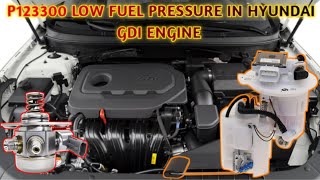
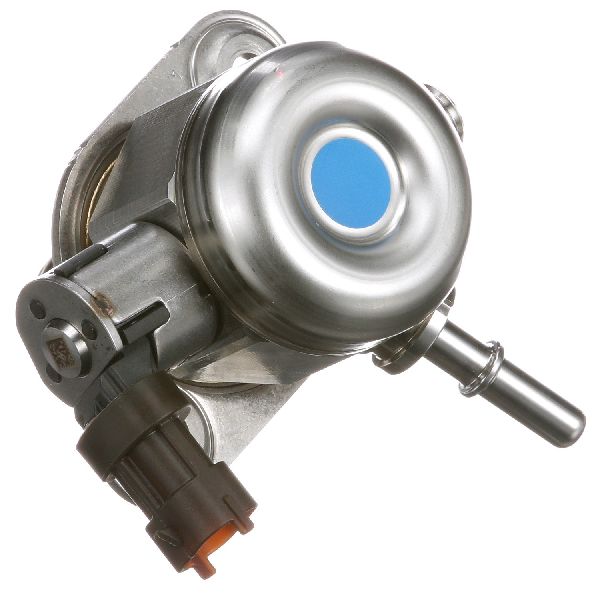
- Replacing the high-pressure fuel pump (HPFP) located on the engine. P1233 is a low-pressure side fault, and replacing the HPFP is an expensive and incorrect repair for this specific code. 🎬 Watch: How to replace the HPFP if you have a different fault.
Most Likely Causes

- Cracked Fuel Pump Filter Housing 🔴 High Probability This is a known manufacturing or material defect. The plastic used for the filter housing is susceptible to developing cracks, often at the bottom joint, causing a severe internal fuel pressure leak inside the tank. The issue is so common that Kia and Hyundai have both issued warranty extensions for it.
How to confirm: According to Kia's TSB FUE061, the presence of DTC P1233 is sufficient confirmation to proceed with the repair. If symptoms are present but the code is not, a technician will perform a fuel pressure bleed-down test. If pressure drops below 14.5 PSI (100 kPa) within one minute of shutting the engine off, it confirms the leak. Visual inspection of the removed part often shows fuel leaking from the bottom of the filter housing.
Typical fix: Replace the fuel filter assembly inside the fuel tank. This repair is covered under Kia's warranty extension program (WTY028) for 15 years/150,000 miles from the vehicle's original in-service date. The warranty covers both original and subsequent owners.
Est. part cost: $30-$100
Diagnosis Steps

- Scan the vehicle's onboard computer for diagnostic trouble codes. Confirm that P1233 is present.
- Contact a Kia dealership with the vehicle's VIN to check for open recalls and confirm eligibility for the Fuel Pump Filter Warranty Extension (WTY028). This should be the first step to avoid paying for a covered repair.
- If the vehicle is covered, schedule a service appointment for the dealer to perform the repair as outlined in TSB FUE061. Diagnosis is also covered at no cost.
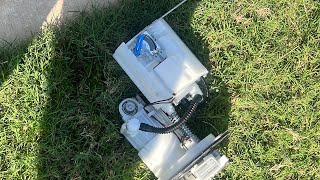
- If the vehicle is not covered, the diagnostic procedure involves accessing the in-tank fuel pump, which is located under the rear seat beneath a service cover. 🎬 Watch: A quick guide to accessing the in-tank fuel pump.
- Safely release the residual pressure in the fuel line following the shop manual procedure to prevent injury.
- Remove the fuel pump assembly from the fuel tank.
- Inspect the fuel filter housing for visible cracks or signs of leaking, particularly around the bottom seam.
- Replace the cracked fuel filter housing with the updated part (31112-C2500QQK). It is also wise to replace the fuel tank O-ring/seal at the same time to ensure a proper seal upon reinstallation.
- Reinstall the fuel pump assembly, ensuring all connections are secure, and check for proper operation and pressure.
Parts You'll Likely Need

- Fuel Filter Assembly Kit
(OEM #31112-C2500QQK)— This is the specific part identified by Kia in TSB FUE061 as the cause of the P1233 code due to its tendency to crack. Some parts catalogs may list the base number as 31112-C2500.
Trusted brands: Kia OE, Hyundai OE
OEM price range: $25-$55
Aftermarket price range: N/A
Technical Service Bulletins (TSBs) & Recalls
- FUE061 (Rev 1) - Provides the inspection and replacement procedure for the cracked fuel pump filter housing to address DTC P1233. It confirms that if P1233 is present, the diagnosis is complete.
- WTY028 - The warranty extension campaign that covers the repair for 15 years/150,000 miles. It explicitly covers diagnosis and repair at no cost to the customer for the specified symptoms.
- Bulletin #WTY028_TSB_R1 - Notes that affected vehicles may exhibit an intermittent reduction in engine power, contain an active or stored DTC P1233, and/or exhibit a "No Start" condition due to a cracked fuel pump filter housing.
Platform-Specific Known Issues
- Kia has issued a warranty extension (Campaign WTY028) that covers the cost of diagnosis and replacement of the fuel filter assembly for 15 years or 150,000 miles from the vehicle's original in-service date, whichever comes first. This issue is directly addressed by Technical Service Bulletin FUE061, Revision 1.
- This warranty extension applies to both original and subsequent owners, so even if you bought the car used, it should be covered.
- Owners who previously paid for this specific repair out-of-pocket may be eligible for reimbursement from Kia.
Mechanic-Grade Diagnostic Values
- Low-Pressure Fuel System Bleed-Down Test — expected: Fuel pressure must remain above 14.5 PSI (100 kPa) for at least one minute after the engine is shut off.. Failure: Pressure drops below 14.5 PSI within one minute, confirming a significant internal leak.
- KDS/GDS Scan Tool Graph Analysis (during Fuel Pump Relay actuation) — expected: The 'Absolute Electrical Fuel Pump Low Pressure Active Value' graph displays five or more even and continuous bars of pressure.. Failure: The graph displays uneven bars, indicating an unstable pump or leak.
Scan Tool Commands That Help
- Kia KDS / GDS: Actuation Test: Fuel Pump Relay — This command is used per TSB FUE061 when stalling/no-start symptoms are present, but DTC P1233 is NOT stored. It manually runs the low-pressure fuel pump, allowing a technician to monitor the live pressure graph for instability that confirms a pump/filter assembly fault.
Wiring & Ground Locations
- Fuel Pump Fuse — In the engine compartment fuse/relay box (Multi fuse block), the fuse is typically a 20A fuse in position 39.. While rarely the cause for P1233 (which indicates a pressure deviation, not necessarily a complete electrical failure), a compromised fuse or circuit could cause intermittent pump operation leading to pressure issues. It's a basic electrical check before condemning the pump assembly if the cause isn't the typical cracked housing.
OEM Part Supersession History
31112-C2500→31112-C2500QQK— The 'QQK' part number denotes the revised fuel filter assembly kit specified in TSB FUE061 to correct the cracking issue. The base part number may refer to the original, failure-prone design.
Heads up: While the base part may physically fit, it is critical to use the 'QQK' kit to ensure the updated, more durable plastic material is installed, preventing a repeat failure. Installing the non-QQK part is a likely comeback.
Model Year Variations Within This Range
- 2016-2020: TSB FUE061 outlines two different diagnostic inspection procedures. Procedure 'A' is for the 2.0L/2.4L GDI engines. Procedure 'B' is for the 1.6L T-GDI engine in 2019-2020 models. While the final repair part is the same, the diagnostic steps to get there vary slightly depending on the powertrain.
Diagnostic Flowchart
Other Known Issues on This Vehicle
Issues unrelated to this code that are worth knowing about as an owner of this generation:
- Theta II GDI Engine Failure (Rod Bearing) 🔴 High — Widespread across 2.0L T-GDI and 2.4L GDI engines. Can occur at various mileages. Subject of multiple class-action lawsuits and recalls. (Ref: Multiple recalls and a lifetime warranty were implemented as part of a legal settlement for vehicles that received a Knock Sensor Detection System (KSDS) software update.)
- Excessive Oil Consumption 🟠 Medium — Common complaint for the 2.4L GDI engine, often a precursor to more serious engine problems. (Ref: Related to the broader Theta II engine issues and settlement.)
- Carbon Buildup on Intake Valves 🟠 Medium — An inherent issue with Gasoline Direct Injection (GDI) engines, as fuel is not sprayed over the intake valves to clean them. Can cause misfires and performance loss over time.
- Leaking High-Pressure Fuel Pipe 🔴 High — Some 2011-2017 models with 2.0L and 2.4L GDI engines were recalled because the high-pressure fuel pipe connecting to the HPFP could leak, creating a fire risk. (Ref: Recall)
- Steering Coupler Failure 🟡 Low — The flexible steering coupler can disintegrate over time, causing a clicking or knocking noise in the steering column when turning the wheel. (Ref: A common wear item, though not typically a formal recall for this generation.)
Used vs. New Parts: Buying Guide for This Vehicle
When a used part is the smart pick: For this specific repair (P1233), using a salvaged or used fuel filter housing is strongly discouraged. The failure is a known material defect in the original part, and a used part is highly likely to have the same defect or develop it soon after installation.
What to inspect on the donor part:
- Do not use a salvaged part for this repair. The risk of repeat failure is extremely high.
- The only theoretical exception would be confirming the salvaged part is the revised OEM part (31112-C2500QQK), which is difficult to verify and not worth the risk given the low cost of a new OEM part.
OEM-only on this vehicle (don't cheap out):
- Fuel Filter Assembly Kit (31112-C2500QQK). It is critical to purchase this part new from a genuine Kia or Hyundai dealer to ensure you receive the updated design that resolves the cracking issue.
Aftermarket brands forum-validated for this vehicle:
- N/A. No aftermarket brands are specifically recommended for the filter housing, as the genuine OEM revised part is inexpensive and the correct fix.
Brands owners have reported issues with on this vehicle:
- Any unbranded or generic fuel filter housing should be avoided, as it will likely not incorporate the material improvements of the revised OEM part.
Real Owner Stories
Aggregated from forums and TSBs cited above. Mileages and costs reflect what owners reported in those sources.
2016-2020 Kia Optima 2.0L T-GDI / 2.4L GDI
Symptoms: When the fuel tank was low, the car would start to accelerate when the gas pedal was pressed hard, but then would suddenly lose power and 'nose-dive' as if the gas was abruptly cut off.
What fixed it: The owner discovered a thin tube on the fuel filter assembly inside the tank had broken off and was dangling. They performed a DIY repair by gluing the tube back in place.
Source hint: DRIVE2.RU
NHTSA Reported Incident
Symptoms: An owner reported receiving error code P1233 after their vehicle required a tow. A mechanic advised that the issue was covered under an extended warranty.
Source hint: NHTSA ODI #11556499
Related OBD-II Codes
Frequently Asked Questions
Is the repair for code P1233 on my 2018 Kia Optima covered by a warranty?
What is the first thing I should do if my Optima shows code P1233 and is stalling?
I already paid a local mechanic to replace the fuel filter housing for this exact problem. Can I get my money back?
My car is hesitating and stalling, but the check engine light isn't on and there's no P1233 code. Could it still be the cracked fuel filter housing?
Does this P1233 fuel pump issue also affect the Hyundai Sonata?
What part number is needed for the fix?
Helpful Videos

We Have This Part in Stock


The information in this article is provided for general reference and educational purposes only. Vehicle specifications, procedures, and part compatibility can vary by production date, trim level, and region. Always consult your vehicle's factory service manual and verify part numbers before purchasing or performing repairs. Safety-critical components such as airbags, seat belts, and braking systems should be installed by a qualified professional.
- Kia Optima:
- 🎬 Helpful Videos
- 🛍️ Shop This Part
- What's Unique About the 2016-2020 Kia Optima
- Symptoms You May Notice
- Most Likely Causes
- Diagnosis Steps
- Parts You'll Likely Need
- Technical Service Bulletins (TSBs) & Recalls
- Platform-Specific Known Issues
- Mechanic-Grade Diagnostic Values
- Scan Tool Commands That Help
- Wiring & Ground Locations
- OEM Part Supersession History
- Model Year Variations Within This Range
- Diagnostic Flowchart
- Other Known Issues on This Vehicle
- Used vs. New Parts: Buying Guide for This Vehicle
- Real Owner Stories
- 2016-2020 Kia Optima 2.0L T-GDI / 2.4L GDI
- NHTSA Reported Incident
- Related OBD-II Codes
- Frequently Asked Questions
- 🎟️ Get 5% Off