

OBD-II Code P1326: Knock Sensor Detection System Fault
The Ultimate Guide to P1326: What It Means, Why It Triggers, and How to Fix It
- Tow your vehicle to a Hyundai or Kia dealership immediately, as P1326 indicates a severe connecting rod bearing failure that caps engine power at 2,000 RPM.
- Hyundai and Kia offer a lifetime engine warranty for this specific defect, covering the $8,000+ engine replacement cost for eligible vehicles.
- Call a dealership with your 17-digit VIN before authorizing any repairs to verify your eligibility for Service Campaign 966 or TSB T6G.
- Leave the P1326 code active on your engine computer; dealerships require the uncleared code to authorize the mandatory Bearing Clearance Test and approve warranty claims.
What Does P1326 Mean?

P1326 is a Hyundai and Kia manufacturer-specific code indicating the Knock Sensor Detection System (KSDS) detected vibrations consistent with excessive connecting rod bearing wear. The engine computer triggers this code and flashes the check engine light to warn of imminent engine failure. This system was intentionally added via software updates (like Service Campaign 966) to monitor for a known manufacturing defect.
Technical definition: The official definition for P1326 on affected Hyundai and Kia models is "Knock Signal Range/Performance" as detected by the Knock Sensor Detection System (KSDS). The system monitors for a unique vibration signature matching connecting rod bearing failure, distinguishing it from generic engine noises.
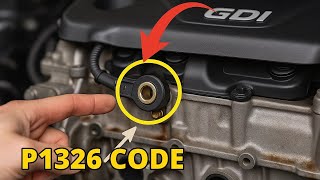
🎬 Watch: A deep dive into Theta II bearing failure mechanics.Can I Drive With P1326?

No — Do Not Drive. Do not drive. The vehicle enters 'limp mode,' capping power at 1,800-2,000 RPM to prevent catastrophic engine failure. Continuing to drive guarantees complete engine seizure, causing sudden loss of power and control. Tow the vehicle directly to a dealership.
Common Causes

- Excessive Connecting Rod Bearing Wear (Very Common) — Manufacturing defects in Hyundai and Kia engines left metallic debris that causes oil starvation and premature connecting rod bearing wear. This wear creates the exact vibration pattern the KSDS monitors.
- Water Intrusion into Wiring Harness (Common) — Water entering the knock sensor connector causes a false P1326 code. This frequently occurs immediately after automatic car washes, 🎬 See how heavy rain or car washes trigger false codes. driving through deep puddles, or heavy rain, as moisture shorts the circuit.
- Faulty Knock Sensor (Common) — The knock sensor fails, becomes overly sensitive, or develops internal shorts, sending false signals to the ECM. Replacing the sensor resolves the code only if a dealership confirms the engine is mechanically sound.
- Damaged Wiring or Poor Connection (Common) — The knock sensor wiring harness frays, corrodes, or suffers oil saturation. Additionally, if the harness rests too close to a fuel injector wire, electrical interference tricks the system into detecting a knock.
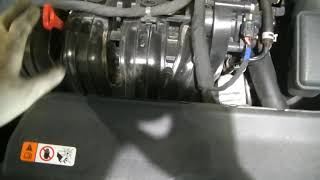
- Outdated Engine Control Module (ECM) Software (Less Common) — If the vehicle lacks the required KSDS software update (like Campaign 966), the system malfunctions. Dealerships apply newer software versions to correct knock sensor oversensitivity if the engine passes the bearing test. 🎬 Watch: Step-by-step knock sensor replacement and diagnostic walkthrough.
- Ancillary System Interference (Rare) — Vibrations from failing alternators, A/C compressors, loose heat shields, or timing chains trick a sensitive knock sensor. While KSDS filters most background noise, exceptionally loud components generate false positive P1326 codes.
Symptoms
- Flashing Check Engine Light — A flashing Check Engine Light signals a severe, active engine failure requiring immediate shutdown.
- Limp Mode / Reduced Power — The ECM forces Engine Protection Mode, capping engine speed at 1,800-2,000 RPM to prevent catastrophic self-destruction.
- Audible Lower Engine Knocking — A heavy metallic knocking or ticking sound from the lower engine block synchronizes with RPM. The absence of noise does not rule out bearing failure.
- Engine Stalling and Rough Idle — The engine runs erratically, stalls unexpectedly at stops, or refuses to start.
Diagnostic Flowchart

Tap your situation to follow the diagnostic path that matches what you're seeing on this code.
Common Fixes & Costs
- Engine Replacement (Under Warranty) — Parts: $0, Labor: $0, ~10.0 hr book time (Professional)
- Knock Sensor Replacement
— Parts: $80-$150, Labor: $150-$400, ~2.5 hr book time
(Intermediate)
Hyundai Sonata / Santa Fe / Tucson: OEM
Kia Optima / Sorento / Sportage: OEM - Repair Wiring Harness
— Parts: $20-$100, Labor: $150-$400, ~2.0 hr book time
(Intermediate)
Applicable Hyundai/Kia Models: OEM - ECM Software Update — Parts: $0, Labor: $0-$175, ~0.5 hr book time (Professional)
- Engine Replacement (Out of Warranty) — Parts: $4000-$7000, Labor: $2000-$4000, ~12.0 hr book time (Professional)
Used vs. New Parts: Buying Guide
When a used part is worth it: Never buy a used knock sensor. The $150-$400 labor cost to remove the intake manifold far outweighs the $80 savings on a used part.
Donor-vehicle mileage cap: roughly under 20000 miles for the part to have meaningful remaining life.
Donor quality checklist:
- Verify donor vehicle was not scrapped for engine-related issues.
- Ensure the part number is an exact match to the OEM part.
- Avoid parts with any signs of corrosion, heat stress, or physical damage to the connector.
Decision logic:
- If The engine has failed the bearing clearance test → Do not buy any parts; pursue warranty engine replacement with the dealer.
- If The engine passed the bearing test and the knock sensor is confirmed faulty → Buy a new OEM or high-quality aftermarket knock sensor. The cost savings of a used part are not worth the risk of repeat labor.
- If You are considering a used engine for an out-of-warranty replacement → This is extremely risky. Do not buy a used Theta II, Nu, or Gamma engine without irrefutable proof it is from a model year outside the defect range or has been professionally remanufactured.
Warranty tradeoff: Used knock sensors typically have a 30-day warranty at best. New aftermarket sensors offer a 1-year to limited lifetime warranty. A new OEM sensor provides the best guarantee of compatibility and longevity.
Worst-case if a used part fails: $400-600 if a used knock sensor fails after installation, requiring a full repeat of the labor-intensive replacement job.
What Happens If You Wait — Timeline
- Immediate: The ECM triggers P1326, flashes the Check Engine Light, and forces Engine Protection Mode, capping RPM at 2,000. (MPG impact: N/A% · Added cost: $75-$250 (Towing cost))
- Minutes of Driving: Continued driving rapidly degrades the failing connecting rod bearing. Friction generates extreme heat, destroying the remaining oil film. (MPG impact: N/A% · Added cost: $0)
- Hours of Driving (Against Advice): Bearing material disintegrates, creating excessive connecting rod play and scoring the crankshaft journal. A heavy metallic knock becomes audible. (MPG impact: N/A% · Added cost: $500-$1,500)
- Continued Operation: The connecting rod breaks and punches a hole in the engine block. The engine seizes violently, causing sudden loss of vehicle control and voiding warranty eligibility. (MPG impact: N/A% · Added cost: $8,000 - $12,000+)
Cost of Not Fixing It
- Immediate: The ECM forces limp mode, capping speed and creating severe safety risks when merging or crossing intersections. (Added cost: Towing fees ($75-$250))
- Minutes to Hours: The failing connecting rod bearing disintegrates, throwing a rod through the engine block and causing violent engine seizure. (Added cost: $8,000 - $12,000+)
- Ongoing: Ignoring a sensor-related P1326 disables the KSDS protection, eliminating the early warning system for catastrophic engine failure. (Added cost: Potential loss of eligibility for warranty engine replacement.)
Diagnosis Steps
- Check for Recalls and TSBs
Contact a Hyundai or Kia dealership with your VIN to verify eligibility for Service Campaign 966, Campaign 953, TSB T6G, or PI2002Y/Z. This dictates your warranty coverage.
Tools: Phone, VIN (Beginner) - Read the Code (DO NOT CLEAR)
Confirm P1326 with an OBD-II scanner. Do not clear the code; dealerships require the active code to process engine warranty claims. Document any accompanying oil pressure codes.
Tools: OBD-II Scanner (Beginner) - Listen for Engine Noise
Listen for metallic knocking from the lower engine block using a mechanic's stethoscope. A clear bottom-end knock confirms internal engine damage. Silence does not rule out early-stage bearing wear.
Tools: Mechanic's Stethoscope (Beginner) - Inspect the Knock Sensor Wiring
Inspect the knock sensor harness under the intake manifold for chafed wires, oil saturation, or corroded pins. Check for water intrusion inside the connector, especially if the code triggered after a car wash.
Tools: Flashlight, Inspection Mirror (Intermediate) - Perform Bearing Clearance Test (Professional)
Dealerships use a Bearing Clearance Tester (SST KQ231-2T110QQK) to apply pressure and vacuum to the cylinders, measuring connecting rod bearing clearance. This mandatory test determines warranty engine replacement approval.
Tools: Bearing Clearance Tester (SST KQ231-2T110QQK) (Professional) - Perform Knock Sensor Resistance Test
Set a multimeter to Ohms (Ω) and probe the sensor's signal pin and metal housing. A functional sensor reads 93-110 ohms. Infinity (OL) or zero indicates a failed sensor.
Tools: Multimeter (Advanced) - Check for Reference Voltage and Signal
Disconnect the harness and verify a 5-volt reference signal at the connector with the key on. Reconnect, back-probe the signal wire, set the multimeter to AC volts, and tap the engine block. A small AC voltage spike confirms the sensor generates a signal.
Tools: Multimeter, Back-probe kit (Advanced) - Check for Signal Interference (Pro-Tip)
Perform a 'Wiring Signal Interference Check' per manufacturer TSBs. If the knock sensor harness picks up electrical noise from the fuel injectors, install an extension harness (Part # 39251-2GBC0) to reroute the wiring.
Tools: Service Manual, Harness Extension Kit (Advanced) - Ensure Proper Knock Sensor Installation & Reset Adaptives
Torque the new knock sensor bolt to exactly 14-17 ft-lbs (21 N.m); improper torque alters vibration detection. Reset the ECM's adaptive memory values using an advanced scan tool.
Tools: Torque Wrench, Advanced OBD-II Scan Tool (Advanced)
When This Code Triggers (Freeze-Frame Conditions)
- Engine Coolant Temp: 185-205°F (Fully warmed up, during or after a drive.)
- RPM: 1500-2500 (Steady cruise or light acceleration.)
- Engine Load: 30-60% (Maintaining speed on a flat road or slight incline.)
- Vehicle Speed: 40-65 mph (Highway or arterial road driving conditions.)
Related Codes
- P0326 — P1326 indicates a mechanical vibration pattern matching rod bearing failure. P0326 is a generic electrical fault for the knock sensor circuit. P1326 requires a mechanical bearing clearance test, while P0326 requires electrical circuit testing.
- P0011, P0014, P0017 — These VVT timing codes trigger from low or contaminated oil. Appearing alongside P1326 confirms widespread lubrication failure. Inspect camshaft position sensors for metallic 'gold flakes,' proving bearing material is circulating in the oil.
- P0300, P0301-P0304 — Failing rod bearings cause erratic crankshaft speeds, triggering misfire codes. The misfire is a symptom of the mechanical failure detected by P1326. Always prioritize P1326 diagnosis over misfire troubleshooting.
- P0524 — Indicates low engine oil pressure. Seeing P0524 alongside P1326 confirms the KSDS vibrations stem from critical oil starvation. Mechanical engine damage is imminent or actively occurring.
Climate & Environmental Factors
- Humidity / Water: Automatic car washes and heavy rain frequently trigger false P1326 codes. Water penetrates the knock sensor's wiring connector, causing a short circuit the ECM misinterprets as critical engine knock.
- Cold Weather: Cold starts cause temporary low oil pressure, briefly starving bearings and creating vibrations the KSDS flags. Cold temperatures also make wiring brittle and susceptible to moisture intrusion.
How to Talk to a Mechanic About This Code
Say this: "My vehicle is in limp mode with a flashing check engine light and active code P1326. Please check my VIN for eligibility under the KSDS lifetime engine warranty extension and schedule the mandatory Bearing Clearance Test."
This language shows you have done your research. It immediately directs the dealer to the specific, required diagnostic path for P1326, focusing on the warranty-covered engine issue rather than unnecessary diagnostics.
Avoid saying:
- 'My check engine light is on, can you look at it?'
- 'My car is shaking and won't go fast.'
- 'Just fix whatever is wrong, I have a warranty.'
Questions to ask before authorizing the repair:
- Have you confirmed my VIN is eligible for the lifetime engine warranty (Campaign T6G/SC200)?
- What were the results of the Bearing Clearance Test? Did it pass or fail?
- If it passed, what is the next step? Are you checking for wiring interference or a faulty sensor per the TSB?
- If it failed, what is the estimated timeline for the warranty engine replacement and is a loaner vehicle available?
- If this repair is not covered by the lifetime warranty, can you explain why my vehicle is ineligible?
Where to Take It: Dealer vs Independent vs Chain
- Dealer:
Required. Dealerships exclusively possess the Bearing Clearance Tester and authorization to approve the $8,000+ lifetime warranty engine replacement. Start here.
Best for: Initial diagnosis of P1326., Performing the specific Bearing Clearance Test (BCT)., Processing a free engine replacement under the lifetime warranty.
Downsides: Can be expensive for non-warranty repairs if the engine passes the BCT., Long wait times for diagnosis and repair are common. (Typical cost: +50% vs. baseline) - Independent Shop:
Use only for sensor or wiring repairs after a dealership officially passes the engine on the Bearing Clearance Test. Going here first risks paying for unnecessary parts.
Best for: Potentially cheaper knock sensor or wiring repair IF the dealer has already performed the BCT and confirmed the engine is healthy.
Downsides: Cannot perform the official Bearing Clearance Test., Cannot authorize a warranty engine replacement., May not be familiar with the specific TSBs for P1326. (Typical cost: +0% vs. baseline) - Chain Shop:
AVOID. These shops are not equipped to handle the specific, warranty-tied nature of the P1326 code. Taking your vehicle here will waste time and money.
Best for: None for this specific code.
Downsides: Lack the specialized tools and knowledge for the required diagnostic procedure., High risk of misdiagnosis, leading to unnecessary and expensive repairs. (Typical cost: -10% vs. baseline)
When to Walk Away From the Repair
The decision to repair or walk away from a P1326 issue depends almost entirely on the dealership's diagnosis and warranty coverage, not just the car's value.
- Car worth $6000, fix is $0: FIX IT. The engine failed the bearing test and is covered by the lifetime warranty. The repair is free.
- Car worth $6000, fix is $8500: WALK AWAY. The engine failed the bearing test but your VIN is not eligible for the warranty extension. The repair cost far exceeds the vehicle's value.
- Car worth $6000, fix is $400: FIX IT. The engine passed the bearing test and only requires a knock sensor replacement. The repair cost is well below the vehicle's value.
What Scan Tool You Need for This Code
Minimum: Any basic OBD-II code reader that can read and clear DTCs.
A basic $20 scanner is sufficient. Your only goal is confirming P1326 before towing the vehicle to a dealership. Advanced bidirectional scanners cannot perform the proprietary Bearing Clearance Test. DO NOT CLEAR THE CODE.
Budget: BlueDriver Pro or basic Autel/Innova models (~$60) — Confirms the P1326 code is active and allows you to read freeze-frame data. This is all the proof you need to take the correct next step: calling the dealer.
Mid-range: Foxwell NT510 Elite for Hyundai/Kia (~$150) — Provides deeper access to manufacturer-specific systems. While not strictly necessary for the initial P1326 diagnosis, it can reset adaptive values after a repair.
Professional: Autel MaxiCOM MK808 (~$500) — Offers professional-level functions, including full bidirectional control. This is overkill for an owner dealing with P1326, as the key diagnostic steps are out of the owner's hands.
Rent vs buy: For this code, simply use the free service at a parts store like AutoZone to read the code, or use their loaner tool program. You only need to read the code once.
How to Clear the Code After You Fix It
- Reconnect battery if disconnected for repair
- Use an OBD-II scan tool to clear the P1326 code
- Reset ECM adaptive values using an advanced scan tool
- Perform a full drive cycle to allow readiness monitors to set
Drive cycle (~30 minutes): From a cold start, idle for 2-3 minutes. Drive in stop-and-go city traffic for 10-15 minutes. Drive at a steady highway speed (55-60 mph) for 10 minutes. Allow the vehicle to cool down completely to ambient temperature.
Readiness monitors affected: Catalyst Monitor, Evaporative System Monitor, O2 Sensor Monitor
Before emissions retest: drive at least 100 miles to fully set monitors.
Watch out for:
- Do not clear the code before dealership diagnosis; active codes are mandatory for warranty claims.
- Disconnecting the battery resets readiness monitors but does not permanently clear P1326, guaranteeing an emissions test failure.
- The code returns immediately upon driving if the underlying bearing wear or sensor fault remains.
Will This Fail Emissions / State Inspection?
Yes — this code typically fails an OBD-II emissions inspection.
- California: A flashing check engine light is an automatic failure of the smog inspection. All readiness monitors must be set to 'Ready', so after a repair and code clear, a full drive cycle is required before re-testing.
- New York: An illuminated or flashing check engine light will cause an automatic failure of the NYS emissions inspection. Clearing the code right before the test will also result in a 'Not Ready' failure.
- Texas: In the 17 counties requiring emissions testing, a vehicle with an active P1326 and illuminated check engine light will automatically fail the OBD portion of the inspection.
Most Commonly Affected Vehicles

- Hyundai Sonata (2011-2019) — Affects YF and LF generations with 2.0L and 2.4L Theta II engines.
- Hyundai Sonata Hybrid / Plug-In Hybrid (2011-2019) — Affects models with Nu GDI and Theta II GDI engines.
- Hyundai Santa Fe / Santa Fe Sport (2010-2019) — Models with the 2.0L and 2.4L Theta II engines are widely affected.
- Hyundai Tucson (2010-2021) — Multiple engine types, including the Nu, Gamma, and Theta II, are implicated.
- Hyundai Veloster (2012-2017) — Included in service campaigns related to the KSDS update.
- Kia Optima (2011-2020) — Shares the problematic Theta II engines with the Sonata.
- Kia Sorento (2012-2020) — Equipped with the affected 2.4L GDI and 2.0L Turbo GDI engines.
- Kia Sportage (2011-2021) — Equipped with the 2.0L and 2.4L engines known to have the rod bearing defect.
- Kia Soul (2012-2016) — Models equipped with 1.6L and 2.0L engines are included in the KSDS update.
Manufacturer-Specific Notes
- Hyundai / Kia: P1326 is generated by the KSDS software update specifically designed to detect a known manufacturing defect. It initiates the diagnostic process for a free lifetime warranty engine replacement.
- Hyundai: Hyundai TSBs 22-01-023H-2 (Campaign T6G) and 21-01-023H-4 (Campaign 966) dictate the mandatory dealer procedures for bearing testing and engine replacement.
- Kia: Kia TSBs PI2002Y/Z, PI1802Y/Z, and SC200 provide the diagnostic flowcharts dictating when dealers perform the bearing clearance test versus checking for wiring interference.
- Hyundai / Kia: Hyundai and Kia TSBs mandate a 'Wiring Signal Interference Check' because water intrusion from car washes frequently triggers false P1326 codes.
- Hyundai / Kia: Generic OBD-II scanners incorrectly define P1326 as 'Glow Relay Stuck' (a diesel code). On gasoline Hyundai/Kia models, P1326 exclusively refers to the Knock Sensor Detection System.
Real Owner Stories
2015 Santa Fe Sport 2.0T with developing engine knock
After several months of minor issues, the vehicle developed a noticeable engine knock, flashing check engine light (P1326), and went into limp mode.
Outcome: The dealership confirmed failing connecting rod bearings. Because the KSDS recall was previously performed, the engine was replaced for free under the extended warranty.
Lesson: If you experience the classic symptoms (knock, flashing light, limp mode), tow the car to a dealership immediately to check your VIN for warranty extensions.
2023 Hyundai Kona N with P1326 after a car wash
Immediately after a touchless car wash, the car threw a P1326 code and entered permanent limp mode with no engine noises.
Outcome: The dealer performed a 'Wiring Signal Interference Check', dried out the water-intruded connection, and cleared the false code.
Lesson: Car washes and heavy rain frequently trigger false P1326 codes. While it requires a dealer trip to clear and verify, it does not always mean engine failure.
2014 Kia Optima passed bearing test, but P1326 returned
A car wash triggered P1326. The dealer kept the car for three weeks, performed the Bearing Clearance Test (which it passed), updated the software, and returned the car.
Outcome: The dealer replaced the knock sensor itself for $450, as the sensor was not covered by the lifetime engine block warranty.
Lesson: If the engine passes the mechanical test, the fault lies in the sensor or wiring. Be prepared to pay out-of-pocket for sensor replacement if the vehicle is outside its bumper-to-bumper warranty.
How to Prevent This Code From Triggering
- Ensure KSDS Software Update is Installed (One-time check) — The KSDS is the safety net. Having the latest version (Campaign 966/953) is a strict prerequisite for the lifetime engine warranty. Call a dealer with your VIN to confirm installation.
- Use High-Quality 5W-30 Synthetic Oil (Every 3,500-5,000 miles) — While the original oil cap says 5W-20, specialists recommend 5W-30 for better film thickness and protection in GDI engines. Short intervals remove abrasive soot particles.
- Check Engine Oil Level Frequently (Every other fuel fill-up) — Theta II engines consume oil between changes. Low oil levels rapidly accelerate bearing wear. Topping off oil is the cheapest insurance against lubrication starvation.
- Apply Dielectric Grease to Knock Sensor Connector (During any related maintenance) — Applying dielectric grease to the knock sensor's electrical connector seals it from moisture, preventing false P1326 codes caused by car washes or heavy rain.
Frequently Asked Questions
Can I just clear the P1326 code and keep driving?
Do not clear the code. Dealerships must see the active code to initiate the warranty process. Clearing it does not fix the underlying defect and driving risks catastrophic engine seizure.
Does P1326 always mean I need a new engine?
Not always, but it is the most likely outcome. The code is also caused by a bad knock sensor, water intrusion, or a software glitch. A dealer must perform a specific bearing clearance test to confirm if the engine needs replacement.
My car has the P1326 code but it's high mileage. Will the warranty still cover it?
Yes, for eligible vehicles. Kia and Hyundai extended the engine warranty to a lifetime warranty for this specific issue, regardless of mileage. Eligibility depends on your VIN and whether the required KSDS software update was previously performed.
Can a car wash cause a P1326 code?
Yes, water intrusion from car washes or heavy rain is a common trigger. Moisture shorts the knock sensor's wiring connector, tricking the computer into triggering limp mode and the P1326 code. You still must tow the car to a dealer to rule out actual engine failure.
My dealer says the engine passed the bearing test, but the P1326 code came back. What's next?
If the engine passes the mechanical test, the fault lies in the detection system. The dealer will inspect the wiring harness for water intrusion or damage and test the knock sensor circuit. If the wiring is intact, replacing the knock sensor or updating the ECM software resolves the issue.
The dealer charged me a diagnostic fee for P1326. Is this normal?
Dealerships typically charge a $150-$250 diagnostic fee for the initial bearing clearance test. If the engine fails the test and is replaced under warranty, this fee is waived or refunded. If the engine passes, you are responsible for the diagnostic fee and any subsequent sensor or wiring repairs.
How long does a P1326 engine replacement take?
Wait times vary dramatically from a few weeks to several months. Delays depend on dealer workload, corporate warranty approval times, and engine availability. Many owners report being without their vehicle for over a month.
Key Takeaways
- Tow your vehicle to a Hyundai or Kia dealership immediately, as P1326 indicates a severe connecting rod bearing failure that caps engine power at 2,000 RPM.
- Hyundai and Kia offer a lifetime engine warranty for this specific defect, covering the $8,000+ engine replacement cost for eligible vehicles.
- Call a dealership with your 17-digit VIN before authorizing any repairs to verify your eligibility for Service Campaign 966 or TSB T6G.
- Leave the P1326 code active on your engine computer; dealerships require the uncleared code to authorize the mandatory Bearing Clearance Test and approve warranty claims.
Helpful Videos
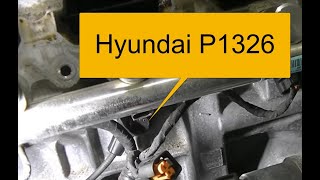

The information in this article is provided for general reference and educational purposes only. Vehicle specifications, procedures, and part compatibility can vary by production date, trim level, and region. Always consult your vehicle's factory service manual and verify part numbers before purchasing or performing repairs. Safety-critical components such as airbags, seat belts, and braking systems should be installed by a qualified professional.
- 🎬 Helpful Videos
- What Does P1326 Mean?
- Can I Drive With P1326?
- Common Causes
- Symptoms
- Diagnostic Flowchart
- Common Fixes & Costs
- Used vs. New Parts: Buying Guide
- What Happens If You Wait — Timeline
- Cost of Not Fixing It
- Diagnosis Steps
- When This Code Triggers (Freeze-Frame Conditions)
- Related Codes
- Climate & Environmental Factors
- How to Talk to a Mechanic About This Code
- Where to Take It: Dealer vs Independent vs Chain
- When to Walk Away From the Repair
- What Scan Tool You Need for This Code
- How to Clear the Code After You Fix It
- Will This Fail Emissions / State Inspection?
- Most Commonly Affected Vehicles
- Manufacturer-Specific Notes
- Real Owner Stories
- 2015 Santa Fe Sport 2.0T with developing engine knock
- 2023 Hyundai Kona N with P1326 after a car wash
- 2014 Kia Optima passed bearing test, but P1326 returned
- How to Prevent This Code From Triggering
- Frequently Asked Questions
- Can I just clear the P1326 code and keep driving?
- Does P1326 always mean I need a new engine?
- My car has the P1326 code but it's high mileage. Will the warranty still cover it?
- Can a car wash cause a P1326 code?
- My dealer says the engine passed the bearing test, but the P1326 code came back. What's next?
- The dealer charged me a diagnostic fee for P1326. Is this normal?
- How long does a P1326 engine replacement take?
- Key Takeaways
- 🎟️ Get 5% Off