

P1101 on 2011-2024 Ford F-150 EcoBoost: Causes and Fixes for MAF Sensor Faults
On a Ford F-150 with an EcoBoost engine, code P1101 is most often caused by oil contamination on the MAP/TMAP sensors from the PCV system. The fix is usually to clean all three sensors with dedicated MAF sensor cleaner, which costs about $10-$15 for a can and is a 1/5 difficulty DIY job. The sensor on the intake manifold is the most common culprit.
- P1101 on an F-150 EcoBoost is almost always related to the MAP/TMAP sensors.
- The most likely and cheapest fix is to clean all three sensors with dedicated MAF sensor cleaner spray.
- Do not immediately replace the sensors; cleaning is highly effective and costs very little.
- If cleaning doesn't work, check thoroughly for vacuum or boost leaks before buying new parts.
- Avoid using oiled air filters, as they can speed up sensor contamination.
What's Unique About the 2011-2024 Ford F-150
Ford's EcoBoost engines are direct-injected and turbocharged, relying on a speed-density system to precisely measure air pressure and temperature throughout the intake tract. Instead of a single traditional MAF sensor, they use multiple Temperature and Manifold Absolute Pressure (TMAP/MAP) sensors. There are typically three: one post-air filter (measures ambient temp/pressure), one on the charge pipe before the throttle body (measures boosted air temp/pressure), and one on the intake manifold itself (measures final temp/pressure before entering cylinders). The Positive Crankcase Ventilation (PCV) system on these engines can route oil vapors back into the intake, which then contaminates these sensitive sensors, particularly the one located on the intake manifold. This contamination is the most common reason an EcoBoost engine will set a P1101 code, often leading to a simple fix of cleaning the sensors rather than replacing them.
Generation note: This issue affects all F-150s with EcoBoost engines from 2011 to 2024, spanning the 12th (2011-2014), 13th (2015-2020), and 14th (2021-2024) generations. The fundamental cause—sensor contamination—is the same, though the exact location and part numbers for the sensors may vary slightly between the 3.5L, 2.7L, and PowerBoost 🎬 See this guide for cleaning sensors on the 2.7L engine hybrid versions. Early 3.5L engines (approx. 2011-2014) were also subject to TSBs regarding the PCV valve which can exacerbate oil contamination.
Symptoms You May Notice
- Check Engine Light is on.
- Rough, unstable, or fluctuating idle, especially on a cold start.
- Hesitation, stumbling, or reduced power during acceleration.
- Poor fuel economy.
- Engine stalling, especially when coming to a stop.
- A whistling or hissing sound from the engine bay, indicating a vacuum or boost leak.
- Replacing the MAP/TMAP sensors without cleaning them first. Many owners report that a simple cleaning is all that is needed to fix the code.
- Replacing spark plugs or ignition coils. While these can cause misfires, they do not directly cause a P1101 code.
- Confusing the speed-density system (MAP/TMAP) with a traditional MAF sensor system. EcoBoost F-150s do not have a single MAF sensor in the traditional sense.
Most Likely Causes
- Contaminated MAP/TMAP Sensors 🔴 High Probability The EcoBoost's PCV system introduces oil vapor into the intake tract, which bakes onto the pressure and temperature sensors, leading to inaccurate readings. The sensor on the intake manifold gets the hottest and is most prone to becoming oily and caked with deposits.
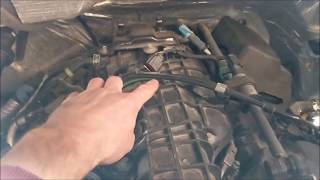
How to confirm: Visually inspect the three MAP/TMAP sensors. Two are located on the intake piping (one near airbox, one near throttle body), and one is on top of the plastic intake manifold. The intake manifold sensor will likely have a visible film of oil on it, sometimes appearing dark and crusty.
Typical fix: Remove and clean all three sensors using a dedicated Mass Airflow (MAF) sensor cleaner spray. Do not use brake or carb cleaner, as they can damage the plastic and sensing elements. Allow them to air dry completely before reinstalling.
Est. part cost: $10-$20 - Vacuum or Boost Leak 🟡 Medium Probability The complex plumbing of a turbocharged engine has many connection points. Hoses for the Charge Air Cooler (CAC) can become loose, the plastic intake manifold gaskets can fail, or the electronic blow-off valve diaphragm can tear, allowing unmetered air to enter or boost pressure to escape.
How to confirm: Visually inspect all intake hoses and clamps between the air filter and the engine. Check that all connections are tight. To find a gasket leak, you can perform a smoke test or carefully spray short bursts of carb cleaner near the intake manifold gasket with the engine idling; a change in idle RPM indicates a leak.
Typical fix: Tighten loose hose clamps or replace cracked hoses. If the intake manifold gasket is leaking, it must be replaced. A torn blow-off valve diaphragm requires replacing the valve assembly.
Est. part cost: $5-$150 - Dirty or Improperly Installed Air Filter ⚪ Low Probability If the air filter is clogged, it can restrict airflow enough to cause the sensor readings to be lower than expected. If the filter or airbox housing isn't sealed correctly, it can cause turbulent, unmetered airflow that confuses the sensors.
How to confirm: Inspect the engine air filter. Check if it is dirty or if the airbox housing is properly closed and sealed.
Typical fix: Replace the engine air filter and ensure the housing is correctly assembled and all clamps are tight.
Est. part cost: $20-$50
Rare But Worth Checking
- Faulty MAP/TMAP Sensor: While contamination is common, the sensor itself can fail electronically. If cleaning the sensors and checking for leaks doesn't resolve the code, the sensor may need to be replaced. The intake manifold sensor is the most common one to fail.
- Wiring Harness Issue: A damaged wire or corroded connector pin for one of the MAP sensors can interrupt the signal to the PCM, causing the self-test to fail. This is less common than sensor contamination but should be checked if other steps fail. On some GM applications with similar codes, wire chafing on the cam cover has been noted as a cause.
- Faulty PCV Valve: Especially on 2011-2014 models, a stuck or faulty PCV valve can increase the amount of oil vapor sent into the intake, accelerating sensor contamination. Ford issued a TSB (15-0005) for this issue on some 3.5L engines.
Diagnosis Steps
- Read the code with an OBD-II scanner to confirm P1101 is present and note any other codes.
- Visually inspect the entire air intake system from the airbox to the throttle body. Ensure all hose clamps are tight and there are no visible cracks in the ducting.
- Locate and remove the three MAP/TMAP sensors. One is on the airbox outlet tube, one is on the charge pipe near the throttle body, and the third is on top of the intake manifold toward the rear. 🎬 Watch: How to clean the sensors on a 3.5L EcoBoost
- Thoroughly spray the sensing elements of all three sensors with a dedicated MAF sensor cleaner. The intake manifold sensor will likely be the dirtiest. Allow them to air dry completely before reinstalling. Do not touch the elements.
- While the sensors are out, inspect the air filter and replace it if it is dirty. Ensure the airbox is re-sealed correctly.
- Clear the trouble code(s) with the scanner and perform a Key-On Engine-Running (KOER) test or drive the vehicle to see if the code returns. Disconnecting the battery for 15 minutes can also reset the learned values.
- If the code returns, perform a smoke test to check for vacuum leaks, paying close attention to the intake manifold gaskets, PCV hoses, and charge pipe connections.
- If no leaks are found, test the sensor's wiring. Using a multimeter, back-probe the sensor connector to check for proper voltage, ground, and signal continuity to the PCM.
- If all wiring and connections are good and no leaks are present, one of the MAP/TMAP sensors has likely failed and will need to be replaced. The intake manifold sensor is the most likely candidate.
Parts You'll Likely Need
- Mass Airflow Sensor Cleaner — This is the most common and cheapest fix. Cleaning oil residue off the MAP/TMAP sensors often restores them to proper function and resolves the code.
Trusted brands: CRC, Liqui Moly
Aftermarket price range: $10-$20 - MAP/TMAP Sensor (Intake Manifold)
(OEM #BB5Z-9F479-C (Supersedes BL3Z-9F479-C, BB5Z-9F479-A/B))— This is the sensor most prone to heavy oil contamination and heat-related failure. If cleaning does not work, this sensor is the most likely to have failed.
Trusted brands: Motorcraft, Bosch, Standard Motor Products
OEM price range: $50-$90
Aftermarket price range: $30-$60 - MAP/TMAP Sensor (Charge Pipe/Airbox)
(OEM #PV4Z-9F479-C (Varies, check VIN))— These sensors are less likely to fail than the intake manifold sensor but can still become contaminated and should be cleaned or replaced as a set if issues persist.
Related Codes That Often Appear With This One
- P0101 — This is a more generic code for 'MAF Circuit Range/Performance'. It can appear alongside the manufacturer-specific P1101 as they both relate to implausible airflow readings.
- P0300-P0306 — Misfire codes (e.g., P0300 for random misfire, P0301 for cylinder 1) can occur because the incorrect airflow data from P1101 leads to an improper air-fuel mixture, causing poor combustion.
- P0171 / P0174 — System Too Lean codes can be triggered if there is a vacuum leak allowing unmetered air into the engine, which is also a primary cause of P1101.
- P0299 — A Turbo/Supercharger Underboost condition can be caused by a significant boost leak, which would also allow unmetered air to affect the MAP sensor readings and potentially trigger P1101.
Technical Service Bulletins (TSBs) & Recalls
- TSB 15-0005: Some 2011-2014 F-150 vehicles with the 3.5L GTDI engine may exhibit a raw fuel odor from the oil or an oil level overfull. The TSB involves checking and potentially replacing the PCV valve and reprogramming the PCM. A faulty PCV system can increase oil vapor in the intake, contributing to the P1101 cause.
Platform-Specific Known Issues
- The use of aftermarket oiled air filters (e.g., K&N) can accelerate the contamination of the MAP/TMAP sensors due to excess filter oil being drawn into the intake.
Mechanic-Grade Diagnostic Values
- MAP Sensor Reference Voltage (KOEO) — expected: ~5V. Failure: No voltage or significantly low voltage indicates a wiring or PCM issue.
- MAP Sensor Signal Return to PCM — expected: Near 0V. Failure: Voltage present on the signal return line suggests a grounding issue within the PCM's circuit.
- MAP Sensor Signal (Frequency Type, KOEO, no vacuum) — expected: ~152-155 Hz. Failure: A reading that is static, zero, or does not change with vacuum is a sign of a failed sensor.
- MAP Sensor Signal (Frequency Type, with 5 in. Hg vacuum) — expected: ~141 Hz. Failure: Sensor frequency does not drop when vacuum is applied.
- MAP Sensor Signal (Voltage Type, KOER) — expected: 0.46V to 2.44V. Failure: Voltage is lower than 0.46V or higher than 2.44V during the self-test.
Scan Tool Commands That Help
- Ford IDS / FORScan: Key-On Engine-Running (KOER) Self-Test — This is the specific self-test that Ford vehicles run which triggers the P1101 code if the sensor readings are out of range. Manually initiating this test with a capable scan tool after a repair (like cleaning sensors) is the fastest way to confirm if the fix was successful without waiting for the PCM to run the test on its own.
- Ford IDS / High-End Scan Tool: PCM Adaptive Memory Reset — After cleaning or replacing sensors, or fixing a vacuum leak, resetting the PCM's learned fuel and air trims is crucial. This forces the computer to immediately re-learn values with the new, correct sensor data, preventing the old, incorrect learned values from causing rough running or temporarily re-triggering the code.
Wiring & Ground Locations
- G101 / G102 — On the firewall, typically behind or to the right of the PCM. Location can vary slightly by model year.. These are primary ground points for the Powertrain Control Module (PCM). A loose or corroded ground here can cause erratic sensor readings and PCM behavior, potentially triggering a P1101 code even if the sensors and wiring are good.
- G106 / G107 — Lower right side of the engine block.. This is a main engine ground. A poor connection here can create a voltage differential between the engine block and the chassis, affecting the reference ground for sensors mounted on the engine, including the MAP sensors.
- MAP Sensor Connector — At each of the three MAP/TMAP sensors.. The connector pins for power (~5V), ground (signal return), and signal must be clean and secure. Technicians should back-probe these connectors to verify voltage. A common failure point is corrosion or a wire breaking right at the connector due to engine vibration.
Real Owner Repair Stories
- YouTube user comment (Opel Meriva B 1.4L Turbo (similar engine controls to Chevy Cruze, which shares P1101 logic)) — Check Engine Light with P1101 code only.
❌ Tried (didn't work) Replacing the MAF sensor (four times)
✅ What actually fixed it Replacing the entire throttle body assembly, even though the old one looked clean. - YouTube video (Fixing the Infamous GM / Chevy P1101) (Buick Encore 1.4L Turbo (shares P1101 logic with many GM/Ford turbo applications)) — Check Engine Light with P1101.
❌ Tried (didn't work) Replacing the valve cover and PCV system components, Replacing the MAF sensor
✅ What actually fixed it A crack in the plastic intercooler charge pipe (GM Part #42698921) was found to be the source of the unmetered air leak, which was not easily found with a visual inspection.
"I Checked Everything" — The Actual Cause
- In some cases, a smoke test may not reveal a leak in a charge pipe if the crack only opens under boost pressure. A user with a similar engine platform found the P1101 was ultimately caused by a cracked plastic intercooler pipe that likely only leaked when pressurized by the turbo, causing the airflow readings to be implausible. This would not be found by a low-pressure smoke test at idle.
OEM Part Supersession History
BB5Z-9F479-A / CX-2419→BB5Z-9F479-B (CX-2558), then to BB5Z-9F479-C (CX-2718)— Standard part revisions for improved reliability, material changes, or manufacturing process updates. The multiple revisions suggest Ford has made ongoing changes to address sensor contamination or failure issues.
Heads up: The revisions (A, B, C) are generally backwards compatible. However, it is always recommended to use the latest available part number (BB5Z-9F479-C) when replacing the intake manifold MAP sensor to get the most updated design.
Model Year Variations Within This Range
- 2011-2016 (Gen 1 3.5L) vs 2017+ (Gen 2/3 3.5L): The Gen 2 3.5L EcoBoost introduced in 2017 is a significant redesign. It features a dual-injection system (both port and direct injection), which helps clean intake valves and can reduce the rate of carbon buildup that might affect sensors. It also uses a different timing chain design and has different power/torque outputs, though the fundamental speed-density system and reliance on MAP sensors remain.
- 2011-2014 (Early 3.5L): These early models were more prone to PCV-related oil ingestion issues. Ford issued TSB 15-0005 for some vehicles, which involved inspecting and potentially replacing the PCV valve to reduce oil vapor carryover into the intake, the primary cause of MAP sensor contamination for this code.
Diagnostic Flowchart
Real Owner Stories
Aggregated from forums and TSBs cited above. Mileages and costs reflect what owners reported in those sources.
2021+ Ford F-150 — 44000 miles
Symptoms: Diminished idle quality.
What fixed it: Checked the three MAP sensors and found the rearmost intake manifold sensor was 'Rather oil soaked for 44k miles.' Cleaning it resulted in a much-improved idle.
Source hint: f150forum.com thread titled 'map-sensor-clean-518193/'
1st Gen Ford F-150 EcoBoost
Symptoms: Cold start rough idle.
What fixed it: Spent about 30 minutes cleaning the sensors. The front two were clean, but the one under the cover was very oily. Cleaning them completely resolved the cold start rough idle.
Source hint: f150forum.com thread titled 'cleaned-map-sensors-ecoboost-472189/'
2015-2020 Ford F-150
Symptoms: Rough idle and poor MPG.
What fixed it: Cleaned the MAP sensors to improve MPG and resolve the rough idle.
Source hint: f150forum.com thread titled 'map-maf-cleaning-490334/'
Related OBD-II Codes
Frequently Asked Questions
Does TSB 15-0005 apply to my F-150 and could it cause the P1101 code?
Where are the MAP/TMAP sensors located on the F-150 EcoBoost?
Can I use an aftermarket oiled air filter like K&N on my EcoBoost?
Should I clean my MAP sensors as preventative maintenance?
What should I use to clean the MAP sensors on my F-150?
I have a whistling sound and a P1101 code. What does this mean for my EcoBoost?
Helpful Videos
We Have This Part in Stock




The information in this article is provided for general reference and educational purposes only. Vehicle specifications, procedures, and part compatibility can vary by production date, trim level, and region. Always consult your vehicle's factory service manual and verify part numbers before purchasing or performing repairs. Safety-critical components such as airbags, seat belts, and braking systems should be installed by a qualified professional.
- Ford F-150:
- 🎬 Helpful Videos
- 🛍️ Shop This Part
- What's Unique About the 2011-2024 Ford F-150
- Symptoms You May Notice
- Most Likely Causes
- Rare But Worth Checking
- Diagnosis Steps
- Parts You'll Likely Need
- Related Codes That Often Appear With This One
- Technical Service Bulletins (TSBs) & Recalls
- Platform-Specific Known Issues
- Mechanic-Grade Diagnostic Values
- Scan Tool Commands That Help
- Wiring & Ground Locations
- Real Owner Repair Stories
- "I Checked Everything" — The Actual Cause
- OEM Part Supersession History
- Model Year Variations Within This Range
- Diagnostic Flowchart
- Real Owner Stories
- 2021+ Ford F-150 — 44000 miles
- 1st Gen Ford F-150 EcoBoost
- 2015-2020 Ford F-150
- Related OBD-II Codes
- Frequently Asked Questions
- 🎟️ Get 5% Off