

OBD-II Code P0299: Turbo/Supercharger Underboost
The Ultimate 2026 Guide to P0299: What It Means, Why It Happens, and How to Fix It for Good
- Always perform a $50-$150 smoke test to check for cracked hoses or leaking intercoolers before spending $2,000+ on a new turbocharger.
- If you drive a 2011-2020 Chevy Cruze 1.4L, inspect the PCV valve cover and intake manifold check valve first, as this $150 repair resolves over 80% of P0299 codes on this platform.
- Stop driving immediately if you hear a high-pitched siren or grinding noise under acceleration, as this indicates imminent turbo failure that will send metal fragments into your engine.
- Use an OBD-II scanner to check for companion codes like P0171 (System Too Lean) or P0234 (Overboost), which pinpoint the issue to a vacuum leak or a sticking wastegate actuator rather than a dead turbo.
What Does P0299 Mean?

P0299 means your engine's computer (ECU) detects the turbocharger or supercharger is failing to provide enough pressurized air (boost). The actual boost pressure measured by the sensors is significantly lower than the computer expects for a set period, causing a noticeable loss of power. For example, on Ford EcoBoost engines, this code triggers if the actual boost drops 4 psi below the target level for over 5 seconds.
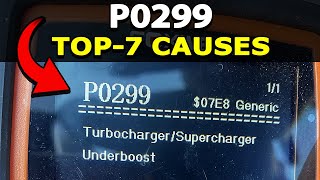
Technical definition: The SAE/OBD-II definition is "Turbocharger/Supercharger 'A' Underboost Condition." 🎬 Watch: A breakdown of the top 7 causes for P0299 This indicates the Powertrain Control Module (PCM) determined the actual boost pressure from the forced induction system is below the commanded range for current engine operating conditions.
Can I Drive With P0299?

Yes, But With Caution. You can drive short distances, but we strongly advise against it. The engine operates with significantly less power, making highway merging dangerous. Continuing to drive causes severe, expensive damage. If the turbocharger fails mechanically, metal fragments enter and destroy the engine (a $5,000-$10,000+ repair). A persistent boost leak overheats and destroys the catalytic converter, a $1,000-$2,500+ repair. If you hear grinding or rattling noises, pull over immediately to prevent catastrophic engine failure.
Common Causes

- Boost or Vacuum Leaks (Very Common) — This is the most frequent cause of P0299. Cracked hoses, a leaking intercooler, failed gaskets, or broken plastic charge pipes allow pressurized air to escape before reaching the engine.
- Faulty Wastegate or Diverter/Bypass Valve (Very Common) — The wastegate controls boost by diverting exhaust gas. If its actuator or control solenoid fails, it sticks open, preventing the turbo from building pressure. Similarly, a torn diverter valve leaks boost back into the intake.
- Faulty PCV System (Common) — A failed Positive Crankcase Ventilation (PCV) valve or ruptured valve cover diaphragm creates a major internal boost leak. This is the primary cause on GM 1.4L and many VW 2.0T engines, allowing boost pressure to escape into the crankcase.
- Failing Turbocharger/Supercharger (Common) — Internal mechanical failure of the turbocharger itself. Worn bearings from oil starvation or damaged compressor wheels from debris prevent the turbo from spinning fast enough to create boost.
- Faulty Boost Pressure or MAP Sensor (Less Common) — Sensors measuring boost pressure fail and send incorrect, low readings to the ECU. This triggers the code even if actual boost pressure is normal.
- Restricted Airflow or Exhaust (Less Common) — A severely clogged engine air filter, blocked intercooler, or restricted exhaust system (like a melted catalytic converter) chokes the engine and prevents the turbo from spooling.
- Charge Air Cooler (CAC) Icing (Uncommon) — In cold climates, moisture from the PCV system freezes inside the intercooler. This ice physically blocks airflow, causing an underboost condition (common on Ford EcoBoost and GM models).
- Low Engine Oil Pressure (Uncommon) — Turbo bearings spin at over 100,000 RPM and require high-pressure oil. Low oil pressure starves the turbo, causing rapid bearing failure and seizure.
- Wiring or Connector Issues (Uncommon) — Damaged wiring or corroded connectors for the boost pressure sensor, MAP sensor, or wastegate control solenoid send incorrect signals to the ECU, triggering a false P0299.
Symptoms

- Significant Loss of Power (Limp Mode) — The car feels sluggish, weak, and slow to accelerate. To protect the engine, the ECU often triggers 'limp mode,' severely restricting RPM and speed.
- Check Engine Light On — The Malfunction Indicator Lamp illuminates on your dashboard.
- Unusual Engine Noises — A distinct whistling or hissing sound under acceleration indicates a boost leak. A siren-like whine, grinding, or rattling points to a failing turbocharger.
- Poor Fuel Economy — Without proper boost, engine efficiency plummets, forcing it to burn significantly more fuel to achieve normal speeds.
- Excessive Exhaust Smoke — If internal turbo seals fail, oil leaks into the exhaust or intake, causing visible blue or gray smoke from the tailpipe during acceleration.
Diagnostic Flowchart
Tap your situation to follow the diagnostic path that matches what you're seeing on this code.
Common Fixes & Costs
- Repairing a Boost/Vacuum Leak (Hose, Clamp, Gasket) — Parts: $10-$150, Labor: $150-$400, ~1.5 hr book time (DIY)
- Replacing a Wastegate Solenoid, Diverter Valve, or PCV Valve
— Parts: $50-$250, Labor: $150-$500, ~1.5 hr book time
(Intermediate)
Chevrolet Cruze/Sonic 1.4L: OEM
Volkswagen/Audi 2.0T TSI: OEM
Ford F-150 EcoBoost 3.5L: OEM - Replacing a Boost Pressure/MAP Sensor — Parts: $50-$200, Labor: $75-$150, ~0.5 hr book time (DIY)
- Replacing the Turbocharger Assembly — Parts: $600-$2,500, Labor: $800-$1,500, ~4.5 hr book time (Professional)
- Replacing Catalytic Converter / DPF — Parts: $800-$2,500, Labor: $200-$600, ~2 hr book time (Professional)
Used vs. New Parts: Buying Guide
When a used part is worth it: For high-cost components like a turbocharger or intercooler on an older, high-mileage vehicle, a used part from a reputable salvage yard is a cost-effective option.
Donor-vehicle mileage cap: roughly under 80000 miles for the part to have meaningful remaining life.
Donor quality checklist:
- Verify the donor vehicle was not scrapped due to engine or turbo failure.
- Inspect turbocharger for shaft play (must be zero) and ensure the wheels spin freely without noise or blade damage.
- Match part numbers exactly, as slight variations cause compatibility issues.
- Prefer parts from regions without heavy road salt use to avoid corrosion.
Decision logic:
- If The part is electronic or has known wear items (e.g., diverter valve, PCV valve, sensors). → Always buy new. The cost savings on a used part are minimal and the risk of premature failure is high.
- If The part is a turbocharger and the vehicle is a performance model or has low mileage. → Buy a new or professionally remanufactured unit to ensure reliability and performance.
- If The vehicle is over 150,000 miles and the part is a major component like a turbo. → A quality-inspected used part is a reasonable choice to manage repair costs.
Warranty tradeoff: Used parts typically come with a 30-90 day warranty covering only the part itself. New aftermarket parts offer a 1-year to limited lifetime warranty. New OEM parts offer a 1-2 year warranty.
Worst-case if a used part fails: $500-$2000 if a used turbo fails after installation, requiring you to pay for labor a second time plus another replacement part.
What Happens If You Wait — Timeline
- 0-4 weeks: Check Engine Light is on. A slight hiss or whistle is heard on acceleration. Power loss is noticeable but the car remains drivable. (MPG impact: 5-10%% · Added cost: $0-$50 in wasted fuel.)
- 1-3 months: Power loss becomes significant, making highway merging difficult. The vehicle enters limp mode intermittently. Fuel economy drops noticeably. The engine runs lean, increasing combustion temperatures.
- 3-6 months: If caused by a boost leak, the sustained lean condition overheats and damages the catalytic converter. If caused by oil starvation, turbo bearings wear severely, leading to shaft play and oil seal failure (blue smoke).
- 6+ months: Catastrophic failure. The turbo bearings seize, the shaft breaks, and the compressor wheel disintegrates. Metal fragments destroy pistons, cylinders, and valves, requiring a complete engine replacement.
Cost of Not Fixing It
- Short-Term (Weeks to Months): Significant decrease in fuel economy (15-30%) and poor engine performance, making driving frustrating and potentially unsafe during acceleration. (Added cost: $50-$150 per month in extra fuel costs.)
- Medium-Term (Several Months): A persistent boost leak causes a lean condition, leading to overheating of the catalytic converter. This melts the internal substrate, causing a blockage. (Added cost: $1,200-$2,800)
- Long-Term (6+ Months): If the cause is a failing turbocharger, continued operation leads to the compressor wheel disintegrating. Metal fragments are ingested by the engine, causing catastrophic internal damage. (Added cost: $5,000-$10,000+)
Diagnosis Steps

- Scan for All Codes & Review Freeze Frame Data
Use an OBD-II scanner to read all stored trouble codes. P0299 is often accompanied by codes like P0171 (Lean) or P0234 (Overboost) that provide crucial clues. Note the freeze frame data to see engine conditions when the fault triggered.
Tools: OBD-II Scanner (Beginner) - Thorough Visual Inspection
Inspect the entire air intake path from the air filter to the engine. Look for disconnected hoses, cracked plastic pipes, loose clamps, or signs of oil residue indicating a leak's location.
Tools: Flashlight (Beginner) - Perform a Smoke Test
This is the most effective way to find hard-to-see leaks. A smoke machine fills the charge system with low-pressure smoke. Smoke pours out of any cracks, bad seals, or leaking gaskets, pinpointing the exact source of a boost leak.
Tools: Automotive Smoke Machine (Intermediate) - Analyze Live Data with a Scan Tool
Graph the 'Desired Boost' vs. 'Actual Boost' PIDs during a test drive. These values must track each other closely. If 'Actual Boost' consistently lags or never reaches the 'Desired Boost' value, it confirms an underboost condition.
Tools: Advanced OBD-II Scan Tool (Intermediate) - Inspect Wastegate Actuator Operation
With the engine off, move the turbo's wastegate actuator rod by hand; it should move smoothly with spring tension. On vacuum-controlled actuators, use a hand-held vacuum pump to verify it holds vacuum and moves the rod.
Tools: Flashlight, Hand Vacuum Pump, Pliers (Intermediate) - Test Boost Pressure Sensor (MAP/BPS) Voltage
Back-probe the sensor's signal wire with a multimeter. With the key on, engine off, verify the baseline voltage. Apply vacuum or pressure with a hand pump; the voltage must change smoothly and linearly. A flatline voltage indicates a faulty sensor.
Tools: Multimeter, Back-probe kit, Hand Vacuum/Pressure Pump (Advanced) - Test Wastegate Solenoid (N75) Resistance
Disconnect the wastegate control solenoid and measure its internal resistance with a multimeter. Compare this to the manufacturer's specification (typically 25-35 ohms). An open or short circuit indicates a failed solenoid.
Tools: Multimeter (Advanced) - Inspect Turbocharger Shaft Play
Remove the intake tube from the turbocharger inlet. Check the compressor wheel for chipped fins. Gently wiggle the central shaft. There must be zero in-and-out (axial) play. Any axial play means the turbo has failed and requires replacement.
Tools: Socket set, Screwdrivers, Flashlight (Advanced)
When This Code Triggers (Freeze-Frame Conditions)
- Engine Coolant Temp: 180-210°F (Engine is at full operating temperature.)
- RPM: 1800-3000 RPM (During moderate acceleration or steady-state cruising, not at idle.)
- Engine Load: 40-70% (The engine is under a moderate load, such as going up a slight incline or accelerating to merge.)
- Vehicle Speed: 40-65 mph (Typically occurs at highway or city cruising speeds when boost is commanded.)
Related Codes
- P0171 — This 'System Too Lean' code often appears with P0299. The same unmetered air leak that causes a loss of boost pressure also allows excess air into the engine at idle, creating a lean mixture.
- P0234 — This code indicates an 'Overboost Condition,' the exact opposite of P0299. Seeing them together strongly points to a failing boost control component, like a sticking wastegate actuator.
- P0045 — This code points directly to an electrical problem with the wastegate control solenoid. P0299 is the mechanical result (low boost), while P0045 is the electrical cause.
- P1101 — On GM vehicles, this code for 'Intake Air Flow System Performance' is a common partner to P0299. It is triggered by the same PCV and vacuum leak issues.
Climate & Environmental Factors
- Cold Weather: In freezing temperatures, moisture from the PCV system freezes inside the intercooler, creating a physical blockage that restricts airflow and causes P0299. This is a known issue on Ford and GM vehicles.
- High Altitude: At higher altitudes, ambient air pressure is lower. The turbocharger must spin significantly faster to produce the same boost pressure. This extra work exposes underlying weaknesses, making underboost codes more likely.
- High Humidity: Humid air contributes more moisture to the intake system, exacerbating the potential for intercooler icing in cold weather.
How to Talk to a Mechanic About This Code
Say this: "I have a P0299 underboost code and a significant loss of power. I'd like to schedule a diagnostic. Please start with a smoke test to check for boost leaks and inspect the wastegate and diverter valve before assuming it's a bad turbo."
This signals you are an informed customer who understands the common, less-expensive causes of P0299. It directs the shop to follow a logical diagnostic procedure, reducing the chance they immediately quote a full turbo replacement.
Avoid saying:
- 'My check engine light is on, can you just fix it?'
- 'I think I need a new turbo.'
- 'Just do whatever you think is best.'
Questions to ask before authorizing the repair:
- Did the smoke test show any leaks? If so, can you show me where?
- How did you test the wastegate actuator and diverter valve? Do they function correctly?
- Can you provide a printout of the live data showing desired boost versus actual boost pressure?
- If you are recommending a turbo replacement, can you show me the failed part and explain why it cannot be repaired (e.g., shaft play, damaged fins)?
Where to Take It: Dealer vs Independent vs Chain
- Dealer:
Recommended for in-warranty vehicles or if a specific manufacturer TSB applies. Otherwise, a qualified independent shop is more cost-effective.
Best for: Vehicles still under powertrain or emissions warranty., Known manufacturer-specific issues covered by a TSB or extended warranty (e.g., BMW wastegate rattle)., Complex electronic or software-related problems.
Downsides: Highest labor rates, typically 1.5-2x more than independent shops., Defaults to replacing entire assemblies rather than smaller, failed components. (Typical cost: +50% vs. baseline) - Independent Shop:
Best overall fit for most out-of-warranty P0299 repairs. A good independent shop has the necessary tools and experience to diagnose this code correctly without the high dealer cost.
Best for: Out-of-warranty vehicles where cost is a factor., Common P0299 causes like boost leaks, PCV issues, and diverter valve replacement., Shops specializing in your vehicle's brand (e.g., a VW/Audi or European specialist).
Downsides: Quality and equipment vary; vet shops by reviews, ASE certifications, and asking if they have a smoke machine and advanced scan tools., Lacks access to the very latest manufacturer software updates. (Typical cost: +0% vs. baseline) - Chain Shop:
AVOID for initial diagnosis. The risk of misdiagnosing P0299 as a bad turbo is high. Only use if the problem is visually obvious and simple to access.
Best for: Simple, visible fixes like a disconnected intercooler hose., Basic code reading (often free).
Downsides: Technician skill and diagnostic equipment are highly variable., Lacks the specialized tools (smoke machine) or in-depth experience for complex turbo diagnostics., High pressure to upsell leads to misdiagnosis and unnecessary, expensive repairs. (Typical cost: -10% vs. baseline)
When to Walk Away From the Repair
If the estimated repair cost for the diagnosed issue exceeds 50% of your car's current private-party value, seriously consider selling or trading in the vehicle instead of repairing it.
- Car worth $4000, fix is $2500: Walk away. A $2,500 turbo replacement on a $4,000 car is a poor investment. The repair cost is over 60% of the car's value.
- Car worth $12000, fix is $600: Fix it. A $600 repair for a boost leak or faulty valve is only 5% of the car's value and is a very sensible repair.
- Car worth $8000, fix is $3000: Borderline. At 37.5% of the vehicle's value, this is a significant repair. Get a second opinion before proceeding. Consider the car's overall condition and any other needed maintenance.
What Scan Tool You Need for This Code
Minimum: A scan tool that reads and graphs live data, specifically the 'Desired Boost Pressure' and 'Actual Boost Pressure' (or MAP/TIP) PIDs.
A basic $20 code reader only tells you the P0299 code exists. It cannot show you the live data needed to confirm if the underboost is real, how severe it is, and under what conditions it occurs. This makes diagnosis impossible and leads to guessing.
Budget: Car Scanner ELM OBD2 App with compatible Bluetooth adapter (e.g., Veepeak) (~$40) — Connects to your smartphone and allows you to view and graph essential live data like boost pressure, engine RPM, and throttle position to help diagnose the problem.
Mid-range: Innova 5610 or Foxwell NT510 Elite (~$350) — These handheld scanners offer robust live data graphing, freeze frame data, and read manufacturer-specific codes. Some offer limited active tests to help diagnose wastegate solenoids.
Professional: Autel MaxiCOM MK808S (~$500) — Provides full bidirectional control, allowing you to command components like the wastegate control solenoid directly from the tool to test its function. It offers comprehensive live data and service functions.
Rent vs buy: For a one-time diagnosis, auto parts stores like AutoZone have a 'Loan-A-Tool' program where you borrow a scanner for free after paying a refundable deposit. If you do your own repairs regularly, buying a mid-range or pro-level scanner is a worthwhile investment.
How to Clear the Code After You Fix It
- Use an OBD-II scan tool to clear the P0299 code from the ECU's memory.
- Perform a complete OBD-II drive cycle to allow the vehicle's readiness monitors to run.
- Do not simply disconnect the battery, as this resets all monitors to 'Not Ready' and fails to clear the fault permanently.
Drive cycle (~20 minutes): A general OBD-II drive cycle includes: 1) a cold start, letting the engine idle for 2-3 minutes. 2) Drive in stop-and-go city traffic for 5-10 minutes. 3) Drive at a steady highway speed (55-60 mph) for 5-10 minutes. 4) Allow the vehicle to cool down completely.
Readiness monitors affected: Catalyst Monitor, Evaporative System Monitor, Oxygen (O2) Sensor Monitor
Before emissions retest: drive at least 50 miles to fully set monitors.
Watch out for:
- Clearing the code without fixing the underlying problem results in the code returning quickly.
- Taking the vehicle for an emissions test immediately after clearing the code results in a 'Not Ready' failure.
Will This Fail Emissions / State Inspection?
Yes — this code typically fails an OBD-II emissions inspection.
- California: An illuminated Check Engine Light from a P0299 code is an automatic failure of the smog check. All OBD-II readiness monitors must be set to 'Ready'.
- New York: The NYS DMV inspection includes an OBD-II scan. The presence of a P0299 code causes the vehicle to fail the emissions portion of the inspection.
- Texas: In counties requiring emissions testing, an active P0299 code causes an automatic inspection failure. After repair, drive 50-100 miles to reset readiness monitors before a re-test.
Most Commonly Affected Vehicles
- Chevrolet Cruze, Sonic, Trax (1.4L Turbo) (2011-2020) — Extremely common due to PCV system failures. The check valve in the intake manifold fails, or the diaphragm in the valve cover ruptures, creating a massive boost/vacuum leak.
- Ford F-150, Escape, Fusion (EcoBoost engines) (2011-Present) — Caused by leaking or stuck-open Turbocharger Bypass Valves (TCBY), especially on 2.7L/3.5L engines. Cracked plastic intake pipes are also common.
- Volkswagen/Audi GTI, Jetta, A4, A3 (2.0T TSI/TFSI engines) (2008-Present) — Frequent culprits include a failed diverter valve (the original diaphragm style tears), a faulty PCV valve, or a worn-out wastegate flapper bushing inside the turbo.
- BMW Various models with N54/N55 engines (e.g., 135i, 335i, 535i) (2007-2015) — Famous for 'wastegate rattle.' The actuator rods and pivot bushings wear out, preventing wastegates from sealing properly. BMW extended the emissions warranty for this issue to 8 years/82,000 miles.
- Honda Civic, CR-V, Accord (1.5T engines) (2016-Present) — Issues link to the electronic wastegate actuator. The linkage becomes loose or falls out of adjustment, preventing proper boost control.
- Hyundai/Kia Sonata, Optima, Veloster (Turbo models) (2011-Present) — Problems tie to failing electronic wastegate actuators, which require turbo replacement as they are integrated. Restricted catalytic converters are also known causes.
- Subaru WRX, Forester XT, Outback XT (2008-Present) — Triggered by vacuum leaks from cracked hoses around the intercooler and turbo inlet, or a failing boost control solenoid (BCS).
- Nissan Juke (1.6L Turbo) (2011-2017) — Triggered by boost leaks or faulty boost pressure sensors (MAP sensors) giving inaccurate readings to the ECU.
Manufacturer-Specific Notes
- General Motors (Chevrolet/Buick): On 1.4L turbo engines, the primary cause is almost always the PCV system. A failed check valve inside the intake manifold or a ruptured diaphragm in the camshaft cover creates a massive internal boost leak.
- Ford: On EcoBoost engines, a common failure point is the electronic Turbocharger Bypass Valve (TCBY), which sticks open due to internal rust, bleeding off boost. In cold weather, condensation freezes in the intercooler.
- Volkswagen/Audi: A very common failure point is the original equipment diaphragm-style diverter valve, which tears easily. An updated piston-style valve (OEM part 06H145710D) is the recommended replacement.
- BMW: On N54 and N55 engines, 'wastegate rattle' is infamous. Actuator rods and bushings wear down, preventing wastegates from closing properly, leading to underboost at low RPMs and a distinct metallic rattle.
Real Owner Stories
2011 VW GTI (~135k miles) - The Common Diverter Valve Failure
Owner got a P0299 code after accelerating to pass a car at highway speed. They previously noticed oil residue near the charge pipe.
What they tried:
- Replaced the original, leak-prone diaphragm-style diverter valve with the upgraded piston-style version.
Outcome: The code returned. The owner noted they also had an aftermarket atmospheric spacer installed on the diverter valve, which causes boost-related codes. Removing the spacer and checking the PCV system resolved the issue.
Lesson: On VW/Audi 2.0T engines, the diverter valve is a top suspect, but aftermarket modifications cause codes themselves. If a new DV doesn't fix it, check the PCV system and inspect the turbo's wastegate for rattle.
2014 Chevy Cruze 1.4L - The Misdiagnosis Trap
A P0299 underboost code appeared. The owner took it to a chain repair shop.
What they tried:
- The shop replaced the entire turbocharger assembly for $1,400.
Outcome: The P0299 code immediately returned. The original problem was misdiagnosed and was actually a failed PCV check valve in the intake manifold, a common $150 fix on the 1.4L engine.
Lesson: Never assume P0299 means a bad turbo on a Chevy Cruze 1.4L. Always diagnose the PCV system and perform a smoke test for leaks before condemning the turbocharger.
2013 Ford F-150 EcoBoost (~29k miles) - The Intermittent Road Trip Nightmare
While towing a 6,500 lb camper, the check engine light for P0299 came on. It would turn off and reappear intermittently.
What they tried:
- Took the truck to a Ford dealer. The dealer found nothing definitively wrong and cleared the code.
Outcome: The light returned shortly after. The actual cause was a failing Blow-Off Valve (BOV) sticking open under heavy load.
Lesson: Intermittent P0299 codes under high load point to components starting to fail but not completely broken, such as a weak wastegate actuator or a sticky bypass valve.
2016 Chevy Cruze - The Simple Fix After a Repair
Immediately after having the front bumper replaced, the check engine light came on with codes P0299, P1101, and P0101. The car stalled and had no power.
What they tried:
- The owner visually inspected all hoses in the engine bay, focusing on areas disturbed during the bumper repair.
Outcome: A large hose connected to the turbo intercooler was completely disconnected. Reconnecting the hose and securing its C-clip resolved all codes.
Lesson: If P0299 appears immediately after another repair, the cause is almost certainly a disconnected hose or electrical connector. Perform a visual inspection before starting complex diagnostics.
How to Prevent This Code From Triggering
- Use high-quality full synthetic oil meeting your manufacturer's specifications. (Every oil change) — Full synthetic oil resists thermal breakdown at extreme temperatures inside the turbocharger, preventing carbon deposits ('coke') that restrict oil flow and destroy turbo bearings.
- Perform regular oil changes according to the 'severe' maintenance schedule. (Every 3,000-5,000 miles) — Turbocharged engines are harder on oil. Frequent changes ensure optimal lubricating and cooling properties, preventing wear on high-speed bearings.
- Inspect and replace the PCV valve/system components. (Inspect every 30,000 miles, replace by 50,000 miles.) — A clogged or failed PCV valve leads to pressure buildup, blown seals, and internal boost leaks that directly cause P0299.
- Allow a 30-60 second idle period before shutting down after hard driving. (After spirited driving or towing) — This cool-down period allows circulating oil to carry away heat from the turbo's center section, preventing oil from coking in the bearings.
- Replace the engine air filter regularly. (Every 15,000-30,000 miles) — A clogged air filter restricts airflow to the turbo, forcing it to work harder to make boost and triggering an underboost condition.
Frequently Asked Questions
What is the most common mistake when diagnosing P0299?
The biggest and most expensive mistake is immediately replacing the turbocharger without a complete diagnosis. The actual cause is far more likely an inexpensive part, such as a cracked hose, a faulty sensor, a stuck wastegate actuator, or a failed PCV valve. Always perform a smoke test for leaks and verify the control system before condemning the turbo.
Can I fix P0299 myself?
Simple fixes like reconnecting a hose or replacing a dirty air filter are easy DIY jobs. Replacing sensors, diverter valves, or performing a smoke test requires intermediate skills and tools. Replacing the turbocharger itself is an advanced job that requires professional tools and procedures; take it to a shop if you lack experience.
How much does it cost to fix code P0299?
A diagnostic fee at a shop typically runs $150-$250. Simple fixes like a new vacuum hose or PCV valve cost $150-$400, while replacing a diverter valve or sensor ranges from $250-$700. A complete turbocharger replacement costs between $1,800 and $4,500+ depending on the vehicle.
My car has both P0299 (underboost) and P0234 (overboost). What does that mean?
Seeing P0299 and P0234 together points to a failing boost regulation system, not a bad turbo. The primary suspect is a sticking wastegate actuator or a faulty electronic boost control solenoid. The component gets stuck, causing the computer to lose control of boost pressure, leading to erratic high and low readings.
Will the P0299 code clear itself?
No, the code will not clear itself and stay off until you repair the underlying mechanical or electrical problem. The Check Engine Light might turn off temporarily on a short trip, but the code remains stored in the ECU. You must fix the fault and clear the code with a scan tool.
What happens if I ignore the P0299 code?
Ignoring this code causes poor engine performance and drops fuel economy by 15-30%. More importantly, a failing turbo sends metal fragments into the engine, causing catastrophic failure that requires a complete engine replacement. A persistent boost leak also creates a lean air/fuel mixture, which destroys catalytic converters over time.
Can a clogged catalytic converter cause P0299?
Yes, a clogged catalytic converter or diesel particulate filter (DPF) creates excessive exhaust backpressure. This backpressure prevents the turbocharger's turbine wheel from spinning up to its required speed. Consequently, the compressor wheel cannot generate boost, triggering the P0299 code.
Does P0299 always mean a bad turbo?
Absolutely not. A boost leak from a cracked hose, a faulty diverter valve, a bad PCV valve, or a stuck wastegate are all significantly more common causes than a failed turbocharger. Always diagnose the intake and control systems before replacing the turbo.
Key Takeaways
- Always perform a $50-$150 smoke test to check for cracked hoses or leaking intercoolers before spending $2,000+ on a new turbocharger.
- If you drive a 2011-2020 Chevy Cruze 1.4L, inspect the PCV valve cover and intake manifold check valve first, as this $150 repair resolves over 80% of P0299 codes on this platform.
- Stop driving immediately if you hear a high-pitched siren or grinding noise under acceleration, as this indicates imminent turbo failure that will send metal fragments into your engine.
- Use an OBD-II scanner to check for companion codes like P0171 (System Too Lean) or P0234 (Overboost), which pinpoint the issue to a vacuum leak or a sticking wastegate actuator rather than a dead turbo.
Helpful Videos

The information in this article is provided for general reference and educational purposes only. Vehicle specifications, procedures, and part compatibility can vary by production date, trim level, and region. Always consult your vehicle's factory service manual and verify part numbers before purchasing or performing repairs. Safety-critical components such as airbags, seat belts, and braking systems should be installed by a qualified professional.
- 🎬 Helpful Videos
- What Does P0299 Mean?
- Can I Drive With P0299?
- Common Causes
- Symptoms
- Diagnostic Flowchart
- Common Fixes & Costs
- Used vs. New Parts: Buying Guide
- What Happens If You Wait — Timeline
- Cost of Not Fixing It
- Diagnosis Steps
- When This Code Triggers (Freeze-Frame Conditions)
- Related Codes
- Climate & Environmental Factors
- How to Talk to a Mechanic About This Code
- Where to Take It: Dealer vs Independent vs Chain
- When to Walk Away From the Repair
- What Scan Tool You Need for This Code
- How to Clear the Code After You Fix It
- Will This Fail Emissions / State Inspection?
- Most Commonly Affected Vehicles
- Manufacturer-Specific Notes
- Real Owner Stories
- 2011 VW GTI (~135k miles) - The Common Diverter Valve Failure
- 2014 Chevy Cruze 1.4L - The Misdiagnosis Trap
- 2013 Ford F-150 EcoBoost (~29k miles) - The Intermittent Road Trip Nightmare
- 2016 Chevy Cruze - The Simple Fix After a Repair
- How to Prevent This Code From Triggering
- Frequently Asked Questions
- What is the most common mistake when diagnosing P0299?
- Can I fix P0299 myself?
- How much does it cost to fix code P0299?
- My car has both P0299 (underboost) and P0234 (overboost). What does that mean?
- Will the P0299 code clear itself?
- What happens if I ignore the P0299 code?
- Can a clogged catalytic converter cause P0299?
- Does P0299 always mean a bad turbo?
- Key Takeaways
- 🎟️ Get 5% Off