

P0887 on 2014-2017 Jeep Cherokee: TCM Power Control Circuit High Causes and Fixes
On a 2014-2017 Jeep Cherokee, code P0887 is almost always caused by outdated software in the Transmission Control Module (TCM). The most common fix is a software update performed by a Jeep dealer, which typically costs around $100-$250. If the software is already current or the flash does not resolve the issue, the TCM itself has likely failed and requires replacement.
- P0887 on a 2014-2017 Cherokee is most often a software problem, not a hardware failure.
- The first and most important diagnostic step is to check if a TCM software update is available.
- This is not a DIY-friendly repair; it requires dealer-level tools for diagnosis and software flashing.
- Driving with this code can be unpredictable due to potential limp mode and unresponsive acceleration, so it should be addressed promptly.
- If a software update doesn't work, the TCM itself is the next most likely cause of failure.
What's Unique About the 2014-2017 Jeep CHEROKEE

The 2014-2017 Jeep Cherokee (KL generation) uses a ZF-designed 9-speed automatic transmission (Chrysler's 948TE). This transmission is known for complex software that has required numerous updates to resolve drivability issues. Code P0887 is a very common manifestation of these software problems, where the module's programming incorrectly interprets or causes a high voltage condition, often without a true electrical fault in the wiring. Multiple Technical Service Bulletins (TSBs) have been issued by FCA specifically to fix P0887 with a software flash.
Diagnostic Flowchart

Tap your situation to follow the diagnostic path that matches what you're seeing on this vehicle.
Symptoms You May Notice

- "Service Transmission" warning light on the dashboard.
- Vehicle enters "limp mode," often stuck in a high gear.
- Check Engine Light is illuminated.
- Erratic or harsh shifting at low speeds.
- Unresponsive accelerator pedal.
- "Service Emergency Brake" and "Traction Control Off" lights may appear.
- Replacing the valve body. While the TCM is often mounted to the valve body, some technicians may replace the entire assembly when only a software flash or a separate TCM replacement is needed.
- Replacing the battery without checking the alternator. If an overcharging alternator is the root cause, a new battery will not solve the problem and may also be damaged.
Most Likely Causes

- Outdated Transmission Control Module (TCM) Software 🔴 High Probability The 9-speed transmission in the KL Cherokee has a well-documented history of software-related issues. FCA has released multiple TSBs (e.g., 21-015-16, 21-006-17 REV. A) specifically to address code P0887 with a software update.
How to confirm: A Jeep dealership or a qualified shop with a wiTECH scan tool can check the current software calibration ID against the latest version available from the manufacturer's database.
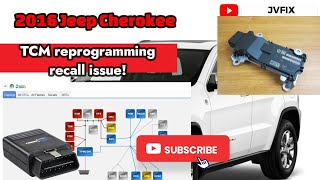
Typical fix: Reprogramming (flashing) the TCM with the latest software. This must be done with a dealer-level scan tool and a stable power supply connected to the vehicle. 🎬 Watch: How to program the TCM and apply software updates.
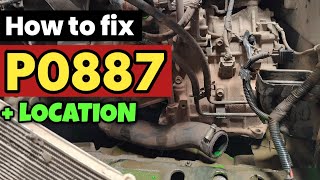
Est. part cost: $0 (software only) - Faulty Transmission Control Module (TCM) 🟡 Medium Probability If a software update does not resolve the code, the internal power relay or other circuitry within the TCM may have failed. The relay is part of the module and cannot be replaced separately. 🎬 Watch: Understanding the P0887 TCM power relay control circuit code.
How to confirm: This is typically diagnosed by exclusion. If the software is confirmed to be up-to-date and all wiring/power/ground inputs are verified as good, the TCM is the likely culprit.
Typical fix: Replace the Transmission Control Module. The new module will require programming to the vehicle's VIN using a tool like wiTECH.
Est. part cost: $400-$800 - Wiring or Connector Issue ⚪ Low Probability While less common for this specific code on the Cherokee, wiring issues can still occur. The platform-mate Ram ProMaster City had a recall for a corroded CAN-C bus connector near the driver's seat that could cause TCM communication loss.
How to confirm: Visually inspect the wiring harness and connectors leading to the TCM for any signs of corrosion, damage, or looseness. Use a multimeter to test the power and ground circuits at the TCM connector to ensure they are within the manufacturer's specified range.
Typical fix: Repair or replace the damaged section of the wiring harness or clean/replace the faulty connector.
Est. part cost: $20-$200
Rare But Worth Checking
- Failing Alternator: An alternator that is overcharging the electrical system can cause voltage spikes throughout the vehicle, potentially triggering a P0887 code. This should be checked if system voltage appears consistently high.
- Weak Battery or Poor Ground Connection: Low system voltage from a failing battery or a corroded/loose ground strap can cause modules to behave erratically and set unexpected codes, including P0887. TSBs for flashing procedures specifically warn to maintain stable battery voltage between 13.2 and 13.5 volts during the process.
Diagnosis Steps
- Scan the vehicle for all stored Diagnostic Trouble Codes (DTCs). Note any other codes that appear with P0887.
- Check battery health and charging system operation. Ensure the battery is fully charged and the alternator is providing stable voltage (typically 13.5-14.5V when running).
- Using a dealer-level scan tool (like wiTECH), check for any applicable Technical Service Bulletins (TSBs) or recalls for the vehicle's VIN. TSBs 21-019-17 REV. A, 21-015-16, and 21-006-17 REV. A directly address P0887.
- Verify the current software version on the TCM. If an update is available, perform the TCM reprogramming procedure. This is the most likely fix. Ensure a battery charger is connected to maintain voltage between 13.2 and 13.5 volts during the flash.
- After flashing, clear all DTCs and perform a "PROXI Configuration Alignment" and "VIN Verification" routine if required by the TSB. A test drive and a TCM "Quick Learn" procedure may also be necessary.
- If the code returns, inspect the wiring and connectors between the battery, fuse box (Power Distribution Center), and TCM. Look for any damage, corrosion, or loose connections. Pay attention to main power and ground wires. 🎬 See this guide to locating the TCM fuse and relay.
- Using a multimeter and a wiring diagram, test the voltage and ground signals at the TCM connector to ensure they are within the specifications outlined in the service manual.
- If the software is current and all wiring tests pass, the Transmission Control Module (TCM) is likely faulty and requires replacement.
Parts You'll Likely Need
- Transmission Control Module (TCM) Software Update — This is the most common and manufacturer-recommended first step to resolve a P0887 code on this platform.
Trusted brands: Mopar (dealer service)
OEM price range: $100-$250
Aftermarket price range: N/A - Transmission Control Module (TCM)
(OEM #68225514AB, 68315880AA (Part numbers vary by year/engine, always verify with VIN))— If a software update does not fix the issue, the module's internal circuitry has likely failed. A core charge often applies.
Trusted brands: Mopar
OEM price range: $400-$700 + $50 Core Charge
Aftermarket price range: $300-$600
Related Codes That Often Appear With This One
- U0401-00 — Indicates implausible data from the Engine Control Module (ECM), often logged with TCM software issues. It is listed in TSB #21-019-17 REV. A and TSB #21-015-16.
- P061B-00 — Relates to an internal control module torque calculation error, pointing to a processing or software fault within the powertrain controllers. It is also listed in TSB #21-019-17 REV. A and TSB #21-015-16.
- U1424-00 — Means 'Implausible Engine Torque Signal Received' and is another code pointing to software or communication errors between modules. It is listed in TSB #21-006-17 REV. A.
- C2226 — Mentioned in an NHTSA complaint alongside P0887, suggesting a related fault in the vehicle's control systems.
Technical Service Bulletins (TSBs) & Recalls
- 21-019-17 REV. A: Lists P0887-00 (TCM Power Control Circuit High) among several other codes for 2015 models, indicating a known electrical system issue addressable by a software flash.
- 21-015-16: Supersedes an earlier TSB and details the procedure for reprogramming the TCM on 2015 Jeep Cherokee and Chrysler 200 models to address various DTCs, including P0887-00, and to improve shifting.
- 21-006-17 REV. A: Mentions P0887-00 as a DTC that can be set on 2017 models and is addressed by a TCM software update.
- 21-017-17 REV. A: Specifically calls out P0887 on the platform-mate 2017 Ram ProMaster City and confirms the fix is a TCM reprogram.
Platform-Specific Known Issues
- Multiple NHTSA owner complaints for 2014-2016 models confirm that P0887 is a common issue, often appearing with symptoms like an unresponsive accelerator or erratic shifting, and is frequently resolved with a software update that owners may have to pay for.
- A Reddit user with a 2016 Cherokee reported the P0887 code and limp mode appeared intermittently right after a dealer performed a different powertrain control module flash, suggesting software updates can sometimes trigger this related issue.
- A user on jeepcherokeeclub.com with a 2014 Cherokee Trailhawk reported experiencing P0887 at 94,000 miles. After the dealer confirmed the software was already up to date, they replaced the TCM, which resolved the problem. This highlights the diagnostic path when a software flash is not the solution.
Mechanic-Grade Diagnostic Values
- Battery Voltage During TCM Flash — expected: Maintain between 13.2 and 13.5 volts. Failure: Voltage dropping below 13.2V or climbing above 13.5V can cause the flash to fail or corrupt the module.
- Transmission Temperature for Quick Learn Procedure — expected: Minimum of 60°C (140°F). Failure: Attempting the Quick Learn procedure at a lower temperature may result in it not running or storing incorrect adaptive values.
Scan Tool Commands That Help
- wiTECH: TCM Quick Learn — After reprogramming the TCM or clearing adaptive memory cells. This procedure resets and learns the clutch adaptive values to ensure proper shift quality.
- wiTECH: PROXI Configuration Alignment — After reprogramming or replacing the TCM to ensure all vehicle modules recognize the new software/hardware and are communicating correctly on the CAN bus network.
- wiTECH: VIN Verification — After replacing and programming a new TCM to write the vehicle's VIN into the module, which is required for it to function.
Wiring & Ground Locations
- Transmission Control Module (TCM) — Mounted on the right side of the transmission assembly itself.. This is the component that sets the code. Its location on the transmission means its wiring harness is subject to engine bay heat and vibration.
- TCM Power Supply Fuse — In the underhood power distribution center (fuse box) located behind the battery on the driver's side. For 2014+ models, this is often fuse F28.. This fuse is the primary power source for the TCM. Although a blown fuse would typically cause a 'no communication' or 'low voltage' code, a poor connection at the fuse terminals could potentially cause voltage fluctuations.
- TCM Ground (G904A) — For 2014 models, a primary ground point (G904A) is located on the lower left rear of the engine (3.2L) or the left front of the engine (2.4L).. A poor ground connection at this point can cause a floating ground or voltage differential, leading the TCM to incorrectly perceive a high voltage condition and set P0887.
Real Owner Repair Stories
- NHTSA ODI #11424171 (2016 Jeep Cherokee) — Unspecified, but resulted in fault codes P0887 and C2226.
✅ What actually fixed it A software update at a CDJR Dealership for $100.45 resolved the issue. - NHTSA ODI #11388682 (2016 Jeep Cherokee) — Harsh shift from 4th to 5th gear and an unresponsive accelerator pedal.
✅ What actually fixed it The owner identified the symptoms matched a recall and the code was P0887. The implied fix is the recall-related software update. - YouTube channel JVFIX LLC (2016 Jeep Grand Cherokee (similar ZF transmission and electronics)) — Shifting issue from 2nd to 3rd gear, revving the engine high. Code P0887 was stored.
❌ Tried (didn't work) The owner took the car to the dealership, who claimed all updates and recalls were already performed.
✅ What actually fixed it The technician used an Autel MaxiFlash tool to reflash the TCM and ECU software, which fixed the shifting problem. This showed the dealer's information was incorrect or incomplete.
OEM Part Supersession History
68225514AB→68315880AA— Part revision and update by manufacturer. The newer part number is specified for 2016-2019 models.
Heads up: While physical fitment may be similar, using the incorrect part number for the vehicle's year and VIN can lead to software incompatibility and programming failures. Always verify the correct part number with the VIN.
Helpful Videos


Used OEM Parts in Stock


New Aftermarket Parts Available



The information in this article is provided for general reference and educational purposes only. Vehicle specifications, procedures, and part compatibility can vary by production date, trim level, and region. Always consult your vehicle's factory service manual and verify part numbers before purchasing or performing repairs. Safety-critical components such as airbags, seat belts, and braking systems should be installed by a qualified professional.
- Jeep CHEROKEE:
- 🎬 Helpful Videos
- 🛍️ Shop This Part
- What's Unique About the 2014-2017 Jeep CHEROKEE
- Diagnostic Flowchart
- Symptoms You May Notice
- Most Likely Causes
- Rare But Worth Checking
- Diagnosis Steps
- Parts You'll Likely Need
- Related Codes That Often Appear With This One
- Technical Service Bulletins (TSBs) & Recalls
- Platform-Specific Known Issues
- Mechanic-Grade Diagnostic Values
- Scan Tool Commands That Help
- Wiring & Ground Locations
- Real Owner Repair Stories
- OEM Part Supersession History
- 🎟️ Get 5% Off