

P0780 on 2003-2007 Honda Accord: Shift Malfunction Causes and Fixes
On a 2003-2007 Honda Accord, P0780 usually points to a problem with the automatic transmission solenoids. Before replacing anything, check the transmission fluid level and condition. The most likely fix is cleaning the solenoid filter screens or replacing a faulty shift solenoid assembly, which is often a DIY-friendly job costing between $50 and $250 for parts.
- P0780 on a 7th Gen Accord is a serious code, but does not automatically mean you need a new transmission.
- Always start with the cheapest and easiest fix: check the transmission fluid level and condition. Use only Honda genuine fluid.
- The most likely cause is clogged solenoid filter screens. Cleaning these screens is a low-cost, high-success-rate repair that can be done by a DIYer.
- If cleaning doesn't work, test the solenoids before replacing them. The faulty part is often an external, bolt-on assembly.
- Be aware that V6 and 4-cylinder models use different transmissions and require different part numbers for their solenoids.
What's Unique About the 2003-2007 Honda Accord

The 7th generation Honda Accord, particularly the V6 models with the 5-speed automatic transmission, had a reputation for transmission issues. Code P0780 is a very common symptom of these well-documented problems. Unlike many other vehicles where this code might lead to a major internal overhaul, on this Accord, the cause is frequently traced to external, bolt-on solenoids with screens that become clogged with clutch material. This makes diagnosis and repair significantly more accessible and affordable for a DIY mechanic. Many owners have successfully resolved this code by cleaning these screens, avoiding a costly transmission replacement.
Symptoms You May Notice
- Check Engine Light is on
- Flashing 'D' or 'D4' gear indicator light on the dashboard
- Harsh, jerky, or delayed gear shifts
- Transmission slipping between gears or engine revving without acceleration
- Vehicle feels stuck in one gear (limp mode), often 2nd or 3rd gear
- Poor or sluggish acceleration
- Whining, clunking, or buzzing noises from the transmission
- Replacing the entire transmission. Many shops will immediately quote a full transmission replacement costing thousands. However, the issue is very often a simple, inexpensive fix related to fluid, clogged solenoid screens, or an external solenoid pack. One owner reported a mechanic fixed the issue for $650 by replacing the internal filter after a dealer quoted $3,000-$4,000 for a new transmission.
Most Likely Causes


- Low or Dirty Automatic Transmission Fluid (ATF) 🔴 High Probability Honda transmissions of this era are sensitive to fluid condition. Deteriorated fluid loses its hydraulic properties and can't properly actuate shifts. Burnt or dirty fluid is often a symptom of clutch material circulating in the system.
How to confirm: Check the transmission fluid dipstick for level and color. The fluid should be red/pink and clear, not brown, black, or smelling burnt. This is the first and most crucial diagnostic step.
Typical fix: Perform a 'drain and fill' of the transmission fluid. Use only Honda Genuine ATF-Z1 or the newer, compatible DW-1 fluid. A single drain and fill only replaces about 1/3 of the fluid, so repeating the process 3 times (with driving in between) is recommended to replace most of the old fluid.
Est. part cost: $40-$80 for fluid - Clogged Shift Solenoid Filter Screens 🔴 High Probability Over time, fine metallic debris from normal clutch wear accumulates on the small mesh screens of the clutch pressure control solenoids, restricting fluid flow and causing pressure issues that trigger P0780.
How to confirm: Remove the external solenoid packs from the transmission case. The small, round filter screens will be visibly clogged with a gray, paste-like sludge. This is a very common finding.
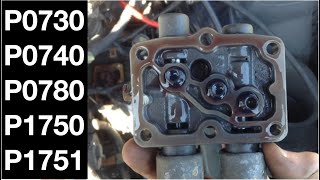
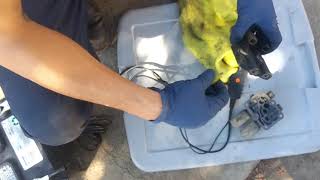
Typical fix: Remove the solenoid assemblies and carefully clean the mesh screens 🎬 Watch: How to clean solenoid screen filters for Honda and Acura with brake cleaner and compressed air. This is a very common, low-cost fix that restores solenoid function. Replace the solenoid gaskets upon reinstallation. A YouTube video by 'Car Repairs Made Simple' demonstrates this process clearly on a related Acura TL.
Est. part cost: $100-$30 for gaskets and brake cleaner - Faulty Shift Solenoid or Linear Solenoid Assembly 🟡 Medium Probability The solenoids are electro-mechanical valves that cycle thousands of times. They can fail electrically (open or shorted coil) or mechanically (sticking plunger). Even a brand new transmission can have a faulty solenoid.
How to confirm: After confirming the screens are clean, test the solenoid's resistance with a multimeter (should be within a specific Ohm range, typically 12-25 Ohms for many Honda solenoids, but check service manual for exact spec). You can also apply 12V power to the solenoid to listen for a distinct 'click' of the plunger activating.
Typical fix: Replace the faulty solenoid assembly. These are typically sold as packs and are bolted to the outside of the transmission, making replacement relatively simple.
Est. part cost: $100-$600 depending on OEM vs aftermarket and specific solenoid
Rare But Worth Checking
- Internal Transmission Failure: If the transmission fluid is full of metal shavings or smells heavily burnt, it's a sign of severe internal wear (e.g., burnt clutch packs). In this case, cleaning solenoids won't help and a rebuild or replacement is likely needed. This was a known weakness, especially in early V6 models. NHTSA ODI #10967521 describes a case where a mechanic diagnosed a "bad transmission" for this code even on a vehicle with only 33,804 miles.
- Faulty Powertrain Control Module (PCM): This is very rare. The PCM should only be considered as the cause after all other transmission-related components and wiring have been thoroughly tested and ruled out.
- Crossed Solenoid Connectors: On some models, different solenoid connectors are physically interchangeable. If recent work was done, it's possible two connectors were swapped, which 🎬 See how one owner diagnosed a P0780 code on his Accord can cause a P0780 code. One owner on YouTube found this to be the root cause after replacing multiple transmissions.
Diagnosis Steps
- Check the transmission fluid level and condition. If low, top off and check for leaks. If dark or burnt, perform a drain and fill with Honda DW-1 ATF.
- Scan for other transmission-related codes with a scanner capable of reading Honda-specific TCM codes. Codes for specific solenoids (e.g., P0756) can help pinpoint the problem. NHTSA ODI #11265807 notes that P0780 may appear alongside P1733 and P0796, indicating multiple pressure and shift circuit faults.
- Remove the external clutch pressure control and shift solenoid assemblies. Inspect and clean the small mesh filter screens thoroughly with brake cleaner.
- While the solenoids are off, test their resistance with a multimeter. Compare the reading to the factory specification (typically 12-25 ohms). Test for audible clicking by applying 12V power.
- Inspect the wiring and connectors going to the transmission solenoids for any signs of damage, corrosion, or looseness. Ensure connectors haven't been swapped if recent work was performed.
- If solenoids test good and the problem persists after cleaning, the issue may be a failing torque converter or internal mechanical wear, which requires professional diagnosis.
Parts You'll Likely Need

- Clutch Pressure Control Solenoid Assembly (V6 Models)
(OEM #28250-P7W-003)— This dual linear solenoid pack is a common failure point for the V6 transmission. The internal screens get clogged or the solenoids fail. Also fits Acura TL/MDX and Honda Odyssey/Pilot of the same era.
Trusted brands: Honda (OEM), WVE, ATP
OEM price range: $550-$770
Aftermarket price range: $50-$150 - Shift Solenoid Assembly (4-Cylinder Models)
(OEM #28260-PRP-014)— This is the equivalent dual linear solenoid pack for the 4-cylinder transmission and is a primary cause of P0780 on those models. Also fits CR-V and Element.
Trusted brands: Honda (OEM), Duralast, ATP
OEM price range: $580-$890
Aftermarket price range: $60-$150 - Transmission Filter (V6 Models, External)
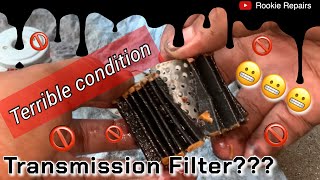
(OEM #25450-RAY-003)— This external, spin-on filter should be changed during a fluid service, especially when dealing with shift quality issues 🎬 Watch: Step-by-step guide to replacing the external transmission filter or a P0780 code.
Trusted brands: Honda (OEM), Wix, Beck/Arnley
OEM price range: $30-$50
Aftermarket price range: $15-$30 - Automatic Transmission Fluid
(OEM #08200-9008 (DW-1))— Clean fluid is critical for proper hydraulic function and solenoid operation. Using only Honda genuine fluid is highly recommended as these transmissions are sensitive to fluid chemistry.
Related Codes That Often Appear With This One
- P0730 — Incorrect Gear Ratio. This code is often a companion to P0780 as it more specifically points out that the computer detected a slip or incorrect ratio.
- P1734 — Problem in Shift Control System. This is another Honda-specific code that is often set at the same time as P0780, indicating a general fault in the shifting mechanism.
- P0740 — Torque Converter Clutch Circuit Malfunction. This can be triggered by the same clogged solenoid screens that cause P0780, as they often affect the TCC solenoid as well.
- P0700 — Transmission Control System Malfunction. This is a general code indicating that the Transmission Control Module (TCM) has stored a fault code. It almost always appears with other, more specific transmission codes like P0780.
Technical Service Bulletins (TSBs) & Recalls
- TSB 03-020: This technical service bulletin, last updated in 2010, is a comprehensive list of all possible OBD-II DTCs for Honda vehicles. It does not provide specific diagnostic or repair procedures for P0780 but simply lists it as 'Shift Malfunction'. It is not a helpful document for diagnosing this specific code.
Platform-Specific Known Issues
- The 5-speed automatic transmission (codename B7XA/BAYA) paired with the V6 engine in this generation was subject to higher failure rates compared to the 4-cylinder model's transmission. A class-action lawsuit was filed regarding these failures, particularly in the 1999-2004 model years of Accord, Odyssey, and Acura TL vehicles. P0780 is a hallmark symptom of the underlying design flaw, which often relates to poor internal lubrication and heat dissipation, leading to premature clutch wear and debris generation that clogs solenoids.
Mechanic-Grade Diagnostic Values
- Torque Converter Clutch (TCC) Solenoid and Shift Solenoid Resistance — expected: 12 - 25 Ohms. Failure: A reading outside of this range (e.g., infinite for an open circuit, or near zero for a short) indicates a failed solenoid coil.
- Shift Solenoid 'Click' Test — expected: An audible and distinct 'click' when 12V power is applied to the solenoid's terminals.. Failure: No click, or a very weak click, indicates a mechanically stuck or failing solenoid plunger. It is also important to visually confirm the plunger is moving, as it can be broken internally while still making a noise.
Scan Tool Commands That Help
- Honda HDS (Honda Diagnostic System): Solenoid Activation Test — After checking fluid and external connections, a technician can use the HDS to command individual shift solenoids (A, B, C, etc.) to activate. This allows for testing the electrical circuit and solenoid function without having to remove parts. It can help isolate a specific faulty solenoid or confirm a wiring issue if the command is sent but the solenoid doesn't respond.
Wiring & Ground Locations
- G101 — On the intake manifold plenum on the driver's side for the 4-cylinder, and on the thermostat housing for many Honda engines of this era.. G101 is a primary ground point for the ECU/PCM and engine sensor harness. A loose or corroded G101 ground can cause a host of erratic electronic problems, including incorrect sensor readings and faulty commands to the transmission solenoids, potentially triggering a P0780 code without any actual transmission fault.
- Transmission Housing Ground — A ground strap typically connects from the transmission case to the vehicle's chassis.. This provides the main ground path for the transmission assembly and its externally mounted solenoids. If this strap is broken, loose, or corroded, the solenoids may not have a reliable ground, leading to intermittent operation, electrical noise, and shift-related fault codes like P0780.
Real Owner Repair Stories
- NHTSA ODI #11034501 — An owner reported that the vehicle lurches forward, though other gear changes function normally. The check engine light was illuminated with a P0780 shift malfunction code, and the lurching continued after every stop and during acceleration.
- NHTSA ODI #10267067 — A driver noticed that the engine light and TCS light would turn on occasionally and completely at random, with diagnostics revealing code P0780.
- NHTSA ODI #10228061 — An owner reported the "D" light started flashing on the instrument panel. A dealer diagnosis found a P0780 shift malfunction along with EGR valve codes P0303, P0305, and P0306.
- Reddit user in r/MechanicAdvice (2003 Honda Accord, 180k miles) — Gradually worsening hard shifts, then a 'pop' sound followed by total loss of power to the transmission. Flashing 'D' light and ATF found everywhere, seemingly from the dipstick tube. Codes P0780, P1734, P0756.
❌ Tried (didn't work) Ordered new solenoids and filter, but they were incorrect/poor quality parts. The original solenoids tested good after cleaning.
✅ What actually fixed it The user's story cuts off after refilling fluid, but the initial failure (catastrophic fluid loss after a 'pop') and presence of multiple solenoid 'stuck' codes strongly implies a severe internal hydraulic overpressure event or mechanical failure, not just a simple solenoid issue. The cleaning of solenoids was unlikely to fix the root cause. - YouTube video by 'Car Repairs Made Simple' (Acura TL (similar transmission) with 209,000 miles) — Excessive slipping, sometimes failing to go into gear, revving without moving. Very aggressive upshifts and downshifts. Codes P0730, P0740, P0780.
❌ Tried (didn't work) The owner went straight to the likely cause.
✅ What actually fixed it The owner removed the external solenoid packs and thoroughly cleaned the clogged filter screens. After reassembly, all shifting problems were gone, and the check engine light did not return after 150 miles of driving. This was a successful, low-cost DIY repair. - Reddit user in r/MechanicAdvice (2002 Honda Accord 2.3L) — Codes P0730 and P0780 appeared after a transmission swap with a new torque converter. No power in 1st gear.
❌ Tried (didn't work) Swapped all solenoids, which initially seemed to fix a bucking issue but resulted in the new codes and low power.
✅ What actually fixed it The story is unresolved, but the user confirmed the fluid level was correct with OEM fluid. The symptoms appearing immediately after a swap suggest a possible compatibility issue with the replacement transmission, a faulty 'new' torque converter, or an installation error like a pinched wire or crossed connector.
OEM Part Supersession History
28250-P6H-024→28250-P7W-003— This part is the dual linear solenoid for the V6 transmission. Honda frequently revises parts associated with known failure points. The -P7W-003 is the later, more common replacement part number for this application.
Model Year Variations Within This Range
- 2006-2007: For the 2006 model year refresh, Honda implemented several powertrain updates. The V6 engine power was increased and renamed from J30A4 to J30A5. The 4-cylinder engine received Drive-By-Wire (DBW) throttle control. The V6 automatic transmission for 2006-2007 models is coded BAYA and is considered by enthusiasts to be more robust than the earlier 2003-2005 V6 transmissions. While externally similar, internal improvements may have been made to address the well-known failure rates of the earlier units. All V6 models from 2006-on also received Vehicle Stability Assist (VSA) as standard.
Diagnostic Flowchart
Other Known Issues on This Vehicle
Issues unrelated to this code that are worth knowing about as an owner of this generation:
- Automatic Transmission Failure (V6 Models) 🔴 High — Very common on 2003-2004 V6 models, but can affect all years. Often occurs between 70,000 and 150,000 miles. (Ref: While no formal recall was issued for all vehicles, Honda did face class-action lawsuits and offered warranty extensions for some owners.)
- Power Steering Whine / Hose Leak 🟠 Medium — Common issue where air enters the system due to a failing O-ring on the power steering pump inlet, causing a whining noise, especially when cold. The high-pressure hose is also prone to leaking.
- Audio/HVAC Display Failure 🟡 Low — The circuit board for the radio and climate control display frequently fails, causing the display to go dark. This is particularly common in 2003-2004 models.
- Starter Motor Failure 🟠 Medium — Failures are common at higher mileage (over 100,000 miles), resulting in a no-crank, no-start condition.
- Excessive Oil Consumption (4-Cylinder K24 Engine) 🟠 Medium — Some K24 engines can consume oil, requiring owners to check and top off oil levels frequently to prevent engine damage.
Used vs. New Parts: Buying Guide for This Vehicle
When a used part is the smart pick: For this specific P0780 issue, purchasing a used OEM solenoid assembly from a reputable junkyard is a very common and cost-effective strategy. Since the primary failure is often clogged screens or a single failed solenoid within a pack, a low-mileage used assembly can be a perfectly viable fix for a fraction of the cost of a new OEM part.
Donor-vehicle mileage cap: roughly under 120000 miles for the part to have meaningful remaining life.
What to inspect on the donor part:
- Check the donor vehicle's VIN to confirm it's the correct year range and engine (V6 vs 4-cyl).
- If possible, inspect the transmission fluid from the donor car. Bright red fluid is a good sign; dark, burnt-smelling fluid is a major red flag.
- Look for a vehicle that appears to have been well-maintained and not involved in a severe front-end collision that could have damaged the transmission or wiring.
- Ask the junkyard for a short warranty period (e.g., 30 days) to protect against a DOA part.
OEM-only on this vehicle (don't cheap out):
- Automatic Transmission Fluid (ATF). Only use Honda Genuine DW-1 or the older, compatible Z1. These transmissions are notoriously sensitive to fluid type.
- Complete Transmission Assembly. Due to the high failure rate of these transmissions, buying a random used unit is a huge gamble. If a replacement is needed, a professionally rebuilt unit with updates and a warranty is a much safer investment than a junkyard transmission.
Aftermarket brands forum-validated for this vehicle:
- For the external spin-on filter (V6), brands like Wix and Beck/Arnley are generally considered reliable alternatives to OEM.
Brands owners have reported issues with on this vehicle:
- Unbranded, low-cost solenoid assemblies from online marketplaces like Amazon or eBay. While tempting, many owner stories report these parts failing quickly or being dead on arrival. Sticking with OEM, even if used, is often the better choice for solenoids.
Real Owner Stories
Aggregated from forums and TSBs cited above. Mileages and costs reflect what owners reported in those sources.
Acura TL (platform mate) — 400 miles
Symptoms: P0780 code appeared just 400 miles after a dealer had replaced the transmission.
What fixed it: The faulty solenoid on the brand-new transmission was replaced under warranty.
Source hint: AcuraZine - 'P0780 on recently replaced tranny'
2002 Honda Accord
Symptoms: Check Engine Light was on with codes P0730 and P0780.
What fixed it: An independent mechanic fixed the issue by replacing the clogged internal transmission filter.
Cost: $650-$650
Source hint: CarComplaints.com - '2002 Honda Accord Code P0780'
NHTSA ODI #11265807
Symptoms: Transmission slips and takes time to engage after being placed in drive. The drive light blinks and codes P0780, P1733, P0008, and P0796 are present.
Related OBD-II Codes
Frequently Asked Questions
My 2004 Accord is a V6. Is it more likely to have this P0780 problem?
I heard there was a class-action lawsuit about these transmissions. Does that apply to my car?
What is the absolute first thing I should check if I get a P0780 code?
What specific transmission fluid should I use for a drain and fill on my Accord?
My mechanic suggested just cleaning the solenoid screens. Is this a legitimate fix for P0780?
My transmission was just replaced and I'm already getting a P0780 code. How is that possible?
Is there a helpful Honda Technical Service Bulletin (TSB) for diagnosing P0780?
Helpful Videos
We Have This Part in Stock



The information in this article is provided for general reference and educational purposes only. Vehicle specifications, procedures, and part compatibility can vary by production date, trim level, and region. Always consult your vehicle's factory service manual and verify part numbers before purchasing or performing repairs. Safety-critical components such as airbags, seat belts, and braking systems should be installed by a qualified professional.
- Honda Accord:
- 🎬 Helpful Videos
- 🛍️ Shop This Part
- What's Unique About the 2003-2007 Honda Accord
- Symptoms You May Notice
- Most Likely Causes
- Rare But Worth Checking
- Diagnosis Steps
- Parts You'll Likely Need
- Related Codes That Often Appear With This One
- Technical Service Bulletins (TSBs) & Recalls
- Platform-Specific Known Issues
- Mechanic-Grade Diagnostic Values
- Scan Tool Commands That Help
- Wiring & Ground Locations
- Real Owner Repair Stories
- OEM Part Supersession History
- Model Year Variations Within This Range
- Diagnostic Flowchart
- Other Known Issues on This Vehicle
- Used vs. New Parts: Buying Guide for This Vehicle
- Real Owner Stories
- Acura TL (platform mate) — 400 miles
- 2002 Honda Accord
- NHTSA ODI #11265807
- Related OBD-II Codes
- Frequently Asked Questions
- 🎟️ Get 5% Off