

P0772 on 2020-2023 Ford Explorer: Shift Solenoid 'E' and Transmission Fixes
On 2020-2023 Explorers, code P0772 almost always points to a known issue with the 10-speed transmission, not just a bad solenoid. The most common fix is replacing the main control valve body due to sticking valves, a repair that can cost $1,500-$2,500. In severe cases, internal failure of the CDF clutch drum may require a transmission rebuild or replacement.
- P0772 on a 2020-2023 Explorer is a serious code that likely indicates a mechanical problem inside the transmission, not just a bad sensor.
- The most common cause is a faulty main control valve body, a known issue addressed by Ford TSBs.
- Do not simply replace the 'E' solenoid; the problem is almost always the valve body or a more severe internal part like the CDF drum.
- Reference Ford TSB 22-2428 when speaking with a repair shop, as it outlines the official diagnostic and repair procedure.
- Due to the complexity and need for special tools and software, this repair should be handled by a professional technician familiar with Ford transmissions.
What's Unique About the 2020-2023 Ford EXPLORER
The 2020-2023 Explorer uses Ford's 10R60 or 10R80 10-speed automatic transmission, which is known for having issues that trigger a wide range of trouble codes, including P0772. Ford has released numerous Technical Service Bulletins (TSBs) acknowledging that symptoms like harsh shifts are often caused by internal mechanical faults. The two most prominent issues are sticking valves within the main control valve body and a design flaw in the 'CDF' clutch drum where a bushing can move and damage a seal, leading to severe hydraulic problems. Therefore, a P0772 code on this platform warrants a deeper investigation beyond the solenoid itself, as outlined in TSBs like 22-2428.
Diagnostic Flowchart
Tap your situation to follow the diagnostic path that matches what you're seeing on this vehicle.
Symptoms You May Notice
- Harsh, jerky, or delayed gear shifts, sometimes feeling like being rear-ended.
- Loud clunking or banging sounds during shifting, especially when slowing down.
- Transmission slipping between gears or flaring (engine revs up between shifts).
- Complete failure to engage in Drive or Reverse, vehicle won't move.
- Vehicle enters 'limp mode' with reduced power and a wrench light.
- Check Engine Light or wrench light is illuminated.
- Decreased fuel efficiency.
- Hesitation or shuddering when accelerating from a stop.
- Inability to shift into higher gears, especially when using cruise control.
- Replacing only the 'E' shift solenoid. While the code points to this solenoid, the failure is often mechanical (sticking valve) or hydraulic (pressure loss from the CDF drum), not electrical. Replacing the solenoid alone is highly unlikely to fix the root cause on this platform.
Most Likely Causes
- Sticking Valves in the Main Control Valve Body 🔴 High Probability This is a primary issue identified in multiple Ford TSBs (like 22-2428 and 23-2250) for the 10R60/10R80 transmission. Debris or inherent design issues can cause the intricate valves to bind, leading to incorrect hydraulic pressure and shift commands.
How to confirm: A technician will follow the diagnostic procedure in the relevant TSB, which first involves a software update and a scan tool-based 'break-in' routine. If symptoms persist after this procedure, the valve body is condemned as the likely cause.
Typical fix: Replacement of the entire main control valve body assembly, followed by a fluid change and adaptive learning procedure. The part is often referred to as the 'Control Assembly Transmission'.
Est. part cost: $700-$1200 - Internal Failure of the CDF Clutch Drum Assembly 🟡 Medium Probability A known design weakness where a bushing can 'walk' or slide out of position, uncovering an oil passage and damaging a Teflon seal. This causes a major internal hydraulic leak. Ford has since released an updated part with a retaining lip to prevent this movement.
How to confirm: This requires transmission disassembly to physically inspect the CDF drum and its seals. It is usually diagnosed after valve body replacement fails to solve the issue, or if symptoms are severe (no movement, loud noises).
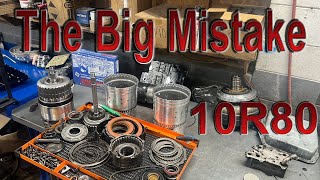
Typical fix: The transmission must be removed and partially or fully disassembled to replace the CDF clutch drum with the updated version (Part No. L1MZ-7H351-B or its predecessor 🎬 Watch: See how the CDF clutch drum fails and the updated part. JL3Z-7H351-B).
Est. part cost: $150-$400 for the drum itself, but labor is extensive. - Low or Contaminated Transmission Fluid (Mercon ULV) 🟡 Medium Probability Fluid can become contaminated with clutch material or metal shavings from other failing internal components (like the CDF drum), which then causes valves in the main control body to stick. It's often a symptom of a larger problem rather than the root cause.
How to confirm: Check the transmission fluid level and condition. The fluid should be red and clear, not brown, black, or containing visible metallic debris. Finding excessive metal in the pan is a strong indicator of internal failure.
Typical fix: A fluid and filter change may provide a temporary fix for minor issues, but if the fluid is heavily contaminated, the root cause of the contamination (e.g., failing CDF drum) must be addressed.
Est. part cost: $150-$300 for fluid and filter service. - Powertrain/Transmission Control Module (PCM/TCM) Software Issue ⚪ Low Probability Ford has issued multiple software updates to improve shift logic and address harsh shifting complaints. TSBs often list reprogramming as the very first step. An outdated calibration can cause or exacerbate harsh shifting.
How to confirm: A Ford dealership or qualified shop can check the current software calibration against the latest available version using their diagnostic tools.
Typical fix: Reprogramming the PCM/TCM to the latest software version and performing a transmission adaptive learning procedure, including the 'Transmission Accelerated Main Control Break-In' routine.
Est. part cost: $0 under warranty, or $100-$250 for labor.
Diagnosis Steps
- Check Transmission Fluid: Verify the fluid level is correct and the condition is good (not burnt or full of debris). Debris in the pan points towards mechanical failure.
- Scan for All Codes: Use a professional scan tool to read all codes from the TCM/PCM. Note any other accompanying codes, as a cluster of solenoid and gear ratio codes is common.
- Check for TSBs: Specifically reference TSB 22-2428 and any superseding bulletins (like TSB 23-2250 or 24-2254). These documents provide the official Ford diagnostic flowchart.
- Perform Software Updates & Relearn: Following the TSB, the first step is to update the PCM/TCM software and perform the 'Transmission Accelerated Main Control Break-In' routine with a scan tool. This attempts to free up sticking valves.
- Test Drive: If the issue is resolved, the problem was likely software-related or a temporarily stuck valve. If it persists, proceed to mechanical inspection.
- Inspect and Replace Valve Body: If software fixes fail, the next step is to drop the transmission pan and replace the main control valve body assembly.
- Inspect CDF Drum: If a new valve body does not resolve the issue or if symptoms are severe (e.g., no movement, loud grinding), the transmission must be removed to inspect the CDF clutch drum for the common bushing failure.
Parts You'll Likely Need
- Main Control Valve Body Assembly
(OEM #L1MZ-7A100-C (or superseding part numbers like ML3Z-7A100-B for other 10R80 applications))— This is the most common mechanical failure point addressed by TSBs, where internal valves stick, causing shifting errors and triggering solenoid codes.
Trusted brands: Motorcraft
OEM price range: $800-$1200
Aftermarket price range: $600-$900 - CDF Clutch Drum
(OEM #L1MZ-7H351-B (this part supersedes earlier versions like JL3Z-7H351-B))— This is the updated part for a known internal failure where a bushing moves and destroys a seal, leading to severe shifting problems or total loss of gears.
Trusted brands: Motorcraft, Suncoast (sells the OEM updated part)
OEM price range: $150-$410 - Transmission Fluid and Filter Kit — Required for any internal transmission service. The correct fluid is Mercon ULV.
Trusted brands: Motorcraft
OEM price range: $150-$250
Aftermarket price range: $100-$180
Related Codes That Often Appear With This One
- P0751 — Shift Solenoid 'A' Performance/Stuck Off
- P0756 — Shift Solenoid 'B' Performance/Stuck Off
- P0761 — Shift Solenoid 'C' Performance/Stuck Off
- P2700-P2705 — Codes related to Transmission Friction Element Apply Time/Performance, P2704 is commonly seen with P0772.
- P0729-P0736 — Codes related to incorrect gear ratios, indicating slipping or failure to engage a gear.
Technical Service Bulletins (TSBs) & Recalls
- TSB 22-2428: A key document outlining the diagnostic procedure for harsh shifts and a host of DTCs including P0772. It instructs technicians to first update software, then perform a break-in routine, and if that fails, replace the valve body, and finally inspect the CDF drum.
- TSB 23-2250: Supersedes TSB 22-2428, updating the procedure and vehicle list but maintaining the same core diagnostic path for the same set of issues and codes.
- TSB 20-2226: An earlier TSB specifically for the 2020 Transit with the 10R80 that mentions P0772 and P2704, pointing to sticking valves in the main control body as the cause.
- Additional TSBs (25-2302, 26-2046, 24-2252, etc.): A series of bulletins provided by NHTSA that all list P0772 as part of a large group of codes related to the same known 10-speed transmission faults, indicating this is a persistent, well-documented problem.
Platform-Specific Known Issues
- The 10-speed (10R60/10R80) automatic transmission in this generation of Explorer is subject to multiple Technical Service Bulletins (TSBs) for harsh shifting, delayed engagement, and various DTCs, including P0772. The issues are so prevalent that several class-action lawsuits have been filed regarding the transmission's performance and reliability across multiple Ford models including the Explorer, F-150, and Ranger. The primary mechanical culprits are typically the main control valve body or the CDF clutch drum.
Mechanic-Grade Diagnostic Values
- Shift Solenoid Coil Resistance — expected: 5 Ω to 15 Ω. Failure: An open circuit (infinite resistance) or a shorted circuit (less than 1 Ω) indicates a damaged solenoid coil.
Hidden / Shadow Codes Worth Checking
- Mode 6 Data: While not a specific 'shadow code', a scan tool capable of reading Mode 6 data can provide non-continuous monitor test results. For the transmission, this can include data on shift times and solenoid performance which may offer clues before a hard code is set. (see via Professional scan tool or advanced DIY tool like FORScan with Mode 6 test capability.)
Scan Tool Commands That Help
- Ford IDS / FORScan: Transmission Accelerated Main Control Break-In Routine — This is the first diagnostic step prescribed by Ford TSBs when addressing harsh shifts or solenoid codes. It's a scan tool-guided procedure designed to un-stick valves within the main control body.
- Ford IDS / FORScan: Clear Transmission Adaptive Tables — This function must be performed after any software update, valve body replacement, or transmission repair. It erases the learned shift parameters, forcing the TCM to start a new learning process.
- N/A - Manual Procedure: Adaptive Learning Drive Cycle — After clearing the adaptive tables, a specific, multi-step drive cycle must be performed to allow the TCM to relearn shift points and pressures correctly. This involves a sequence of light-throttle accelerations, gentle braking, and shifting between gears while stopped.
Wiring & Ground Locations
- 10R80 Case Connector Pin 17 — On the main 26-pin electrical connector on the transmission case.. Pin 17 is a primary ground circuit for the transmission control functions. A poor connection at this pin or a bad ground connection at its termination point ('Frame Middle Right') could cause erratic solenoid behavior and trigger various transmission codes.
- 10R80 Case Connector Pins 14-16, 18-26 — On the main 26-pin electrical connector on the transmission case.. These pins are the control circuits from the TCM for the various pressure control solenoids. A continuity or voltage check at these pins can isolate a wiring issue between the control module and the transmission's internal harness.
Real Owner Repair Stories
- Reddit user in r/f150 (2019 Ford F-150 with 10R80 transmission) — Initially, harsh upshifts and downshifts. Later, a 2-3 second delay when shifting from Park to Drive/Reverse.
❌ Tried (didn't work) A PCM reflash and replacement of some parts per a TSB initially addressed the harsh shifting, but the delayed engagement problem developed later.
✅ What actually fixed it The delayed engagement was fixed by replacing the CDF clutch drum. However, 900km later, very hard shifts into 3rd gear appeared, which then required replacing the main control valve body assembly. This shows both common failures can occur on the same vehicle.
"I Checked Everything" — The Actual Cause
- The equivalent for this transmission code is when electrical tests on the solenoid pass, but the problem persists. A technician may test the resistance of Shift Solenoid 'E' and find it within the typical 5-15 ohm range, and a bidirectional scan tool command may even show the solenoid is receiving the correct signal. However, the P0772 code returns because the root cause is not electrical. The actual failure is mechanical (a valve physically sticking in the valve body bore) or hydraulic (a pressure leak from the failed CDF drum seal), neither of which would be caught by a simple electrical test of the solenoid itself.
When the Usual Fixes Don't Work
- While the common causes are often presented as an 'either/or' diagnosis (valve body OR CDF drum), real-world repairs show it can be more complex. A vehicle may have the CDF drum replaced to fix a delayed engagement issue, only to develop harsh shifting symptoms shortly after, which then requires the replacement of the valve body. This indicates that the two primary failure points of the 10R80 transmission are not mutually exclusive and can occur sequentially or have overlapping symptoms.
OEM Part Supersession History
JL3Z-7H351-B→L1MZ-7H351-B— The original CDF clutch drum design had a bushing that could walk out of position, causing a major hydraulic leak. The updated part (L1MZ-7H351-B) includes a machined lip to retain the bushing, preventing this failure.L1MZ-7A100-A→L1MZ-7A100-C (and others)— Revisions to the main control valve body assembly to address issues with sticking valves and improve shift quality. TSBs often specify using the latest available part number.
Heads up: When replacing the valve body, the new solenoid strategy/ID printed on the part must be programmed into the TCM using a compatible scan tool for proper operation.
Model Year Variations Within This Range
- 2020-2022: Vehicles built on or before approximately August 15, 2022, are more susceptible to the CDF clutch drum failure due to the original bushing design.
- 2023: Most Ford vehicles produced after December 23, 2022, are likely to have the revised CDF drum from the factory, making this specific failure less probable, though not impossible. For these later models, a P0772 code is more likely to be related to the main control valve body or software.
Helpful Videos
Used OEM Parts in Stock


New Aftermarket Parts Available


The information in this article is provided for general reference and educational purposes only. Vehicle specifications, procedures, and part compatibility can vary by production date, trim level, and region. Always consult your vehicle's factory service manual and verify part numbers before purchasing or performing repairs. Safety-critical components such as airbags, seat belts, and braking systems should be installed by a qualified professional.
- Ford EXPLORER:
- 🎬 Helpful Videos
- 🛍️ Shop This Part
- What's Unique About the 2020-2023 Ford EXPLORER
- Diagnostic Flowchart
- Symptoms You May Notice
- Most Likely Causes
- Diagnosis Steps
- Parts You'll Likely Need
- Related Codes That Often Appear With This One
- Technical Service Bulletins (TSBs) & Recalls
- Platform-Specific Known Issues
- Mechanic-Grade Diagnostic Values
- Hidden / Shadow Codes Worth Checking
- Scan Tool Commands That Help
- Wiring & Ground Locations
- Real Owner Repair Stories
- "I Checked Everything" — The Actual Cause
- When the Usual Fixes Don't Work
- OEM Part Supersession History
- Model Year Variations Within This Range
- 🎟️ Get 5% Off