

P0741 on 2017-2025 Chrysler Pacifica: Torque Converter Clutch Performance Causes and Fixes
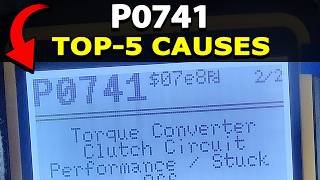
P0741 on your Pacifica means the torque converter clutch isn't locking up as it should, hurting fuel economy and potentially causing transmission overheating. The cause isn't consistently one single part; it could be low fluid, a bad solenoid, a software glitch, or an internal transmission issue. A thorough diagnosis is crucial before replacing expensive parts like the torque converter.
- P0741 means your Pacifica's transmission is failing to lock its torque converter, which wastes fuel and creates extra heat.
- Always start diagnosis by checking the transmission fluid level and condition. This must be done at a specific temperature as there is no dipstick.
- Unlike some other vehicles, there is no single 'most common' fix for this code on the Pacifica. A full diagnosis of the fluid, solenoids, and wiring is required before condemning the expensive torque converter.
- This is not a DIY-friendly repair. Due to the complexity of the 9-speed transmission, professional service is strongly recommended to avoid causing more damage.
What's Unique About the 2017-2025 Chrysler Pacifica
The Chrysler Pacifica uses a 9-speed automatic transmission (known as the 948TE, a version of the ZF 9HP). While this transmission has had many documented software and shifting complaints, especially in earlier model years, there is no single common failure part that causes the P0741 code specifically on the Pacifica. Unlike some other vehicles where this code often points directly to a faulty torque converter, on the Pacifica, a full diagnostic approach is necessary as the cause could range from simple fluid issues to software updates, a faulty solenoid/valve body, or the torque converter itself.
Symptoms You May Notice
- Check Engine Light is on
- Reduced fuel economy
- Engine RPM is higher than usual at highway speeds
- A sensation of shuddering or vibration, sometimes described as driving over rumble strips.
- Transmission slipping, delayed, or harsh shifts.
- Transmission overheating, potentially triggering a warning light.
- Vehicle may stall after driving at high speeds.
- Replacing the torque converter without diagnosing the solenoids, valve body, or checking for software updates first. The torque converter is expensive and labor-intensive to replace, so it should be the last resort after all other possibilities are eliminated.
Most Likely Causes
- Low or Degraded Transmission Fluid 🟡 Medium Probability The ZF 9-speed transmission is highly sensitive to fluid level and condition. This is the easiest and cheapest potential cause to check first, and dirty fluid can cause solenoids to stick.
How to confirm: The fluid level and condition must be checked. This transmission does not have a traditional dipstick; the level is checked via a plug on the side of the transmission case while the fluid is at a specific temperature (typically 35°C-45°C or 95°F-113°F). The fluid should be bright red and not smell burnt. Dark, contaminated, or burnt-smelling fluid indicates internal wear or overheating.
Typical fix: Perform a transmission fluid drain-and-fill using the correct specification fluid. A full fluid flush may be recommended if the fluid is very dirty, though some experts caution against this on high-mileage vehicles.
Est. part cost: $150-$300 for fluid - Faulty Torque Converter Clutch (TCC) Solenoid or Valve Body 🔴 High Probability Solenoids are electro-mechanical valves that can fail by sticking or having electrical faults. Debris in the fluid is a common cause of solenoid malfunction. In the 948TE, the TCC solenoid is typically part of the larger valve body assembly and may not be sold separately, making the repair more involved.
How to confirm: A technician can use an advanced scan tool to command the TCC solenoid on and off while monitoring its operation and TCC slip speed. The solenoid's electrical circuit can also be tested for proper resistance, which requires accessing the valve body inside the transmission pan.
Typical fix: Replace the faulty TCC solenoid, which often means replacing the entire valve body assembly. This requires removing the transmission oil pan.
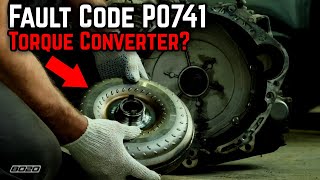
Est. part cost: $800-$1500 - Faulty Torque Converter 🟡 Medium Probability An internal failure of the torque converter's lock-up clutch is a primary cause for this code. The clutch lining can wear out or internal seals can fail, causing a pressure leak. This is a common misdiagnosis, so other causes should be eliminated first.
How to confirm: If the fluid, wiring, and solenoids all test good, the torque converter itself is the likely culprit. A technician may perform a stall speed test or analyze live data for TCC slip RPM to confirm. Metal shavings in the transmission pan are a strong indicator of converter or other internal failure.
Typical fix: The transmission must be removed from the vehicle to replace the torque converter. This is a major, labor-intensive repair.
Est. part cost: $500-$1200
Rare But Worth Checking
- Wiring Harness or Connector Issue: An often-overlooked cause. The wiring harness to the transmission can become damaged, or pins in the main connector can corrode, causing an intermittent loss of signal to the TCC solenoid.
- Transmission Control Module (TCM) Software Issue: Early versions of the ZF 9-speed transmission were known to have software-related shifting issues. Chrysler has released multiple software updates for the TCM to address harsh shifting and other DTCs. Checking with a dealer for the latest software flash is a critical and relatively inexpensive diagnostic step before replacing any hardware.
Diagnosis Steps
- Check for Technical Service Bulletins (TSBs). Use the VIN to check with a Chrysler dealer for any open recalls or software updates for the TCM. This is a crucial first step for the 948TE transmission.
- Check and verify the transmission fluid level and condition. This requires the vehicle to be level and the fluid to be at a specific temperature (95°F-113°F). Incorrect level or poor condition is a common cause.
- Use an advanced OBD-II scanner to check for any other transmission-related codes and to view live data, specifically Engine RPM, Transmission Input Speed, and TCC Slip Speed.
- While driving at a steady cruise speed (e.g., 50-60 mph), monitor the TCC command and slip speed. If the PCM is commanding lock-up but slip remains high (over ~200 RPM), the fault is active.
- Inspect the main transmission wiring harness and connector for any visible damage, corrosion, or loose pins.
- If fluid, software, and electrical components check out, the problem is likely internal to the transmission. Further diagnosis will be needed to isolate the fault between the TCC solenoid/valve body and the torque converter itself.
- At this stage, professional diagnosis is strongly recommended before proceeding with expensive part replacements like the valve body or torque converter.
Parts You'll Likely Need
- Automatic Transmission Fluid
(OEM #68218925AB (Mopar ZF 8&9 Speed ATF))— The first step in diagnosis and a potential fix if the fluid is low or degraded. Correct fluid type is critical for the 948TE transmission.
Trusted brands: Mopar
OEM price range: $25-$40 per quart
Aftermarket price range: $20-$30 per quart (ensure it meets Chrysler MS-90030-A5 spec) - Transmission Valve Body w/ Solenoids
(OEM #68318224AA (supercedes 04753134AA))— A common failure point. The TCC solenoid is often integrated into the valve body, requiring replacement as a complete unit. This part directs hydraulic fluid to engage clutches.
Trusted brands: Mopar, ZF
OEM price range: $1000-$1500
Aftermarket price range: $600-$900 (Remanufactured) - Torque Converter — The final suspect if fluid, software, and the valve body are confirmed to be good. An internal clutch failure inside the converter will cause this code.
Trusted brands: Mopar, ZF Aftermarket
OEM price range: $500-$1200
Aftermarket price range: $300-$700
Related Codes That Often Appear With This One
- P0740 — P0740 indicates an electrical circuit malfunction for the TCC solenoid, whereas P0741 indicates a performance problem (the circuit is okay, but the lock-up isn't happening). They can sometimes appear together if the problem is intermittent or complex.
- P0731-P0735 — These codes indicate incorrect gear ratios. If you have gear ratio codes along with P0741, it points towards a more severe internal transmission problem, such as widespread clutch failure, low fluid pressure, or a failing valve body.
- U0402 — This code for 'Invalid Data Received From Transmission Control Module' can sometimes accompany shift quality issues. A TSB for other vehicles with the 948TE transmission (Jeep Cherokee, Chrysler 200) linked this code to an internal C-Clutch snap ring issue, indicating a potential for deeper mechanical problems.
Technical Service Bulletins (TSBs) & Recalls
- TSB 21-008-15 REV. A: Addresses a C-Clutch snap ring replacement for harsh shifts and U0402 codes on 2014-15 Jeep Cherokee and 2015 Chrysler 200 with the 948TE. While not for the Pacifica, it shows a history of internal mechanical revisions on this transmission family.
Mechanic-Grade Diagnostic Values
- TCC Pressure Control Solenoid Resistance — expected: 5.3 - 5.6 Ohms. Failure: A reading outside this range indicates a faulty solenoid coil.
- Dog Clutch Solenoid Resistance — expected: 10.0 - 12.0 Ohms. Failure: A reading outside this range suggests a problem with the solenoid.
- TCC Slip Speed (Live Data) — expected: Near 0 RPM when TCC is commanded ON and locked.. Failure: A slip of more than 60-200 RPM when the TCC is commanded to lock indicates the clutch is not engaging properly.
Scan Tool Commands That Help
- wiTECH (Chrysler Dealer Tool): Quick Learn Procedure — This procedure must be performed after replacing the transmission, valve body, or TCM, or after clearing adaptation memory cells. It helps the TCM relearn clutch fill times and pressures to ensure proper shift quality. It's also a first step to address general shift quality complaints.
- wiTECH (Chrysler Dealer Tool): Valve Body Solenoid Learn — This specific learn procedure is required to match the TCM's electrical system with the solenoids in a newly installed valve body. It should NOT be performed for a full transmission replacement, as it can erase factory settings.
- wiTECH (Chrysler Dealer Tool): TCC Dynamic Test — Allows a technician to command the TCC on and off during a road test to verify its engagement. The technician can monitor TCC slip speed to see if it drops to near zero, confirming mechanical and hydraulic operation.
Wiring & Ground Locations
- Main Transmission Harness Connector — The main electrical connector for the transmission assembly, where the vehicle harness connects to the internal transmission wiring.. This is the primary point for testing continuity and resistance of the internal solenoids (like the TCC solenoid) without dropping the transmission pan. A diagnostic chart for the 948TE shows measuring resistance between specific pins at this connector to validate solenoid integrity.
- Rear Undercarriage Ground Strap — On the aft left-hand side of the undercarriage, attached to the frame via a bolt.. While not directly for the TCM, this ground strap is in the vicinity of the transmission. A poor ground connection can cause a variety of electrical issues. During diagnosis, ensuring all chassis and powertrain grounds are clean and secure is a crucial, often overlooked step.
Real Owner Repair Stories
- YouTube video by 'siu automotive' (2014 Jeep Cherokee with 948TE transmission (same family as Pacifica's)) — Harsh shifting, multiple transmission-related fault codes.
❌ Tried (didn't work) The video focuses on the diagnostic process and the importance of software updates and proper procedures rather than a list of failed parts.
✅ What actually fixed it The video documents a valve body replacement. The key takeaway was that after the physical replacement, a 'Valve Body Solenoid Relearn' and 'Quick Learn' procedure using a capable scan tool (like wiTECH) is absolutely mandatory for the repair to be successful. Simply swapping the part is not enough.
OEM Part Supersession History
04753134AA→68318224AA— This is a common supersession for the valve body assembly. The change often indicates revisions to address reliability issues, solenoid performance, or manufacturing improvements.
Model Year Variations Within This Range
- 2017-2019 (Early Models): Earlier models of the 948TE transmission family were more prone to software-related issues causing harsh shifts and setting various DTCs. Chrysler released numerous TCM software updates to address these concerns. While P0741 is performance-based, ensuring the TCM has the latest software is especially critical on these earlier Pacificas before condemning hardware.
Diagnostic Flowchart
Other Known Issues on This Vehicle
Issues unrelated to this code that are worth knowing about as an owner of this generation:
- Harsh/Jerky Shifting & Transmission Hesitation 🔴 High — Very common, especially on 2017-2019 models. Often reported at low mileage. Many software updates have been released to address this. (Ref: Multiple software update TSBs (e.g., 21-008-21) have been issued.)
- Engine Start/Stop (ESS) System Faults 🟠 Medium — Common across 2017-2019 models. Often caused by a failing secondary/auxiliary battery or a loose main battery ground connection. (Ref: Recall V53 (NHTSA 19V-344) was issued for a loose battery ground connection that could cause stalling.)
- Sudden Engine Shutdown (Hybrid Models) 🔴 High — Affects 2017-2023 Pacifica Hybrid models. An internal transmission wiring connector can short, causing the engine to shut down unexpectedly. (Ref: Recall 23V-010 (NHTSA) was issued to update software as a remedy.)
- Infotainment System Glitches (Uconnect) 🟡 Low — Frequently reported across many model years. Symptoms include screen freezing, unresponsiveness, and Bluetooth connectivity problems. (Ref: Software updates are periodically released by dealers to fix bugs.)
- Power Inverter Module Failure (Early Hybrid Models) 🔴 High — Affected a small number of 2017 Hybrid models. Diodes in the power inverter module could fail, leading to a no-move/stall condition. (Ref: Recall T34 (NHTSA) was issued for affected 2017 models.)
Used vs. New Parts: Buying Guide for This Vehicle
When a used part is the smart pick: For this specific repair, sourcing used parts is generally not recommended for the core components. A used wiring harness could be a viable option if a specific connector or wire is damaged and can be sourced from a low-mileage donor vehicle with no signs of corrosion or damage.
Donor-vehicle mileage cap: roughly under 50000 miles for the part to have meaningful remaining life.
What to inspect on the donor part:
- For a wiring harness, check for any signs of brittleness, cracking, or previous repairs.
- Ensure all connector locking tabs are intact.
- Avoid parts from vehicles with flood or fire damage.
- Verify the donor vehicle did not have the same P0741 code or other transmission issues.
OEM-only on this vehicle (don't cheap out):
- Transmission Valve Body: Due to the integration of solenoids and the requirement for software relearn procedures, using a new Mopar or OEM ZF valve body is critical. Remanufactured units can be a gamble, and their quality is inconsistent.
- Torque Converter: This is a critical wear item. Installing a used torque converter is highly risky as it may have the same internal wear that caused the original failure. A new or high-quality remanufactured unit from a reputable supplier is the only reliable option.
- Transmission Fluid: Only use the specified Mopar ZF 8&9 Speed ATF (or an aftermarket fluid that explicitly meets the MS-90030-A5 specification). The 948TE is extremely sensitive to fluid properties.
Aftermarket brands forum-validated for this vehicle:
- ZF Aftermarket: ZF is the original manufacturer of the transmission, so their aftermarket parts are equivalent to OEM.
- Precision of New Hampton (PNH): Mentioned as a large-scale rebuilder of torque converters, focusing on correcting OEM design flaws.
Brands owners have reported issues with on this vehicle:
- Unbranded/white-box valve bodies or torque converters from online marketplaces. The failure rate is high, and they often lack proper warranty support or the engineering to fix original design flaws.
Real Owner Stories
Aggregated from forums and TSBs cited above. Mileages and costs reflect what owners reported in those sources.
2017-2025 Chrysler Pacifica 3.6L V6 — 60000 miles
Symptoms: Owner experienced P0741 appearing alongside code P076F.
What fixed it: The dealer diagnosed an internal failure that required a full transmission replacement.
Source hint: https://www.pacificaforums.com/threads/p0741-and-p076f-at-60k-miles-need-advice.40158/
2017-2025 Chrysler Pacifica 3.6L V6 — ~120000 miles
Symptoms: The owner noted how heat affected the transmission symptoms and used a scanner to perform a detailed diagnostic process.
What fixed it: Detailed diagnostic process using a scanner to isolate the fault between the solenoid and the converter.
Source hint: https://www.gmtnation.com/forums/threads/transmission-issue-p0741.19839/
Related OBD-II Codes
Frequently Asked Questions
Does TSB 21-008-15 REV. A apply to my 2017-2025 Chrysler Pacifica?
How do I check the transmission fluid level on my Pacifica to rule out P0741?
Could a loose battery ground cause my Pacifica to stall, or is it definitely the P0741 code?
Is there a software update for the harsh shifting I'm experiencing alongside P0741?
If I need to replace the TCC solenoid, can I buy it individually for the 948TE?
My Pacifica Hybrid shut down suddenly; is this related to the torque converter clutch?
Helpful Videos

We Have This Part in Stock



The information in this article is provided for general reference and educational purposes only. Vehicle specifications, procedures, and part compatibility can vary by production date, trim level, and region. Always consult your vehicle's factory service manual and verify part numbers before purchasing or performing repairs. Safety-critical components such as airbags, seat belts, and braking systems should be installed by a qualified professional.
- Chrysler Pacifica:
- 🎬 Helpful Videos
- 🛍️ Shop This Part
- What's Unique About the 2017-2025 Chrysler Pacifica
- Symptoms You May Notice
- Most Likely Causes
- Rare But Worth Checking
- Diagnosis Steps
- Parts You'll Likely Need
- Related Codes That Often Appear With This One
- Technical Service Bulletins (TSBs) & Recalls
- Mechanic-Grade Diagnostic Values
- Scan Tool Commands That Help
- Wiring & Ground Locations
- Real Owner Repair Stories
- OEM Part Supersession History
- Model Year Variations Within This Range
- Diagnostic Flowchart
- Other Known Issues on This Vehicle
- Used vs. New Parts: Buying Guide for This Vehicle
- Real Owner Stories
- 2017-2025 Chrysler Pacifica 3.6L V6 — 60000 miles
- 2017-2025 Chrysler Pacifica 3.6L V6 — ~120000 miles
- Related OBD-II Codes
- Frequently Asked Questions
- 🎟️ Get 5% Off