

P0735 on 2020-2023 Ford Explorer: Gear 5 Incorrect Ratio Causes and Fixes
On a 2020-2023 Ford Explorer, P0735 is most often caused by a software issue in the transmission or powertrain control module. A trip to the dealer for a software update as outlined in TSB 22-2428 is the first logical step. If that doesn't work, the issue could be a faulty valve body or a known internal transmission failure related to the CDF clutch drum, which is a more expensive repair.
- P0735 means the transmission is slipping in 5th gear.
- For the 2020-2023 Explorer, the most likely cause is a software glitch that a Ford dealer can fix with an update.
- Before any major repairs, ensure the transmission fluid level and condition are checked by a professional.
- Do not ignore this code. Driving with it can lead to severe and expensive transmission damage.
- This is not a DIY-friendly repair; professional diagnosis is highly recommended.
What's Unique About the 2020-2023 Ford EXPLORER
The 2020-2023 Ford Explorer uses a 10-speed automatic transmission (10R60 or 10R80). Ford has issued multiple Technical Service Bulletins (TSBs) for these transmissions, with TSB 22-2428 being a key comprehensive bulletin that supersedes several others. This TSB explicitly lists P0735 and points to three primary causes: software glitches needing a PCM/TCM reflash, sticking valves in the main control (valve) body, and a specific internal mechanical failure involving axial movement of the CDF clutch cylinder sleeve. This makes diagnosis a multi-step process starting with software and potentially leading to significant mechanical repair.
🎬 Watch: A professional walkthrough of the 10R80 diagnostic process.Diagnostic Flowchart
Tap your situation to follow the diagnostic path that matches what you're seeing on this vehicle.
Symptoms You May Notice
- Check Engine Light is on
- Harsh, erratic, or delayed shifts, particularly a flare or clunk on the 4-5 upshift.
- Transmission gets stuck in a lower gear (limp mode).
- Flashing Overdrive (O/D) light or wrench light on the dashboard.
- Poor acceleration.
- Reduced fuel economy.
- A loud thud or bang during acceleration, sometimes followed by temporary warning messages.
- Replacing a shift solenoid when the problem is in the valve body, software, or the CDF drum.
- Immediately performing a transmission rebuild without first applying software updates or considering a valve body replacement, as outlined in Ford's TSBs.
Most Likely Causes
- Powertrain/Transmission Control Module (PCM/TCM) Software Issue 🔴 High Probability TSB 22-2428, which supersedes multiple previous bulletins, explicitly lists software updates as the first step for a wide range of shift quality issues and DTCs, including P0735.
How to confirm: A Ford dealer or a qualified shop with a Ford-specific scan tool (like FDRS) can check for and apply the latest software updates per TSB 22-2428.
Typical fix: Reprogram the PCM/TCM to the latest calibration.
Est. part cost: $0 - Sticking Valves in the Main Control Valve Body 🟡 Medium Probability TSB 22-2428 directly identifies sticking valves in the main control valve body as a primary cause for these symptoms and codes after software has been ruled out. Debris from normal wear or other internal issues can cause valves to stick.
How to confirm: This is diagnosed by a technician after ruling out software and fluid issues. It may require pressure testing and advanced diagnostics. If a PCM reprogram doesn't fix the issue, the TSB directs technicians to replace the valve body.
Typical fix: Replacement of the main control valve body assembly.
Est. part cost: $500-$1200 - Internal Transmission Mechanical Failure (CDF Clutch Drum) 🟡 Medium Probability A well-documented failure point in the 10R80/10R60 is the sleeve inside the CDF (Clutch D/F) drum, which can move out of position, causing hydraulic leaks and erratic shifting. TSB 22-2428 specifically mentions "axial movement of the CDF clutch cylinder sleeve" as a root cause.
How to confirm: Diagnosed after software and valve body replacement fail to resolve the issue. Finding significant metallic debris in the transmission pan is a strong indicator of internal damage.
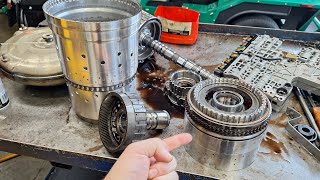
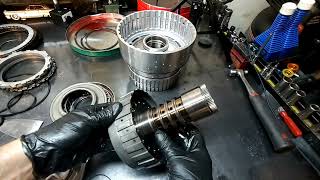
Typical fix: Requires transmission removal to replace the CDF drum with an updated part that has a machined lip to prevent the sleeve from moving. 🎬 Watch: Detailed teardown showing the CDF drum bushing failure. This is a full transmission rebuild-level repair.
Est. part cost: $2000-$7000 - Low or Contaminated Transmission Fluid (ATF) ⚪ Low Probability While less common as a primary cause without an underlying leak, these transmissions are sensitive to fluid level and condition. A leak from a cooler line, a known issue on some 2020 models (Customer Satisfaction Program 20B34), can lead to low fluid.
How to confirm: Check the transmission fluid level and condition. Note: These transmissions do not have a traditional dipstick, so this must be checked by a technician from underneath the vehicle at a specific temperature.
Typical fix: Top off the fluid or perform a fluid and filter change using the correct Motorcraft ULV ATF. If a leak is present, it must be repaired.
Est. part cost: $50-$250
Rare But Worth Checking
- Faulty Input/Output Speed Sensor: While a faulty sensor can cause this code, it's less common than the causes listed above. Often, a failing sensor will be accompanied by other specific sensor-related trouble codes (e.g., P0720).
- Minor Engine Misfire: In some documented cases on the 10R80, a subtle engine misfire, not severe enough to set a P030x misfire code, can be misinterpreted by the highly sensitive transmission controls, leading to a gear ratio DTC like P0735.
Diagnosis Steps
- Check for any Technical Service Bulletins (TSBs), specifically TSB 22-2428, which is the most current and comprehensive guide for this issue.
- Use a professional scan tool (like Ford's FDRS) to check for any other pending or stored trouble codes, paying close attention to clutch apply time codes (P270x).
- Have a technician check for and apply any available PCM/TCM software updates as per TSB 22-2428. This is the mandatory first step.
- If the code persists, have a technician check the transmission fluid level and condition. The fluid should be at the correct level, red in color, and not have a burnt smell.
- If software updates do not resolve the issue, the next step prescribed by the TSB is the replacement of the main control (valve body) assembly.
- If the code still persists after a new valve body, an internal transmission inspection is required, focusing on the CDF clutch drum and sleeve for the known failure mode.
Parts You'll Likely Need
- Transmission Main Control Valve Body
(OEM #JL3Z-7A100-B, JL3Z-7A100-C (verify correct part for specific vehicle build date))— TSB 22-2428 indicates that sticking valves are a common cause of shifting issues and this code on the 10-speed transmission after software is ruled out.
Trusted brands: Motorcraft
OEM price range: $700-$1200
Aftermarket price range: $500-$900 - Automatic Transmission Fluid
(OEM #Motorcraft MERCON ULV (XT-12-QULV))— Low or dirty fluid is a potential cause of many transmission problems. The correct ULV (Ultra-Low Viscosity) fluid is essential for proper operation.
Trusted brands: Motorcraft (ULV)
OEM price range: $20-$30 per quart
Aftermarket price range: $15-$25 per quart - CDF Clutch Drum Assembly — If software and valve body replacement do not fix the issue, the underlying cause is often a failed CDF drum sleeve, requiring a full teardown and replacement with an updated drum design.
Trusted brands: Motorcraft
OEM price range: $300-$500
Related Codes That Often Appear With This One
- P0731-P0734, P0736 — These are incorrect gear ratio codes for other gears. Seeing them together strongly points to a systemic issue like low fluid, a faulty valve body, or a failing TCM.
- P2700-P2705 — These codes relate to clutch apply time faults. P2704 (Friction Element 'E' Apply Time) is particularly common with P0735 on the 10R80, as both point to an issue with the 'E' clutch circuit, which is used for 5th gear.
Technical Service Bulletins (TSBs) & Recalls
- TSB 22-2428: This is the main, superseding TSB. It covers harsh/delayed shifts and a long list of DTCs including P0735 for 2020-2023 Explorers. It points to software, the valve body, or the CDF clutch cylinder sleeve as potential causes.
- TSB 22-2102, TSB 21-2434: These are older, now superseded bulletins that addressed similar harsh/delayed shift issues and DTCs. TSB 22-2428 replaces them with an updated procedure.
- TSB 23-2062: While this TSB is for a rear seat latch issue on the Ranger, it is sometimes confused in searches. It is not relevant to this P0735 transmission issue.
Platform-Specific Known Issues
- Ford's primary fix procedure is outlined in TSB 22-2428, which supersedes older TSBs like 22-2102 and 21-2434. It provides a clear diagnostic path: 1) Reprogram PCM/TCM, 2) Replace Valve Body, 3) Inspect/Replace CDF clutch cylinder.
- The internal failure of the CDF clutch drum sleeve is a widely discussed issue among owners and technicians for the 10R family of transmissions. The sleeve can slide out of place, uncovering oil passages and causing severe hydraulic pressure loss, leading to codes like P0735.
- Some 2020 models were subject to a customer satisfaction program (20B34) for leaking transmission oil cooler lines, which could lead to low fluid levels and cause this code.
- Owner forums contain numerous accounts of these transmission issues. One owner on explorerst.org with a P0772 code (related solenoid issue) found their transmission pan full of metal debris, confirming internal failure after a reprogram did not help. Another on Reddit described their 2020 model's transmission failure at 73k miles due to nonstop shifting errors, which was ultimately traced to the known
Mechanic-Grade Diagnostic Values
- Shift Solenoid A-F Resistance — expected: 5.0-5.4 ohms at 68°F (20°C). Failure: Resistance outside of this range indicates a faulty solenoid coil.
- Line Pressure Control (LPC) Solenoid Current — expected: Inversely proportional; high pressure at low current (50 mA), low pressure at high current (850 mA). Failure: Pressure not responding correctly to commanded current.
- Torque Converter Clutch (TCC) Solenoid Current — expected: Directly proportional; low pressure at low current (50 mA), high pressure at high current (850 mA). Failure: Pressure not responding correctly to commanded current.
- Transmission Fluid Temperature (TFT) Sensor Resistance — expected: 2.7K-1.5K Ohms from 195°F-230°F. Failure: Readings outside the expected range for a given temperature can cause incorrect shift scheduling and pressure control.
Scan Tool Commands That Help
- FORScan/FDRS: Clear Transmission Adaptive Tables / Reset KAM — This is a mandatory step after any transmission repair, including software updates, valve body replacement, or internal work. It erases the learned shift patterns, forcing the TCM to start a new learning process.
- FORScan/FDRS: Halt Transmission Adaptive Learning — Some advanced users or tuners may use this to stop the transmission from adjusting shift behavior, which can be useful for diagnosing if a specific learned behavior is causing an issue. However, it is generally not recommended for standard repairs.
- FDRS: CDF Test — As per a recent TSB, this is a specific hydraulic test performed with pressure transducers to verify leakage in the CDF clutch circuit before authorizing internal transmission repair.
- Generic OBD-II Scanner with Live Data: Monitor Input/Output Speed Sensors — While driving, a technician can monitor the input shaft speed, output shaft speed, and commanded gear. For P0735, they would look for a significant deviation between the calculated gear ratio (Input RPM / Output RPM) and the expected ratio for 5th gear (approx. 1.00 for the 10R80).
Wiring & Ground Locations
- Main Transmission Wire Connector Harness — External connector on the transmission housing.. This harness provides all electrical connections between the vehicle's control modules and the transmission's internal components (solenoids, sensors). A damaged, corroded, or loose connector can interrupt signals, leading to various transmission codes, including P0735.
- Engine Compartment Wiring Harness — Runs across the engine bay, connecting the PCM to various components, including the transmission harness.. Chafing or damage to this harness can cause intermittent shorts or opens in the circuits controlling the transmission solenoids and sensors, leading to incorrect ratio codes. Specific part numbers like L1MZ-14290-BAB are used depending on the engine.
Real Owner Repair Stories
- Reddit user in r/f150 (2018 Ford F-150 with 10-speed transmission, 145k miles) — Crazy shift problems, including floating between gears and then slamming into another gear.
❌ Tried (didn't work) Transmission relearn procedure, Valve body replacement
✅ What actually fixed it The user self-diagnosed the issue as the CDF drum failure based on TSB 22-2428. The final fix required replacing the CDF drum, confirming the diagnostic path outlined in the TSB where software and valve body fixes are attempted first before moving to internal mechanical repair.
OEM Part Supersession History
JL3Z-7A100-B→JL3Z-7A100-C (and others, verify by VIN)— Updates to address valve sticking issues and improve shift quality, as outlined in various TSBs.
Heads up: While physically similar, different valve bodies are calibrated for different engine/vehicle combinations. Using the wrong part number can cause new or different shifting problems.ML3Z-7A100-A→ML3Z-7A100-B— Revision for the valve body used in F-150 hybrid models, indicating ongoing updates to the 10-speed platform.
Heads up: This specific part is listed for hybrid applications and may not be correct for a standard Explorer.Original CDF Clutch Drum→Updated CDF Clutch Drum (multiple revisions)— The original drum design allowed an internal sleeve to move axially, uncovering hydraulic passages and causing pressure loss. The updated part has a machined lip on the inner half to prevent the sleeve from moving.
Model Year Variations Within This Range
- 2020-2023: The specific 10-speed transmission can be a 10R60 or 10R80, depending on the engine and drivetrain. The Safety Compliance Certification Label will have a transmission code 'T' for 10R60 or 'U' for 10R80. While internally very similar, fluid capacities and some service parts may differ slightly.
- 2020-2023: After a TCM reset or replacement, a specific, multi-step 'Adaptive Learning Drive Cycle' must be performed. This involves a sequence of light accelerations through gears 1-10, gentle braking, and shifting between N, R, and D. Many technicians may be unaware of or skip this complex procedure, leading to the return of shift quality issues.
Helpful Videos

Used OEM Parts in Stock


New Aftermarket Parts Available


The information in this article is provided for general reference and educational purposes only. Vehicle specifications, procedures, and part compatibility can vary by production date, trim level, and region. Always consult your vehicle's factory service manual and verify part numbers before purchasing or performing repairs. Safety-critical components such as airbags, seat belts, and braking systems should be installed by a qualified professional.
- Ford EXPLORER:
- 🎬 Helpful Videos
- 🛍️ Shop This Part
- What's Unique About the 2020-2023 Ford EXPLORER
- Diagnostic Flowchart
- Symptoms You May Notice
- Most Likely Causes
- Rare But Worth Checking
- Diagnosis Steps
- Parts You'll Likely Need
- Related Codes That Often Appear With This One
- Technical Service Bulletins (TSBs) & Recalls
- Platform-Specific Known Issues
- Mechanic-Grade Diagnostic Values
- Scan Tool Commands That Help
- Wiring & Ground Locations
- Real Owner Repair Stories
- OEM Part Supersession History
- Model Year Variations Within This Range
- 🎟️ Get 5% Off