

P0734 on 2018-2023 Lincoln Navigator: Gear 4 Incorrect Ratio Causes & Fixes
On a 2018-2023 Lincoln Navigator, code P0734 is almost always caused by an internal transmission failure related to the 10R80 transmission's CDF clutch drum. This is a known design flaw where a sleeve inside the drum walks out of position, causing a hydraulic leak. The issue is outlined in Ford's Technical Service Bulletin (TSB) 24-2046 and requires professional transmission repair, which can be costly, often requiring a partial or full rebuild.
- P0734 on a 2018-2023 Navigator is not a minor issue; it strongly suggests a significant internal transmission problem.
- The most likely cause is a known design flaw in the 10R80 transmission's CDF clutch drum, as identified in TSB 26-2046.
- Do not ignore this code. Continued driving can lead to a complete transmission failure.
- Repair is not a DIY project. It requires a transmission specialist and will involve removing and disassembling the transmission.
- Ensure any repair includes the updated CDF drum to prevent the issue from recurring.
What's Unique About the 2018-2023 Lincoln NAVIGATOR
The 2018-2023 Lincoln Navigator uses the Ford 10R80 10-speed automatic transmission, co-developed with General Motors (who use a version called the 10L80). This specific transmission is known to have a design weakness in the CDF (Clutch D/F) clutch drum assembly. A sleeve inside this drum can move out of place ('walk out'), uncovering hydraulic passages and causing a loss of pressure needed to apply the clutches for 4th gear (and often other gears as well). This specific failure is so common that Ford issued a series of Technical Service Bulletins, with the latest being TSB 24-2046, that directly links code P0734 to this internal component failure.
Diagnostic Flowchart
Tap your situation to follow the diagnostic path that matches what you're seeing on this vehicle.
Symptoms You May Notice
- "Powertrain Malfunction / Reduced Power" warning light on the dashboard.
- Check Engine Light is on.
- Harsh, delayed, or failed shifts into or out of fourth gear.
- Slipping or RPM flare between shifts, especially the 3-4 shift.
- Loud clunking or banging noises during shifts, particularly at low speeds. 🎬 Watch: A mechanic explains the four most common 10R80 failure points.
- Vehicle may enter a "limp mode" with limited gear availability.
- Decreased fuel economy.
- Momentary feeling of being in neutral when trying to accelerate from a stop.
- Whining noise from the transmission during shifts or at idle.
- Replacing only the shift solenoids or the entire valve body without inspecting the CDF drum. While a solenoid can fail, the root cause on the 10R80 is more often the mechanical drum failure, which will not be fixed by replacing electrical components.
- Performing only a transmission fluid flush. A tech on BobIsTheOilGuy forums notes that dealers may suggest this first, but it will not solve the underlying mechanical problem.
Most Likely Causes
- Internal CDF Clutch Drum Failure 🔴 High Probability This is a well-documented weak point in the 10R80 transmission. A sleeve within the drum assembly can move axially ('walk out'), uncovering hydraulic passages and causing a pressure leak to the clutch pack responsible for 4th gear (and others). This is the primary issue addressed by multiple Ford TSBs.
How to confirm: This requires transmission disassembly for visual inspection of the CDF drum. 🎬 See this quick overview of the CDF drum replacement process. A technician may first perform a hydraulic pressure test at the valve body ports to confirm a leak in the 'F' clutch circuit. Dropping the pan and finding excessive grey clutch material or metallic 'glitter' is also a strong indicator of this internal failure.
Typical fix: The transmission must be removed and disassembled to replace the faulty CDF drum with an updated part (like OEM part # JL1Z-7H351-B) that features a machined lip or improved design to prevent the sleeve from moving. Any clutches damaged by the slipping will also be replaced, often requiring a full overhaul kit. Aftermarket companies like Sonnax offer permanent solutions like their CDF Drum Saver Kit (129910-01K) that locks the sleeve in place.
Est. part cost: $200-$500 for an updated CDF drum assembly or aftermarket kit. - Low or Contaminated Transmission Fluid 🟡 Medium Probability While not a design flaw, low fluid can exacerbate existing issues by causing poor hydraulic pressure and overheating. Contaminated fluid (often with clutch material from a failing CDF drum) is a symptom of the larger problem.
How to confirm: Check the transmission fluid level and condition according to the manufacturer's procedure. The 10R80 transmission does not have a traditional dipstick, so this must be done from under the vehicle. Fluid should be clean, red, and free of metallic debris or a burnt smell. The correct fluid is Motorcraft MERCON ULV.
Typical fix: Perform a transmission fluid and filter change using the correct Motorcraft ULV fluid. If the fluid is heavily contaminated, it is a strong sign of the internal CDF drum failure and a fluid change alone will not solve the problem.
Est. part cost: $150-$250 for fluid and a filter. A full fluid change can cost $400-$515 at a shop. - Faulty Valve Body or Shift Solenoid ⚪ Low Probability While solenoids can fail, and the valve body is a complex component, TSBs point to the mechanical CDF drum failure as the root cause for these specific gear ratio codes far more often than an electrical or valve body fault alone. Often, a valve body replacement is attempted first but fails to solve the issue when the drum is the real culprit.
How to confirm: A technician can use an advanced scan tool to command the specific shift solenoids on and off to check their function. The valve body can be inspected for cracks, warping, or stuck valves once the transmission pan is removed.
Typical fix: Replace the individual faulty solenoid or the entire valve body assembly. This is often done in conjunction with a PCM software update as prescribed by the TSB, but may not fix the code if the CDF drum has failed.
Est. part cost: $50-$150 for a single solenoid, $500-$1200+ for a valve body assembly. - PCM/TCM Software Out of Date ⚪ Low Probability TSB 22-2428 and its successors note that PCM software updates and an adaptive learning reset are required steps in the diagnostic process. However, a software update by itself is unlikely to fix a significant mechanical failure like a leaking drum; it is meant to correct shift strategy, not a hydraulic leak.
How to confirm: A dealership or qualified shop can check the current software calibration of the PCM/TCM against the latest version available from Ford.
Typical fix: Update the module to the latest software version and perform the adaptive learning drive cycle. This is often the first step a dealer will take. If the problem persists, mechanical repair is necessary.
Est. part cost: $0-$200, typically charged as one hour of labor.
Rare But Worth Checking
- Faulty Molded Leadframe / Speed Sensor:
Diagnosis Steps
- Verify the transmission fluid level and condition. Ensure the correct Motorcraft MERCON ULV fluid is used.
- Use a diagnostic scan tool to check for any other transmission-related trouble codes, especially other gear ratio codes.
- Check for available software updates for the Powertrain Control Module (PCM) and Transmission Control Module (TCM) by referencing the latest TSB (currently TSB 22-2428). Perform the update and adaptive learning cycle.
- If software and fluid level are correct, the next step is to suspect a mechanical fault.
- A transmission specialist will likely drop the transmission pan to inspect for excessive clutch material (gray sludge) or metal debris, which indicates internal wear.
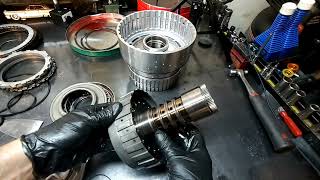
- Advanced diagnosis involves performing a clutch air pressure test with the valve body removed. Applying air to the F clutch port and hearing a significant leak points directly to a failed CDF drum seal. 🎬 Watch: See a failed CDF drum and the sleeve movement explained.
- If a pressure leak is confirmed or heavy debris is found, the transmission must be removed and disassembled for inspection and repair of the CDF drum and related clutches.
Parts You'll Likely Need
- CDF Clutch Drum Assembly (Updated)
(OEM #JL1Z-7H351-B)— This is the most common point of failure on the 10R80 transmission that leads to code P0734. The updated part has a design that prevents the internal sleeve from moving and causing a hydraulic leak.
Related Codes That Often Appear With This One
- P0729, P0731, P0732, P0733, P0735, P0736, P076F — These are all incorrect gear ratio codes for other gears (6th, 1st, 2nd, 3rd, 5th, Reverse, 7th respectively). TSB 22-2428 lists all of these codes as being related to the same potential CDF drum and software issues. Their presence together strongly points to a systemic transmission problem originating from the CDF drum leak.
Technical Service Bulletins (TSBs) & Recalls
- TSB 24-2046: The most recent bulletin that supersedes previous versions. It addresses harsh/delayed shifts and multiple DTCs including P0734, pointing to causes in PCM software, sticking valves in the main control body, and/or axial movement of the CDF clutch cylinder sleeve causing hydraulic leaks.
- TSB 23-2350 / TSB 22-2428: Earlier versions of the bulletin addressing the same 10R80 issues. A technician at a Ford dealer on Reddit specifically referenced TSB 22-2428 as the guide for the CDF drum repair.
Platform-Specific Known Issues
- A widely known issue with the 10R80 transmission is the failure of the CDF clutch drum, where an internal sleeve 'walks out' of position, causing hydraulic leaks and multiple gear ratio codes, including P0734. This is documented in a series of Ford Technical Service Bulletins, most recently TSB 24-2046.
- Vehicles built after August 16, 2022, are believed to have the updated CDF drum from the factory, though some forum users debate the exact cutoff date.
Mechanic-Grade Diagnostic Values
- Shift Solenoid (A-F) Resistance — expected: 5.0 - 5.4 Ohms at 68°F (20°C). Failure: A reading outside this range indicates a faulty solenoid coil.
- Clutch Pack Air Test (Valve Body Removed) — expected: Applying compressed air to a clutch port should result in a solid 'thud' as the clutch applies and holds pressure.. Failure: For P0734, applying air to the 'F' clutch port and hearing a continuous hiss of leaking air strongly indicates a failed CDF drum seal or sleeve.
Scan Tool Commands That Help
- Ford IDS (Integrated Diagnostic System): Solenoid Strategy Download/Programming — This is required any time the valve body or the entire transmission is replaced. The scan tool writes the 13-digit solenoid body ID and strategy file to the TCM to ensure correct solenoid operation.
- Ford IDS (Integrated Diagnostic System): Clear Adaptive Tables — After any transmission repair, software update, or valve body replacement, this function must be performed to reset the transmission's learned shift behavior and allow it to relearn based on the new components.
Real Owner Repair Stories
- Reddit user on r/FordTransmissionTech (Early 2018 Ford Mustang (mfg. Aug 2017) with 10R80) — Slipping in 3rd, 4th, and 5th gears 80% of the time under 50-70% acceleration. A whining noise during shifts in gears 1-4. Codes P0732, P0734, P076F were present.
❌ Tried (didn't work) Replaced the entire valve body assembly., Updated the PCM firmware., Performed solenoid strategy update and cleared adaptive tables.
✅ What actually fixed it The confirmed fix was not posted in the thread, but the expert consensus was that the symptoms pointed directly to the classic CDF clutch cylinder bushing misalignment (walk-out), and that an internal transmission repair to replace the CDF drum was the necessary next step.
OEM Part Supersession History
HL3Z-7H351-A→JL3Z-7H351-A, then JL3Z-7H351-B— The original CDF drum was prone to the internal sleeve 'walking out'. The updated 'B' version includes a machined lip to physically prevent the sleeve from moving, providing a permanent fix to the hydraulic leak issue.
Model Year Variations Within This Range
- 2018 - Mid-2022: Vehicles built before approximately August 2022 are more susceptible to the original CDF drum failure. Ford began phasing in the updated drum with the machined lip (Part No. JL3Z-7H351-B) on the production line for 2023 models, making later models less likely to experience this specific failure.
Helpful Videos

We Have This Part in Stock



The information in this article is provided for general reference and educational purposes only. Vehicle specifications, procedures, and part compatibility can vary by production date, trim level, and region. Always consult your vehicle's factory service manual and verify part numbers before purchasing or performing repairs. Safety-critical components such as airbags, seat belts, and braking systems should be installed by a qualified professional.
- Lincoln NAVIGATOR:
- 🎬 Helpful Videos
- 🛍️ Shop This Part
- What's Unique About the 2018-2023 Lincoln NAVIGATOR
- Diagnostic Flowchart
- Symptoms You May Notice
- Most Likely Causes
- Rare But Worth Checking
- Diagnosis Steps
- Parts You'll Likely Need
- Related Codes That Often Appear With This One
- Technical Service Bulletins (TSBs) & Recalls
- Platform-Specific Known Issues
- Mechanic-Grade Diagnostic Values
- Scan Tool Commands That Help
- Real Owner Repair Stories
- OEM Part Supersession History
- Model Year Variations Within This Range
- 🎟️ Get 5% Off