

P0701 on 2007-2012 Hyundai Santa Fe: Transmission Performance Causes and Fixes
P0701 on a 2007-2012 Santa Fe almost always indicates a failing Transmission Range Sensor, also known as an Inhibitor Switch. This common failure causes no-start conditions (especially in Park), erratic shifting, or limp mode. Expect to pay $40-$90 for an aftermarket part or $90-$135 for an OEM switch (Part No. 42700-3B700), with DIY difficulty at 3/5.
- P0701 is a general transmission performance code, but on a 2007-2012 Santa Fe, it's a strong indicator of a failing Transmission Range Sensor (Inhibitor Switch).
- A key diagnostic clue is if the vehicle fails to start in Park but starts correctly when the shifter is in Neutral.
- Before replacing parts, always inspect the wiring and connector for the inhibitor switch, as corrosion is a common issue.
- Replacing the inhibitor switch is a manageable DIY job for someone with moderate experience, but proper alignment of the new part is crucial.
- Do not immediately assume a major transmission failure; this code is very often resolved by replacing a relatively inexpensive external sensor.
What's Unique About the 2007-2012 Hyundai Santa Fe
On the second-generation (CM) Hyundai Santa Fe, the P0701 code is very commonly triggered by a single, well-documented point of failure: the Transmission Range Sensor, which Hyundai calls the 'Inhibitor Switch'. This external sensor is known to fail, leading to a host of shifting and starting problems. While other causes are possible, the inhibitor switch is so frequently the culprit that it should be the first component investigated, especially if the vehicle has trouble starting in Park but will start in Neutral, a classic symptom of this specific failure.
🎬 Watch: How to start your car when it won't crank.Symptoms You May Notice
- Check Engine Light is on
- Transmission gets stuck in one gear (fail-safe or 'limp mode'), often 4th gear.
- Harsh, delayed, or erratic shifting
- Vehicle will not start, or only starts intermittently
- Engine may start in Neutral but not in Park
- Incorrect or blank gear position indicator on the dashboard
- Reverse lights do not work
- Flashing 'P' or other gear indicator on the instrument cluster
- Replacing the starter when the vehicle has a no-start condition. If the car starts in Neutral but not Park, the issue is almost certainly the inhibitor switch, not the starter.
- Condemning the entire transmission. The P0701 code and its associated symptoms are very often caused by an inexpensive external sensor, not a catastrophic internal failure.
Most Likely Causes
- Faulty Transmission Range Sensor (Inhibitor Switch) 🔴 High Probability This is a widely documented failure point on this platform and many other Hyundai/Kia vehicles, acknowledged through multiple Technical Service Bulletins (like TSB 17-AT-005) for related codes P0705-P0708. The sensor is mounted externally on the transmission, making it susceptible to moisture and corrosion over time.
How to confirm: Scan for other codes; P0705, P0706, P0707, or P0708 strongly point to this sensor. Test if the car starts in Neutral but not Park. Use a multimeter to test the sensor's output signals for each gear position against the service manual specifications. 🎬 Watch: How to test and replace the inhibitor switch. A visual guide is available on YouTube showing the sensor's location and function.
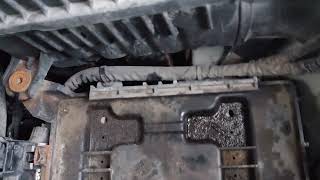
Typical fix: Replace the inhibitor switch. The switch is located on the front of the transmission where the shifter cable attaches. The battery, air cleaner, and battery tray typically need to be removed for access. Proper alignment of the new switch in the Neutral position is critical for correct operation; TSB 17-AT-005 details using a 5mm pin or bolt for alignment before tightening the lever nut.
Est. part cost: $40-$135 - Corroded or Damaged Wiring/Connector 🟡 Medium Probability The wiring harness to the inhibitor switch and other transmission sensors is exposed to the elements, making it vulnerable to corrosion, especially in regions with harsh winters. The connector sits on top of the transmission, exposed to heat and vibration.
How to confirm: Visually inspect the wiring harness and connector going to the inhibitor switch and the main transmission connector. Look for green/white corrosion, frayed wires, or bent pins. Perform a continuity test on the wires between the sensor and the Transmission Control Module (TCM).
Typical fix: Clean the connector terminals with electrical contact cleaner. If the wiring is damaged, repair the specific wires or replace the connector pigtail. In severe cases, a section of the harness may need to be replaced.
Est. part cost: $5-$50 - Low or Degraded Transmission Fluid ⚪ Low Probability
How to confirm: Check the transmission fluid level and condition using the dipstick with the engine warm and running in Park. The fluid should be at the correct level, pink/red in color, and not smell burnt. The correct fluid for this generation is typically Hyundai SP-III or an equivalent compatible fluid.
Typical fix: If the fluid is low, top it off with Hyundai-specified SP-III fluid and check for leaks. If the fluid is old or burnt, a transmission fluid and filter change is necessary. A full flush is generally not recommended on high-mileage transmissions with no service history.
Est. part cost: $50-$150
Rare But Worth Checking
- Faulty Input/Output Speed Sensor: A failure of one of the transmission speed sensors can provide conflicting data to the TCM, triggering a performance code. This is often accompanied by other specific speed sensor codes (e.g., P0717, P0722). While TSB 11-AT-002 was cited, its content is for a Dual Clutch Transmission learning procedure on a Veloster and not directly relevant. However, a faulty speed sensor remains a possible, though less common, cause.
- Failing Transmission Control Module (TCM): While uncommon, the TCM itself can fail due to internal circuit issues or software corruption. This is usually diagnosed only after all other possibilities (sensors, wiring, fluid) have been ruled out. TSB 17-AT-005 lists replacing the PCM/TCM as the final step if all other diagnostics fail.
- Low System Voltage: A weak battery or failing alternator can cause voltage irregularities, which may disrupt TCM communication and trigger false performance codes. If you're experiencing other electrical issues, check the battery and charging system. On 3.3L V6 models, a known valve cover gasket leak can drip oil onto the alternator, causing it to fail.
Diagnosis Steps
- Scan the computer for all stored trouble codes. Pay close attention to any codes accompanying P0701, as P0705-P0708 will strongly point to the inhibitor switch.
- Check the transmission fluid level and condition. Ensure it is full, clean, and does not smell burnt. Use the correct fluid type (Hyundai SP-III or equivalent).
- Test for a no-start condition in Park, then try starting in Neutral. If it starts in Neutral, the inhibitor switch is highly suspect.
- Visually inspect the inhibitor switch connector and nearby wiring harness for any signs of corrosion, damage, or loose connections.
- If the switch and wiring appear okay, test the inhibitor switch circuit with a multimeter according to the factory service manual to confirm if it is sending the correct signals for each gear position.
- If the switch tests bad, replace it. The OEM part number is 42700-3B700, which may be superseded by 42700-3B710. Be sure to properly align the new switch in the Neutral position using a 5mm pin or bolt as a guide.
- If the switch and wiring are good, further diagnosis of other transmission sensors (like input/output speed sensors) and the TCM itself is required, as outlined in TSB 17-AT-005.
Parts You'll Likely Need
- Transmission Range Sensor (Inhibitor Switch)
(OEM #42700-3B700 (superseded by 42700-3B710))— This is the most common failure part for code P0701 and related symptoms on the 2007-2012 Santa Fe, confirmed by multiple TSBs.
Trusted brands: Hyundai (OEM), Kia (OEM), Standard Motor Products, Dorman, Beck/Arnley
OEM price range: $90-$135
Aftermarket price range: $40-$90
Related Codes That Often Appear With This One
- P0705 — This code specifically indicates a 'Transmission Range Sensor Circuit Malfunction,' which is the most common root cause of a P0701 on this vehicle. TSB 17-AT-005 directly addresses this code.
- P0706 — This code indicates 'Transmission Range Sensor Circuit Range/Performance,' pointing directly to a problem with the inhibitor switch's signal quality or alignment.
- P0707 — This code for 'Transmission Range Sensor Circuit Low Input' points to an open circuit or fault in the inhibitor switch.
- P0708 — This code for 'Transmission Range Sensor Circuit High Input' points to a short circuit or fault in the inhibitor switch.
Technical Service Bulletins (TSBs) & Recalls
- TSB 17-AT-005: Directly applies to the 2007-2012 Santa Fe (CM) for inhibitor switch DTCs P0705-P0708, providing full diagnostic and replacement procedures.
- TSB 11-AT-002: Mentioned in pass 1, but research shows this TSB is for a DCT learning procedure on a Veloster and is not relevant to the Santa Fe's issue.
- Kia Service Action SA317A: While for Kia models, it describes identical symptoms (P0705, no-start, erratic shifting) caused by the same inhibitor switch, confirming the widespread nature of this part failure across the Hyundai/Kia family.
Platform-Specific Known Issues
- There are multiple Technical Service Bulletins (TSBs) from Hyundai related to intermittent no-start conditions and incorrect gear displays caused by a faulty inhibitor switch, confirming this is a known issue.
- TSB 17-AT-005 specifically covers the 2007-2012 Santa Fe (CM) and provides a detailed diagnostic flowchart for codes P0705, P0706, P0707, and P0708, all related to the inhibitor switch.
Mechanic-Grade Diagnostic Values
- Inhibitor Switch Power Supply Voltage — expected: Battery Voltage (approx. 12V) with ignition on. Failure: No voltage indicates a wiring or fuse issue upstream of the switch.
- Inhibitor Switch Signal Voltage (at specific pins) — expected: Approx. 12V on the corresponding signal pin when the gear is selected (e.g., Signal 1 pin shows 12V in Park, Signal 3 pin shows 12V in Neutral), and 0V otherwise.. Failure: No voltage when a gear is selected, or voltage present on multiple pins at once, indicates a faulty switch.
- TCM Ground Resistance — expected: Below 0.1 Ω. Failure: Higher resistance indicates a poor ground connection, which can cause erratic module behavior.
- Scan Tool Live Data: Input vs. Output Speed Sensors — expected: Speeds should correlate and rise together. A large mismatch indicates internal slipping or a sensor fault.. Failure: One sensor reading is erratic or drops to zero while the other is reading normally.
Scan Tool Commands That Help
- Hyundai GDS (Global Diagnostic System): TCM Neutral mode — This procedure is required after installing a new Transmission Control Module (TCM) to allow the new module to learn vehicle-specific information, such as smart key data.
- Professional Scan Tool: Transmission Solenoid Test / Controlled Activation Test — To individually command each shift solenoid on and off to verify its electrical circuit and mechanical function, helping to rule out a specific solenoid as the cause of a performance issue.
Wiring & Ground Locations
- Inhibitor Switch Connector — On the front of the transmission, where the gear shift cable attaches.. This is the primary connection point for the most common failed part. A detailed test procedure involves checking specific pins: Pin 3 is the 12V power supply, and other pins (Signal 1, 2, 3, 4) are outputs for Park, Reverse, Neutral, and Drive respectively.
- TCM Ground Circuit — The TCM is located under the battery tray in the engine compartment. The ground circuit is checked at the TCM harness connector.. A poor ground connection to the TCM can cause a wide range of false codes and erratic transmission behavior, mimicking other failures. Verifying a solid ground (<0.1 Ohms) is a critical step before condemning the module itself.
Real Owner Repair Stories
- Community-validated fix across multiple forums and TSBs (2007-2012 Hyundai Santa Fe, all engines) — Vehicle will not crank/start when the gear selector is in Park, but starts normally when shifted to Neutral. Often accompanied by P0701 and P0705-P0708 codes.
❌ Tried (didn't work) Replacing the starter motor, Replacing the battery, Checking starter fuses and relays
✅ What actually fixed it Replacing the Transmission Range Sensor (Inhibitor Switch) located on the front of the transmission. This is the overwhelmingly common solution for this specific symptom.
OEM Part Supersession History
42700-3B700→42700-3B710— Likely an internal revision for improved durability or material change, as is common with high-failure rate electronic parts.
Heads up: Part number 42700-3B500 is also listed as a related variant. While some sources suggest they can be used interchangeably on certain models, it is critical to verify the correct part number for your vehicle's specific VIN to avoid fitment or electrical issues.
Model Year Variations Within This Range
- 2007-2009: Pre-refresh models used a 2.7L V6 with a 4-speed automatic or a 3.3L V6 with a 5-speed automatic transmission.
- 2010-2012: The 2010 model year refresh introduced new powertrains: a 2.4L 4-cylinder or a 3.5L V6, both paired with a new 6-speed automatic transmission. While the P0701 code and its primary cause (inhibitor switch) persist, the transmission it is attached to and the controlling software are different from earlier models.
Diagnostic Flowchart
Other Known Issues on This Vehicle
Issues unrelated to this code that are worth knowing about as an owner of this generation:
- Faulty Fuel Level Sending Units 🟠 Medium — Very common on 2007-2009 models. The fuel gauge becomes erratic or reads empty after a fill-up, often triggering codes like P0463. (Ref: No recall, but it is a widely reported problem requiring replacement of one or both sending units in the tank.)
- Valve Cover Gasket Oil Leak (3.3L V6) 🔴 High — Common on 2007-2009 models with the 3.3L V6. Oil leaks from the front valve cover gasket directly onto the alternator, causing alternator failure and potential vehicle stalling. (Ref: Hyundai Service Campaign 936 and the later Campaign 976 were issued to address this. The fix involves replacing the gasket and inspecting/replacing the alternator.)
- Prematurely Worn Suspension Components 🟠 Medium — Ball joints, tie rods, and control arm bushings are known to wear out faster than expected, leading to suspension noises, poor alignment, and uneven tire wear.
- Failing Crankshaft Position Sensor 🔴 High — A common failure that can cause intermittent stalling or a no-start condition, sometimes with an erratic tachometer reading.
- Erratic Paint Peeling 🟡 Low — Many owners, particularly of white-painted models, report large sheets of paint peeling from the roof and hood. This is a cosmetic issue but can be expensive to repair.
Used vs. New Parts: Buying Guide for This Vehicle
When a used part is the smart pick: A used inhibitor switch from a reputable salvage yard can be a cost-effective option for this repair, as it is an external, easily accessible sensor. It is a good choice for a budget-conscious DIY repair if the donor part is inspected carefully.
Donor-vehicle mileage cap: roughly under 80000 miles for the part to have meaningful remaining life.
What to inspect on the donor part:
- Check for a clean, corrosion-free electrical connector. Avoid parts with any green or white powder on the pins.
- Inspect the plastic housing for cracks or heat damage.
- Ensure the manual control lever arm is straight and not bent or damaged.
- If possible, choose a part from a vehicle that was in a rear-end collision to reduce the chance of front-end impact or weather damage to the part.
OEM-only on this vehicle (don't cheap out):
- Transmission Control Module (TCM) - If the TCM is diagnosed as faulty, it is highly recommended to use a new OEM part or a professionally remanufactured unit that is programmed to your vehicle's VIN. A used TCM from a junkyard may have software incompatibilities or carry its own faults.
Aftermarket brands forum-validated for this vehicle:
- Hyundai/Kia (OEM)
- Beck/Arnley
Brands owners have reported issues with on this vehicle:
- Dorman and Standard Motor Products (SMP) have mixed reviews in owner forums for this type of sensor; some report premature failure while others have no issues. Purchase with caution or from a supplier with a good warranty/return policy.
Real Owner Stories
Aggregated from forums and TSBs cited above. Mileages and costs reflect what owners reported in those sources.
2007-2012 Hyundai Santa Fe
Symptoms: The car would not start when in Park, but would start up fine when shifted into Neutral.
What fixed it: Replacing the faulty inhibitor switch resolved the starting issue.
Source hint: Hyundai-Forums.com: Multiple threads discuss the 'starts in neutral but not park' issue, with owners confirming the inhibitor switch as the fix.
2007-2012 Hyundai Santa Fe
Symptoms: Experienced an intermittent starting issue where the car would not start in Park, but would always start in Neutral.
What fixed it: The problem was identified as the transmission position sensor (inhibitor switch).
Source hint: RepairPal: 'Hyundai Santa Fe intermittent starting issue in park, starts always in neutral'
Related OBD-II Codes
Frequently Asked Questions
My 2008 Santa Fe won't start in Park but starts fine in Neutral. Is this related to the P0701 code?
I have code P0701 and also P0705. What does that mean for my 2010 Santa Fe?
Is the inhibitor switch failure a known issue on the 2007-2012 Santa Fe?
I'm replacing the inhibitor switch myself. Is there anything special I need to know for the installation?
My reverse lights stopped working and my 'P' is flashing on the dash. Could this be caused by the same issue as P0701?
What is the correct transmission fluid for my 2009 Santa Fe when checking for issues related to P0701?
Helpful Videos


We Have This Part in Stock

The information in this article is provided for general reference and educational purposes only. Vehicle specifications, procedures, and part compatibility can vary by production date, trim level, and region. Always consult your vehicle's factory service manual and verify part numbers before purchasing or performing repairs. Safety-critical components such as airbags, seat belts, and braking systems should be installed by a qualified professional.
- Hyundai Santa Fe:
- 🎬 Helpful Videos
- 🛍️ Shop This Part
- What's Unique About the 2007-2012 Hyundai Santa Fe
- Symptoms You May Notice
- Most Likely Causes
- Rare But Worth Checking
- Diagnosis Steps
- Parts You'll Likely Need
- Related Codes That Often Appear With This One
- Technical Service Bulletins (TSBs) & Recalls
- Platform-Specific Known Issues
- Mechanic-Grade Diagnostic Values
- Scan Tool Commands That Help
- Wiring & Ground Locations
- Real Owner Repair Stories
- OEM Part Supersession History
- Model Year Variations Within This Range
- Diagnostic Flowchart
- Other Known Issues on This Vehicle
- Used vs. New Parts: Buying Guide for This Vehicle
- Real Owner Stories
- 2007-2012 Hyundai Santa Fe
- 2007-2012 Hyundai Santa Fe
- Related OBD-II Codes
- Frequently Asked Questions
- 🎟️ Get 5% Off