

OBD-II Code P0708: Transmission Range Sensor 'A' Circuit High
The Ultimate Guide to P0708: What It Means, Why It Happens, and How to Fix It for Good
- P0708 is a critical safety code indicating the Transmission Range Sensor is sending an impossibly high voltage signal (over 4.5V) to the engine computer.
- Do not drive the vehicle; the transmission will lock into 3rd or 4th gear (limp mode) and the engine may dangerously start while in Drive or Reverse.
- Replacing the Transmission Range Sensor resolves the code in 80% of cases and typically costs between $200 and $500 for parts and labor.
- Never replace the starter motor for a P0708 no-start condition; the computer intentionally disables the starter because it cannot verify the vehicle is in Park.
What Does P0708 Mean?

P0708 means your car's Powertrain Control Module (PCM) is receiving an impossibly high voltage signal from the Transmission Range Sensor (TRS). This sensor (also known as a neutral safety switch) tells the computer which gear you selected (Park, Reverse, Neutral, Drive). When the signal voltage sticks high (typically above 4.5V) or the computer receives signals for two different gears simultaneously for over 30 seconds, it cannot determine the shifter's actual position. This confusion triggers P0708, illuminates the Check Engine Light, and forces the transmission into a protective fail-safe mode.
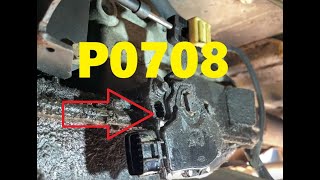
Technical definition: The SAE/ISO definition for P0708 is "Transmission Range Sensor 'A' Circuit High Input. 🎬 Watch: A quick overview of P0708 causes and common fixes." The PCM or Transmission Control Module (TCM) sets this code when voltage from the TRS 'A' circuit exceeds the maximum specified threshold (typically 4.5V) for a predetermined period. On many systems, it triggers when the PCM detects conflicting signals (e.g., Park and Drive simultaneously) for more than 30 seconds. It is a Type B DTC, meaning the PCM requires the fault to occur on two consecutive drive cycles to illuminate the Malfunction Indicator Lamp (MIL).
Can I Drive With P0708?

No — Do Not Drive. Driving is unsafe. A P0708 code causes the engine to start in gear, creating sudden, unexpected movement that poses a severe safety risk. While driving, the transmission shifts erratically, downshifts harshly, or locks in a single gear ('limp mode'), creating unpredictable traffic hazards. You also risk being stranded; the vehicle will not restart once turned off because the computer cannot confirm it is in Park or Neutral.
Common Causes

- Faulty Transmission Range Sensor (TRS) (Very Common) — Internal contacts wear out or the circuit board corrodes from moisture, causing the sensor to send continuously high voltage signals.
- Damaged, Corroded, or Shorted Wiring/Connectors (Common) — Wires chafe or short to a power source. Connector pins corrode from road salt and moisture, creating high resistance that triggers the code.
- Misadjusted Transmission Range Sensor or Shift Linkage (Common) — Improper alignment causes the sensor to report a gear position that contradicts the driver's physical selection, leading the PCM to see an illogical input.
- Fluid Contamination of Sensor or Connector (Less Common) — Coolant or oil leaks saturate and destroy the sensor. For example, on Ford Escapes, a leaking thermostat housing drips coolant directly onto the TRS. 🎬 See how to fix this common Ford Escape sensor failure.
- Voltage Backfeed from Other Circuits (Rare) — A fault in an unrelated circuit (like a faulty tail light assembly) back-feeds voltage into the reverse light circuit, which the TCM misinterprets as a high signal from the range sensor.
- Software or Calibration Glitches (Rare) — Outdated TCM software misinterprets a normal sensor signal as too high. This requires a dealership software re-flash to correct.
- Faulty Powertrain or Transmission Control Module (PCM/TCM) (Very Rare) — The computer itself fails and misreads a perfectly normal signal. A failed module typically sets numerous other codes alongside P0708.
Symptoms

- Engine Will Not Start or Starts in Any Gear — The vehicle refuses to crank because the computer cannot confirm Park or Neutral. Dangerously, it starts in Reverse or Drive, causing the vehicle to lurch.
- Transmission Stuck in Limp Mode — The transmission defaults to a single gear (usually 3rd or 4th) to prevent damage, resulting in poor acceleration and high highway RPMs.
- Check Engine Light and/or Transmission Warning Light On — The Malfunction Indicator Lamp (MIL) illuminates, often accompanied by a flashing gear icon or wrench on the dashboard.
- Incorrect or Blank Gear Indicator — The PRNDL display on the dashboard shows the wrong gear, flickers between gears, or goes completely blank.
- Harsh or Failed Shifting — Shifts become rough or delayed because the computer cannot determine the correct shift points.
- Reverse Lights Inoperative or Stuck On — The computer fails to activate reverse lights due to an unclear signal, or a short keeps them permanently on.
- Freeze Frame Data Logged (scan-tool only — no driver-felt sign) — The PCM stores a snapshot of sensor data from the moment the fault occurred, which is crucial for professional diagnosis.
Diagnostic Flowchart
Tap your situation to follow the diagnostic path that matches what you're seeing on this code.
Common Fixes & Costs
- Replacing the Transmission Range Sensor — Parts: $50-$200, Labor: $150-$300, ~1.5 hr book time (Intermediate)
- Repairing Damaged Wiring or Cleaning Connectors — Parts: $10-$50, Labor: $150-$300, ~2 hr book time (Intermediate)
- Adjusting the Transmission Range Sensor/Shift Cable — Parts: $0, Labor: $100-$200, ~1 hr book time (DIY)
- TCM Software Reflash/Update — Parts: $0, Labor: $100-$250, ~1 hr book time (Professional)
- Replacing the Powertrain/Transmission Control Module (PCM/TCM) — Parts: $600-$1200, Labor: $150-$300, ~2.5 hr book time (Professional)
DIY vs Professional
- Replacing the Transmission Range Sensor — Beginner:
Tools: Basic socket set, wrenches, pliers, jack and jack stands, multimeter. - Repairing Damaged Wiring or Cleaning Connectors — Beginner:
Tools: Electrical contact cleaner, wire strippers, butt connectors, heat shrink tubing, multimeter. - Adjusting the Transmission Range Sensor/Shift Cable — Beginner:
Tools: Basic hand tools. Some models require a 5mm drill bit or special alignment tool. - TCM Software Reflash/Update — Beginner:
Tools: Proprietary dealership-level scan tool with subscription for software downloads. - Replacing the Powertrain/Transmission Control Module (PCM/TCM) — Beginner:
Tools: Dealership-level scan tool for programming the new module to the vehicle's VIN.
Used vs. New Parts: Buying Guide
When a used part is worth it: Only for rare or vintage vehicles where new parts are unavailable. New aftermarket sensors cost $50-$150, making used parts an unnecessary risk.
Donor-vehicle mileage cap: roughly under 50000 miles for the part to have meaningful remaining life.
Donor quality checklist:
- Verify the donor vehicle was not scrapped due to transmission issues.
- Inspect the used sensor's connector for any signs of corrosion, bent pins, or plastic degradation.
- Match the part number exactly.
Decision logic:
- If New aftermarket part is available for under $150 → Always buy new. The labor cost to replace a failed used part negates any savings.
- If Vehicle is over 15 years old and new OEM part is over $300 → A used part from a reputable salvage yard is acceptable, but new aftermarket is preferred.
- If The part is known for high failure rates (e.g., Hyundai/Kia inhibitor switches) → Never buy used. The used part is already near the end of its service life.
Warranty tradeoff: Used parts offer a 30-90 day warranty covering only the part. New aftermarket parts include a 1-year to limited lifetime warranty.
Worst-case if a used part fails: $250-$500 if a used sensor fails after installation, primarily due to repeated labor costs.
What Happens If You Wait — Timeline
- 0-2 weeks: Intermittent Check Engine Light. Fault occurs under specific temperature or vibration conditions. (MPG impact: 0%% · Added cost: $0)
- 2 weeks - 2 months: Constant Check Engine Light. Occasional hesitation to start; requires jiggling the shifter. (MPG impact: 0-5%% · Added cost: $0-$25 in wasted fuel)
- 2-6 months: Frequent limp mode (locked in 3rd gear). Poor acceleration and high highway RPMs. High risk of being stranded. (MPG impact: 10-20%% · Added cost: $50-$150 in wasted fuel)
- 6+ months: Prolonged limp mode causes premature wear on transmission clutches, turning a $300 sensor fix into a $4,000 rebuild. (MPG impact: 15-25%% · Added cost: $3000-$5000)
Cost of Not Fixing It
- Immediate: Severe safety risk. The vehicle starts in gear, lurches unexpectedly, or becomes uncontrollable due to sudden harsh shifts. (Added cost: N/A)
- 0-3 months: Increased stress on transmission components. Driving in limp mode puts excessive wear on clutches and bands, dropping fuel economy by 10%. (Added cost: $50-$200 (in wasted fuel))
- 3+ months: Catastrophic transmission damage. Prolonged operation with incorrect gear commands causes overheating, turning a $300 sensor repair into a $4,000 transmission rebuild. (Added cost: $3000-$5000)
Diagnosis Steps

- Scan for All Codes and Review Freeze Frame Data
Confirm P0708 is present and check for related codes (P0700, P0705, P0706, P0707). Document the freeze frame data to see the vehicle's state when the code set.
Tools: OBD-II Scanner (Beginner) - Perform a Thorough Visual Inspection
Inspect the TRS, connector, and wiring harness. Look for frayed wires, loose connections, and green/white corrosion. Check for fluid leaks directly above the sensor.
Tools: Flashlight, Inspection Mirror, Safety Glasses (Beginner) - Test Sensor Voltage Output (Live Data)
Monitor live data for TRS voltage while moving the shifter through each gear. Watch for voltage exceeding 4.5V or multiple gears selected at once. A steady 5V indicates a short to power; erratic high readings suggest a faulty sensor.
Tools: Advanced OBD-II Scanner (Intermediate) - Verify Sensor Reference Voltage and Ground
Key on, engine off. Disconnect the TRS connector. Verify the reference voltage wire has 5V or 12V. Check the ground wire for less than 0.5 ohms resistance to chassis ground. A missing reference voltage points to a wiring or PCM issue.
Tools: Digital Multimeter, Vehicle-Specific Repair Manual (Intermediate) - Perform a 'Wiggle Test'
While monitoring live data, gently wiggle the TRS wiring harness and connector. If voltage jumps, locate and repair the intermittent open or short in the wiring.
Tools: Advanced OBD-II Scanner (Advanced) - Test for a Short to Power
Disconnect the sensor and PCM/TCM. Probe the signal wire pin at the harness connector with a multimeter grounded to the chassis. A reading above 0V confirms a short to power in the harness.
Tools: Digital Multimeter, Vehicle-Specific Repair Manual (Advanced) - Bench Test the Sensor with a Multimeter
Remove the sensor. Measure resistance (Ohms) between signal and ground pins while manually moving the selector. Compare to manufacturer specifications. 'OL' or out-of-spec values confirm a failed sensor.
Tools: Digital Multimeter, Vehicle-Specific Repair Manual, Jumper Wires (Advanced) - Analyze with an Oscilloscope
Back-probe the signal wire. A healthy sensor shows a clean step-pattern. Noise, dropouts, or spikes above 5V confirm internal failure that a multimeter misses.
Tools: Oscilloscope, Back-Probe Kit (Professional)
When This Code Triggers (Freeze-Frame Conditions)
- Engine Coolant Temp: 180-210°F (82-99°C) (The fault often appears once the vehicle reaches full operating temperature.)
- RPM: 1200-2500 RPM (The code triggers during steady-state cruising or light acceleration.)
- Vehicle Speed: 15-45 mph (24-72 kph) (P0708 sets at low to moderate city speeds where gear changes are frequent.)
- Gear Commanded: Drive (Freeze frame shows the TCM commanding a forward gear while receiving an invalid 5V signal from the TRS.)
Related Codes
- P0700 — Generic transmission fault code requesting the Check Engine Light. Almost always accompanies P0708.
- P0705 — General malfunction in the TRS circuit. P0708 is more specific, pointing directly to a high voltage fault.
- P0707 — TRS Circuit Low Input. The direct opposite of P0708. Diagnosis focuses on open circuits or shorts to ground rather than shorts to power.
- P0706 — TRS Circuit Range/Performance. Sets when the PCM sees an erratic signal. Frequently caused by a failing sensor or misadjustment.
Climate & Environmental Factors
- High Humidity & Water Exposure: Moisture penetrates the sensor housing, causing internal circuit board corrosion and erratic high voltage signals.
- Road Salt (Salt Belt Regions): Corrosive salt spray accelerates degradation of the wiring harness and connector pins, creating shorts and high resistance.
- Extreme Cold: Freezes moisture inside the sensor, cracking the housing or circuit board. Makes plastic wiring insulation brittle and prone to cracking.
How to Talk to a Mechanic About This Code
Say this: "I have a P0708 code, the car is in limp mode, and it won't always start. I suspect an issue with the transmission range sensor circuit."
Directs the technician to the sensor, wiring, or alignment, preventing an immediate quote for a new transmission.
Avoid saying:
- 'My car is acting weird.'
- 'Just fix the check engine light.'
- 'I think I need a new transmission.'
Questions to ask before authorizing the repair:
- Did you test the sensor's live voltage output?
- Did you inspect the wiring harness for corrosion?
- Does the cost include the alignment procedure?
- What is the warranty on the parts and labor?
Where to Take It: Dealer vs Independent vs Chain
- Dealer:
Recommended if your vehicle is under warranty or requires a software re-flash.
Best for: Vehicles under warranty., Repairs requiring a TCM software update., Complex cases on European brands (BMW, Mercedes).
Downsides: Highest labor rates., May replace the sensor without diagnosing nuanced wiring issues. (Typical cost: +50% vs. baseline) - Independent Shop:
Best fit for most situations. P0708 is a common code, and experienced mechanics fix it frequently.
Best for: Most out-of-warranty vehicles., Common failures (Hyundai inhibitor switch, Ford Escape sensor)., Cost-conscious owners.
Downsides: Quality varies; ensure ASE certification., May lack brand-specific tools for software updates. (Typical cost: +0% vs. baseline) - Chain Shop:
Acceptable if you are certain the sensor is the problem. Avoid for initial diagnosis.
Best for: You self-diagnosed a bad sensor and just need replacement.
Downsides: Technician skill is inconsistent., Less likely to perform in-depth electrical diagnostics. (Typical cost: -10% vs. baseline)
When to Walk Away From the Repair
If the estimated repair cost exceeds 50% of the car's private-party value, consider selling.
- Car worth $3500, fix is $400: Fix it. Repair is well below the 50% threshold.
- Car worth $2000, fix is $1200: Walk away. Repair is over 50% of the car's value.
- Car worth $8000, fix is $1500: Fix it, but confirm it's not a simple wiring issue before replacing the PCM.
What Scan Tool You Need for This Code
Minimum: An OBD-II scanner that reads transmission codes and displays live sensor data.
A $20 reader only shows the code. Live data is essential to watch the TRS voltage change and confirm a fault.
Budget: BlueDriver Pro (~$99) — Connects via Bluetooth and graphs live TRS voltage data.
Mid-range: Foxwell NT510 Elite / Autel MaxiDiag MD806 Pro (~$150-250) — Handheld unit with live data PIDs and bidirectional controls for a 'quick learn' after replacement.
Professional: Autel MaxiCOM MK808 / Launch X431 Series (~$450-600) — Tablet scanner with full bidirectional control and OEM-level TCM programming capabilities.
How to Clear the Code After You Fix It
- Reconnect the battery.
- Use an OBD-II scan tool to manually clear all diagnostic trouble codes.
- Perform a complete drive cycle to run readiness monitors.
Drive cycle (~20 minutes): 1. Cold start and idle for 3 minutes. 2. Drive in stop-and-go traffic, shifting through all gears. 3. Accelerate to 55 mph for 10 minutes. 4. Safely stop and idle for 30 seconds. 5. Turn off the engine.
Readiness monitors affected: Comprehensive Component Monitor (CCM), Catalyst (CAT) Monitor, Oxygen (O2) Sensor Monitor
Before emissions retest: drive at least 50 miles to fully set monitors.
Watch out for:
- Disconnecting the battery clears the code but resets all readiness monitors, guaranteeing an emissions test failure.
- If the root cause (corroded wire, misaligned sensor) remains, the code returns immediately.
Will This Fail Emissions / State Inspection?
Yes — this code typically fails an OBD-II emissions inspection.
- California: P0708 causes an automatic smog check failure. A complete drive cycle must set all OBD-II readiness monitors before a re-test.
- New York: An active Check Engine Light and P0708 code causes an immediate NYS DMV inspection failure.
- Texas: Vehicles in the 17 emissions-testing counties fail the OBD portion of the inspection with an active P0708.
Most Commonly Affected Vehicles
- Hyundai Santa Fe, Tucson, Elantra, Sonata (2010-2018) — TSBs 19-AT-024H and 17-AT-005 acknowledge high inhibitor switch failure rates. Fix is replacing the sensor (Part #42700-3B700).
- Kia Sorento, Optima, Sportage (2011-2018) — Shares platforms with Hyundai; suffers identical inhibitor switch failures covered under Service Actions SA317A/B/C.
- Ford Escape, Explorer, F-150, Fusion (2002-2012) — On 3.0L V6 Escapes, coolant leaking from the thermostat housing destroys the Digital Transmission Range (DTR) sensor.
- Chevrolet / GMC Silverado, Sierra, Tahoe, Suburban (1999-2007) — Neutral Safety Switch (NSS) failure is frequent, causing P0708 and no-start conditions.
- Honda Accord, Civic, Odyssey, CR-V (2003-2013) — Range switch failure causes a flashing 'D' light and prevents key removal from the ignition.
- Subaru Outback, Forester, Impreza (2000-2010) — Inhibitor switch fails from moisture, locking the transmission in 3rd gear fail-safe.
- BMW 3-Series, 5-Series, X3, X5 (2006-2013) — Mechatronic sleeve leaks fluid onto the connector, or the Gear Selector Switch (GWS) module fails internally.
- Nissan Altima, Maxima, Rogue (2007-2015) — CVT models trigger this code due to sensor failure or complex valve body electrical faults.
Manufacturer-Specific Notes
- Hyundai / Kia: TSB 19-AT-024H addresses massive inhibitor switch failure rates. The repair requires replacing the switch and aligning it using a 5mm pin or special tool (SST 09480-A3800).
- Ford: On Escapes with the DTR sensor under the thermostat housing, a coolant leak is the primary suspect. Repair the leak before replacing the sensor to prevent immediate repeat failure.
- Honda: A faulty range sensor prevents the driver from removing the key from the ignition as a safety measure because the system cannot confirm Park.
- Subaru: Inhibitor switch failure forces the transmission into 3rd gear limp mode and disables the reverse lights.
Real Owner Stories
2013 Hyundai Elantra at 110K miles - The Classic Fix
Check Engine Light on, PRNDL blank, stuck in 3rd gear. Car would only start in Neutral.
What they tried:
- Attempted to clear the code, but it returned immediately.
Outcome: Replaced the inhibitor switch (OEM 42700-26000) for $45. Took 1 hour with basic tools. Code cleared and symptoms resolved.
Lesson: P0708 on a Hyundai is almost guaranteed to be a failed inhibitor switch and is an easy DIY fix.
2008 Ford Escape 3.0L V6 at 145K miles - The Misleading Leak
No-start and harsh shifting. P0708 and P0707 present.
What they tried:
- Shop quoted $2,500 transmission rebuild.
- Took to a second shop for another opinion.
Outcome: Second mechanic found a leaking thermostat housing dripping coolant onto the TRS connector. Replaced housing ($80) and sensor ($60). Total repair under $400.
Lesson: Always check for model-specific external leaks before condemning the transmission. Repairing the leak is as important as replacing the sensor.
2005 Chevrolet Silverado 1500 at 180K miles - The Misdiagnosis Story
Truck would not crank or start.
What they tried:
- Replaced starter motor for $200.
- Replaced battery.
Outcome: Scanned code P0708, revealing the computer blocked the starter. Replaced Neutral Safety Switch ($50). Truck started perfectly.
Lesson: A no-start with P0708 is never the starter's fault. Always scan codes first.
How to Prevent This Code From Triggering
- Apply Dielectric Grease to the TRS Connector (Once, or every 3-5 years in harsh climates) — Seals the connector from moisture and corrosion, preventing high-resistance faults.
- Inspect Under-Hood Area for Leaks (Every oil change) — Catching coolant or oil leaks early prevents them from dripping onto and destroying the TRS.
- Check Transmission Fluid (Check annually, change per manufacturer's schedule) — Clean fluid prevents overheating and mechanical stress on internal linkages.
- Inspect Wiring Harnesses (Annually) — Securing loose wires with zip ties prevents chafing against the chassis and shorting out.
Frequently Asked Questions
What is the most common misdiagnosis for a P0708 code?
The most common mistake is replacing the starter motor when the car won't start. The P0708 fault prevents the PCM from verifying the car is in Park/Neutral, so it blocks the starter command as a safety feature. The starter is almost always fine.
Can I just bypass the neutral safety switch to fix this?
Bypassing the switch by jumping wires is extremely dangerous and not recommended. It allows the vehicle to start in any gear, causing unexpected lurching. It is a temporary diagnostic trick for professionals, not a permanent fix.
My car won't start and shows P0708. Is my starter bad?
Almost certainly not. The P0708 code means the computer doesn't know if the transmission is in Park or Neutral, so it disables the starter for safety. The no-start is a symptom of the P0708 fault, not a bad starter.
Does P0708 mean I need a new transmission?
Highly unlikely. This code almost always points to a faulty external sensor, damaged wiring, or an alignment issue. These are significantly cheaper and easier to fix than an internal transmission failure.
How much does it cost to fix a P0708 code?
Replacing the sensor typically costs between $200 and $500 for parts and labor. A wiring repair costs $160 to $350. In rare cases, a replacement PCM/TCM costs $750 to $1500 including programming.
Can a bad battery cause a P0708 code?
A failing battery causes random electrical codes due to voltage instability, but rarely an isolated P0708 code. If P0708 is your only code, the battery is not the root cause.
What does 'limp mode' feel like?
Limp mode feels extremely sluggish because the transmission locks in a single gear (usually 3rd or 4th). Accelerating from a stop feels incredibly slow, like starting a bicycle in the highest gear. At highway speeds, the engine runs at unusually high RPMs.
Key Takeaways
- P0708 is a critical safety code indicating the Transmission Range Sensor is sending an impossibly high voltage signal (over 4.5V) to the engine computer.
- Do not drive the vehicle; the transmission will lock into 3rd or 4th gear (limp mode) and the engine may dangerously start while in Drive or Reverse.
- Replacing the Transmission Range Sensor resolves the code in 80% of cases and typically costs between $200 and $500 for parts and labor.
- Never replace the starter motor for a P0708 no-start condition; the computer intentionally disables the starter because it cannot verify the vehicle is in Park.
Helpful Videos


The information in this article is provided for general reference and educational purposes only. Vehicle specifications, procedures, and part compatibility can vary by production date, trim level, and region. Always consult your vehicle's factory service manual and verify part numbers before purchasing or performing repairs. Safety-critical components such as airbags, seat belts, and braking systems should be installed by a qualified professional.
- 🎬 Helpful Videos
- What Does P0708 Mean?
- Can I Drive With P0708?
- Common Causes
- Symptoms
- Diagnostic Flowchart
- Common Fixes & Costs
- DIY vs Professional
- Used vs. New Parts: Buying Guide
- What Happens If You Wait — Timeline
- Cost of Not Fixing It
- Diagnosis Steps
- When This Code Triggers (Freeze-Frame Conditions)
- Related Codes
- Climate & Environmental Factors
- How to Talk to a Mechanic About This Code
- Where to Take It: Dealer vs Independent vs Chain
- When to Walk Away From the Repair
- What Scan Tool You Need for This Code
- How to Clear the Code After You Fix It
- Will This Fail Emissions / State Inspection?
- Most Commonly Affected Vehicles
- Manufacturer-Specific Notes
- Real Owner Stories
- 2013 Hyundai Elantra at 110K miles - The Classic Fix
- 2008 Ford Escape 3.0L V6 at 145K miles - The Misleading Leak
- 2005 Chevrolet Silverado 1500 at 180K miles - The Misdiagnosis Story
- How to Prevent This Code From Triggering
- Frequently Asked Questions
- What is the most common misdiagnosis for a P0708 code?
- Can I just bypass the neutral safety switch to fix this?
- My car won't start and shows P0708. Is my starter bad?
- Does P0708 mean I need a new transmission?
- How much does it cost to fix a P0708 code?
- Can a bad battery cause a P0708 code?
- What does 'limp mode' feel like?
- Key Takeaways
- 🎟️ Get 5% Off