

P0496 on 2013-2020 Ford Fusion Hybrid/Energi: Causes and Fixes for EVAP High Purge Flow
On a 2013-2020 Ford Fusion Hybrid or Energi, code P0496 is almost always caused by a faulty canister purge valve that is stuck open. The original-spec valve (often part AU5Z-9C915-B) is a known high-failure item. A classic symptom is difficulty starting or a stumbling engine right after refueling. Expect to pay $40-$80 for a new, updated Motorcraft valve (AU5Z-9C915-E / CX-2409), and it's a DIY-friendly repair that takes less than an hour.
- P0496 on a Fusion Hybrid/Energi almost always means you need a new canister purge valve.
- The most reliable symptom is the engine struggling or failing to start right after you fill up the gas tank.
- This is a very beginner-friendly DIY repair that can be done in under an hour with basic tools.
- Always check for companion codes like P1450, which further confirms a stuck-open purge valve.
- Use a quality Motorcraft replacement part (AU5Z-9C915-E or CX-2409); aftermarket versions may not last as long.
What's Unique About the 2013-2020 Ford Fusion

The canister purge valve is a well-documented, high-failure item on this generation of Ford Fusion and its platform-mates, the Lincoln MKZ Hybrid and Ford C-Max. The issue is so common that Ford has issued multiple Technical Service Bulletins (TSBs) related to the EVAP system, often pointing to the purge valve's poor sealing capability. Owners across all three platforms frequently report the classic symptom of the engine stumbling or refusing to start immediately after filling the gas tank, which is a tell-tale sign of this specific valve failure.
Symptoms You May Notice
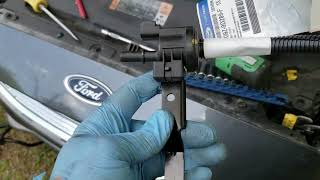
- Difficulty starting, long crank, stumbling, or stalling immediately after refueling. 🎬 Watch: Diagnose and fix a hard start after refueling
- Illuminated Check Engine Light.
- Slightly reduced fuel economy due to the un-metered vapor entering the engine.
- Audible 'farting' or vacuum release noise from the gas cap area.
- Replacing the charcoal canister. The canister is a storage device and rarely the primary cause. It typically only fails from long-term saturation with liquid fuel caused by a stuck-open purge valve, making it a secondary failure.
- Blaming the capless fuel filler neck. While a dirty or faulty filler neck can cause EVAP leak codes like P0456, it is not the typical cause for a high-flow code like P0496. However, cleaning it is good practice.
Most Likely Causes

- Faulty Canister Purge Valve 🔴 High Probability This is a very common failure part on many modern Fords, including the Fusion, C-Max, and MKZ. TSB 19-2207 confirms that the original valve's sealing capability can be insufficient, leading it to get stuck open from wear or fuel debris.
How to confirm: With the engine off, disconnect the purge valve's electrical connector and the hose leading to the intake manifold. Try to blow through the valve. If any air passes through, it is faulty and needs to be replaced. A properly functioning valve should be completely closed with the engine off. A more definitive professional test involves using a scan tool to monitor Fuel Tank Pressure (FTP) while the engine is running and the purge valve is unplugged; if vacuum builds, the valve is leaking internally.
Typical fix: Replace the canister purge valve assembly. It is located on top of the engine and is accessible for DIY replacement, often requiring only basic tools and about 15-30 minutes.
Est. part cost: $40-$80
Rare But Worth Checking
- Faulty Fuel Tank Pressure (FTP) Sensor: The FTP sensor provides the data that triggers the code. If the sensor is faulty and sends incorrect vacuum readings (e.g., showing a vacuum when there is none), it can cause a false P0496 code even if the purge valve is working correctly. This is much less common than the valve itself failing.
- Clogged or Faulty EVAP Canister Vent Valve: Less common for this specific code, but a blockage in the EVAP canister or a malfunctioning vent valve (located near the fuel tank) can disrupt system pressures and contribute to the code. In some cases, both the purge valve and vent valve required replacement to fix the issue.
- Disconnected Fuel Vapor Line: While rare, a manufacturer service bulletin for other Ford models, TSB 25-2431, notes that P0496 can be caused by a disconnected fuel vapor line inside the fuel tank, leading to stalls upon restart after refueling.
- Wiring Harness Issues: Manufacturer bulletin SSM 51247 indicates that P0496 and related EVAP codes can sometimes be traced to a faulty wiring harness connection at connector C1198 on the driver's side lower frame area.
- Cracked or Disconnected EVAP Hose: A crack or leak in the vacuum lines connected to the purge valve or EVAP system can also trigger this code, though it's less frequent than the valve itself failing. A smoke test is the most effective way to find such a leak.
Diagnosis Steps

- Read the code with an OBD-II scanner to confirm P0496 and check for any other related codes like P1450 or P0456.
- The most common symptom is a hard start after refueling. If this is present, the purge valve is the primary suspect.
- Visually inspect the canister purge valve and its connecting hoses on top of the engine for any obvious cracks, damage, or loose connections. The valve is located on the intake manifold.
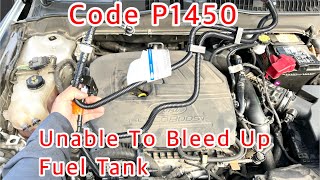
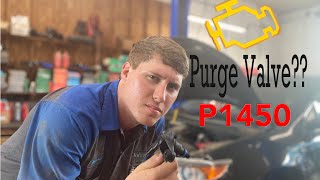
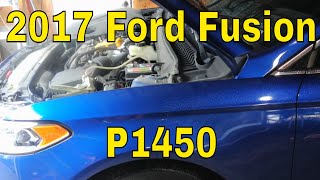
- Perform a functional test of the purge valve. With the engine off, disconnect the valve's electrical connector and outlet hose. It should be closed, and no air should pass through it. If you can blow through it, it has failed. 🎬 See a mechanic's guide to diagnosing and repairing code P1450
- For a more advanced check, use a scan tool to monitor the Fuel Tank Pressure (FTP) sensor. With the purge valve electrically disconnected, start the engine. If the FTP sensor shows a growing vacuum, the valve is confirmed to be leaking.
- If the purge valve tests good, inspect the capless fuel filler neck for debris and clean it with a funnel and a clean cloth.
- If the valve is good and the code persists, the next steps involve more advanced diagnostics, such as performing a smoke test on the EVAP system to find hard-to-see leaks.
Parts You'll Likely Need

- Canister Purge Valve / Solenoid
(OEM #AU5Z-9C915-E (supersedes AU5Z-9C915-B, -C, -D), Motorcraft CX-2409)— This is the overwhelming cause of P0496 on this vehicle. The valve fails internally and gets stuck open, causing un-commanded vapor flow. The -B part is often the original failing part, and the -E is the updated replacement.
Trusted brands: Motorcraft
OEM price range: $50-$80
Aftermarket price range: $35-$65 - EVAP Purge Valve Hose Assembly
(OEM #AU5Z-9D653-B)— While not always necessary, the plastic lines and connectors can become brittle over time. Some owners choose to replace the entire hose assembly along with the valve for preventative maintenance, although the valve itself is the typical failure point.
Trusted brands: Motorcraft
OEM price range: $60-$100
Aftermarket price range: $40-$70
Related Codes That Often Appear With This One
- P1450 — This code for 'Unable to Bleed Up Fuel Tank Vacuum' is a very common companion to P0496. A stuck-open purge valve creates a constant vacuum on the tank that the system cannot release, triggering both codes. TSB 19-2207, which addresses this issue on the Fusion, C-Max, and MKZ, lists them together as resulting from the same faulty valve.
- P0456 — This code for 'EVAP System Small Leak Detected' can sometimes appear because the computer may interpret the purge valve's inability to seal completely as a small leak under certain test conditions. TSB 19-2207 also includes this code as a possible result of the faulty purge valve.
Technical Service Bulletins (TSBs) & Recalls
- SSM 48301: Notes that 2017-2020 Fusion Hybrid vehicles may exhibit a check engine light with DTCs P0496 and P1450, pointing towards a common EVAP system diagnosis.
- TSB 19-2207: Issued for 2013-2017 Fusion, C-Max, and MKZ Hybrid/Energi models for code P1450 and related codes. It identifies the root cause as the canister purge valve's poor sealing capability and instructs dealers to replace the valve and reprogram the PCM.
- SSM 50306: Advises technicians to perform a specific 'EVAP Purge Valve Leak Test' with a scan tool before replacing the valve, as many returned parts under warranty were found to be functional.
- TSB 25-2431: A related manufacturer bulletin notes that P0496 may be stored in the PCM due to a disconnected fuel vapor line inside the fuel tank, leading to stalls upon restart after refueling.
- SSM 51247: This bulletin identifies that multiple DTCs including P0496 and P0456 may be due to a wiring harness connection issue at connector C1198.
Platform-Specific Known Issues
- Ford has issued multiple TSBs acknowledging EVAP system problems on this platform. TSB 19-2207 is highly relevant, addressing DTC P1450 (and others) on 2013-2017 Fusion/C-Max/MKZ Hybrid/Energi models by replacing the canister purge valve and updating PCM software. This fix directly applies to P0496.
- TSB SSM 48301 also acknowledges that 2017-2020 Fusion Hybrid vehicles may exhibit a check engine light with DTCs P0496 and P1450, pointing towards a common EVAP system diagnosis.
- TSB SSM 50306 warns technicians that many purge valves are replaced unnecessarily. Ford recommends using a specific scan tool test ('EVAP Purge Valve Leak Test') to confirm the valve is leaking before replacement, as many returned parts under warranty were found to be functional.
Mechanic-Grade Diagnostic Values
- Fuel Tank Pressure (FTP) Sensor Voltage (KOEO) — expected: 2.4V - 2.8V (at atmospheric pressure). Failure: A voltage significantly outside this range suggests a biased or faulty sensor that could falsely trigger the code. A static voltage of 2.6V to 2.65V is considered normal.
- Canister Purge Valve Solenoid Resistance — expected: 14 - 18 Ohms. Failure: Infinite resistance (open circuit) or near-zero resistance (short circuit) indicates a failed solenoid coil.
- Canister Vent Valve Solenoid Resistance — expected: 12 - 80 Ohms. Failure: A reading outside this range indicates a faulty solenoid coil in the vent valve assembly.
- Canister Purge Valve Connector Power Wire Voltage (KOEO) — expected: Battery Voltage. Failure: Low or no voltage points to a wiring or fuse issue upstream of the valve, not the valve itself.
Scan Tool Commands That Help
- Ford IDS / FDRS: EVAP Purge Valve Leak Test — This is the specific, manufacturer-recommended test to definitively confirm an internal leak in the canister purge valve before replacement, as advised in TSB SSM 50306.
- Ford IDS / FDRS or capable scan tool (like FORScan): EVAP Purge Solenoid Valve (VMV) Duty Cycle PID & Fuel Tank Pressure (FTP) PID — Command the purge valve to 0% duty cycle (closed) and the canister vent valve to ON (closed). While the engine is running, monitor the FTP sensor. If the FTP data shows a vacuum developing (pressure dropping), it confirms the purge valve is mechanically stuck open and leaking.
- Ford IDS / FDRS: EVAP Test (Key On Engine Off) — This is a general system integrity test. For P0496, it's less direct than the specific purge valve leak test but can help verify overall system function after a repair.
Wiring & Ground Locations

- G101 — Left front of the engine compartment.. This is a primary engine compartment ground point. A corroded or loose G101 could potentially affect the reference for various sensors in the EVAP system, although it is not a common cause for P0496.
- Canister Purge Valve Connector — On the canister purge valve itself, located on top of the engine on the intake manifold.. This 2-pin female connector provides power and control to the valve. Pin 2 (often a Green wire on related models) should have battery voltage with the key on. The other pin receives a pulse-width modulated ground signal from the PCM to operate the valve.
Real Owner Repair Stories
- NHTSA ODI #11537486 — An owner reported years of struggling to turn the vehicle on after a fill-up. A dealership inspection found codes P0496 and P0456, leading to a quote for a new VMV (Vapor Management Valve), charcoal canister, and VMV reprogramming.
- NHTSA ODI #11606854 — An owner of a related Ford model used a scanner to find code P0496 after experiencing a rough start after filling the gas tank, which was attributed to the canister purge valve remaining stuck open.
- NHTSA ODI #11727824 — A report describes how after fueling, code P0496 would show and the car would not start or struggle to start, accompanied by stalling on the freeway and a rough idle.
- Reddit user Jollyrancher1543 (2019 Ford Fusion SEL, 40,000 miles) — Check Engine Light with code P0496, poor city MPG (18.5), and took 5 attempts to start the car after refueling.
❌ Tried (didn't work) Initial diagnosis at AutoZone pointed to the purge valve.
✅ What actually fixed it The user was advised by others that the symptoms pointed directly to the purge valve. Another user in the thread with a 1.5L engine confirmed they fixed the same issue and symptoms by replacing the purge valve assembly in 5 minutes, which resolved the code and hard-start issue. - Car Talk Community user 'pvtstreet' (2015 Ford Fusion Titanium) — Persistent P1450 code (often paired with P0496), inconsistent hard start after refueling, and loud vacuum noise from the capless filler neck.
❌ Tried (didn't work) Replaced the purge valve and solenoid., Replaced spark plugs., Replaced both high and low fuel pressure sensors., Checked all EVAP hoses.
✅ What actually fixed it The user's story was unresolved in the thread, highlighting a scenario where replacing the most common part (purge valve) did not fix the issue, suggesting a more complex underlying problem like a faulty vent valve, FTP sensor, or an intermittent wiring issue.
"I Checked Everything" — The Actual Cause
- A smoke test is designed to find external leaks where vapor is escaping the EVAP system. Code P0496, however, is for 'High Purge Flow,' which means the engine is pulling an un-commanded vacuum on the system, usually through an internally leaking (stuck open) purge valve. Because there is no external leak, a smoke test will almost always pass, showing no issues. This can mislead a technician into thinking the EVAP system is sealed and the problem lies elsewhere, when in fact the correct diagnostic is to test the purge valve's function directly with a scan tool, not to look for external leaks.
OEM Part Supersession History
AU5Z-9C915-B→AU5Z-9C915-E (Motorcraft CX-2409)— The original -B valve was known for poor internal sealing capability, leading to leaks that cause P0496 and P1450. The subsequent revisions, culminating in -E, feature improved design and materials to prevent sticking open.AU5Z-9C915-A→AU5Z-9C915-B, and subsequently -E— Part of the revision history to improve valve sealing and reliability.
Diagnostic Flowchart
Real Owner Stories
Aggregated from forums and TSBs cited above. Mileages and costs reflect what owners reported in those sources.
2019 Ford Fusion SEL — 40000 miles
Symptoms: Check engine light, poor MPG (18.5 city), took 5 tries to start the car after refueling.
What fixed it: Replacing the canister purge valve after AutoZone pulled code P0496.
Source hint: r/fordfusion - Canister Purge Valve Replacement.... (PO496)
Ford Fusion
Symptoms: Check engine light (P0496), decreased gas mileage after filling up.
What fixed it: Replacing the purge valve with a Motorcraft unit.
Cost: $40-$200+
Source hint: r/fordfusion - P0496
2019 Ford Fusion 2.5L I4
Symptoms: Check engine light with code P0496, hard start after refueling.
What fixed it: Changing the canister purge valve located on top of the engine.
Source hint: YouTube - 2019 Ford Fusion 4 cylinder p0496 and hard start after refueling #p0496
2013 Ford Fusion
Symptoms: Classic symptom of a long crank and rough run for 10 seconds after a fill-up.
What fixed it: Replacing the canister purge valve.
Source hint: bobistheoilguy.com - Thread: 'Fusion didn't want to start AGAIN after fueling'
Ford Fusion Hybrid
Symptoms: P0496 and P1450 codes accompanied by a hard-start-after-fueling symptom.
What fixed it: Replacing the purge valve with Motorcraft part CX-2409 (a 15-minute job with basic tools).
Source hint: fordfusionhybridforum.com - Thread: 'P0496 and P1450 - Purge Valve DIY'
Related OBD-II Codes
Frequently Asked Questions
Does TSB 19-2207 apply to my 2013-2020 Ford Fusion Hybrid for code P0496?
Why does my Fusion Hybrid struggle to start right after I put gas in it?
Can I test the purge valve on my 2.0L Hybrid engine myself?
What is the 'EVAP Purge Valve Leak Test' mentioned in Ford's SSM 50306?
What part do I need to fix P0496 on my Fusion, and how much does it cost?
Could the capless fuel filler neck on my Fusion be causing the P0496 code?
Helpful Videos


Used OEM Parts in Stock

New Aftermarket Parts Available


The information in this article is provided for general reference and educational purposes only. Vehicle specifications, procedures, and part compatibility can vary by production date, trim level, and region. Always consult your vehicle's factory service manual and verify part numbers before purchasing or performing repairs. Safety-critical components such as airbags, seat belts, and braking systems should be installed by a qualified professional.
- Ford Fusion:
- 🎬 Helpful Videos
- 🛍️ Shop This Part
- What's Unique About the 2013-2020 Ford Fusion
- Symptoms You May Notice
- Most Likely Causes
- Rare But Worth Checking
- Diagnosis Steps
- Parts You'll Likely Need
- Related Codes That Often Appear With This One
- Technical Service Bulletins (TSBs) & Recalls
- Platform-Specific Known Issues
- Mechanic-Grade Diagnostic Values
- Scan Tool Commands That Help
- Wiring & Ground Locations
- Real Owner Repair Stories
- "I Checked Everything" — The Actual Cause
- OEM Part Supersession History
- Diagnostic Flowchart
- Real Owner Stories
- 2019 Ford Fusion SEL — 40000 miles
- Ford Fusion
- 2019 Ford Fusion 2.5L I4
- 2013 Ford Fusion
- Ford Fusion Hybrid
- Related OBD-II Codes
- Frequently Asked Questions
- 🎟️ Get 5% Off