

P0496 on 2017-2019 Ford Escape 1.5L: Causes and Fixes for EVAP High Purge Flow
On a 2017-2019 Ford Escape with the 1.5L engine, code P0496 is almost always caused by a faulty vapor canister purge valve that is stuck open. A classic symptom is difficulty starting after refueling. Replacing the purge valve assembly is a common, DIY-friendly fix costing around $30-$80 for the part. The part is an entire assembly with multiple hoses, not just the valve itself.
- P0496 on your 2017-2019 Escape almost certainly points to a bad vapor canister purge valve assembly.
- The most telling symptom is the engine struggling to start immediately after you fill the gas tank.
- This is a DIY-friendly repair. The part is a complete assembly with hoses (OEM P/N: GV6Z-9D289-E) and is located on top of the engine.
- The correct test is to remove the valve assembly and see if you can blow air through it. If you can, it's bad.
- Do not replace the gas cap or vent solenoid for this code; the purge valve is the culprit in the vast majority of cases.
What's Unique About the 2017-2019 Ford Escape

For the 1.5L EcoBoost engine in this generation of Escape (C520 platform), the canister purge valve is not a standalone component but is integrated into a complex, pre-formed hose assembly. Unlike vehicles where you can swap a small, inexpensive valve, on this Escape, you must replace the entire assembly with its multiple molded plastic lines and connectors. While this makes the part slightly more expensive and the replacement process more involved due to multiple connection points, it's still considered a very common and straightforward DIY repair for this specific vehicle.
🎬 Watch: Complete step-by-step walkthrough for replacing the purge valve assembly.Symptoms You May Notice
- Check Engine Light is on
- Difficulty starting the engine, or a long crank time, especially right after filling the gas tank.
- Rough or unstable idle.
- Slight decrease in fuel economy.
- Sputtering or stumbling immediately after starting.
- Replacing the gas cap. A faulty gas cap on this capless system would manifest as a fault with the filler neck seal, typically causing large or small leak codes (like P0455 or P0457), not a P0496 'flow during non-purge' condition.
- Replacing the EVAP Vent Solenoid. The vent solenoid is located near the charcoal canister at the rear of the vehicle and typically causes different codes, like P0446 (Vent Control Circuit).
Most Likely Causes

- Faulty Vapor Canister Purge Valve/Solenoid 🔴 High Probability This is a very common failure item across many Ford models, including the Escape and its platform-mate, the Fusion. The internal valve mechanism wears out and gets stuck in a partially or fully open position, allowing fuel vapor to be drawn into the engine at all times.
How to confirm: Locate the purge valve assembly on the top of the engine. Disconnect it from its electrical connector and all associated hoses. Attempt to blow air through the main port of the valve where the vapor line from the canister connects. If any air passes through, it is stuck open and has failed the test, as it should be normally closed when de-energized.
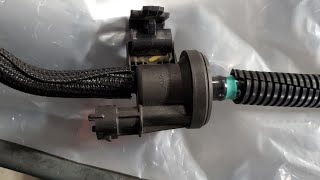
Typical fix: Replace the entire vapor canister purge valve and hose assembly. The part is a single, integrated unit with molded plastic lines that cannot be easily separated.
Est. part cost: $30-$80
Rare But Worth Checking
- Faulty Fuel Tank Pressure (FTP) Sensor: A faulty FTP sensor can send incorrect vacuum readings to the PCM, tricking it into believing there is flow when there isn't. This is much less common than a failed purge valve for this specific code.
- Wiring issue to the purge valve: A short in the wiring could potentially hold the valve open, but this is rare. A visual inspection of the harness and connector for damage is a good first step before replacing parts.
- Saturated EVAP Charcoal Canister: If the canister becomes saturated with liquid fuel, typically from habitually over-filling the gas tank (topping off), it can cause various EVAP system problems. This can sometimes lead to P0496 or other codes like P04F0.
Diagnosis Steps

- Verify the Check Engine Light is on and scan for codes. Confirm P0496 is the primary code. 🎬 Watch: Understanding the P0496 code and what it means for your car.
- The most common and telling symptom is a hard start or stumbling engine right after refueling. If this is present, the purge valve is the prime suspect.
- Locate the vapor canister purge valve assembly on the top passenger side of the 1.5L engine. It is a black plastic assembly with several rigid lines and one electrical connector.
- Disconnect the electrical connector from the purge valve solenoid. There is usually a small tab to press.
- Carefully disconnect the EVAP lines. These connectors often have colored locking clips (e.g., green, red, white) that must be released or slid out before the connector can be squeezed and pulled off. Be gentle as the plastic can become brittle.
- With the valve assembly completely removed from the vehicle, attempt to blow through the port that connects to the EVAP canister line. It should be completely sealed. If you can blow through it at all, it is defective and must be replaced.
- If the valve tests good (which is unlikely with these symptoms), inspect the associated EVAP hoses for any cracks, kinks, or damage.
- If no physical faults are found, the next step would involve using a professional scan tool to monitor the Fuel Tank Pressure (FTP) sensor data and command the purge valve on and off to check for proper circuit function, but this is rarely necessary for this specific code and vehicle.
Parts You'll Likely Need

- Vapor Canister Purge Valve and Hose Assembly
(OEM #GV6Z-9D289-E)— This is the component that fails in over 95% of P0496 cases on this vehicle. It gets stuck open, causing the un-commanded flow of fuel vapors. The OEM part GV6Z-9D289-E supersedes the older part number GV6Z-9D289-A.
Trusted brands: Motorcraft (OEM), Standard Motor Products (SMP), Dorman, NOVAPARTS
OEM price range: $50-$90
Aftermarket price range: $30-$60
Related Codes That Often Appear With This One
- P0456 — A 'Very Small Leak' code can sometimes accompany P0496 if the purge valve is not sealing perfectly, which the system's leak test may interpret as a small leak in the system.
- P1450 — This Ford-specific code for 'Unable to Bleed Up Fuel Tank Vacuum' is often linked directly to a faulty purge valve. A stuck-open valve prevents the system from sealing properly to perform its vacuum tests, making it a strong companion code to P0496. 🎬 See how to diagnose and fix P1450 on the 1.5L engine.
- P04F0 — This code for 'EVAP System Leak Detected (Gross Leak/No Flow)' can sometimes appear after a P0496 is fixed, or alongside it, indicating a more complex EVAP system fault that may have been masked by the stuck purge valve.
Technical Service Bulletins (TSBs) & Recalls
- SSM 50306: Titled "Illuminated MIL With DTC P0496, P0456, P0455, P04F0 And/Or P0451". Acknowledges that these EVAP codes are common and advises technicians to perform specific scan tool leak tests before replacing the canister purge valve, as analysis of returned parts showed many were not faulty.
Platform-Specific Known Issues
- Ford has issued a Special Service Message (SSM 50306) for various 2018-2022 models, including the Escape, noting that canister purge valves are sometimes misdiagnosed. It advises technicians to perform specific scan tool leak tests (using FDRS) before replacement, as many returned parts are found to be working correctly. However, for the classic symptom of hard-starting after refueling combined with P0496, a faulty valve remains the most probable cause.
Mechanic-Grade Diagnostic Values
- Canister Purge Valve Solenoid Resistance — expected: 7-30 Ohms (based on similar Ford solenoids). Failure: Infinite resistance (open circuit) or zero resistance (short circuit) indicates a failed coil.
- Fuel Tank Pressure (FTP) Sensor Voltage (Key On, Engine Off) — expected: Approximately 2.6V - 2.65V at atmospheric pressure.. Failure: A significant deviation from this range could indicate a faulty sensor, though this is less common for P0496.
- EVAP System Test Vacuum (via Scan Tool) — expected: The PCM will attempt to pull the system to a target vacuum, often around -8.0 inches of water (inH2O).. Failure: With a stuck-open purge valve, the system will be unable to build or hold this vacuum, which the FTP sensor will report to the PCM.
Scan Tool Commands That Help
- FORScan / Ford IDS: EVAP System Leak Test — This is the manufacturer-prescribed test to run before replacing parts, as per SSM 50306. It commands the vent valve closed and the purge valve closed to seal the system, then monitors the FTP sensor for any vacuum decay, which would indicate a leak. For P0496, it can confirm the purge valve isn't sealing.
- FORScan / Ford IDS: Command Purge Valve (CPV) Duty Cycle — Allows a technician to manually command the purge valve open to varying degrees (e.g., 0%, 25%, 50%) while monitoring FTP sensor data. With the engine off, commanding the valve to 0% should result in no change in tank pressure. If vacuum develops, the valve is leaking or stuck open.
Wiring & Ground Locations
- Purge Valve Connector — On the purge valve solenoid, part of the assembly on top of the 1.5L engine.. This is the connection point for power and the PCM control signal. A visual inspection for corrosion or damage is crucial. One pin should have battery voltage with the key on, and the other is the ground-side control wire from the PCM.
- Engine Ground Cable — Various points on the engine block and chassis. A key ground strap for the 1.5L engine is part number GV6T-14324-R59CL.. While not a primary cause for P0496, a poor engine ground can cause a variety of erratic electronic behaviors and sensor readings. Verifying the main engine-to-chassis ground is clean and tight is a good practice during any electrical diagnosis.
Real Owner Repair Stories
- Reddit user in r/fordescape (2017 Ford Escape SE 1.5L) — Check Engine Light with code P0496.
❌ Tried (didn't work) Initially replaced the purge valve with a Duralast (aftermarket) brand part. The Check Engine Light returned.
✅ What actually fixed it The user noted that a Ford dealer technician advised them that aftermarket purge valves often cause issues. The implication is that replacing the part with a genuine Motorcraft (OEM) assembly is the correct and final fix.
OEM Part Supersession History
GV6Z-9D289-A→GV6Z-9D289-E— Standard part revision, likely for improved durability or to address the common failure mode.
Heads up: The parts are interchangeable, but GV6Z-9D289-E is the most current and recommended version.
Diagnostic Flowchart
Other Known Issues on This Vehicle
Issues unrelated to this code that are worth knowing about as an owner of this generation:
- Engine Coolant Intrusion 🔴 High — A well-documented design flaw in the 'open-deck' block can cause cracks between cylinders, leading to coolant leaking into the combustion chamber. Symptoms include unexplained coolant loss, white exhaust smoke, and misfire codes (P0300-P0304). It can occur at various mileages. (Ref: TSB 20-2100 (supersedes 19-2375) advises replacing the engine short block. Customer Satisfaction Program 21N12 extended warranty coverage for this issue to 7 years/84,000 miles.)
- Torque Converter Shudder / Transmission Failure 🟠 Medium — The 6F35 transmission can be a weak point. Owners report a shuddering sensation during light acceleration or low-speed turns. In some cases, this precedes a complete torque converter failure, which can send metal debris through the transmission, requiring a costly rebuild or replacement. (Ref: TSB 25-2351 addresses a shudder/chatter during low-speed turns for some 2020-2024 models, but similar symptoms are widely reported on 2017-2019 models.)
- Capless Fuel Filler Neck Problems 🟡 Low — While not the cause of P0496, the capless fuel filler system can sometimes fail to seal properly, leading to other EVAP leak codes like P0455 or P0457. This can be caused by debris in the filler neck or a worn internal spring.
Used vs. New Parts: Buying Guide for This Vehicle
When a used part is the smart pick: A used part is generally not recommended for this specific repair. The purge valve is a known high-failure item due to internal wear. The risk of a used part from a salvage yard having the same issue or a very short remaining life is high. Given the relatively low cost of a new aftermarket or OEM part ($30-$90), the savings do not justify the risk and labor.
Donor-vehicle mileage cap: roughly under 40000 miles for the part to have meaningful remaining life.
What to inspect on the donor part:
- Verify the part is from a vehicle with the exact same 1.5L engine.
- Inspect all plastic lines for any signs of cracking, brittleness, or heat damage.
- Check that all connector clips (green, red, white) are present and not broken.
- If possible, perform the 'blow-through' test on the spot. If any air passes, the part is already bad.
OEM-only on this vehicle (don't cheap out):
- Vapor Canister Purge Valve and Hose Assembly
Brands owners have reported issues with on this vehicle:
- Dorman
- Duralast
Real Owner Stories
Aggregated from forums and TSBs cited above. Mileages and costs reflect what owners reported in those sources.
2018 Ford Escape 1.5L — 96000 miles
Symptoms: Check Engine Light on; the car won't start after filling up with gas until trying a few times. Once started, it runs fine until the next refill.
What fixed it: Replaced the Evap assembly that has several hoses and the Evap valve.
Source hint: Ford Forum - P0496 then P04F0 2018 Escape
2019 Ford Escape 1.5L EcoBoost
Symptoms: Loud ticking sound coming from the engine bay along with codes P0456 and P0496.
What fixed it: Replacement of the EVAP purge valve.
Source hint: YouTube by user 'Just a dude and his tools' titled '2019 Ford Escape 1.5 Ecoboost Purge Valve Replacement'
2019 Ford Escape
Symptoms: Check Engine Light on with code P0496, but no noticeable performance issues or symptoms initially.
What fixed it: Purge valve replacement.
Source hint: Reddit r/fordescape thread 'P0496 code'
2019 Ford Fusion 1.5L EcoBoost — 40000 miles
Symptoms: Poor MPG and a 5-crank hard start after refueling.
What fixed it: DIY replacement of the purge valve assembly.
Cost: $74-$74
Source hint: Reddit r/fordfusion thread 'Canister Purge Valve Replacement.... (PO496)'
Related OBD-II Codes
Frequently Asked Questions
Does SSM 50306 mean I shouldn't replace my purge valve for a P0496 code?
Can I just replace the valve itself, or do I need the whole hose assembly?
Is the P0496 code related to the coolant intrusion issue common on the 1.5L EcoBoost?
Why does my Escape struggle to start only after I fill up the gas tank?
Could my capless fuel filler be causing the P0496 code?
Helpful Videos

Used OEM Parts in Stock

New Aftermarket Parts Available


The information in this article is provided for general reference and educational purposes only. Vehicle specifications, procedures, and part compatibility can vary by production date, trim level, and region. Always consult your vehicle's factory service manual and verify part numbers before purchasing or performing repairs. Safety-critical components such as airbags, seat belts, and braking systems should be installed by a qualified professional.
- Ford Escape:
- 🎬 Helpful Videos
- 🛍️ Shop This Part
- What's Unique About the 2017-2019 Ford Escape
- Symptoms You May Notice
- Most Likely Causes
- Rare But Worth Checking
- Diagnosis Steps
- Parts You'll Likely Need
- Related Codes That Often Appear With This One
- Technical Service Bulletins (TSBs) & Recalls
- Platform-Specific Known Issues
- Mechanic-Grade Diagnostic Values
- Scan Tool Commands That Help
- Wiring & Ground Locations
- Real Owner Repair Stories
- OEM Part Supersession History
- Diagnostic Flowchart
- Other Known Issues on This Vehicle
- Used vs. New Parts: Buying Guide for This Vehicle
- Real Owner Stories
- 2018 Ford Escape 1.5L — 96000 miles
- 2019 Ford Escape 1.5L EcoBoost
- 2019 Ford Escape
- 2019 Ford Fusion 1.5L EcoBoost — 40000 miles
- Related OBD-II Codes
- Frequently Asked Questions
- 🎟️ Get 5% Off