

P0461 on 2014-2019 Toyota Corolla: Fuel Gauge Problems and Fixes
This code means your fuel gauge is unreliable. The most common fix is replacing the fuel level sensor (sending unit) inside the gas tank. Expect to pay around $80-$115 for an OEM sensor and 1-2 hours of labor.
- P0461 on your Corolla means the fuel gauge is not reliable; the most likely cause is a bad fuel level sensor in the gas tank.
- You can continue driving, but use your trip meter to track fuel usage to avoid running out of gas.
- The fuel level sensor (part #83320-02010) can be replaced separately from the more expensive fuel pump assembly.
- Before buying parts, inspect the electrical connector on top of the fuel tank (under the rear seat) for corrosion, as this is a known and cheaper fix.
What's Unique About the 2014-2019 Toyota Corolla
For the 11th generation Corolla (E170), the P0461 code is a straightforward issue, almost always pointing to the fuel sending unit itself or its wiring. Unlike some vehicles where software glitches are a common cause (though a TSB for a software reflash did exist for 2012-2013 Tundras/Sequoias with P0461), on the Corolla, it's typically a hardware failure from age or wear. The fuel level sensor is available as a separate part from the main fuel pump assembly, which can make the repair more affordable.
Symptoms You May Notice
- Check Engine Light is on
- Fuel gauge behaves erratically (fluctuates, jumps to full or empty)
- Fuel gauge is stuck on full, empty, or at a specific level
- Low fuel warning light is on even when the tank is not empty
- Fuel gauge reads lower than the actual fuel level
- Replacing the entire fuel pump assembly when only the sending unit has failed. On this Corolla, the sending unit is often sold separately, which is a much cheaper repair.
- Replacing the instrument cluster. This is an expensive and rarely the correct fix for a P0461 code.
Most Likely Causes
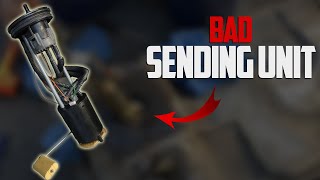
- Faulty Fuel Level Sending Unit 🔴 High Probability The sending unit is a mechanical part with a variable resistor that is constantly submerged in fuel. Over many years and miles, the resistor contacts can wear down or get coated with fuel deposits (especially from lower quality fuel), causing dead spots and erratic readings.
How to confirm: Access the fuel pump assembly and test the resistance of the sending unit with a multimeter while manually moving the float arm. The resistance should change smoothly without any dropouts. For this Corolla, the expected resistance is approximately 13.5-16.5 Ω when full and 405.5-414.5 Ω when empty. Any sudden jumps or infinite resistance readings indicate a bad sensor.
Typical fix: Replace the fuel level sending unit (also called a fuel sender gage assembly).
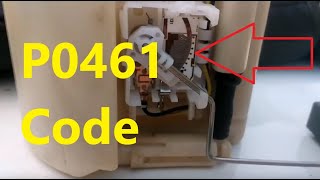
Est. part cost: $75-$115 - Corroded or Damaged Wiring/Connector 🟡 Medium Probability The main electrical connector sits on top of the fuel pump assembly, under the rear seat. It can be exposed to moisture or get damaged during other service, leading to corrosion (green or white powder) or loose pins. Road salt in winter climates can accelerate this corrosion.
How to confirm: Visually inspect the wiring harness and connector at the top of the fuel pump assembly for any signs of corrosion, melted plastic, or broken/chafed wires. A specific case on a 2017 Corolla noted a corroded connector as the cause.
Typical fix: Clean the connector terminals with a contact cleaner or replace the connector pigtail if it is severely damaged.
Est. part cost: $15-$30 - Stuck or Damaged Sender Float Arm ⚪ Low Probability While less common, debris in the fuel tank could potentially obstruct the float's movement, or the arm could become bent or detached from the sensor. The float itself could also become saturated with fuel and sink.
How to confirm: After removing the fuel pump assembly, visually inspect the float and arm. Ensure it moves freely through its full range of motion and is securely attached. Check that the float is buoyant.
Typical fix: Free the stuck float or replace the fuel level sending unit if the arm is damaged or the float has failed.
Est. part cost: $0-$115
Rare But Worth Checking
- Faulty Instrument Cluster: This is very rare. Before suspecting the cluster, all components of the fuel sending circuit must be tested and confirmed to be working perfectly. A faulty cluster would likely have other symptoms as well, such as other gauges malfunctioning.
- Faulty Engine Control Module (ECM): This is extremely unlikely and should only be considered after every other possibility has been exhausted by a professional technician. A PCM failure is the least likely cause for this code.
Diagnosis Steps
- Read the code with an OBD-II scanner to confirm P0461 is present.
- Use the scanner's live data function to observe the 'Fuel Level Input' percentage. Note if it is stuck or behaving erratically.
- To gain access, remove the lower cushion of the rear seat by pulling up firmly on the front edge.
- Remove the black, circular service cover plate for the fuel pump assembly, typically held by sealant.
- Disconnect the electrical connector and inspect it carefully for corrosion, damage, or loose pins.
- If the connector looks good, you can test the circuit. Using a multimeter and a wiring diagram, check for proper voltage and ground at the connector.
- If the circuit is okay, the next step is to remove the fuel pump assembly from the tank. CAUTION: Relieve fuel pressure before disconnecting lines and work in a well-ventilated area away from ignition sources. Disconnect the battery.
- Once the assembly is out, test the resistance of the fuel level sensor while moving the float arm. The reading should be smooth and within the specified range (approx. 13.5 Ω full to 414.5 Ω empty). Any sudden jumps or open circuits indicate a bad sensor.
- If the sensor tests good, check for a stuck float arm or debris in the tank.
Parts You'll Likely Need
- Fuel Level Sending Unit
(OEM #83320-02010)— This is the component that fails most frequently, causing the erratic signal that triggers the P0461 code.
Trusted brands: Toyota (Genuine), Denso
OEM price range: $75-$115
Aftermarket price range: $50-$90
Technical Service Bulletins (TSBs) & Recalls
- While no specific TSB for P0461 on the 2014-2019 Corolla was found, Toyota has issued TSBs for other models with this code (e.g., T-SB-0206-12 for 2012-13 Tundra/Sequoia) that involved an ECM software update. This highlights that while it's rare for the Corolla, software-related fixes are a possibility in the broader Toyota lineup. Specifically, TSB Bulletin #T-SB-0206-12 notes that some vehicles may exhibit a MIL "ON" condition with DTC P0461 after a recent fuel refill, requiring an ECM update.
Platform-Specific Known Issues
- Fuel Pump Recall Context: Toyota issued a major recall (NHTSA Recall No. 20V-012, expanded in 20V-121) for failing low-pressure fuel pumps on many vehicles, including the 2018-2019 Corolla. That recall was for pumps (impellers) that could suddenly stop working, causing the engine to stall, and does not directly cause a P0461 code. However, it's important context as the fuel level sender is part of that same in-tank assembly. If your vehicle is part of the recall, the entire assembly might be handled by the dealer.
- Corroded Connector: A known failure point is the electrical connector on top of the fuel pump assembly. A 2017 Corolla with P0461 was specifically diagnosed with a corroded pin in this connector, which was a much cheaper fix than replacing the sender.
Mechanic-Grade Diagnostic Values
- Fuel Level Sensor Voltage (Live Data) — expected: Approximately 0.5V (empty) to 4.5V (full). Failure: Voltage is stuck at a fixed value (e.g., 0V) or is outside the expected 0.5V-4.5V range.
- Fuel Pump Power Supply (at connector) — expected: 12V only during engine cranking or when the engine is running. No voltage with key-on-engine-off.. Failure: No voltage during cranking indicates a potential issue with the fuel pump relay or circuit, not the sender.
Scan Tool Commands That Help
- Toyota Techstream: ECU Flash Reprogramming — This is NOT typically required for a 2014-2019 Corolla with P0461. However, it was the specified fix for a similar P0461 issue on 2012-2013 Tundra/Sequoia models, as per TSB T-SB-0206-12. It's a tool of last resort if all hardware checks out, though it's highly unlikely to be the cause on this Corolla.
Wiring & Ground Locations
- Fuel Pump Relay — In the main engine fuse box under the hood, on the driver's side.. While not a direct cause of P0461 (which is a sensor performance code), confirming power to the fuel pump assembly is a key diagnostic step. On this Corolla, power is only supplied during engine cranking or running, not at key-on. If there's no power, it points to a relay or fuse issue rather than the sender.
- Fuel Pump Assembly Connector — Under the rear seat lower cushion, beneath a black circular service cover.. This is the primary connection point for the fuel level sender. The two smaller gauge wires in the connector are for the sender. Inspecting this connector for corrosion is a critical first step.
Real Owner Repair Stories
- YotaTech Forums user 'Colt.85' (1985 Toyota 4x4 (similar diagnostic principle)) — Fuel gauge not working.
❌ Tried (didn't work) Initial diagnosis was pointing to a bad sending unit.
✅ What actually fixed it After removing the fuel tank, the user discovered the sending unit float arm was physically stuck from sitting for a long time with rust in the tank. After cleaning the tank and freeing the arm, the original sending unit worked correctly.
Diagnostic Flowchart
Other Known Issues on This Vehicle
Issues unrelated to this code that are worth knowing about as an owner of this generation:
- CVT Transmission Issues (2014-2016) 🟠 Medium — More common on early 11th-gen models. Owners report jerking, hesitation, or momentary power loss. Often related to old software or degraded fluid. (Ref: Software updates were released by Toyota to improve CVT performance. A recall also existed for some early models that could require valve body or transmission replacement if the update wasn't performed.)
- Infotainment System Glitches 🟡 Low — Reported across multiple model years. Symptoms include the touchscreen freezing, rebooting randomly, or becoming unresponsive.
- Premature Front Lower Control Arm Bushing Noise 🟡 Low — Owners report a 'clunking' noise from the front suspension when turning sharply on uneven surfaces, like entering a driveway. A Toyota Master Tech described it as an annoyance rather than a safety issue, fixed with an updated control arm.
- Ignition Coil Failure 🟠 Medium — Can occur after 60,000 miles, causing engine misfires (codes P0301-P0304), rough idling, and power loss.
- Front Timing Cover Oil Leak 🟠 Medium — A slow oil seep from the front timing cover that can develop over time. It is an expensive repair due to labor, but not immediately critical.
Used vs. New Parts: Buying Guide for This Vehicle
When a used part is the smart pick: A used fuel sending unit from a low-mileage donor vehicle is a reasonable choice for this repair. Since it is a relatively simple electro-mechanical part and not integrated with complex electronics, a tested unit from a reputable salvage yard can be a cost-effective alternative to a new OEM part.
Donor-vehicle mileage cap: roughly under 80000 miles for the part to have meaningful remaining life.
What to inspect on the donor part:
- Verify the donor vehicle's mileage.
- Inspect the part for physical damage, especially the float and arm.
- Check the electrical connector for any signs of corrosion or bent pins.
- If possible, test the resistance with a multimeter while moving the float arm to ensure it sweeps smoothly without dropouts.
OEM-only on this vehicle (don't cheap out):
- While not strictly 'OEM-only', using a Genuine Toyota or Denso (the original equipment manufacturer) part is highly recommended for reliability.
Aftermarket brands forum-validated for this vehicle:
- Denso
- Spectra Premium
Brands owners have reported issues with on this vehicle:
- Unbranded, 'white-box' parts from online marketplaces should be avoided, as their resistor quality and lifespan can be highly variable.
Real Owner Stories
Aggregated from forums and TSBs cited above. Mileages and costs reflect what owners reported in those sources.
2017 Toyota Corolla
Symptoms: The vehicle triggered a P0461 code and the fuel gauge was not reading correctly.
What fixed it: Inspection revealed a corroded pin in the electrical connector on top of the fuel pump assembly.
Source hint: vehicle_specific_issues
2013 Scion FR-S
Symptoms: The owner experienced fuel level sensor issues and performed detailed troubleshooting by measuring resistance values of the old and new sensors.
What fixed it: Replacement of the fuel level sensor after confirming bad resistance sweeps.
Source hint: Reddit - r/ft86: A user with a 2013 Scion FR-S
Related OBD-II Codes
Frequently Asked Questions
Is my 2018-2019 Toyota Corolla fuel pump recall related to the P0461 code?
What are the specific resistance values I should look for when testing the fuel sender on my Corolla?
I have a 2017 Corolla with P0461; do I definitely need a new fuel pump assembly?
Where is the fuel level sender located on the 2014-2019 Corolla, and how do I get to it?
Can I use a fuel sender from a Toyota Matrix to fix my Corolla?
Is there a software update (TSB) for P0461 on the 11th-gen Corolla?
Helpful Videos
We Have This Part in Stock


The information in this article is provided for general reference and educational purposes only. Vehicle specifications, procedures, and part compatibility can vary by production date, trim level, and region. Always consult your vehicle's factory service manual and verify part numbers before purchasing or performing repairs. Safety-critical components such as airbags, seat belts, and braking systems should be installed by a qualified professional.
- Toyota Corolla:
- 🎬 Helpful Videos
- 🛍️ Shop This Part
- What's Unique About the 2014-2019 Toyota Corolla
- Symptoms You May Notice
- Most Likely Causes
- Rare But Worth Checking
- Diagnosis Steps
- Parts You'll Likely Need
- Technical Service Bulletins (TSBs) & Recalls
- Platform-Specific Known Issues
- Mechanic-Grade Diagnostic Values
- Scan Tool Commands That Help
- Wiring & Ground Locations
- Real Owner Repair Stories
- Diagnostic Flowchart
- Other Known Issues on This Vehicle
- Used vs. New Parts: Buying Guide for This Vehicle
- Real Owner Stories
- 2017 Toyota Corolla
- 2013 Scion FR-S
- Related OBD-II Codes
- Frequently Asked Questions
- 🎟️ Get 5% Off