

P0456 on 2003-2008 Toyota Corolla: EVAP Small Leak Causes and Fixes
For a 2003-2008 Toyota Corolla, code P0456 is most often caused by a loose or worn-out gas cap, or rust on the fuel filler neck preventing a good seal. Start by inspecting and cleaning the cap and filler neck before replacing any parts. A new OEM gas cap costs around $25-$40. If the issue persists, inspect EVAP hoses in the engine bay for cracks before suspecting more expensive parts like the purge valve or charcoal canister.
- Always start with the simplest fix: ensure your gas cap is tight. If the light returns, inspect the cap's seal and the fuel filler neck for rust.
- A new OEM (Original Equipment Manufacturer) gas cap is the most likely part you'll need and is a cheap, easy first step if the original is old.
- Cleaning rust off the fuel filler neck is a common, vehicle-specific fix for this Corolla that costs nothing but a few minutes of time.
- Do not replace expensive parts like the charcoal canister until you have ruled out the gas cap, filler neck, and small vacuum hoses in the engine bay.
- A smoke test is the best way for a mechanic to find the leak quickly if it's not obvious.
What's Unique About the 2003-2008 Toyota Corolla

On the 9th generation Corolla, the P0456 code is exceptionally common and frequently traces back to simple, inexpensive issues at the fuel filler area. While many cars get this code from a loose gas cap, this specific Corolla model and its platform mates (Toyota Matrix, Pontiac Vibe) are known for developing rust on the fuel filler neck's sealing surface. This corrosion prevents even a new gas cap from sealing properly. Owners often solve the problem not just by replacing the cap, but by carefully cleaning this rusted surface with a file or emery cloth. This issue is so prevalent that it should be the second check after ensuring the gas cap is tight.
🎬 Watch: This quick fix shows how to clean the filler neck.Symptoms You May Notice
- Check Engine Light is on.
- A faint fuel smell may be noticeable, especially around the rear of the car after it has been parked, though often there is no smell.
- No noticeable impact on drivability or fuel economy in most cases.
- Replacing the charcoal canister before thoroughly checking the gas cap, filler neck, and engine bay vacuum hoses. The canister is an expensive part and less likely to be the cause than the simpler components.
- Replacing the gas cap but failing to inspect and clean the fuel filler neck, leading to the code returning.
Most Likely Causes

- Loose, Worn, or Incorrect Gas Cap 🔴 High Probability The gas cap is the most frequently handled part of the EVAP system, and its rubber O-ring seal degrades over time. Aftermarket caps are a frequent cause of sealing issues, so an OEM cap is strongly recommended.
How to confirm: Ensure the cap is tightened until it clicks at least once. Inspect the rubber seal for cracks, stiffness, or damage. If the seal is compromised or it's a non-OEM cap, replacement is the best test. A worn cap may feel loose even before the clicks.
Typical fix: Replace the gas cap with a new Genuine Toyota part. Clear the codes and wait several drive cycles for the EVAP monitor to run again.
Est. part cost: $25-$40 - Rusted or Dirty Fuel Filler Neck 🔴 High Probability This specific Corolla generation is known to accumulate rust and debris on the metal lip where the gas cap seal makes contact, creating a path for vapor to escape. This is a very common point of failure after the gas cap itself has been ruled out.
How to confirm: Remove the gas cap and carefully inspect the filler neck's rim. Look and feel for any rust, corrosion, or dirt buildup that would prevent a flat seal. A smoke test will often show smoke escaping from the gas cap area even with a new cap if the neck is corroded.
Typical fix: Carefully stuff a rag into the filler opening to prevent debris from falling into the tank. Use a small file, emery cloth, or a wire brush to gently sand the rust off the rim until it is smooth and clean. Apply a very light coat of silicone grease to the cleaned rim to inhibit future rust. In severe cases, the entire filler neck may need replacement. 🎬 Watch: See how to replace a rusted fuel filler neck.
Est. part cost: $0-$5 for cleaning, $60-$150 for a replacement neck. - Cracked or Brittle EVAP Vacuum Hoses 🟡 Medium Probability The small rubber hoses in the engine bay, particularly those connected to the purge valve, are exposed to constant engine heat. Over 15+ years, they become hard, brittle, and develop small cracks that are often invisible until the hose is flexed.
How to confirm: Visually inspect the EVAP hoses running from the intake manifold to the purge valve (VSV). Bend them slightly to reveal any hidden cracks. A professional smoke test is the definitive way to find a small hose leak.
Typical fix: Replace the cracked section of the vacuum hose. It's often inexpensive to buy a small length of the correct diameter hose from an auto parts store.
Est. part cost: $5-$20 - Faulty Vapor Canister Purge Valve (VSV) ⚪ Low Probability This solenoid, located in the engine bay, can fail by getting stuck slightly open, creating a constant small leak. It is a common failure point on many Toyota vehicles of this era.
How to confirm: With the engine off, disconnect the hoses from the purge valve. Try to blow through it. If any air passes, the valve is stuck open and faulty. The valve should be normally closed with no power applied. You can also test it by applying 12V to its terminals and listening for a click, or by using a scan tool's bidirectional control to command it on and off.
Typical fix: Replace the purge valve assembly. It is typically mounted on the air filter housing or nearby in the engine bay.
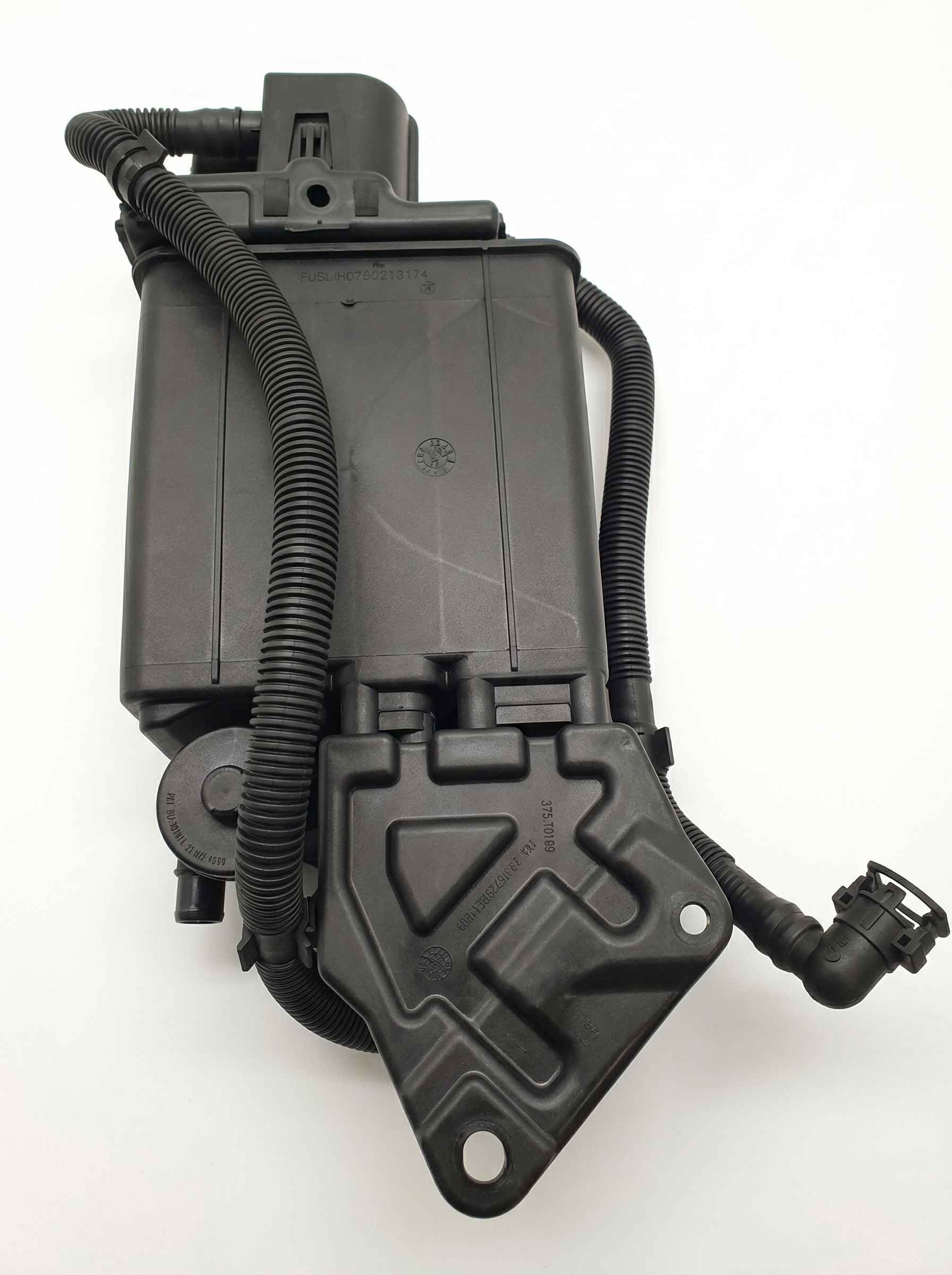
Est. part cost: $40-$90 - Cracked Charcoal Canister or Faulty Vent Valve ⚪ Low Probability The plastic canister housing can develop cracks from age, road debris impact, or stress. On 2003-2004 models, the vent valve is often separate, but on 2005-2008 models, it is frequently integrated into the canister assembly (sometimes called a leak detection pump), requiring the entire unit to be replaced if the valve fails.
How to confirm: Visually inspect the canister (located near the rear driver's side, by the fuel tank) for any visible cracks or damage. A smoke test is the most reliable way to confirm a leak in this area.
Typical fix: Replace the entire charcoal canister assembly. This can be a DIY job but may require dropping the muffler for access.
Est. part cost: $200-$350
Rare But Worth Checking
- Faulty Fuel Tank Pressure Sensor:
- ECM Failure: While rare, NHTSA ODI #10325896 describes a case where a vehicle stalled and threw codes P0606 and P0456, which was eventually diagnosed as an ECM failure.
Diagnosis Steps

- Read the code with an OBD-II scanner to confirm P0456 is the primary code.
- Inspect the Gas Cap: Remove the gas cap. Check that it's an OEM or high-quality aftermarket cap. Inspect the rubber O-ring for cracks, deformities, or hardness. Ensure you are tightening it until it clicks multiple times. Manufacturer service bulletin TSB Bulletin #T-SB-0086-16 notes that a "no click" or "no spring return" condition from the cap can lead to P0456.
- Inspect the Fuel Filler Neck: With the cap off, carefully examine the metal rim of the filler neck. If you see any rust or corrosion, clean it off completely with a file or emery cloth as described in the 'Common Causes' section. This is a critical step for this vehicle. TSB Bulletin #T-SB-0086-16 also mentions that the fuel filler neck may be out of position, preventing a proper seal.
- Clear the Code and Drive: After checking/replacing the cap and cleaning the neck, clear the code with your scanner. The EVAP monitor requires specific conditions to run, often including a cold start after sitting for 5+ hours and a fuel level between 1/4 and 3/4 full. It may take several days of normal driving to confirm the fix.
- Visually Inspect Engine Bay Hoses: If the code returns, pop the hood and locate the EVAP purge valve (VSV), often mounted on the airbox. Carefully inspect all the small rubber hoses connected to it for cracks or loose fittings. Flex the hoses to reveal hidden cracks.
- Test the Purge Valve: Disconnect the purge valve and try to blow air through it with the engine off. If air passes, it has failed and needs to be replaced.
- Perform a Smoke Test: If the leak source is still not obvious, the most effective next step is a smoke test. This involves feeding low-pressure smoke into the EVAP system's service port and watching for where it escapes. 🎬 Watch: A professional walkthrough of EVAP smoke testing and troubleshooting. This can pinpoint tiny leaks in hoses, the canister, or the fuel tank seals that are otherwise impossible to see.
Parts You'll Likely Need

- Fuel Tank Cap
(OEM #77300-06040 (supersedes 77300-52030))— This is the most common failure point. The seal wears out over time, causing a small leak. Using an OEM cap is highly recommended as many aftermarket caps do not seal correctly.
Trusted brands: Genuine Toyota
OEM price range: $25-$40
Aftermarket price range: $10-$25 - Vapor Canister Purge Valve / Solenoid
Related Codes That Often Appear With This One
- P0441 — This code for 'Incorrect Purge Flow' can appear alongside P0456 if the purge valve is malfunctioning or if there's a blockage or leak affecting the flow rate during the EVAP test.
- P0446 — This code for 'Vent Control Circuit Malfunction' points to an issue with the vent valve or its wiring, which is part of the same system and can be a root cause of the leak detected by P0456.
- P0455 — Indicates a large EVAP leak. Seeing both P0455 and P0456 can suggest an intermittent, significant leak, such as a very bad gas cap seal or a component that has failed completely.
- P0606 — An ECM/PCM processor fault that has been documented in conjunction with P0456 in some stalling instances (NHTSA ODI #10325896).
Technical Service Bulletins (TSBs) & Recalls
- TSB EG002-06 - While not directly for P0456, this TSB addresses related EVAP codes (P2401, P2402, P2419, etc.) on 2005-2006 models caused by a faulty charcoal canister (leak detection pump), a known cause for P0456 on these specific years.
- TSB Bulletin #T-SB-0086-16 - This bulletin notes that a "No Click" and/or "No Spring Return" condition from the fuel cap when fully seated can cause MIL illumination with DTC P0456, sometimes due to the fuel filler neck being out of position.
Platform-Specific Known Issues
- A well-documented issue on this platform is the formation of rust on the fuel filler neck's sealing surface, which prevents the gas cap from sealing and is a very common cause for P0456.
Hidden / Shadow Codes Worth Checking
- Mode $06, Test ID $81: This is not a trouble code, but raw data from the onboard EVAP leak test monitor. It displays the measured pressure decay value from the last test cycle. A technician can compare this value against the manufacturer's specified pass/fail threshold to see how close to the limit the system is, even if a code hasn't been set yet. (see via A professional scan tool capable of displaying Mode $06 data.)
Scan Tool Commands That Help
- Toyota Techstream: Automatic EVAP System Check — This is a guided, automated test that forces the EVAP monitor to run without waiting for the typical 5-hour cold soak. It commands the valves and pump to run in sequence to check for leaks and will set a code if a malfunction is detected, confirming a repair or finding a problem quickly.
- Toyota Techstream / Professional Bidirectional Scanner: Actuation Test: Purge VSV — This command allows a technician to manually open and close the purge valve (VSV) in the engine bay. You can listen for an audible click to confirm the solenoid is activating and check if it holds vacuum when commanded closed.
- Toyota Techstream / Professional Bidirectional Scanner: Actuation Test: Vent Valve / CCV — This command manually opens and closes the canister close valve (or vent valve) located near the charcoal canister. This is essential for sealing the system during a smoke test to ensure the smoke is directed properly and to test the function of the valve itself.
Wiring & Ground Locations
- Purge Valve (VSV) Connector — In the engine bay, typically mounted on or near the air filter housing. It's a two-wire connector.. A corroded or loose connector here can prevent the purge valve from operating correctly, potentially causing related codes like P0441, but a poor connection could also be misinterpreted by the system during self-tests.
- Ground Point IE — Located behind the driver's side kick panel, near the instrument panel junction block.. This is a primary ground distribution point for many components controlled by the ECM. A poor ground here can cause erratic behavior in various sensors and solenoids, including those in the EVAP system.
- Canister/Vent Valve Connector — At the charcoal canister assembly, located under the car near the driver's side rear wheel and fuel tank.. This connector powers the vent valve (and on later models, the leak detection pump). Corrosion from road salt and moisture is common here and can cause vent valve failure (P0446) or prevent the system from sealing for the P0456 test.
Real Owner Repair Stories
- DanielJaegerFilms on YouTube (2007 Toyota, ~180,000 miles) — P0456 code (very small EVAP leak).
❌ Tried (didn't work) The owner did not report trying other fixes first; they went straight to inspection.
✅ What actually fixed it A small, brittle, cracked vacuum hose right at the purge valve in the engine bay. The crack was hidden under the clamp and only became visible when the clamp was moved and the hose was flexed. Replacing the small section of hose fixed the code. - Reddit user in r/AskMechanics (2014 Toyota Camry (similar EVAP system logic)) — Persistent P0456 code.
❌ Tried (didn't work) Replaced gas cap with OEM part., Replaced charcoal canister vent valve assembly (based on a smoke test from a mechanic).
✅ What actually fixed it The user's thread ended without a final confirmed fix after replacing the canister, with the code returning after 5 days. This highlights the difficulty in diagnosing these leaks, even after replacing components identified by a smoke test. - NHTSA ODI #10350227 — An owner reported that their check engine light came on with code P0456. When taken to the dealer, they were told an animal had made a small pinhole in the gas return line.
- NHTSA ODI #10172017 — An owner of a vehicle with 45,000 miles reported that the check engine light illuminated with code P0456, noting that their investigation revealed many other vehicles with the same issue.
OEM Part Supersession History
77300-52030→77300-06040— Standard part update/consolidation by Toyota.
Heads up: The new part number is a direct, compatible replacement.
Model Year Variations Within This Range
- 2003-2004: The charcoal canister assembly (OEM #77740-02121) is a distinct part for these years. The vent valve may be serviced separately.
- 2005-2008: The charcoal canister assembly was updated (OEM #77740-02310). On these models, the vent valve and sometimes a leak detection pump are integrated into the canister assembly, meaning a failure of the valve often requires replacing the entire, more expensive unit.
Diagnostic Flowchart
Other Known Issues on This Vehicle
Issues unrelated to this code that are worth knowing about as an owner of this generation:
- Excessive Oil Consumption (1ZZ-FE Engine) 🔴 High — Very common on 2003-2005 models. Toyota redesigned the pistons and rings around mid-2005 to address the issue, so 2006-2008 models are less affected. (Ref: Toyota addressed this with warranty extensions and TSBs for early models, but these have long since expired. The root cause is a flawed piston/oil-ring design that allows oil to burn in the combustion chamber.)
- Intake Manifold Gasket Leak 🟠 Medium — Common as the vehicle ages. The gasket can shrink or degrade, causing a vacuum leak. (Ref: A known issue, often resulting in a P0171 (System Too Lean) code. The fix is straightforward: replacing the gasket.)
- Power Steering Pressure Hose Leak 🟡 Low — A frequent leak point as the car ages. The high-pressure hose tends to seep power steering fluid.
- Transmission Issues (2003 model year) 🟠 Medium — Some reports of transmission hesitation or failure were more common on the 2003 model year specifically.
- Rust on Rocker Panels/Rear Quarter Panels 🟡 Low — Cosmetic but very common, especially in the rust belt. Rust often forms on the rocker panels just in front of the rear wheels.
Used vs. New Parts: Buying Guide for This Vehicle
When a used part is the smart pick: For expensive components like the charcoal canister or fuel filler neck, a used part can be a cost-effective solution, especially if the failure on your car is a physical crack or rust.
Donor-vehicle mileage cap: roughly under 120000 miles for the part to have meaningful remaining life.
What to inspect on the donor part:
- For a fuel filler neck, source it from a donor vehicle in a dry, salt-free climate to avoid inheriting the same rust problem. Inspect photos for a clean, smooth sealing surface.
- For a charcoal canister, visually inspect for any cracks, damage, or signs of fuel saturation. Ensure all hose ports are intact.
- Confirm the part number matches your specific model year (2003-2004 vs. 2005-2008), as the canister assemblies are different.
OEM-only on this vehicle (don't cheap out):
- Fuel Cap: Due to the sensitivity of the EVAP system test, aftermarket gas caps are a very common cause of P0456. Always use a Genuine Toyota cap to ensure a perfect seal.
Aftermarket brands forum-validated for this vehicle:
- For sensors and valves, Denso is the original equipment manufacturer for Toyota and is a reliable choice if not buying the Toyota-branded part.
Brands owners have reported issues with on this vehicle:
- Generic, no-name aftermarket gas caps are frequently reported by owners to not seal properly and cause the P0456 code to persist or return.
Real Owner Stories
Aggregated from forums and TSBs cited above. Mileages and costs reflect what owners reported in those sources.
2005 Toyota Corolla 1.8L 1ZZ-FE
Symptoms: Check engine light on; owner questioned if it was safe to drive and if the gas cap was the likely culprit.
What fixed it: The discussion confirmed starting with the gas cap is the standard first step for this common issue.
Source hint: Reddit r/MechanicAdvice thread titled 'p0456 code on a 05 corolla a few questions'
2008 Toyota Corolla 1.8L 1ZZ-FE
Symptoms: Owner experienced a P0456 code and attempted to fix it by replacing the gas cap and the charcoal canister, but the code persisted, leading to suspicions of other faulty components.
What fixed it: The owner's experience highlighted a common misdiagnosis path involving the replacement of the cap and canister before identifying the actual leak source.
Source hint: Reddit r/AskMechanics thread titled '2008 corolla throwing a p0456 small evap leak'
2004 Toyota Corolla 1.8L 1ZZ-FE
Symptoms: EVAP system codes triggered by a failure to seal at the fuel tank entry point.
What fixed it: Replacement of the fuel filler neck.
Source hint: YouTube video 'k-D-3tQeX4Y' showing fuel filler neck replacement
Related OBD-II Codes
Frequently Asked Questions
Does TSB EG002-06 apply to my 2005 Corolla regarding the P0456 code?
I replaced my gas cap with one from a local parts store but the light is still on. What should I do?
Is it safe to drive my 2005 Corolla with a P0456 code?
Where is the charcoal canister located on a 2008 Corolla?
How do I clean the fuel filler neck to fix this code?
Why does my Corolla smell like fuel after being parked?
Helpful Videos
Used OEM Parts in Stock
New Aftermarket Parts Available


The information in this article is provided for general reference and educational purposes only. Vehicle specifications, procedures, and part compatibility can vary by production date, trim level, and region. Always consult your vehicle's factory service manual and verify part numbers before purchasing or performing repairs. Safety-critical components such as airbags, seat belts, and braking systems should be installed by a qualified professional.
- Toyota Corolla:
- 🎬 Helpful Videos
- 🛍️ Shop This Part
- What's Unique About the 2003-2008 Toyota Corolla
- Symptoms You May Notice
- Most Likely Causes
- Rare But Worth Checking
- Diagnosis Steps
- Parts You'll Likely Need
- Related Codes That Often Appear With This One
- Technical Service Bulletins (TSBs) & Recalls
- Platform-Specific Known Issues
- Hidden / Shadow Codes Worth Checking
- Scan Tool Commands That Help
- Wiring & Ground Locations
- Real Owner Repair Stories
- OEM Part Supersession History
- Model Year Variations Within This Range
- Diagnostic Flowchart
- Other Known Issues on This Vehicle
- Used vs. New Parts: Buying Guide for This Vehicle
- Real Owner Stories
- 2005 Toyota Corolla 1.8L 1ZZ-FE
- 2008 Toyota Corolla 1.8L 1ZZ-FE
- 2004 Toyota Corolla 1.8L 1ZZ-FE
- Related OBD-II Codes
- Frequently Asked Questions
- 🎟️ Get 5% Off