

P0456 on 2005-2016 Scion tC: EVAP Small Leak Causes and Fixes
For a P0456 code on a Scion tC, the problem is almost always a loose, faulty, or non-OEM gas cap. Before buying any parts, tighten the cap until it clicks, clean the filler neck rim, and clear the code. If that fails, an OEM gas cap is the recommended next step and costs around $25-$35. If the cap doesn't solve it, the next most likely culprits are age-cracked EVAP hoses in the engine bay.
- Always start with the simplest fixes: tighten the gas cap and clean the filler neck's sealing surface.
- If you need a new gas cap, spend the extra money on a genuine OEM Toyota/Scion part to avoid recurring issues.
- If the gas cap isn't the fix, the next most likely culprit is a small, cracked vacuum hose in the engine bay near the air filter box.
- A smoke test is the best way to find a stubborn leak without needlessly replacing expensive parts like the charcoal canister.
What's Unique About the 2005-2016 Scion tC
On the Scion tC, the P0456 code is a persistent but rarely serious issue that frustrates many owners. While the gas cap is the most common culprit, these cars are also prone to age-related cracking of specific rubber EVAP hoses in the engine bay, which can be a simple fix if you know where to look. A less common but documented issue on first-generation models is a leak in the fuel filler neck itself, which can be a more involved repair. For second-generation models, aftermarket modifications like strut bars can cause hoses to rub and crack.
Generation note: This guide covers two generations of the Scion tC: the first generation (tC1, 2005-2010) and the second generation (tC2, 2011-2016). While the most common causes are the same for both, there are some differences in specific hose failure points and a documented issue with the fuel filler neck on some tC1 models. The engine bay purge valve and associated hoses are a very common failure point on the tC1.
Symptoms You May Notice
- Check Engine Light is on
- A faint fuel smell may be noticeable, particularly around the rear of the car after it has been parked.
- No noticeable impact on engine performance or drivability.
- Replacing the gas cap with a cheap aftermarket version. Many aftermarket caps do not meet the precise sealing requirements of the EVAP system and will not fix the code.
- Replacing the charcoal canister or purge valve before thoroughly checking the gas cap seal, filler neck surface, and all accessible vacuum hoses in the engine bay.
- Assuming a smoke test that shows no leak means the EVAP system is fine. Some components, like the charcoal canister, can fail internally and cause codes without producing visible smoke.
Most Likely Causes
- Loose, Damaged, or Incorrect Gas Cap 🔴 High Probability This is the most frequent cause for any vehicle with a P0456 code. Aftermarket gas caps are notorious for not sealing correctly and causing this specific code. Owners often report trying multiple aftermarket caps before an OEM Toyota/Scion cap finally resolves the issue.
How to confirm: Ensure your current cap is tightened until it clicks at least once. Inspect the cap's rubber O-ring for cracks, stiffness, or deformities. If you have an aftermarket cap, replacing it with a genuine OEM Toyota/Scion cap is the best first step. Some owners report that even a seemingly good cap can fail to seal properly.
Typical fix: Replace the gas cap with a new OEM part.
Est. part cost: $25-$35 - Cracked or Disconnected EVAP Vacuum Hose 🟡 Medium Probability Rubber hoses in the engine bay become brittle over time due to heat and age, leading to small cracks, especially at connection points. This is a very common failure point after the gas cap has been ruled out, particularly on the first-generation tC.
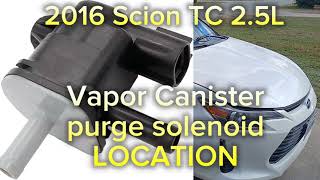
How to confirm: Visually inspect the small rubber hoses connected to the purge valve (also called a VSV or Vacuum Switching Valve) located in the engine bay, typically on or near the air filter box. 🎬 See this video to locate the purge solenoid on your tC2. For tC1 models, a specific hose identified by the last five digits of its part number, '23829', is a known failure point where it connects to a metal hard pipe. For tC2 models, check for hoses rubbing against other components like aftermarket strut bars. A smoke test is the definitive way to find a hard-to-see crack.
Typical fix: Replace the cracked section of hose. It's often a standard vacuum hose that can be purchased by the foot, but it must be rated for fuel/oil vapors, not just vacuum.
Est. part cost: $5-$20 - Dirty or Corroded Fuel Filler Neck 🟡 Medium Probability Rust, dirt, or grit can build up on the metal lip of the filler neck where the gas cap gasket seals. This prevents a perfect seal, even with a brand new OEM cap. This is more common in regions that use road salt.
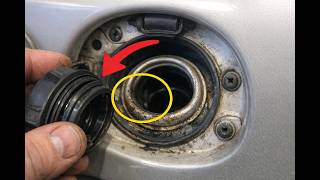
How to confirm: Remove the gas cap and carefully inspect and feel the metal rim of the filler neck for any roughness, rust pits, or visible corrosion.
Typical fix: Gently clean the sealing surface of the filler neck with a mild abrasive like a Scotch-Brite pad or fine-grit sandpaper until it is smooth and shiny. Wipe away 🎬 Watch: Why aftermarket caps fail and how to clean the neck. all debris before reinstalling the gas cap.
Est. part cost: $0 - Faulty Vapor Canister Purge Valve/Solenoid ⚪ Low Probability The purge valve is an electronic solenoid that can fail internally, getting stuck slightly open and creating a small, constant leak. While not as common as a cap or hose, it's a frequent next step in diagnosis.
How to confirm: The valve is located in the engine bay, near the airbox. Disconnect it and try to blow air through it. When unpowered, it should be completely closed. If you can blow any air through it, it has failed and needs to be replaced.
Typical fix: Replace the purge valve solenoid.
Est. part cost: $40-$90
Rare But Worth Checking
- Cracked Fuel Filler Neck Pipe: On first-generation (tC1) models, there are documented cases where the metal filler neck pipe itself develops a crack or rust perforation, causing a persistent leak that a new gas cap won't fix. A Reddit user with a 2007 tC concluded this was the only remaining possibility after replacing all other common parts and having smoke tests repeatedly show a leak from the gas cap area even with a new, tight cap. This is an expensive repair and should only be considered after a smoke test has definitively confirmed the leak location.
- Cracked Charcoal Canister: The charcoal canister, located near the fuel tank under the car, can develop a hairline crack. This is less common for a P0456 (small leak) than for a P0455 (large leak), but it is possible. A smoke test is required to confirm a leak from the canister body. In some cases, the canister can fail internally without showing an external leak on a smoke test, leading to a persistent P0456 code.
Diagnosis Steps
- Check the Gas Cap: Ensure the gas cap is tight. If it doesn't click when tightened, or if the seal is cracked or hard, replace it with a genuine OEM cap.
- Clean the Fuel Filler Neck: Use a cloth and a mild abrasive (like a Scotch-Brite pad) to clean any rust or debris from the metal rim where the gas cap seals. Ensure the surface is perfectly smooth.
- Clear the Code and Drive: After the steps above, clear the code with a scanner. The EVAP monitor runs under specific conditions (often with 1/4 to 3/4 tank of fuel, after the car has sat for several hours), so it may take a few days of normal driving for the light to either stay off or return.
- Inspect Engine Bay Hoses: If the light returns, pop the hood and carefully inspect the small rubber vacuum hoses around the purge solenoid (VSV), which is mounted on or near the airbox. Look for tiny cracks or loose connections, especially where the hoses connect to metal pipes. Pay special attention to the hose identified in forums as a common failure point on the tC1.
- Test the Purge Valve: Remove the purge valve. With it unplugged, try to blow through it. If any air passes through, the valve is faulty and must be replaced.
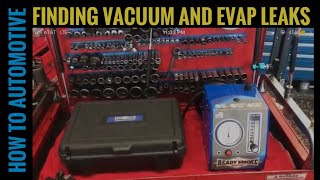
- Perform a Smoke Test: If the leak is still not found, the most effective method is to have a smoke test performed. This involves injecting pressurized smoke into the EVAP system to visually pinpoint the source of the leak, 🎬 Watch: How to use a smoke machine to find small leaks. whether it's a hidden hose, the charcoal canister, or the fuel filler neck. Note that even a smoke test can sometimes fail to find the issue if the component is failing internally.
Parts You'll Likely Need
- Fuel Tank Cap
(OEM #77300-52040 (Supersedes 77300-52030, now 77300-06040). Always verify with dealer.)— This is the most common fix. Using an OEM cap ensures a proper seal that aftermarket caps often fail to provide. Part numbers for Toyota/Scion are frequently superseded.
Trusted brands: Toyota Genuine Parts
OEM price range: $25-$35
Aftermarket price range: $10-$20 - Vapor Canister Purge Valve / Vacuum Switching Valve (VSV)
(OEM #90910-TC001 (Supersedes 90910-12276). Verify for your vehicle.)— This valve can get stuck open, causing a persistent small leak. It's a common failure point after the gas cap is ruled out.
Trusted brands: Toyota Genuine Parts, Denso
OEM price range: $70-$100
Aftermarket price range: $40-$70 - EVAP Hose (Engine Bay)
(OEM #23829-28110 (Example for a specific tC1 hose, often sold as bulk vacuum line))— The small rubber hoses in the engine bay are a known failure point due to cracking from age and heat. A specific hose on the tC1 is frequently cited in forums.
Trusted brands: Generic fuel/vapor-rated hose
OEM price range: $15-$25 (for pre-formed hose)
Aftermarket price range: $5-$10 (for bulk hose)
Related Codes That Often Appear With This One
- P0441 — This code indicates 'Incorrect Purge Flow' and often appears with leak codes like P0456 if the leak is related to the purge valve or its hoses.
- P0455 — This code means 'Large EVAP Leak Detected'. Sometimes a problem can be intermittent or worsen over time, causing the system to log both small and large leak codes.
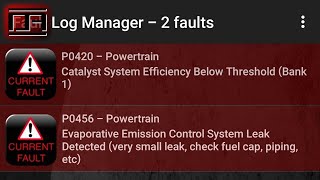
- P0420 — While less common, a P0420 'Catalyst System Efficiency Below Threshold' code can sometimes appear alongside a P0456. One owner documented this occurrence, with both codes clearing after fixing the EVAP hose leak. The exact relationship is unclear but may be related to altered air-fuel mixtures from the vacuum leak.
Technical Service Bulletins (TSBs) & Recalls
- While no specific TSB was found for the Scion tC and P0456 in the search, Toyota TSB EG045-07 is a widely known document addressing EVAP system diagnosis and leak testing procedures for multiple Toyota/Scion/Lexus models from 2004-2007. It details the conditions under which the EVAP monitor runs and provides a flowchart for diagnosing leaks, reinforcing the steps outlined in this guide.
- NHTSA Action Number 10033635 (Service Bulletin 288332) notes that some tC vehicles may exhibit a MIL on condition with one or more of the following DTCs: P0455, P0441, or P0456.
Mechanic-Grade Diagnostic Values
- Canister Pressure Sensor input voltage — expected: Regulated 5V from the ECM. Failure: Voltage significantly higher or lower than 5V would indicate a wiring or ECM issue.
- Purge Valve (VSV) Coil Resistance (2AZ-FE / 2AR-FE) — expected: 26 - 30 Ω at 68°F (20°C). Failure: Resistance outside of this range indicates a faulty solenoid coil.
Hidden / Shadow Codes Worth Checking
- P043E, P043F, P2401, P2402, P2419: These are reference pressure and leak detection pump circuit codes. The ECM may store these if the reference pressure difference during the self-test is greater than the specification, indicating a problem with the test's ability to run correctly, not just a simple leak. (see via These codes are visible with a professional scan tool like Toyota Techstream. They are stored if the EVAP monitor's internal checks fail.)
Documented NHTSA Reports
- NHTSA ODI #10569421 describes a situation where the check engine light came on with codes P043E, P043F, P0456, P0401, P0402, and P2419, which the dealership related to TSB EG047-06.
- NHTSA ODI #10493611 documents that some tC vehicles may exhibit a MIL on condition with DTCs P0455, P0441, or P0456.
Scan Tool Commands That Help
- Toyota Techstream or equivalent professional scan tool (e.g., Snap-on): EVAP System Test (Automatic Mode) / Cold Soak Bypass — Use this after a repair to immediately verify the fix without waiting for the natural 5-hour cold soak period. The tool commands the vent valve and leak detection pump to run an 8-15 minute test, and it will set a pending code if a leak is still present. Pre-conditions must be met: Ignition ON, Engine OFF, fuel temp < 95°F, and fuel level between 15-85%.
Wiring & Ground Locations
- Purge Valve (VSV) — On first-generation (tC1) models, the purge valve is located in the engine bay, near the air filter box and firewall, with two vacuum hoses and an electrical connector.. This valve is commanded by the ECM to control the flow of fuel vapors. A wiring issue (short/open) or poor ground connection can prevent it from closing properly, causing a leak.
- Charcoal Canister / Canister Pump Module — On first-generation (tC1) models, the charcoal canister assembly is located under the vehicle, just in front of the driver's side rear wheel.. This assembly contains the canister, vent valve, and pressure sensor. Damage to the wiring harness in this exposed location from road debris or corrosion can cause multiple EVAP codes.
Real Owner Repair Stories
- ScionLife forum user 'nickhenry' and 'bbsciontc' (Scion tC 1st Generation (2005-2010)) — Persistent P0456 code for over a year, which later included P0455 and P0441.
❌ Tried (didn't work) Replacing the gas cap three different times, including with a new OEM cap.
✅ What actually fixed it A small crack was found in the EVAP hose identified by the part number suffix '23829'. The crack was located right where the rubber hose connects to a metal hard pipe in the engine bay near the VSV (purge valve). Replacing this specific hose resolved all EVAP codes.
When the Usual Fixes Don't Work
- While replacing the gas cap, hoses, and purge valve are the most common fixes, they are not a silver bullet. One owner of a 2007 tC reported having a persistent P0456 for over two years despite replacing the purge valve, charcoal canister, and trying three different gas caps (including OEM). A smoke test repeatedly showed a leak from the gas cap area, leading to the replacement of the entire fuel filler neck. However, the Check Engine Light returned even after this expensive repair, indicating the root cause was something else entirely or that multiple leak points existed. This highlights that P0456 can sometimes be one of the most frustrating codes to diagnose, requiring methodical testing beyond just replacing parts.
OEM Part Supersession History
77300-52030→77300-52040, then 77300-06040— Design improvement for better sealing and durability of the click mechanism and gasket material.
Heads up: While all are physically compatible, using the latest superseded part number is highly recommended as aftermarket and older OEM versions are common sources of the P0456 code.
Model Year Variations Within This Range
- 2005-2010 (tC1): The first-generation tC uses a traditional vacuum-based EVAP system. The key components for testing are the gas cap, purge VSV in the engine bay, and the charcoal canister/vent valve assembly under the car. A specific hose in the engine bay (P/N ending in 23829) is a known weak point.
- 2011-2016 (tC2): The second-generation tC likely uses a more modern EVAP system with a Leak Detection Pump (LDP) as part of the canister assembly. This system pressurizes itself for testing, typically 5 hours after the engine is shut off. Diagnosis often relies more heavily on a bidirectional scan tool to force the LDP to run during a 'cold soak bypass' test.
Diagnostic Flowchart
Real Owner Stories
Aggregated from forums and TSBs cited above. Mileages and costs reflect what owners reported in those sources.
First-Generation Scion tC (tC1)
Symptoms: Battled P0456, P0455, and P0441 codes for over a year after trying multiple gas caps.
What fixed it: Found and replaced a small crack in EVAP hose '23829' right where it connected to a metal pipe.
Source hint: ScionLife.com thread titled 'The dreaded P0456 plus more now - ScionLife.com'
2007 Scion tC
Symptoms: Fought a 2-year battle with P0456. Replaced the purge valve, charcoal canister, and tried three different OEM gas caps to no avail. A smoke test consistently showed a leak at the cap area.
What fixed it: Determined the fuel filler neck itself was the likely culprit causing the bad seal.
Source hint: Reddit thread 'P0456 Code | 2007 Scion tC - Reddit'
Scion tC2 / tC2.5
Symptoms: Experienced a P0456 code causing a P0420 CEL. Ruled out the gas cap as the cause.
What fixed it: Discovered an EVAP hose in the engine bay was rubbing against an aftermarket strut bar for three years, eventually causing a crack. Replaced the hose.
Source hint: YouTube video 'P0456 EVAP Very Small Leak Detected Code Causing P0420 CEL (Scion tC2 / tC2.5)'
Scion tC
Symptoms: Bought a new OEM fuel cap but still had the P0456 code and poor fuel economy.
What fixed it: Sanded the edges of the fuel filler neck to ensure a smooth mating surface for the gasket.
Source hint: ScionLife.com thread titled 'P0456 and not great fuel economy - ScionLife.com'
Scion tC
Symptoms: P0456 code appeared because the gas cap had no resistance upon removal, indicating a failed seal.
What fixed it: Replaced the gas cap with a new OEM part as the first and cheapest step in diagnosis.
Source hint: ScionLife forums (cited in common causes)
Related OBD-II Codes
Frequently Asked Questions
Does Toyota TSB EG045-07 apply to my Scion tC for the P0456 code?
I replaced my gas cap with an aftermarket one, but the P0456 code came back on my tC. What should I do?
What is hose '23829' and why is it important for a first-generation tC with a P0456 code?
I have a second-generation (tC2) Scion tC with an aftermarket strut bar and a P0456 code. Could they be related?
I bought a new OEM gas cap but still have the P0456 code. Could the fuel filler neck be the problem?
How do I test the purge valve on my Scion tC?
Helpful Videos
Used OEM Parts in Stock

New Aftermarket Parts Available


The information in this article is provided for general reference and educational purposes only. Vehicle specifications, procedures, and part compatibility can vary by production date, trim level, and region. Always consult your vehicle's factory service manual and verify part numbers before purchasing or performing repairs. Safety-critical components such as airbags, seat belts, and braking systems should be installed by a qualified professional.
- Scion tC:
- 🎬 Helpful Videos
- 🛍️ Shop This Part
- What's Unique About the 2005-2016 Scion tC
- Symptoms You May Notice
- Most Likely Causes
- Rare But Worth Checking
- Diagnosis Steps
- Parts You'll Likely Need
- Related Codes That Often Appear With This One
- Technical Service Bulletins (TSBs) & Recalls
- Mechanic-Grade Diagnostic Values
- Hidden / Shadow Codes Worth Checking
- Documented NHTSA Reports
- Scan Tool Commands That Help
- Wiring & Ground Locations
- Real Owner Repair Stories
- When the Usual Fixes Don't Work
- OEM Part Supersession History
- Model Year Variations Within This Range
- Diagnostic Flowchart
- Real Owner Stories
- First-Generation Scion tC (tC1)
- 2007 Scion tC
- Scion tC2 / tC2.5
- Scion tC
- Scion tC
- Related OBD-II Codes
- Frequently Asked Questions
- 🎟️ Get 5% Off