

P0455 on 2006-2012 Toyota RAV4: EVAP Gross Leak Causes and Fixes
For a 2006-2012 Toyota RAV4, code P0455 most often means you have a loose or faulty gas cap. If a new OEM gas cap (Part No. 77300-06040, ~$25-$40) doesn't fix it, the next most likely causes are a cracked charcoal canister or a rusted fuel filler neck, especially in regions that use road salt.
- Always check the gas cap first for code P0455. Ensure it's tight and the seal is in good condition. Replace it with an OEM part if you have any doubts.
- If the gas cap isn't the issue, the most effective next step is a smoke test to find the leak.
- On a 2006-2012 RAV4, pay special attention to the fuel filler neck for rust and the charcoal canister for cracks.
- This code will not affect how your car drives, but it will cause an automatic failure on an emissions test.
What's Unique About the 2006-2012 Toyota RAV4

On the third-generation (XA30) RAV4, the most common culprits for a large EVAP leak, beyond the universal gas cap issue, are specific to the vehicle's design and age. The fuel filler neck is highly susceptible to rust, especially in regions that use road salt, leading to leaks where the tube is welded to a mounting bracket or flange. Additionally, the charcoal canister assembly, located under the vehicle, is a known failure point on Toyotas of this era. The plastic housing can crack or the integrated canister close valve (vent valve) can fail, a problem addressed in Toyota TSB EG048-07.
Symptoms You May Notice
- Check Engine Light is on.
- A faint smell of gasoline, possibly near the rear of the vehicle or around the gas cap area.
- Slight decrease in fuel economy over time.
- In some cases, a rough idle or difficulty starting immediately after refueling (symptom of a stuck-open purge valve).
- An owner report in NHTSA ODI #11331260 noted that the vehicle may not perform properly when multiple codes including P0455 and P0171 are present.
- Replacing the fuel tank pressure sensor. While it's part of the system, it's unlikely to cause a P0455 code without other accompanying sensor-specific codes (like P0452).
- Using a cheap, aftermarket gas cap. Many owners report that only a genuine Toyota OEM cap will resolve the issue.
Most Likely Causes


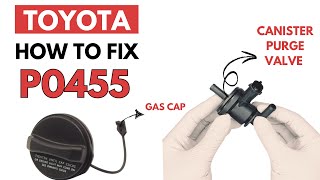
- Loose, Worn, or Incorrect Gas Cap 🔴 High Probability The gas cap is a simple sealing component that is frequently removed and reinstalled. Its rubber O-ring can dry out, crack, or get dirty over time, preventing a proper seal. Using a non-OEM cap is a very common cause for the code to persist after replacement, as many aftermarket caps do not seal to Toyota's specification. Manufacturer Bulletin #T-SB-0086-16 notes that a "No Click" or "No Spring Return" condition from the fuel cap can lead to P0455.
How to confirm: Inspect the gas cap for any visible cracks on the seal or body. Ensure it is tightened until it clicks multiple times. If the seal looks old or flattened, it's suspect. The easiest confirmation is to replace it with a new genuine Toyota cap, clear the code, and see if it returns after a few drive cycles.
Typical fix: Replace the gas cap with a new, genuine Toyota part (OEM Part No. 77300-06040, which supersedes 77300-52030).
Est. part cost: $25-$40 - Cracked or Rusted Fuel Filler Neck 🟡 Medium Probability The metal pipe leading from the gas cap to the fuel tank is exposed to the elements under the vehicle. In areas with road salt or high humidity ('Salt Belt'), it can rust through, creating a large leak. TSB Bulletin #T-SB-0086-16 also indicates that the fuel filler neck may be out of position, contributing to EVAP leak conditions.
How to confirm: A visual inspection may reveal heavy rust or holes, particularly behind the plastic wheel well liner. The most definitive way to confirm is with a smoke test, which will show smoke billowing from the rusted area of the neck.
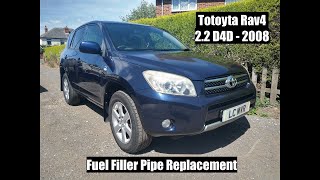
Typical fix: The fuel filler neck must be replaced. This involves removing the rear wheel and wheel well liner for access. Aftermarket options like the Spectra Premium FN933 are widely available. 🎬 Watch: Step-by-step guide to replacing a rusted fuel filler neck.
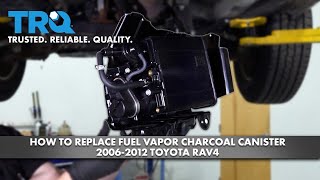
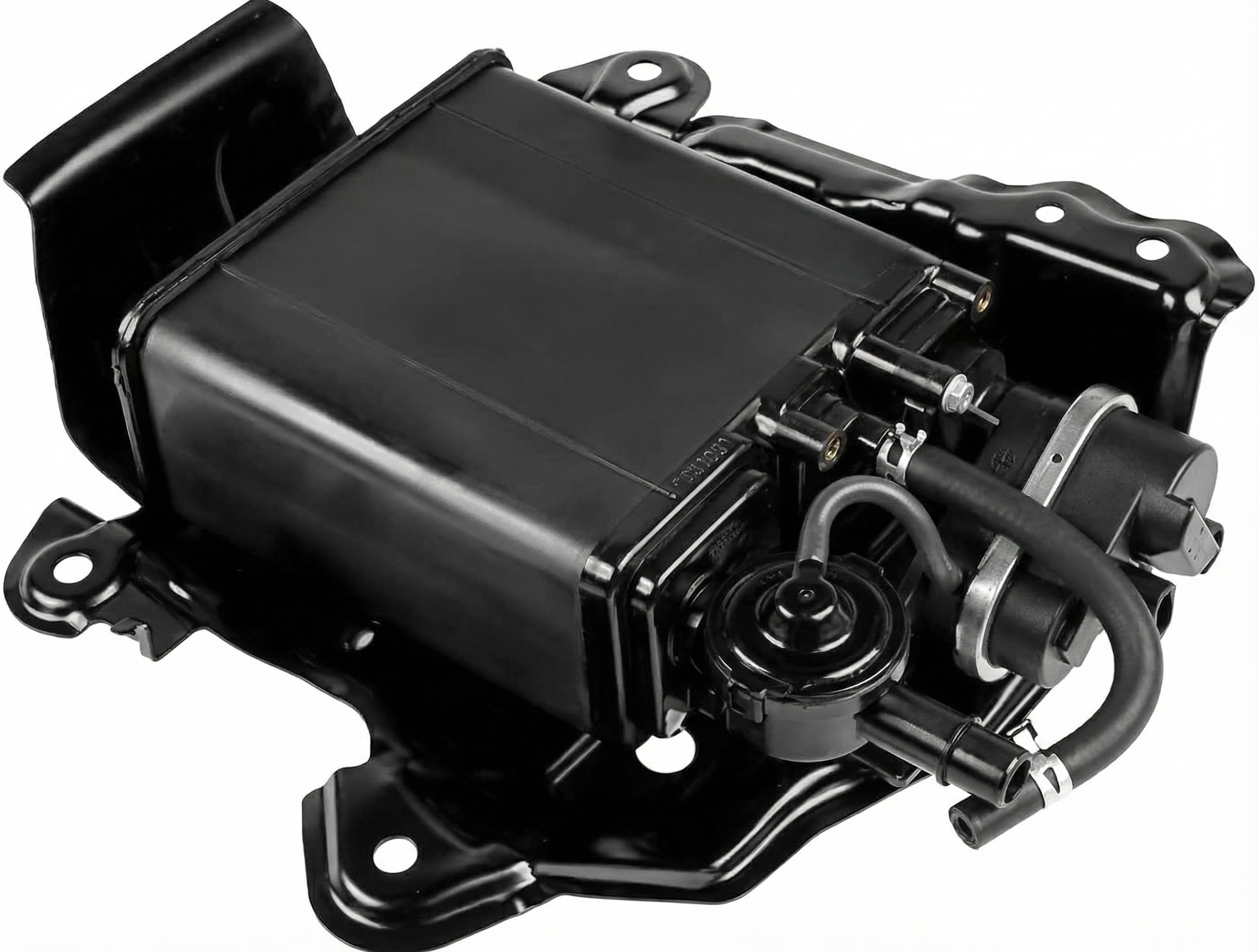
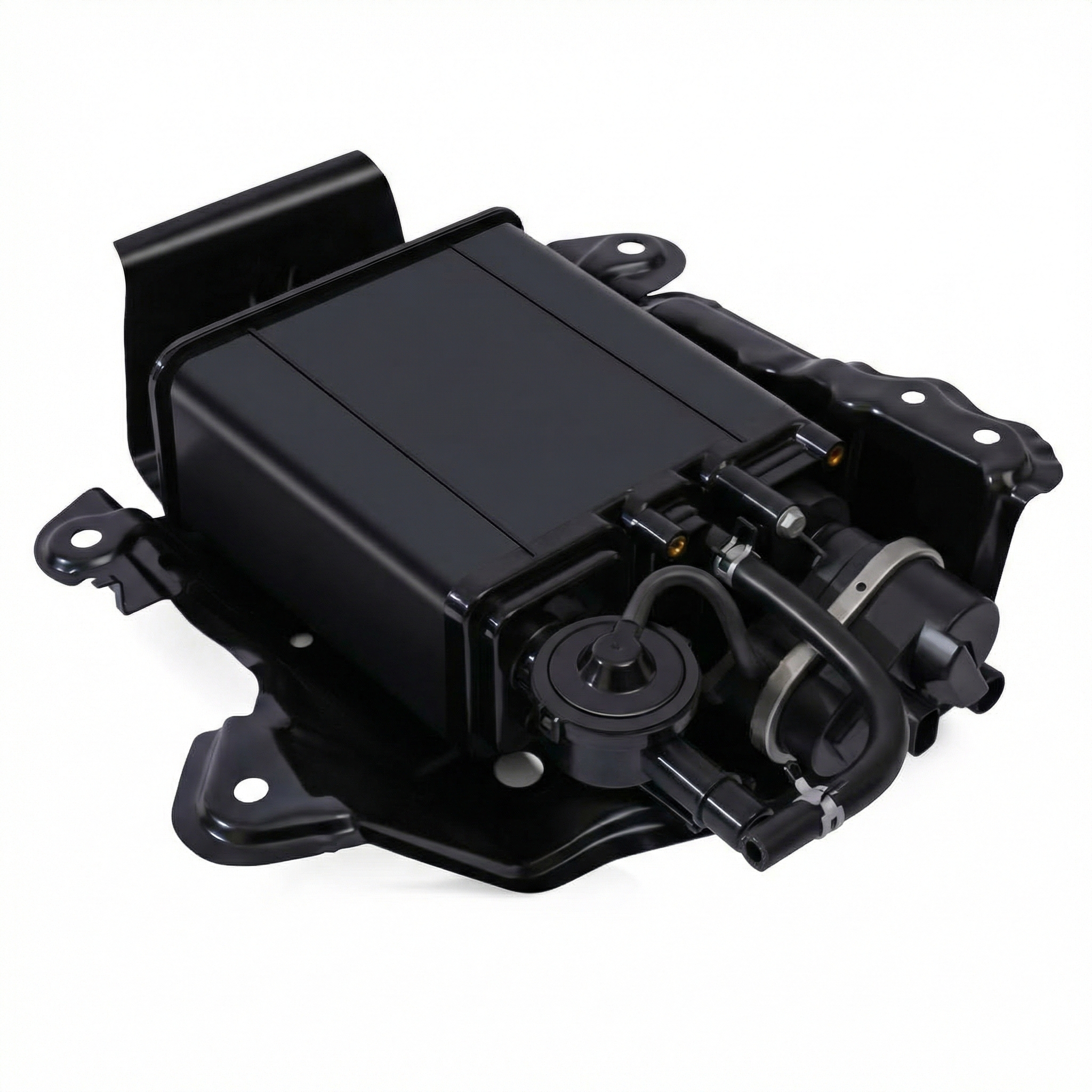
Est. part cost: $100-$250 - Cracked Charcoal Canister or Faulty Vent Valve 🟡 Medium Probability The charcoal canister assembly on this RAV4 generation is a large plastic box located under the driver's side of the vehicle. It is exposed to road debris and can develop cracks. More commonly, the integrated vent valve (Canister Close Valve) fails and gets stuck open. This is a known wear item on Toyotas from this period and is the subject of TSB EG048-07.
How to confirm: Visually inspect the canister for any cracks or physical damage. A smoke test is the best method; if the canister itself is leaking, smoke will emerge from the plastic housing. If the vent valve is stuck open, smoke will exit the vent port even when the valve should be commanded closed by a scan tool.
Typical fix: Replace the entire charcoal canister assembly. It is typically replaced as a single unit. 🎬 See how to replace the charcoal canister assembly yourself. Part numbers differ by year: 77740-0R010 for ~2006-2008 and 77740-0R020 or 77740-42090 for ~2009-2012.
Est. part cost: $450-$600 - Stuck-Open Purge Valve (VSV) ⚪ Low Probability The purge valve, which Toyota calls a Vacuum Switching Valve (VSV), is located in the engine bay. It can fail and stick open, creating a constant vacuum leak into the EVAP system which the computer may interpret as a large leak, often accompanied by code P0441.
How to confirm: With the engine off, remove the valve and try to blow through it. It is a normally-closed valve, so if air passes through, it has failed. A rough idle or hard start immediately after refueling can also be a symptom of a stuck-open purge valve.
Typical fix: Replace the purge valve (VSV). A common part number is 90910-12276 for the 2AZ-FE engine.
Est. part cost: $50-$100 - Cracked or Disconnected EVAP Hoses ⚪ Low Probability Rubber hoses become brittle with age and heat cycles. Hoses connected to the charcoal canister, filler neck, and purge valve can crack or become disconnected, especially if disturbed during other maintenance.
How to confirm: Visually inspect all accessible EVAP lines for obvious cracks or disconnections. A smoke test will pinpoint the exact location of a hose leak.
Typical fix: Replace the specific cracked hose section.
Est. part cost: $10-$50
Diagnosis Steps

- Read the code with an OBD-II scanner to confirm P0455 is present and note any other codes.
- Inspect the gas cap. Ensure it's tight and clicks. Check the rubber seal for cracks or damage. If in doubt, this is the cheapest part to replace first. Always use a genuine OEM cap.
- Clear the code and drive for a few days to see if it returns. The EVAP monitor only runs under specific conditions (e.g., fuel level between 15-85%, specific ambient temperatures).
- If the code returns, perform a thorough visual inspection of the EVAP system. Look under the vehicle on the driver's side for the charcoal canister and hoses. Check for any obvious cracks, damage, or loose connections.
- Pay close attention to the fuel filler neck, looking for significant rust or corrosion, especially near mounting points.
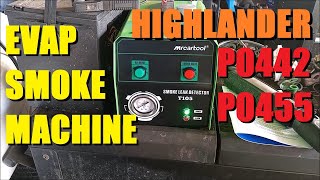
- For a definitive diagnosis, perform a smoke test. Introduce smoke into the EVAP service port. Use a scan tool to command the purge valve and vent valve (canister close valve) to close. This seals the system and allows the smoke to reveal the leak's location. 🎬 Watch: How to use a smoke machine to find leaks.
- Watch for smoke escaping from the gas cap seal, filler neck, canister body, vent valve outlet, or any hoses.
- Based on the smoke test results, replace the faulty component.
Parts You'll Likely Need

- Fuel Cap
(OEM #77300-06040 (supersedes 77300-52030))— This is the most frequent cause of P0455 due to its seal wearing out over time. It's the first, easiest, and cheapest part to replace. Using a genuine OEM part is highly recommended.
Trusted brands: Toyota (OEM)
OEM price range: $25-$40
Aftermarket price range: $15-$30 - Charcoal Canister Assembly
(OEM #77740-0R010 (approx. 2006-08), 77740-0R020 / 77740-42090 (approx. 2009-12))— The canister housing can crack or the integrated vent valve can fail, causing a large leak. It is a common failure point on this platform, as noted in TSBs.
Trusted brands: Toyota (OEM), Denso, Dorman
OEM price range: $500-$600
Aftermarket price range: $200-$400 - Fuel Filler Neck
(OEM #77201-42150 (example, varies by 2WD/4WD))— Highly susceptible to rusting through in certain climates, creating a very common source for a large EVAP leak on the RAV4.
Trusted brands: Toyota (OEM), Spectra Premium (e.g., FN933)
OEM price range: $200-$300
Aftermarket price range: $80-$150
Related Codes That Often Appear With This One
- P0441 — Incorrect Purge Flow. Often appears with P0455 if the purge valve (VSV) is stuck open or there's another major flow issue.
- P0456 — Very Small Leak Detected. Sometimes a large leak can initially be intermittent or be detected as a different size leak by the system, though seeing P0455 and P0456 together is less common.
- P0171 — System Too Lean. As noted in NHTSA ODI #11331260, this code may appear alongside P0455, indicating a potential fuel/air mixture issue.
Technical Service Bulletins (TSBs) & Recalls
- S-SB-0030-09 Rev1: While for a Scion tC, it shows a pattern of Toyota addressing P0455 codes that are caused by faulty fuel caps
- TSB Bulletin #T-SB-0086-16: This bulletin addresses instances where a "No Click" condition from the fuel cap or an out-of-position fuel filler neck leads to DTC P0455 and P0456.
Platform-Specific Known Issues
- Rusted Fuel Filler Neck in Salt Belt Regions: A very common repair story found on owner forums involves the fuel filler neck rusting completely through. An owner of a 2008 RAV4 in a northern state reported chasing a P0455 code for months. After replacing the gas cap with no success, a smoke test performed by a local shop instantly revealed smoke billowing from the filler neck, right where a support bracket was welded to the pipe. The owner replaced the neck with an aftermarket part (Spectra Premium) in their driveway in about two hours, which permanently resolved the code. This failure is particularly common on vehicles with over 100,000 miles that have been exposed to road salt.
Mechanic-Grade Diagnostic Values
- Purge VSV (for 2AR-FE engine) resistance — expected: 23 to 26 Ω at 68°F (20°C). Failure: Resistance outside of this range indicates a faulty valve coil.
- Voltage at Purge VSV connector (harness side) — expected: Battery voltage with ignition switch ON. Failure: No voltage suggests a wiring or fuse issue between the valve and the power source.
- Fuel Tank Pressure Sensor Voltage (Key On, Engine Off) — expected: Approximately 1.4-1.5 V at atmospheric pressure.. Failure: Voltage significantly higher or lower suggests a sensor or wiring fault.
Hidden / Shadow Codes Worth Checking
- Mode 6, Test ID $82: This test monitor in Mode 6 data relates to the EVAP system leak check. A technician can view the raw test data, including pressure values, to see how close the system was to failing before the DTC was set. (see via A professional scan tool with Mode 6 capability, such as Toyota Techstream.)
Scan Tool Commands That Help
- Toyota Techstream: Active Test: 'Evaporative System Check (Automatic Mode)' — This is a comprehensive, automated 5-step test that commands the pump and valves to check for large and small leaks. It takes approximately 18 minutes and is the dealer-level method for confirming a leak after a repair.
- Toyota Techstream: Active Test: 'Control the Purge VSV' — This allows a technician to manually command the purge valve open and closed while performing a smoke test or checking for vacuum, isolating it as a potential leak point.
- Toyota Techstream: Active Test: 'Activate the VSV for Vent Valve' — Used to command the canister vent valve closed during a smoke test to seal the system. If smoke still escapes from the vent port with the valve commanded ON (closed), the valve is faulty.
Wiring & Ground Locations
- Engine Ground (2GR-FE V6) — A ground bundle attaches to a bracket on the front valve cover.. A poor ground connection for the engine harness can cause erratic behavior in engine-mounted sensors and solenoids, including the Purge VSV.
- Body Ground Points — General ground points are designated with a two-letter code in wiring diagrams, where the first letter indicates location (e.g., 'I' for Instrument Panel, 'B' for Body).. The charcoal canister assembly and its integrated components rely on a solid body ground to function. Corrosion or looseness at the ground point near the rear of the vehicle can cause intermittent valve or sensor failures.
- Purge VSV Connector (2AR-FE) — Located in the engine bay, connected to the purge valve. Pin 2 (Pink wire) should have battery voltage with key on.. Verifying power at the connector is a key step in diagnosing whether a non-responsive purge valve is due to a bad valve or a wiring/fuse problem upstream.
Real Owner Repair Stories
- Reddit user on r/Rav4 (2012 RAV4 2.5L, ~105,000 miles) — Check Engine Light, 4WD, and Trac lights all on. Codes P0455 and P0441 present.
❌ Tried (didn't work) Tightening original gas cap., Replacing gas cap with an aftermarket (non-Toyota) part., Trimming and re-securing cracked vacuum hoses near the purge valve.
✅ What actually fixed it The user did not post a final resolution, but suspected the next step was to inspect or replace the charcoal canister vent valve. This highlights a common diagnostic path where simple fixes fail, pointing towards the more complex canister assembly. - JasmineFatherGarage4k on YouTube (Toyota RAV4 (year not specified, but 3rd gen)) — Multiple EVAP codes including P0455, P0441. Strong fuel smell.
❌ Tried (didn't work) Initial smoke test showed a disconnected/improperly repaired hose near the filler neck, which was fixed.
✅ What actually fixed it After fixing the initial hose leak, a repeat smoke test revealed a second, separate leak coming from the gas cap seal itself. The final diagnosis was that the vehicle needed both the hose repair AND a new gas cap, demonstrating that multiple failure points can exist simultaneously. - NHTSA ODI #11415574: An owner reported that replacing the gas cap, EVAP system leak detection pump, and the vapor canister purge solenoid did not resolve the P0455 and P0441 codes, suggesting a more complex underlying issue.
- NHTSA ODI #10525700: A Toyota owner reported that a dealership resolved P0441 and P0455 codes by replacing the fuel tank cap assembly, the fuel pipe sub-assembly, and the vacuum valve assembly.
"I Checked Everything" — The Actual Cause
- In some cases, a P0455 can be caused by a leak at the fuel pump sending unit gasket on top of the fuel tank. This area is often difficult to access and may be missed during a standard smoke test if the smoke is not introduced with enough pressure or for a long enough duration to become visible. The leak is often discovered only after all other common components have been replaced.
OEM Part Supersession History
77300-52030→77300-06040— Updated design for better sealing and durability.77740-0R010→77740-42090, 77740-0R020— Design change in the charcoal canister assembly.
Heads up: The early (2006-2008) and late (2009-2012) canisters are not interchangeable due to differences in mounting and hose connections. It is critical to verify the correct part number for the vehicle's specific model year.
Model Year Variations Within This Range
- 2006-2008 vs 2009-2012: The charcoal canister assembly was changed around the 2009 model year. The earlier part number is typically 77740-0R010, while later models use 77740-0R020 or 77740-42090. These parts are not cross-compatible.
Diagnostic Flowchart
Real Owner Stories
Aggregated from forums and TSBs cited above. Mileages and costs reflect what owners reported in those sources.
2008 Toyota RAV4 — ~115000 miles
Symptoms: Chased a P0455 code for months. Replaced the gas cap with no success.
What fixed it: A smoke test by a local shop revealed smoke billowing from the filler neck where a support bracket was welded. Replaced the rusted filler neck with an aftermarket Spectra Premium part in the driveway in about two hours.
Source hint: Vehicle Specific Issues - Rusted Fuel Filler Neck in Salt Belt Regions
2012 Toyota RAV4 2.5L — 105000 miles
Symptoms: Experienced EVAP codes P0455 and P0441. Checked the original gas cap, replaced it with an aftermarket one, and checked the purge valve hoses, all without success.
What fixed it: Determined the next logical steps were replacing the charcoal canister or purchasing a genuine OEM gas cap after aftermarket parts failed to resolve the issue.
Source hint: Reddit - r/Rav4 - 'EVAP codes P0455 / P0441' and owner_reports
2012 Toyota RAV4
Symptoms: Threw codes P0455 and P0441. Started by using a non-Toyota gas cap which failed to fix the issue, then tested the purge valve.
What fixed it: Ultimately suspected the charcoal canister after the aftermarket cap and purge valve tests did not clear the codes.
Source hint: RAV4World - 'P0455 and P0441'
Toyota RAV4
Symptoms: Check engine light on with a P0455 large leak code.
What fixed it: A diagnostic smoke test confirmed that both a severely rusted fuel filler neck and a bad gas cap were the culprits.
Source hint: YouTube - JasmineFatherGarage4k
Related OBD-II Codes
Frequently Asked Questions
What is the correct OEM gas cap part number for my 2006-2012 RAV4?
I live in the Salt Belt and have a P0455 code on my RAV4. What should I check first?
Does TSB EG048-07 apply to my RAV4's P0455 code?
Why is my RAV4 idling rough and hard to start after getting gas with a P0455 code?
What charcoal canister part number do I need to fix my RAV4?
How much fuel should be in my RAV4's tank to run the EVAP monitor after clearing the code?
Helpful Videos
Used OEM Parts in Stock
New Aftermarket Parts Available


The information in this article is provided for general reference and educational purposes only. Vehicle specifications, procedures, and part compatibility can vary by production date, trim level, and region. Always consult your vehicle's factory service manual and verify part numbers before purchasing or performing repairs. Safety-critical components such as airbags, seat belts, and braking systems should be installed by a qualified professional.
- Toyota RAV4:
- 🎬 Helpful Videos
- 🛍️ Shop This Part
- What's Unique About the 2006-2012 Toyota RAV4
- Symptoms You May Notice
- Most Likely Causes
- Diagnosis Steps
- Parts You'll Likely Need
- Related Codes That Often Appear With This One
- Technical Service Bulletins (TSBs) & Recalls
- Platform-Specific Known Issues
- Mechanic-Grade Diagnostic Values
- Hidden / Shadow Codes Worth Checking
- Scan Tool Commands That Help
- Wiring & Ground Locations
- Real Owner Repair Stories
- "I Checked Everything" — The Actual Cause
- OEM Part Supersession History
- Model Year Variations Within This Range
- Diagnostic Flowchart
- Real Owner Stories
- 2008 Toyota RAV4 — ~115000 miles
- 2012 Toyota RAV4 2.5L — 105000 miles
- 2012 Toyota RAV4
- Toyota RAV4
- Related OBD-II Codes
- Frequently Asked Questions
- 🎟️ Get 5% Off