

P0451 on 2015-2023 Ford Mustang: EVAP Pressure Sensor Causes and Fixes
On a 2015-2023 Mustang, P0451 almost always points to a faulty Fuel Tank Pressure (FTP) sensor. The part itself is moderately priced, but it is very difficult to access above the rear subframe, making professional replacement costly (often over $800, with some owners reporting costs over $1000 CAD). Contamination from undercoating sprays is a frequently cited cause of failure.
- P0451 on a 2015-2023 Mustang is almost always a faulty Fuel Tank Pressure (FTP) sensor.
- The main issue is not the part cost, but the extremely high labor cost due to the sensor's location above the rear subframe.
- Do not replace the purge valve without proper diagnostics as per Ford's own service message (SSM 50306).
- Be cautious with oil-based undercoating, as it is a known cause of FTP sensor failure on this platform.
What's Unique About the 2015-2023 Ford Mustang

On the S550 Mustang platform (2015-2023), the defining issue for code P0451 is the physical location of the Fuel Tank Pressure (FTP) sensor. It is mounted on a vapor line directly above the rear differential and subframe, making access extremely difficult. This design turns what would be a simple sensor swap on many other vehicles into a labor-intensive job, often requiring the dealership to drop the entire rear subframe and fuel tank, leading to significant repair costs. Additionally, Ford has issued guidance (SSM 50306) for 2021 models cautioning against the common misdiagnosis of replacing the canister purge valve for this code, as returned parts are often found to be functional.
Symptoms You May Notice
- Check Engine Light is on.
- Possible faint fuel odor near the rear of the vehicle.
- Vehicle will fail an emissions inspection.
- In rare cases, difficulty starting after refueling if the issue is related to a stuck purge valve, though this is less common for P0451.
- Replacing the EVAP canister purge valve. A Ford Special Service Message (SSM 50306) specifically advises against this common misdiagnosis for 2021 models (and many other Fords), stating that returned valves are often fully functional.
- Replacing the gas cap. The 2015-2023 Mustang uses a capless fuel filler system, so there is no cap to replace.
Most Likely Causes

- Faulty Fuel Tank Pressure (FTP) Sensor 🔴 High Probability The sensor is exposed to road grime, moisture, and especially contamination from oil-based undercoating or rust-proofing sprays, which can lead to electronic failure. Multiple owners on forums report the code appearing after having their car undercoated.
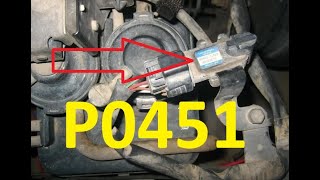
How to confirm: A technician can monitor the sensor's voltage or pressure readings with a professional scan tool (like Ford's FDRS). The reading should be stable and near atmospheric pressure (around 2.5-2.6 volts or 0 inH2O) with the engine off and fuel cap removed (or the capless filler funnel inserted). A reading that is stuck, erratic, or significantly offset (e.g., stuck at 1.8V or 0.78V) indicates a faulty sensor. 🎬 Watch: Understanding P0451 causes and how the pressure sensor works
Typical fix: Replace the Fuel Tank Pressure sensor and the attached vapor line/tube assembly. Due to its location, this often involves lowering the rear subframe and fuel tank for access. Some owners have reported success by only lowering the tank brackets to gain enough hand access, but it is extremely difficult.
Est. part cost: $50-$150 - Damaged Wiring or Connector 🟡 Medium Probability The wiring harness to the sensor is in a vulnerable location above the rear axle and can be damaged by road debris, corrosion, or improper servicing of rear-end components. Manufacturer service bulletins for other Ford platforms, such as SSM 50348 and SSM 51247, note that P0451 can be triggered by issues at specific wiring harness connections, such as connector C1198.
How to confirm: Visually inspect the wiring harness leading to the FTP sensor for any signs of fraying, corrosion, or rodent damage. Test for proper voltage (5V reference), ground, and signal continuity at the sensor connector using a multimeter and wiring diagram.
Typical fix: Repair the damaged section of the wiring harness and clean or replace the connector. Use dielectric grease to protect the connection.
Est. part cost: $10-$50 - Debris in Capless Fuel Filler Neck ⚪ Low Probability The capless system can accumulate dirt or dust around the seal, which can cause an imperfect seal. While this more commonly causes small leak codes (like P0456), it can sometimes lead to erratic pressure readings that trigger P0451.
How to confirm: Visually inspect the fuel filler neck for any debris. The area should be clean.
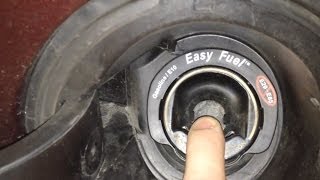
Typical fix: Clean the capless fuel filler opening with a clean cloth and compressed air. Use the emergency fuel funnel provided with the vehicle 🎬 Watch: How to properly maintain your Ford capless fuel filler to cycle the internal flap several times 🎬 See how to clean the filler neck to clear leak codes to dislodge any stuck debris.
Est. part cost: $0
Rare But Worth Checking
- Faulty EVAP Canister Purge Valve: While this can cause EVAP system issues, Ford has specifically warned against replacing this part for P0451 without proper diagnosis, as it's often not the cause. It would typically be accompanied by other codes like P0496 (Purge Flow) or P1450 (Unable to Bleed Up Fuel Tank Vacuum).
- Disconnected Internal Fuel Vapor Line: According to TSB 25-2431, a disconnected fuel vapor line inside the fuel tank can cause P0451 along with stalling after refueling when the tank is more than half-full.
- Loose Fuel Pump Locking Ring: One owner on a forum reported that their P0451 code was resolved by tightening a loose locking ring on the fuel pump assembly, which created a proper seal for the tank. This is a very rare cause but worth noting if other diagnostics fail.
- Powertrain Control Module (PCM) Fault: This is extremely rare and should only be considered after all other possibilities, including wiring and sensors, have been exhaustively ruled out by a qualified technician.
Diagnosis Steps
- Read the code with an OBD-II scanner to confirm P0451 is present. Note any other accompanying EVAP codes.
- Inspect the capless fuel filler neck for debris and clean it as a preliminary step. Cycle the flap with the emergency funnel.
- Using a scan tool with live data capability, monitor the Fuel Tank Pressure (FTP) sensor readings (often displayed as a voltage or in inches of water, 'inH2O'). With the engine off and the capless filler open, the reading should be close to 0 inH2O or ~2.5-2.6V. If the value is stuck high, low, or is erratic, the sensor is likely faulty.
- If scan tool access is limited, attempt to visually inspect the wiring and connector for the FTP sensor, which is located above the rear differential, on the passenger side of the fuel tank. Look for any signs of physical damage, corrosion, or heavy contamination from undercoating.
- If wiring looks good but the signal is bad, the FTP sensor is the most likely culprit and requires replacement.
- If the cause is still unclear, follow the diagnostic procedure outlined in Ford's service manual or SSM 50306, which advises performing a full EVAP system leak test and a canister purge valve (CPV) check using the Ford FDRS scan tool before replacing any components.
Parts You'll Likely Need
- Fuel Tank Pressure Sensor / Vapor Tube Assembly
(OEM #9U5A-9C052-BC or FR3Z-9C052-A (Verify with VIN))— This is the most common failure point for code P0451 on this vehicle. The sensor itself fails electronically or becomes contaminated. It is serviced as part of the vapor tube assembly.
Trusted brands: Motorcraft
OEM price range: $70-$150
Aftermarket price range: $50-$100
Related Codes That Often Appear With This One
- P0452 — This code indicates the FTP sensor signal is low (short to ground), which can be a related symptom of a failing sensor or wiring issue.
- P0453 — This code indicates the FTP sensor signal is high (short to power), which can also be a related symptom of a failing sensor or wiring issue.
- P1450 — Indicates an inability to bleed up fuel tank vacuum, which can sometimes appear alongside FTP sensor codes if there's a blockage or a malfunctioning valve in the EVAP system.
- P0496 — Indicates high purge flow, which can be triggered alongside P0451 if the sensor's incorrect readings are caused by contamination from undercoating, as reported by some owners.
Technical Service Bulletins (TSBs) & Recalls
- SSM 50306: For 2021 Mustangs (and many other 2018-2022 Ford models), advises against replacing the EVAP canister purge valve for P0451, P0496, P0455, P0456, or P04F0 without performing specific scan tool tests first, as the valve is often not the cause of the fault.
- TSB 22-2219: While not directly for P0451, this TSB addresses other EVAP issues and highlights the complexity of the system, reinforcing the need for proper diagnostics.
- SSM 50348 & SSM 51247: These bulletins for other Ford models highlight that P0451 can be caused by wiring harness connection issues, specifically at connector C1198, which should be inspected prior to component replacement.
- TSB 25-2431: Notes that P0451 may be stored in the PCM due to a disconnected fuel vapor line inside the fuel tank, which can also cause stalling after refueling.
Platform-Specific Known Issues
- The FTP sensor is in a very difficult-to-access location above the rear subframe, making replacement a labor-intensive and expensive job.
- A recall (14S24) was issued for a small number of early 2015 models for a different fuel pressure sensor on the fuel line that could leak, but this is unrelated to the EVAP system's P0451 code.
- Contamination from aftermarket undercoating is a very common trigger for this specific code on the S550 platform, as reported by numerous owners.
Mechanic-Grade Diagnostic Values

- Fuel Tank Pressure (FTP) Sensor Voltage (PID: FTP_V) — expected: ~2.5V - 2.6V with Key On, Engine Off (KOEO) and fuel filler open (atmospheric pressure).. Failure: A voltage that is stuck or significantly different, such as 1.8V, 0.78V, or below 1.0V / above 3.5V, indicates a sensor or wiring fault.
- FTP Sensor Reference Voltage (VREF) — expected: 5.0V at the sensor connector.. Failure: No voltage or low voltage points to a wiring issue between the sensor and the PCM or a faulty PCM.
- FTP Sensor Signal Return (Ground) — expected: 0.0V at the sensor connector.. Failure: Any voltage reading indicates a wiring problem.
- Fuel Tank Pressure (FTP) PID in inH2O — expected: 0 inches of water (inH2O) with fuel filler open.. Failure: The code sets when the sensor output is offset by more than +/- 1.7 inches of water when it should be at atmospheric pressure.
Scan Tool Commands That Help
- Ford IDS / FDRS / FORScan: Live Data PID: FTP_V (Fuel Tank Pressure Voltage) — This is the primary data point for diagnosing P0451. Monitoring this while opening the fuel filler is the quickest way to see if the sensor is responding or stuck.
- Ford IDS / FDRS: EVAP System Test / On-Board Evap Test — This automated test commands the purge and vent valves to seal the system and applies a vacuum, then monitors the FTP sensor's response to see if it holds pressure. It's used to verify the sensor's functionality and check for leaks after a repair or if other codes are present.
- Ford IDS / FDRS: EVAP Purge Valve Leak Test (CPV Check) — Use this to specifically test the canister purge valve's ability to seal, which helps rule it out as the cause, as recommended by Ford's SSM 50306 before replacing parts for a P0451 code.
Wiring & Ground Locations

- FTP Sensor Connector (C435) — Located on the sensor itself, which is on a vapor line above the rear differential, generally on the passenger side of the fuel tank.. This is the direct connection point for the sensor. It is in a vulnerable location and should be checked for corrosion, damage, or contamination from undercoating fluids.
- Rear Chassis Ground (G400) — Located in the trunk area on the driver's side.. This ground point serves the fuel pump driver module and rear lamps. While not the direct ground for the FTP sensor, a poor ground in this area can cause various electrical issues with the fuel system.
- Rear Chassis Ground (Passenger Side) — A ground point exists behind the rear passenger seat panel, inside the car.. This is a major chassis ground point in the rear of the vehicle. Ensuring all rear grounds are clean and secure is a good practice when diagnosing electrical faults in components located at the back of the car, like the FTP sensor.
Real Owner Repair Stories
- Mustang6G.com user 'Alex2020GT' (2018 Mustang) — Check Engine Light with codes P0451 and P0496 appeared immediately after getting the car rustproofed/undercoated.
❌ Tried (didn't work) Initial diagnosis was required as the cause was unknown.
✅ What actually fixed it The dealership identified that the FTP sensor, located on top of the fuel tank, was damaged by the oil from the rustproofing service. They replaced the fuel hose assembly with the integrated sensor (Part No. JR3Z-9E325-A). This required 5 hours of labor, dropping the fuel tank, and a subsequent rear wheel alignment, costing $922 CAD. The codes did not return after the repair. - Mustang6G.com user 'Philgadeth' (2017 Mustang GT Convertible) — Check Engine Light with P0451 after having the car treated with Krown undercoating.
❌ Tried (didn't work) Attempted to clean the sensor with CFC airflow cleaner, but the light did not turn off.
✅ What actually fixed it The owner ultimately took the car to a Ford dealership, where the FTP sensor assembly was replaced. The repair cost $1100 CAD. - NHTSA ODI #11643510 — An owner reported that their vehicle was diagnosed with codes P0456, P0451 (Evap. System Switch), and P1450 (Bleed out Fuel Vacuum) after experiencing issues.
OEM Part Supersession History
9U5A-9C052-BC→FR3Z-9C052-A— Part number update/revision for the S550 platform.
Heads up: Both part numbers refer to the sensor and tube assembly. It is critical to verify the correct part number with the vehicle's VIN before ordering.JR3Z-9E325-A→Unknown— This part number, cited in a repair for a 2018 model, is described as a fuel hose with an integrated sensor. It may be a different assembly or a specific revision for 2018+ models.
Heads up: The existence of multiple part numbers for the sensor assembly highlights the importance of using a VIN to get the exact replacement part, as there may be variations between model years (e.g., 2015-17 vs 2018+).
Model Year Variations Within This Range
- 2018-2023: The 2018 model year introduced a facelift with engine and transmission updates. While the fundamental EVAP system design and FTP sensor location remained the same, part numbers for related components may have changed. For example, a repair on a 2018 model used part number JR3Z-9E325-A for the sensor/hose assembly, which differs from the FR3Z-9C052-A part commonly associated with earlier S550s. This reinforces the need to verify all parts against the vehicle's VIN.
Diagnostic Flowchart
Other Known Issues on This Vehicle
Issues unrelated to this code that are worth knowing about as an owner of this generation:
- A/C Evaporator Core Leak 🔴 High — Common, especially on 2015-2017 models, but can occur on later years. Failures reported at low mileage (e.g., <30k miles). Repair is very labor-intensive, requiring full dashboard removal. (Ref: TSB 18-2166 acknowledges the issue and provides a procedure to replace only the evaporator core instead of the entire climate control housing.)
- MT-82 Manual Transmission Problems 🟠 Medium — Widespread complaints across the entire generation, including difficult cold shifting, high-RPM lockout, and internal failures like broken shift forks. (Ref: Multiple TSBs exist, including TSB 11-3-18 for cold shift effort and TSB 22-2372 for broken 3-4 shift forks in 2018 models.)
- 5.0L Coyote "BBQ Tick" Noise 🟡 Low — Very common ticking noise from the engine, particularly noticeble at idle. Ford generally considers this a normal characteristic of the direct injection system and not a mechanical fault.
- Excessive Oil Consumption (Gen 3 Coyote 5.0L) 🟠 Medium — Affects some 2018-2020 models with the 5.0L V8. Can consume over a quart of oil in 3,000 miles. (Ref: TSB 19-2365 was issued for F-150s with the same engine, addressing the issue with a PCM reprogram and a new oil dipstick.)
- 2.3L EcoBoost Head Gasket Failure 🔴 High — A known issue, particularly in earlier models (2015-2017), sometimes due to incorrect gaskets from the factory. Can occur between 30-60k miles.
- Poor Paint/Corrosion on Aluminum Hood 🟡 Low — Paint bubbling and corrosion, especially on the leading edge of the aluminum hood, is a common cosmetic complaint.
Used vs. New Parts: Buying Guide for This Vehicle
When a used part is the smart pick: For this specific repair, buying a used FTP sensor assembly is NOT recommended. The part is an electronic sensor known to fail from environmental exposure and contamination. The labor cost to replace it is extremely high, often exceeding $800, due to the need to drop the rear subframe and/or fuel tank. The risk of a used part failing prematurely far outweighs the small savings on the part itself.
What to inspect on the donor part:
- Not applicable, as a used part is not advised.
OEM-only on this vehicle (don't cheap out):
- Fuel Tank Pressure (FTP) Sensor / Vapor Tube Assembly. Given the high labor cost of replacement, using a new OEM Motorcraft part is the most reliable way to ensure the repair lasts and avoids a costly repeat job.
Brands owners have reported issues with on this vehicle:
- Unknown or unverified brands. While some aftermarket brands may offer the part, the risk associated with a premature failure is too high given the labor-intensive replacement process. Stick with OEM (Motorcraft) for this component.
Real Owner Stories
Aggregated from forums and TSBs cited above. Mileages and costs reflect what owners reported in those sources.
2015-2023 Ford Mustang
Symptoms: Check Engine Light with code P0451 appeared after the vehicle was undercoated.
What fixed it: The owner confirmed the cause was the Fuel Tank Pressure (FTP) sensor failing due to contamination from the undercoating spray. The fix is to replace the sensor, which is a difficult job requiring access above the rear differential.
Cost: $850-$1100 CAD
Source hint: Mustang6G.com - Thread 'P0451 Evap FTP sensor location/code'
Related OBD-II Codes
Frequently Asked Questions
Where is the Fuel Tank Pressure (FTP) sensor located on my 2015-2023 Mustang?
I just had my Mustang undercoated and now the Check Engine Light is on for P0451. Is this related?
My mechanic wants to replace the canister purge valve for code P0451. Is this the right move?
How much does it typically cost to fix the P0451 code at a dealership?
Can I fix P0451 myself by cleaning the capless fuel filler neck?
What is the part number for the FTP sensor on the S550 Mustang?
Helpful Videos
We Have This Part in Stock


The information in this article is provided for general reference and educational purposes only. Vehicle specifications, procedures, and part compatibility can vary by production date, trim level, and region. Always consult your vehicle's factory service manual and verify part numbers before purchasing or performing repairs. Safety-critical components such as airbags, seat belts, and braking systems should be installed by a qualified professional.
- Ford Mustang:
- 🎬 Helpful Videos
- 🛍️ Shop This Part
- What's Unique About the 2015-2023 Ford Mustang
- Symptoms You May Notice
- Most Likely Causes
- Rare But Worth Checking
- Diagnosis Steps
- Parts You'll Likely Need
- Related Codes That Often Appear With This One
- Technical Service Bulletins (TSBs) & Recalls
- Platform-Specific Known Issues
- Mechanic-Grade Diagnostic Values
- Scan Tool Commands That Help
- Wiring & Ground Locations
- Real Owner Repair Stories
- OEM Part Supersession History
- Model Year Variations Within This Range
- Diagnostic Flowchart
- Other Known Issues on This Vehicle
- Used vs. New Parts: Buying Guide for This Vehicle
- Real Owner Stories
- 2015-2023 Ford Mustang
- Related OBD-II Codes
- Frequently Asked Questions
- 🎟️ Get 5% Off