

P0443 on 2008-2014 Subaru WRX: EVAP Purge Solenoid Circuit Causes and Fixes
On a 2008-2014 Subaru WRX, code P0443 is almost always caused by a failed EVAP Purge Control Solenoid Valve located on the intake manifold. It's an electrical circuit fault, not a leak. Replacing the solenoid is a simple DIY fix, with the part costing approximately $70-$150. You can confirm the failure in minutes with a multimeter by checking for resistance across the solenoid's pins; a healthy one reads 20-30 ohms, while a failed one will read open ('OL').
- P0443 is an electrical circuit code, not a leak code. Do not replace the gas cap.
- The most likely cause by far is a failed EVAP Purge Control Solenoid Valve.
- You can confirm a bad solenoid in minutes with a multimeter; look for infinite resistance ('OL') between 20-30 ohms.
- The correct OEM part number is 42084FG060 for the 2008-2014 WRX and other EJ255-equipped Subarus.
- This is a very DIY-friendly repair that requires basic hand tools (10mm socket/wrench) and takes less than an hour.
What's Unique About the 2008-2014 Subaru WRX
On the EJ255-powered WRX of this era, the EVAP purge solenoid is a very common failure point. Unlike some EVAP codes that can lead to a frustrating search for tiny leaks, P0443 is straightforward. The issue is almost always the solenoid itself failing electrically. The part is located directly on the driver's side of the intake manifold in the engine bay, making it one of the easier emissions-related components to access and replace on this turbocharged platform.
Symptoms You May Notice
- Check Engine Light is on
- Slightly rough or unstable idle, especially when coming to a stop
- A faint fuel odor, particularly if the valve is stuck open
- Vehicle will not pass an emissions inspection
- Stalling or near-stalling when the clutch is depressed or when rolling to a stop
- Difficulty starting the engine, especially after refueling
- Replacing the gas cap. A loose or faulty gas cap causes EVAP leak codes (like P0455 or P0457), not an electrical circuit code like P0443.
Most Likely Causes
- Failed EVAP Purge Control Solenoid Valve 🔴 High Probability The internal coil windings of the solenoid are prone to breaking from engine heat and vibration over time, creating an open circuit that the ECM detects. This is a widely documented failure on this platform.
How to confirm: Locate the solenoid on the driver's side of the intake manifold. Disconnect the electrical connector. Set a multimeter to measure resistance (Ω). Touch the probes to the two pins on the solenoid. A healthy solenoid should read between 20-30 ohms. A reading of infinity ('OL' or '1') indicates an open circuit and confirms the solenoid is bad. A reading of zero ohms indicates a short.
Typical fix: Replace the EVAP Purge Control Solenoid Valve. This involves removing two 10mm bolts and two vacuum hoses.
Est. part cost: $70-$150 - Damaged Wiring or Connector ⚪ Low Probability The engine bay is a harsh environment. Wires can become brittle and crack, or rodents can cause damage. The connector itself can also become corroded or the locking tab can break, leading to a poor connection.
How to confirm: Visually inspect the wiring harness leading to the purge solenoid for any signs of chafing, melting, or breaks. Check the connector for corrosion, bent pins, or a loose fit. With the key on and engine off, use a multimeter to check for battery voltage (approx. 12V) on one of the pins in the harness-side connector. If voltage is missing, the problem is upstream (fuse, relay, or wiring).
Typical fix: Repair the damaged section of wire or clean/replace the connector pigtail.
Est. part cost: $5-$30
Rare But Worth Checking
- Blown Fuse: A short in the circuit or the solenoid itself can blow the fuse that supplies power to the EVAP system. While uncommon, it's a quick check before replacing more expensive parts. The fuse may be shared with other components, so a schematic is helpful.
- Faulty Engine Control Module (ECM): This is extremely rare. The ECM's internal driver for the purge solenoid circuit can fail, but all other potential causes should be exhaustively ruled out before considering ECM replacement. This is a last resort after confirming the solenoid and wiring are good.
Diagnosis Steps
- Scan the vehicle's computer to confirm P0443 is the primary code. Note any other codes present, like P0444 or P0171.
- Locate the EVAP Purge Control Solenoid on the driver's side of the intake manifold. It has two vacuum hoses and a two-wire electrical connector.
- Inspect the electrical connector and wiring harness for any visible damage, corrosion, or loose connections.
- Disconnect the connector. Use a multimeter set to Ohms (Ω) to measure the resistance across the two pins on the solenoid itself. A reading between 20-30 ohms is good. An infinite ('OL') or zero reading means the solenoid is bad and needs replacement.
- If resistance is good, test the circuit. Turn the ignition to 'ON' (engine off). Set the multimeter to DC Volts and check for battery voltage (approx. 12V) at one of the pins on the harness-side connector (use a good chassis ground for the other probe).
- If voltage is present and the solenoid's resistance is good, the issue may be in the ground-side wire going back to the ECM or, rarely, the ECM itself.
- If no voltage is present, check the appropriate fuse in the fuse box. Consult the owner's manual or a wiring diagram for the correct fuse.
- After replacing the part, clear the code with a scan tool and perform a drive cycle to ensure the Check Engine Light does not return.
Parts You'll Likely Need
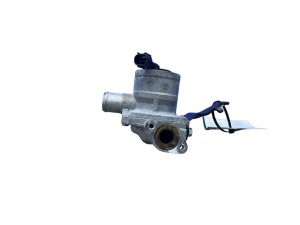
- Evaporative Emissions Purge Control Solenoid Valve
(OEM #42084FG060)— This is the most common failure point for code P0443 on this vehicle. The internal coil fails, causing an electrical circuit fault.
Trusted brands: Subaru (Genuine), Denso, Standard Motor Products (CP584)
OEM price range: $120-$160
Aftermarket price range: $70-$110
Related Codes That Often Appear With This One
- P0444 — P0444 is 'EVAP System Purge Control Valve Circuit Open,' which is a more specific version of the P0443 general circuit fault. They often appear together when the solenoid's internal coil has broken.
- P0445 — P0445 is 'EVAP System Purge Control Valve Circuit Shorted.' This can appear with P0443 if the solenoid's internal windings have shorted together.
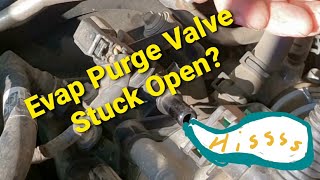
- P0171 — P0171 is 'System Too Lean (Bank 1)'. If the purge solenoid fails by getting mechanically stuck open, it creates a constant vacuum leak, allowing unmetered air and fuel vapor into the intake manifold. 🎬 Watch this quick test to check if your purge valve is stuck open This can lean out the air/fuel mixture enough to trigger a P0171 code, often accompanied by a rough idle.
Technical Service Bulletins (TSBs) & Recalls
- While no specific TSB exists for this common P0443 failure, Subaru TSB 12-184-15 is an example of a service bulletin for another common issue on this platform (clutch pedal bracket failure), indicating a pattern of known weaknesses.
Platform-Specific Known Issues
- Extremely Common Failure Item: Owner forums for the WRX, Forester XT, and Legacy GT are filled with threads about P0443. It is considered a 'when, not if' failure, typically occurring between 80,000 and 150,000 miles. The overwhelming consensus is that replacing the purge solenoid (42084FG060) is the definitive fix.
Mechanic-Grade Diagnostic Values
- Purge Control Solenoid Coil Resistance — expected: 29 - 35 Ohms for the EJ253 engine (similar architecture), and generally 20-30 Ohms for this type of solenoid.. Failure: Infinite resistance ('OL') indicates an open coil; near-zero resistance indicates a shorted coil.
- Voltage at Purge Solenoid Connector (Power Pin) — expected: Battery voltage (~12V) with Key On, Engine Off.. Failure: 0V or significantly low voltage points to a problem in the power supply circuit, fuse, or relay.
- Voltage at Purge Solenoid Connector (Control Pin) — expected: This is a Pulse-Width Modulated (PWM) ground signal from the ECM. Voltage should drop to near 0V when the valve is commanded ON by a scan tool.. Failure: Voltage does not drop when commanded ON, indicating a break in the control wire or a faulty ECM driver.
- Scan Tool Live Data - Purge Solenoid Duty Cycle — expected: Should show 0% at cold start/idle. The ECM will command a duty cycle percentage above 0% after the engine warms up and under specific load conditions.. Failure: The scan tool shows a commanded duty cycle, but the valve does not physically operate (no clicking or vacuum change), indicating a failed solenoid or circuit.
Scan Tool Commands That Help
- Subaru Select Monitor (SSM) or equivalent professional scan tool: Active Test / EVAP VSV (or Purge Solenoid) Activation — This command allows a technician to manually turn the purge solenoid ON and OFF while the engine is running. It is used to verify if the solenoid clicks audibly and if it opens to allow vacuum to pass, confirming both electrical and mechanical function without having to remove the part.
Wiring & Ground Locations
- Purge Solenoid Connector — On the purge solenoid itself, located on the driver's side of the intake manifold.. This 2-pin connector is the primary point for testing. Pin 2 is typically the 12V power supply, and Pin 1 is the ground-side control wire from the ECM.
- ECM Connector (e.g., B39 on similar models) — At the Engine Control Module, usually in the passenger footwell behind the glove box.. The specific pin for the purge solenoid control wire (e.g., Pin 62, PRG) can be checked for continuity back to the solenoid connector to diagnose a broken wire in the harness.
- Engine Ground Points — Main ECU grounds are on top of the intake manifold.. While a bad ground here is less likely to cause a specific circuit code like P0443, a loose or corroded main ground can cause a host of intermittent electrical issues. It's a known Subaru weak point worth checking if other tests are inconclusive.
Real Owner Repair Stories
- Subaru Legacy International (sl-i.net) forum user 'blankdeluxe' (Subaru Legacy with similar EJ engine architecture) — Check Engine Light with P0443, engine dying when coming to a stop, rolling idle between 250-750 RPM.
❌ Tried (didn't work) Visual inspection of vacuum lines.
✅ What actually fixed it The user tested the resistance of the purge solenoid and found it was an open circuit ('OL'). Replacing the purge solenoid resolved the P0443 code. (The idle issue was found to be a separate problem).
"I Checked Everything" — The Actual Cause
- P0443 is an electrical circuit code, so a smoke test (used for finding physical leaks in the EVAP system) is not the correct diagnostic procedure. Technicians would instead perform electrical tests. An equivalent scenario would be 'Resistance Test Good, But Actually...'. In this case, if the solenoid resistance measures correctly (20-30 ohms) but the code persists, the failure could be mechanical (the valve is stuck internally despite a good coil) or a wiring issue between the solenoid and the ECM. A bidirectional scan tool test to command the valve 'ON' would reveal if it clicks; if it has good resistance but doesn't click, it's mechanically failed.
OEM Part Supersession History
16102AA360→16102AA391, 16102AA490— Standard part evolution and supplier changes.
Heads up: This part number is often listed for the EVAP purge control solenoid on the 2008-2014 WRX/STI, but some vendors may mislabel it as a 'boost control solenoid' for older models. Ensure the part is specified for the EVAP system for correct fitment and function.
Model Year Variations Within This Range
- 2011-2014: The WRX (non-STI) received a 'wide body' design similar to the STI, which changed some body panels and suspension track width. However, the EJ255 engine and the location/function of the EVAP purge solenoid on the intake manifold remained consistent with the 2008-2010 'narrow body' models, so the diagnosis and repair for P0443 are identical across the entire 2008-2014 range.
Diagnostic Flowchart
Other Known Issues on This Vehicle
Issues unrelated to this code that are worth knowing about as an owner of this generation:
- Piston Ringland Failure 🔴 High — A notorious and widespread issue for the EJ255/EJ257 engines, often occurring between 60,000-120,000 miles, but can happen earlier, especially on modified vehicles. The stock engine tune running lean is often cited as a contributing factor.
- Secondary Air Injection System Failure 🟠 Medium — Very common failure, usually presenting after 60,000 miles. The air pump seizes or the valves get stuck open/closed due to moisture and rust, triggering codes like P0410, P2441, P2443, or P2444.
- Clutch Pedal Bracket/Firewall Spot Weld Failure 🟠 Medium — Common on 2008-2014 models. The spot welds holding the clutch pedal assembly to the firewall break, causing a squeaking, clicking, or flexing pedal. Can lead to difficulty shifting. (Ref: Subaru TSB 12-184-15 addresses this issue, noting a production change and providing repair guidance.)
- Turbocharger (IHI VF52) Failure 🟠 Medium — Failures are not uncommon, often occurring around 100,000 miles. Causes include oil starvation from a clogged banjo bolt filter screen, oil contamination, or increased stress from modifications.
- High Oil Consumption 🟡 Low — The EJ255 engine is known to consume oil between changes, which is considered 'normal' by Subaru to an extent. It can be exacerbated by worn piston rings or turbo seals and requires owners to check oil levels frequently.
Used vs. New Parts: Buying Guide for This Vehicle
When a used part is the smart pick: A used OEM purge solenoid from a junkyard is a reasonable choice for this repair, especially if on a tight budget. Since the failure is typically a sudden electrical open circuit rather than gradual wear, a used part that tests good with a multimeter (shows 20-30 ohms resistance) is likely to have significant life left.
Donor-vehicle mileage cap: roughly under 100000 miles for the part to have meaningful remaining life.
What to inspect on the donor part:
- Test the resistance across the two pins with a multimeter before purchase; it must be within the 20-30 ohm range.
- Inspect the plastic body for cracks or signs of extreme heat stress.
- Ensure the electrical connector pins are clean, straight, and free of corrosion.
- Check that the vacuum hose nipples are intact and not broken or cracked.
OEM-only on this vehicle (don't cheap out):
- Engine Control Module (ECM) - Aftermarket or improperly matched used ECMs can cause a wide range of issues and often require dealer programming.
Aftermarket brands forum-validated for this vehicle:
- Denso (often the original OEM supplier)
- Standard Motor Products (SMP)
Brands owners have reported issues with on this vehicle:
- No-name, unbranded parts from online marketplaces should be avoided, as their coil windings and internal seals may not meet OEM durability standards, leading to premature failure.
Real Owner Stories
Aggregated from forums and TSBs cited above. Mileages and costs reflect what owners reported in those sources.
Subaru Legacy GT EJ255
Symptoms: Check engine light with stalling symptoms.
What fixed it: Confirmed an open circuit on the purge solenoid via a resistance test and replaced the unit.
Source hint: https://sl-i.net/forums/topic/10633-p0443-help/?do=findComment&comment=113054 - A LegacyGT.com (SL-i) user
2008-2014 Subaru WRX EJ255 — ~115000 miles
Symptoms: Check Engine Light (P0443).
What fixed it: Replacing the purge solenoid (42084FG060).
Source hint: Vehicle_specific_issues: Extremely Common Failure Item
Subaru WRX
Symptoms: Check engine light with codes P0451 and P0443.
What fixed it: The user triggered a P0443 code after disconnecting the purge solenoid during testing.
Source hint: https://www.reddit.com/r/MechanicAdvice/comments/1bheg7x/p0443_dtc_code_after_testing_for_a_bad_purge/ - Reddit r/MechanicAdvice
Related OBD-II Codes
Frequently Asked Questions
Is there a specific TSB for the P0443 code on my 2008-2014 WRX?
What is the specific part number I need to fix the P0443 code on my EJ255 engine?
Where is the purge solenoid located on the 2008-2014 WRX?
Can I test the solenoid myself with a multimeter?
Why does this part fail so often on the WRX and Forester XT?
Will a bad purge solenoid cause my WRX to stall?
Helpful Videos
We Have This Part in Stock

The information in this article is provided for general reference and educational purposes only. Vehicle specifications, procedures, and part compatibility can vary by production date, trim level, and region. Always consult your vehicle's factory service manual and verify part numbers before purchasing or performing repairs. Safety-critical components such as airbags, seat belts, and braking systems should be installed by a qualified professional.
- Subaru WRX:
- 🎬 Helpful Videos
- 🛍️ Shop This Part
- What's Unique About the 2008-2014 Subaru WRX
- Symptoms You May Notice
- Most Likely Causes
- Rare But Worth Checking
- Diagnosis Steps
- Parts You'll Likely Need
- Related Codes That Often Appear With This One
- Technical Service Bulletins (TSBs) & Recalls
- Platform-Specific Known Issues
- Mechanic-Grade Diagnostic Values
- Scan Tool Commands That Help
- Wiring & Ground Locations
- Real Owner Repair Stories
- "I Checked Everything" — The Actual Cause
- OEM Part Supersession History
- Model Year Variations Within This Range
- Diagnostic Flowchart
- Other Known Issues on This Vehicle
- Used vs. New Parts: Buying Guide for This Vehicle
- Real Owner Stories
- Subaru Legacy GT EJ255
- 2008-2014 Subaru WRX EJ255 — ~115000 miles
- Subaru WRX
- Related OBD-II Codes
- Frequently Asked Questions
- 🎟️ Get 5% Off