

P0443 on 2011-2017 Honda Odyssey: EVAP Purge Valve Circuit Causes and Fixes
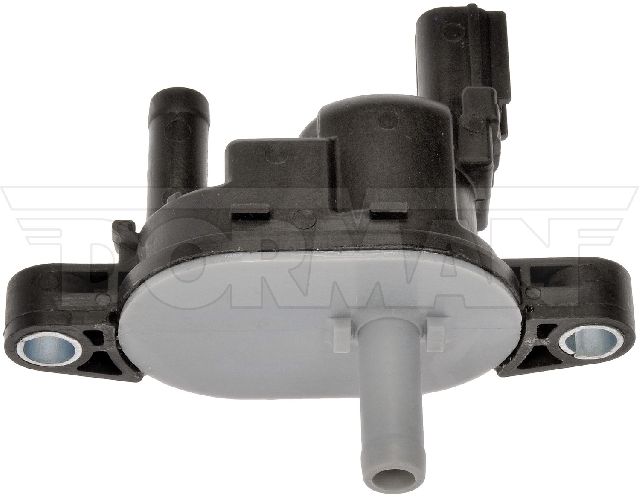
This code almost always points to a faulty EVAP Purge Control Valve (Solenoid) located on top of the engine. It's an electrical circuit fault, not a leak. Replacing the valve is a common DIY fix costing between $40 and $100 for the part. The valve's internal coil fails, causing an out-of-spec resistance reading.
- P0443 is an electrical circuit code, not a leak code. Don't rush to replace the gas cap.
- The most likely culprit is the EVAP purge valve solenoid itself, which should have a resistance of 22-26 Ohms.
- The valve is located on top of the engine and is held by two 10mm bolts, making it a very accessible and DIY-friendly repair.
- Always check the wiring and connector for damage before buying a new part.
- The correct OEM part number for the 2011-2017 Honda Odyssey appears to be 36162-R70-A01, but always verify with your VIN.
What's Unique About the 2011-2017 Honda Odyssey

On the 4th generation Honda Odyssey (2011-2017), the V6 engine's EVAP purge valve is conveniently located right on top of the engine, making it much easier to access and diagnose than on many other vehicles where it might be buried. The issue is typically the valve itself failing electrically rather than a more complex wiring problem, leading to a straightforward replacement. The failure is often an internal open or short in the solenoid's coil.
Symptoms You May Notice
- Check Engine Light is on
- Vehicle will fail an emissions inspection
- Possible slight decrease in fuel economy
- Potential for a rough idle, though less common
- In rare cases, a fuel odor may be noticeable if the valve is stuck open
- Difficulty starting the engine, especially after refueling (if valve is stuck open)
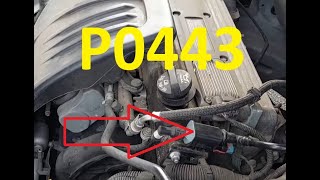
- Replacing the gas cap. A loose or faulty gas cap will typically cause an EVAP leak code (like P0455 or P0456), not a circuit code like P0443. 🎬 See common causes and fixes for the P0443 code
- Replacing other EVAP components like the vent solenoid or charcoal canister before verifying the purge valve circuit is faulty.
Most Likely Causes

- Faulty EVAP Purge Control Valve (Solenoid) 🔴 High Probability The internal coil of the solenoid can fail over time due to heat cycles and vibration, creating an open or short in the circuit. This is the most frequent point of failure for this code on Honda V6 engines.
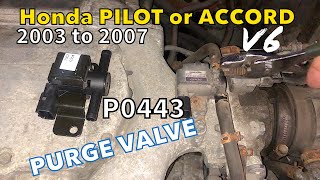
How to confirm: With the engine off, unplug the connector and measure the resistance across the two pins 🎬 Watch: How to test and replace the purge valve on the valve with a multimeter. A correct reading should be between 22-26 Ohms at room temperature. An open circuit (infinite resistance/OL) or a dead short (near zero resistance) indicates a bad valve. You can also try applying 12V and ground to the pins to see if it audibly clicks.
Typical fix: Replace the EVAP purge control valve. It is mounted on top of the engine with two 10mm bolts and has two hoses and one electrical connector.
Est. part cost: $40-$100 - Damaged Wiring or Connector 🟡 Medium Probability The wiring harness in the engine bay is exposed to heat and potential rodent damage, which can cause wires to break, chafe, or corrode the connector pins.
How to confirm: Visually inspect the wiring going to the purge valve for any signs of cracking, melting, or chewing. Unplug the connector and check for corrosion or bent pins. Use a multimeter to check for battery voltage (approx. 12V) on one wire with the key on, engine off. The other wire is the control wire from the PCM.
Typical fix: Repair the broken or shorted wire. If the connector is corroded, clean it with electrical contact cleaner or replace the connector pigtail.
Est. part cost: $5-$30
Rare But Worth Checking
- Blown Fuse: The purge valve circuit is protected by a fuse, often shared with other components. While not common for it to blow without another issue, it's a quick and easy check before replacing parts.
- Faulty Powertrain Control Module (PCM): This is very rare. The internal driver circuit in the PCM that controls the purge valve can fail. This should only be considered after all other possibilities have been exhaustively ruled out by a professional.
Diagnosis Steps

- Read the code with an OBD-II scanner to confirm P0443 is present.
- Locate the EVAP purge valve. On the 3.5L V6, it's on top of the engine, slightly to the passenger side, mounted on a bracket.
- Visually inspect the electrical connector and wiring harness leading to the valve. Look for obvious damage, corrosion, loose connections, or signs of rodent activity.
- Test the valve's internal coil resistance. Disconnect the electrical connector. Use a multimeter set to Ohms (Ω) to measure the resistance between the two pins on the valve itself. A healthy valve should read approximately 22-26 Ω. A reading of infinite resistance (OL) or near 0 ohms indicates a faulty valve.
- Test for power at the connector. With the key in the 'ON' position (engine off), use a multimeter to check for battery voltage (around 12V) at one of the pins in the connector harness.
- If power is present and the valve's resistance is out of spec, the purge valve is bad and needs to be replaced. This is the most common outcome. 🎬 Watch this quick guide to fixing P0443 fast
- If the valve tests good (correct resistance and clicks with 12V applied), the problem likely lies in the wiring between the valve and the PCM, or (rarely) the PCM itself. Check for continuity on the ground-side control wire back to the PCM.
- After repair, clear the code and drive the vehicle to ensure the Check Engine Light does not return.
Parts You'll Likely Need

- EVAP Canister Purge Control Solenoid Valve
(OEM #36162-R70-A01)— This is the most common failure point for a P0443 code. The internal electronics of the solenoid fail, causing the circuit fault.
Trusted brands: Honda (Genuine), Dorman (e.g., 911-773), Standard Motor Products (e.g., CP751), Denso
OEM price range: $80-$110
Aftermarket price range: $40-$75
Related Codes That Often Appear With This One
- P0444 — Indicates the purge control valve circuit is open, which is a more specific version of the general P0443 fault.
- P0445 — Indicates the purge control valve circuit is shorted, another specific fault related to the P0443 code.
- P0497 — Indicates 'EVAP System Low Purge Flow,' which can sometimes accompany P0443 if the valve is failing in a way that affects both its electrical integrity and its mechanical function.
Platform-Specific Known Issues
- Intermittent 'Check Fuel Cap' Message: Some owners on forums report that prior to the P0443 code appearing, they experienced an intermittent 'Check Fuel Cap' message on the dashboard. While this message is typically for a leak, in some cases it has been an early symptom of the purge valve circuit beginning to fail.
Mechanic-Grade Diagnostic Values
- Voltage at Purge Valve Connector (Power Wire) — expected: 9 to 14 Volts with ignition ON, engine OFF.. Failure: 0 Volts indicates a problem with the power supply from the fuse or relay.
- Purge Valve Control Signal (Ground Wire) — expected: A fluctuating ground signal (duty cycle) when the valve is commanded ON by a scan tool.. Failure: No fluctuation or a constant ground/open indicates a wiring issue or a faulty PCM driver.
Scan Tool Commands That Help
- Honda HDS (or advanced bidirectional scanner): EVAP System Test / Purge Valve Test — This command allows the technician to manually activate the purge valve solenoid to verify its operation. When commanded ON (e.g., 100%), a connected vacuum gauge should show a drop to zero, and a test light on the control wire should illuminate, confirming the PCM driver and wiring are functional.
Wiring & Ground Locations
- G101 — On the front of the right cylinder head, often near the thermostat housing.. This is a primary ground termination point for the PCM. A poor connection at G101 can cause erratic behavior and fault codes for various engine sensors and actuators controlled by the PCM, including the EVAP purge valve.
- EVAP Canister Purge Valve 2P Connector — On top of the engine, plugged directly into the purge valve solenoid.. This is the direct connection point for testing. Pin 1 is typically the power supply (battery voltage with key on), and Pin 2 is the control wire (ground side) from the PCM. Verifying power and signal here is the most direct way to diagnose the circuit.
Real Owner Repair Stories
- YouTube Commenter (2012 Honda Odyssey) — Check Engine Light with P0443.
❌ Tried (didn't work) Replaced the gas cap a year prior., Paid a mechanic $560 to replace the EVAP Purge Valve and the Canister Vent Valve.
✅ What actually fixed it The Check Engine Light with code P0443 returned just two hours after the professional repair, indicating the problem was likely not the parts replaced but rather an underlying wiring or PCM issue that was missed. The final fix was not posted, but the story highlights that even replacing the most common parts is not a guaranteed solution.
OEM Part Supersession History
36162-RMX-A01→36162-R70-A01— Part update for J-series V6 engines with VCM.
Heads up: While other part numbers like 36162-RNA-A01 exist for other Honda models (e.g., Civic), they are not correct for the 2011-2017 Odyssey. Using the wrong part can result in incorrect fitment or function. Always verify the part number with the vehicle's VIN.
Model Year Variations Within This Range
- 2011-2017: All models within this generation use the same 3.5L J35Z8 V6 engine and share the same EVAP system components and locations. There are no significant variations related to the P0443 code within this year range.
Diagnostic Flowchart
Used vs. New Parts: Buying Guide for This Vehicle
When a used part is the smart pick: A used part is generally not recommended for this specific repair. The purge valve is a relatively inexpensive electronic solenoid that fails due to internal wear, heat, and vibration over time. A used part carries a high risk of having limited remaining life or being faulty already.
Donor-vehicle mileage cap: roughly under 50000 miles for the part to have meaningful remaining life.
What to inspect on the donor part:
- Check for cracks in the plastic housing or connector.
- Ensure the connector pins are clean and free of corrosion.
- If possible, test the resistance with a multimeter before purchase; it should be within the 22-26 Ohm range.
Aftermarket brands forum-validated for this vehicle:
- Denso (often the original equipment manufacturer)
- Standard Motor Products (SMP)
- Dorman
Brands owners have reported issues with on this vehicle:
- Unbranded, no-name parts from online marketplaces should be avoided, as their internal coil quality and durability can be highly questionable, leading to premature failure.
Real Owner Stories
Aggregated from forums and TSBs cited above. Mileages and costs reflect what owners reported in those sources.
2016 Honda Odyssey
Symptoms: Check engine light was on with a code for the fuel purge system.
What fixed it: Tightening the gas cap resolved the code after a few miles of driving.
Source hint: Reddit r/MechanicAdvice
2012 Honda Odyssey
Symptoms: While test driving, the check engine light came on with codes P0443, P0420, and P0430. The car seemed to be running fine.
What fixed it: The original poster was test driving the vehicle and did not report a fix.
Source hint: Reddit r/MechanicAdvice
2011-2017 Honda Odyssey
Symptoms: Check Engine Light on with code P0443.
What fixed it: Replacement of the purge valve solenoid (P/N 36162-R70-A01).
Source hint: OdyClub.com: Multiple threads confirm the purge valve (P/N 36162-R70-A01) is the primary culprit for P0443 on 2011-2017 models.
2009-2014 Acura TL
Symptoms: Check Engine Light on with code P0443.
What fixed it: The issue was successfully fixed by replacing the purge valve.
Source hint: AcuraZine.com (Platform Mate): A thread titled 'Cel p0443' for a 3rd Gen Acura TL
Related OBD-II Codes
Frequently Asked Questions
Where is the EVAP purge valve located on my 2011-2017 Odyssey?
What is the correct resistance for the purge valve on my Odyssey?
I'm getting a 'Check Fuel Cap' message. Could this be related to the P0443 code?
Is the P0443 code on my Odyssey just a loose gas cap?
What part number do I need for the purge valve replacement?
How difficult is it to replace the purge valve myself?
Can a bad purge valve cause my Odyssey to have trouble starting?
Helpful Videos
Used OEM Parts in Stock



New Aftermarket Parts Available



The information in this article is provided for general reference and educational purposes only. Vehicle specifications, procedures, and part compatibility can vary by production date, trim level, and region. Always consult your vehicle's factory service manual and verify part numbers before purchasing or performing repairs. Safety-critical components such as airbags, seat belts, and braking systems should be installed by a qualified professional.
- Honda Odyssey:
- 🎬 Helpful Videos
- 🛍️ Shop This Part
- What's Unique About the 2011-2017 Honda Odyssey
- Symptoms You May Notice
- Most Likely Causes
- Rare But Worth Checking
- Diagnosis Steps
- Parts You'll Likely Need
- Related Codes That Often Appear With This One
- Platform-Specific Known Issues
- Mechanic-Grade Diagnostic Values
- Scan Tool Commands That Help
- Wiring & Ground Locations
- Real Owner Repair Stories
- OEM Part Supersession History
- Model Year Variations Within This Range
- Diagnostic Flowchart
- Used vs. New Parts: Buying Guide for This Vehicle
- Real Owner Stories
- 2016 Honda Odyssey
- 2012 Honda Odyssey
- 2011-2017 Honda Odyssey
- 2009-2014 Acura TL
- Related OBD-II Codes
- Frequently Asked Questions
- 🎟️ Get 5% Off