

P0443 on 2010-2017 Chevrolet Equinox: EVAP Purge Valve Circuit Causes and Fixes
On a 2010-2017 Equinox, code P0443 is almost always caused by a failed EVAP purge solenoid valve. It's a common failure item that is relatively inexpensive and easy to replace. Expect to pay $25-$50 for an aftermarket part or $45-$80 for an OEM part. The issue is shared with its platform mate, the GMC Terrain.
- P0443 on a 2010-2017 Equinox points to an electrical issue with the EVAP purge valve circuit, not a gas cap leak.
- The most likely culprit is a failed purge valve solenoid itself, which is a common and inexpensive part to replace. The issue is shared with the GMC Terrain.
- Symptoms often include a rough idle or stalling after a cold start, which is a strong indicator the valve is stuck open.
- Before replacing the valve, always check its electrical connector for damage and verify the emissions-related fuse isn't blown.
- For a reliable repair, consider using an OEM (ACDelco) or reputable aftermarket part; some owner experiences show cheap parts failing quickly.
What's Unique About the 2010-2017 Chevrolet Equinox

For the second-generation Equinox and its platform mate, the GMC Terrain, the EVAP purge solenoid is a very common failure point leading to code P0443. While the code is for an electrical circuit, the valve itself often fails internally, either electrically or by getting stuck open or closed. Owners frequently report symptoms like stalling after a cold start or rough idling, which points directly to a purge valve stuck open and creating a vacuum leak. This issue is prevalent across the different engines offered, including the 2.4L 4-cylinder and the 3.0L/3.6L V6 engines.
Symptoms You May Notice
- Check Engine Light is on
- Rough or unstable idle, sometimes feeling like a vacuum leak
- Engine stalling, especially on a cold start or shortly after starting
- Difficulty starting the engine, particularly after refueling
- Slightly reduced fuel economy
- Audible clicking from the engine bay when testing with a scan tool, but the valve remains stuck
- "Reduced Propulsion" message on the dashboard (reported in some GM EVAP circuit failures)
- Replacing the gas cap. A bad gas cap causes EVAP leak codes (like P0455 or P0457), not a circuit code like P0443. While a user on a forum mentioned a 'tighten gas cap' message appearing with the code, the ultimate fix was the purge valve itself.
Most Likely Causes

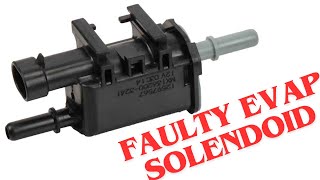
- Faulty EVAP Purge Valve/Solenoid 🔴 High Probability This component is a known high-failure item on many GM vehicles from this era, including the Equinox and its sibling, the GMC Terrain. It can fail electrically (triggering the P0443 circuit code) or mechanically by sticking open (causing drivability symptoms and often a P0496 code). Manufacturer Bulletin #PIP5552 notes that engineering has investigated conditions where P0443 sets due to component concerns.
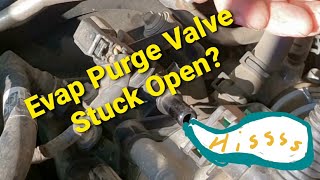
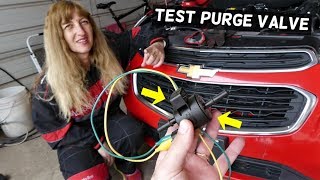
How to confirm: Remove the valve. With no power applied, try to blow through it; no air should pass. Then, apply 12V power to its two pins; it should click open, and you should be able to blow through it. If it fails either test, it's bad. 🎬 Watch: How to test if an EVAP purge solenoid is bad. You can also test its internal resistance with a multimeter, which should typically be between 20-30 ohms for GM vehicles. A bi-directional scan tool can also command the valve open and closed to verify function while monitoring system pressure.
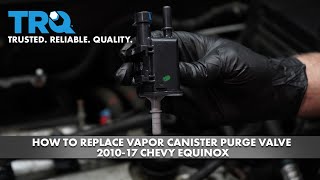
Typical fix: Replace the vapor canister purge valve. It is typically mounted on the engine's intake manifold and is accessible after removing the plastic engine cover. 🎬 Watch: See this step-by-step purge valve replacement walkthrough.
Est. part cost: $25-$80 - Damaged Wiring or Electrical Connector 🟡 Medium Probability The engine wiring harness is subject to heat and vibration, which can lead to chafing, breaks, or corrosion over time. A TSB for a similar GM platform (PIT5336) specifically notes harness damage causing this code. A newer TSB (21-NA-149) also points to potential harness chafing issues on various GM models.
How to confirm: Visually inspect the wiring harness leading to the purge valve connector. Look for any signs of chafing, melting, or breaks. Unplug the connector and check the terminals for corrosion or damage. Use a multimeter to check for 12V power on one wire (with key on) and for continuity to ground on the other wire when the PCM commands it.
Typical fix: Repair the damaged section of the wiring harness. Clean or replace the electrical connector if it is corroded or damaged.
Est. part cost: $5-$50 - Blown Fuse ⚪ Low Probability A short circuit in the purge valve itself or in the wiring can cause the fuse for the emissions system to blow. NHTSA ODI #11632222 describes a scenario where a blown fuse led to P0443 along with several other circuit codes.
How to confirm: Check the fuse box for a blown fuse. On similar GM vehicles, this is often labeled as the 'Emission 1' fuse. If the fuse is blown, it indicates a short circuit that must be found.
Typical fix: Find and repair the short circuit in the wiring or replace the shorted component (usually the purge valve), then replace the blown fuse.
Est. part cost: $1-$5
Rare But Worth Checking
- Faulty Powertrain Control Module (PCM): This is extremely rare. The PCM's internal driver for the purge valve circuit can fail, but all other possibilities (valve, wiring, fuse) should be exhaustively ruled out before considering PCM replacement.
Diagnosis Steps

- Read the trouble codes with an OBD-II scanner. Note any other codes present, especially P0496, P0444, or P0445. As noted in NHTSA ODI #11448862, P0443 often appears in a long list of circuit-related codes if there is a shared power or ground issue.
- Visually inspect the EVAP purge valve, its electrical connector, and the surrounding wiring harness for any obvious signs of damage, corrosion, or loose connections.
- Check the fuse for the emissions system (may be labeled 'EMIS' or similar) in the fuse box to ensure it is not blown. TSB Bulletin #PIT5336 notes that technicians may find the Emission 1 Fuse open due to harness damage.
- Disconnect the purge valve. Test its function by applying 12V and ground to the terminals to listen for a 'click'.
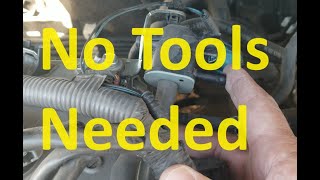
- With the valve removed, check if it is stuck open or closed by attempting to blow air through it 🎬 Watch: Quick test for a stuck open valve with no tools. (it should be closed with no power).
- If the valve seems functional, use a multimeter to test for 12V power at the connector with the ignition on. Then check the ground control wire from the PCM for continuity.
- If you have a bi-directional scanner, command the purge valve to open and close to verify its operation and check for a response from the system.
- If the valve, wiring, and fuse are all good, the final step is to investigate the PCM driver circuit, though this is a very unlikely failure.
Parts You'll Likely Need
- Vapor Canister Purge Valve / Solenoid
(OEM #12610560 (superseded by 12690512))— This is the most common component to fail, causing the P0443 code and associated drivability issues on the 2010-2017 Equinox. Part number 12690512 is a common replacement that supersedes 12610560.
Trusted brands: ACDelco (OEM), Delphi, Standard Motor Products (SMP), Dorman (911-082)
OEM price range: $45-$80
Aftermarket price range: $25-$50
Related Codes That Often Appear With This One
- P0496 — This code means 'EVAP Flow During a Non-Purge Condition' and is often triggered when the purge valve is mechanically stuck open, which is a common failure mode that also causes P0443.
- P0444 — This code for 'EVAP Purge Control Valve Circuit Open' is a more specific version of P0443 and points directly to a break in the wiring or an open coil inside the solenoid.
- P0445 — This code for 'EVAP Purge Control Valve Circuit Shorted' is another specific version of P0443, indicating the control circuit is shorted to ground or power.
- P06DB / P0030 — These codes may appear alongside P0443 if a common fuse or wiring harness section is compromised, as documented in NHTSA ODI #11681144.
Technical Service Bulletins (TSBs) & Recalls
- PIT5336 (Related GM Platform): Notes that a damaged engine wiring harness can cause a short, blow the 'Emission 1' fuse, and trigger code P0443. It advises technicians to inspect and repair any wire damage on the engine harness.
- 21-NA-149 (General GM): A broader TSB that discusses various engine harness chafing issues on many GM vehicles which could potentially lead to circuit faults like P0443.
- Bulletin #PIP5552: A manufacturer bulletin indicating that engineering has investigated P0443 settings as a known concern on certain GM models.
Platform-Specific Known Issues
- While no TSB directly links P0443 to the Equinox, a bulletin for the similar GM 3.6L engine (TSB PIT5336) highlights a known issue where the engine wiring harness can chafe against a bracket, causing a short that blows the emissions fuse and triggers this code.
- On V6 models (3.0L, 3.6L), the purge valve is located near the throttle body, requiring removal of the engine cover for access.
- Real-world owner experiences strongly caution against certain cheap aftermarket purge valves. One owner on the Car Talk Community forum reported a Duralast-branded valve failing within a couple of weeks, requiring a second replacement.
Mechanic-Grade Diagnostic Values
- EVAP Purge Solenoid Coil Resistance — expected: 20-30 Ohms. Failure: A reading of infinity (open circuit) or near zero (short circuit) indicates a failed solenoid.
- Voltage at Purge Solenoid Connector (Power Side) — expected: Battery Voltage (approx. 12V) with Key On, Engine Off.. Failure: No voltage indicates a blown fuse, a bad relay, or a break in the power wire.
- Voltage at Purge Solenoid Connector (Control Side) — expected: The PCM pulse-width modulates the ground side. With a test light connected to B+, it should flash when the valve is commanded ON by a scan tool.. Failure: A constant light or no light when commanded indicates a wiring problem or a faulty PCM driver.
Scan Tool Commands That Help
- GDS2 / Tech2 / Professional Bi-Directional Scanner: EVAP Purge/Seal or Purge Solenoid Command — This command allows the technician to manually open and close the purge solenoid valve to test its functionality. You can command the valve to a specific percentage (e.g., 50%) and verify with a test light that the control circuit is being pulsed by the PCM. It also helps confirm if the valve is mechanically stuck by seeing if the engine RPM changes or if fuel trims are affected when the valve is commanded open.
Wiring & Ground Locations

- EVAP Purge Solenoid Connector — On the EVAP purge solenoid itself, mounted to the intake manifold.. This is the primary connection point to check for corrosion, damage, or a loose fit. It is a 2-wire connector.
- Power Wire (to Solenoid) — One of the two wires in the solenoid connector. It is typically a Pink/Black wire on some GM models.. This wire supplies 12V power to the solenoid from a fuse in the under-hood fuse block. A break in this wire will cause an open circuit fault.
- Control Wire (from PCM) — The second wire in the solenoid connector, typically Dark Green/White, running to the ECM. On some diagrams, it is Pin 48 on one of the main ECM connectors.. The PCM provides a pulsed ground on this wire to control the solenoid. A short to ground or an open circuit on this wire will trigger P0443.
- Fuse F21 (Under-hood) — In the under-hood fuse block, located on the driver's side of the engine bay.. This fuse provides power to the EVAP system components, including the purge solenoid. A short in the solenoid or wiring can cause this fuse to blow, resulting in a P0443 code.
Real Owner Repair Stories
- Car Talk Community (2010 Chevrolet Equinox LS) — Sputters and dies on cold start when shifting into drive, stalls during acceleration.
❌ Tried (didn't work) Replacing O2 sensors, Replacing MAF sensor, Replacing the gas cap
✅ What actually fixed it The user replaced the purge solenoid, but the problem persisted. A follow-up comment warned against using a Duralast (AutoZone brand) part, as their replacement failed within two weeks. The final fix was using a quality OEM part for the purge solenoid. - Reddit r/chevyspark (Chevrolet Spark (similar GM EVAP system)) — Check Engine Light with code P0443.
❌ Tried (didn't work) Checking the gas cap.
✅ What actually fixed it The owner took the vehicle to a shop, which determined the purge valve itself was good. The actual cause was that rats had chewed through the wiring harness leading to the valve, causing the circuit fault. - NHTSA ODI #11632222 — An owner reported a Check Engine Light and "Reduced Propulsion" message. The technician found a blown fuse (F03) likely caused by a sticking EGR valve, which shared a circuit path that triggered P0443 among other codes.
"I Checked Everything" — The Actual Cause
- P0443 is a circuit malfunction code, not a leak code. A smoke test is designed to find physical leaks in the EVAP system (hoses, canister, gas cap seal) which would typically set codes like P0442 (small leak) or P0455 (gross leak). While a smoke test is a key part of overall EVAP diagnostics, it will not identify the electrical open, short, or high resistance that causes P0443. Technicians should focus on electrical testing (voltage, resistance, continuity) for this specific code.
Documented NHTSA Reports
- NHTSA ODI #11448862: An owner reported a console message stating "engine offline" with P0443 found among a large group of other circuit codes including P0031 and P0403.
- NHTSA ODI #11681144: A report describes a failure to circulate coolant properly accompanied by a Check Engine Light and a list of codes including P0443, P06DB, and P0458.
OEM Part Supersession History
12610560→12690512, 12737252— Likely internal design improvements for durability and reliability to address the high failure rate of the original part.
Heads up: The newer part numbers are direct replacements and fully compatible. It is highly recommended to use the latest available part number (e.g., 12690512 or 12737252) instead of sourcing the original 12610560.
Diagnostic Flowchart
Used vs. New Parts: Buying Guide for This Vehicle
When a used part is the smart pick: For the EVAP purge solenoid, a used part is generally not recommended. It is a known high-failure item, and the cost of a new, quality aftermarket part is low enough that the risk of a used part failing quickly outweighs the small cost savings.
Donor-vehicle mileage cap: roughly under 30000 miles for the part to have meaningful remaining life.
What to inspect on the donor part:
- If considering used, visually inspect the connector pins for any signs of corrosion (green or white powder).
- Check the plastic housing for cracks or heat damage.
- Ask for the donor vehicle's mileage; a part from a low-mileage wreck is preferable.
Aftermarket brands forum-validated for this vehicle:
- ACDelco (OEM)
- Delphi
- Standard Motor Products (SMP)
Brands owners have reported issues with on this vehicle:
- Duralast (based on a specific forum report of premature failure for this part on this platform).
Real Owner Stories
Aggregated from forums and TSBs cited above. Mileages and costs reflect what owners reported in those sources.
2010 Chevrolet Equinox LS
Symptoms: The check engine light was on with code P0443. On a cold start, the car would sputter and die when shifted into drive. It would also sometimes stall during acceleration.
What fixed it: The owner did not report the final solution. After replacing the purge solenoid, O2 sensors, and MAF sensor without success, other forum users suggested checking the wiring to the new purge valve and testing the new part to ensure it wasn't faulty.
Source hint: Car Talk Community - '2010 Equinox P0443'
2010 Equinox
Symptoms: Check Engine Light on with code P0443.
What fixed it: The owner replaced the purge valve, but the aftermarket Duralast-branded part failed within a few weeks, causing the code to return and requiring a second replacement.
Source hint: Car Talk Community - '2010 Equinox P0443'
Chevrolet Equinox
Symptoms: The check engine light came on, displaying code P0443.
What fixed it: The issue was resolved by replacing the vapor canister purge solenoid valve (translated from 'VALVULA DE QUEMA DE GASES O VACIO SELENOIDE DEL CANISTER').
Source hint: Opinautos - 'Me prendió el código p0443'
Related OBD-II Codes
Frequently Asked Questions
Where is the EVAP purge valve located on my 2010-2017 Equinox?
Does TSB PIT5336 apply to my Equinox for the P0443 code?
Are there any specific aftermarket purge valves I should avoid for my Equinox?
My GMC Terrain has a P0443 code. Is the diagnosis the same as for the Equinox?
What fuse should I check first when diagnosing a P0443 code?
I replaced the purge valve on my Equinox, but it still stalls on a cold start. What's next?
Helpful Videos
Used OEM Parts in Stock

New Aftermarket Parts Available



The information in this article is provided for general reference and educational purposes only. Vehicle specifications, procedures, and part compatibility can vary by production date, trim level, and region. Always consult your vehicle's factory service manual and verify part numbers before purchasing or performing repairs. Safety-critical components such as airbags, seat belts, and braking systems should be installed by a qualified professional.
- Chevrolet Equinox:
- 🎬 Helpful Videos
- 🛍️ Shop This Part
- What's Unique About the 2010-2017 Chevrolet Equinox
- Symptoms You May Notice
- Most Likely Causes
- Rare But Worth Checking
- Diagnosis Steps
- Parts You'll Likely Need
- Related Codes That Often Appear With This One
- Technical Service Bulletins (TSBs) & Recalls
- Platform-Specific Known Issues
- Mechanic-Grade Diagnostic Values
- Scan Tool Commands That Help
- Wiring & Ground Locations
- Real Owner Repair Stories
- "I Checked Everything" — The Actual Cause
- Documented NHTSA Reports
- OEM Part Supersession History
- Diagnostic Flowchart
- Used vs. New Parts: Buying Guide for This Vehicle
- Real Owner Stories
- 2010 Chevrolet Equinox LS
- 2010 Equinox
- Chevrolet Equinox
- Related OBD-II Codes
- Frequently Asked Questions
- 🎟️ Get 5% Off