

P0442 on 2006-2010 Kia Optima: EVAP Small Leak Causes and Fixes
For a 2006-2010 Kia Optima, P0442 most often means you have a loose or faulty gas cap. If that doesn't fix it, the canister close valve (CCV) or purge valve are the next most likely culprits. A new OEM gas cap is about $20-$40. Due to its exposed location, the canister close valve is a very common failure on this platform, especially in salt-belt states.
- Always check the gas cap first for a P0442 code. Ensure it's tight and the seal is good. Replace it with an OEM cap if in doubt.
- If a new gas cap doesn't solve the problem, the next most likely culprits are the Canister Close Valve (CCV) under the car or the Purge Valve (PCSV) in the engine bay.
- For vehicles in snowy climates, pay close attention to rust and corrosion on the fuel filler neck and under-vehicle EVAP components.
- If the leak isn't obvious after checking the cap and valves, a smoke test is the fastest and most accurate way to find the source of the leak before buying more parts.
What's Unique About the 2006-2010 Kia Optima
The 2006-2010 Kia Optima (generation 'MG') is mechanically identical to the Hyundai Sonata of the same years, so they share the exact same EVAP components and common failures. While a loose gas cap is always the first suspect, this specific platform is known for failures of the canister close valve (CCV), located near the rear driver's side wheel, and the purge control valve (PCSV) in the engine bay. For vehicles in states with road salt, corrosion on under-vehicle components like the charcoal canister and fuel filler neck is a significant factor, as noted in Kia TSB SC135. Manufacturer TSB Bulletin #TSB-SC135R1 further clarifies that vehicles registered in 28 "salt belt" states may experience leak detection warnings specifically accompanied by DTC P0442 or P0455 due to these environmental factors.
Symptoms You May Notice
- Check Engine Light is on
- A faint fuel smell, particularly around the gas cap area or outside the vehicle
- The gas cap may not click or feel tight when secured
- Difficulty starting the car immediately after refueling (a symptom of a stuck-open purge valve)
- Replacing the purge valve or canister close valve without first checking the gas cap. The gas cap is the simplest and most frequent cause and should always be the first check.
- Replacing parts without performing a smoke test. For small leaks that aren't obvious, a smoke test is the most efficient way to pinpoint the exact source, saving time and money on unnecessary parts. An expert on a forum advised a 2007 Optima owner to get a smoke test after they had already replaced the gas cap and purge valve without success.
Most Likely Causes
- Loose or Faulty Gas Cap 🔴 High Probability The gas cap is a frequently used part and its rubber seal can wear out, crack, or get dirty over time, preventing a proper seal. This is the most common cause for P0442 on any vehicle.
How to confirm: Ensure the gas cap is tightened until it clicks several times. Inspect the rubber O-ring on the cap for cracks, brittleness, or debris. Also, check the rim of the fuel filler neck for rust or dirt that could prevent a seal.
Typical fix: First, try tightening the cap. If the code returns or the seal is visibly damaged, replace the gas cap. It is highly recommended to use a genuine OEM Kia gas cap, as aftermarket caps are known to cause sealing issues.
Est. part cost: $20-$40 - Faulty Canister Close Valve (CCV) 🟡 Medium Probability This valve is located under the car near the charcoal canister, making it susceptible to road debris and corrosion, especially in 'salt belt' states. It is a very common failure point on this platform, as confirmed in multiple owner forums for both the Optima and its platform-mate, the Hyundai Sonata.
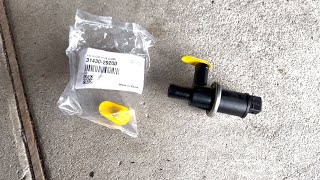
How to confirm: The valve is normally open and should close when 12V is applied. It can be tested with a scan tool or by applying power directly. A smoke test is the most definitive way to confirm if the valve is leaking. The CCV is located behind the driver's side rear wheel, attached to the charcoal canister. 🎬 See this walkthrough for replacing the canister close valve A mechanic can use a bidirectional scan tool to command the valve shut to seal the system for a smoke test.
Typical fix: Replace the canister close valve. The part often fails due to internal corrosion or getting stuck.
Est. part cost: $40-$60 - Faulty Canister Purge Valve (PCSV) 🟡 Medium Probability This is a common failure item on many Kia and Hyundai models of this era. The valve can get stuck open or closed due to age or carbon buildup.
How to confirm: The purge valve is located in the engine bay. It is normally closed when the engine is off. You can test it by applying vacuum to see if it holds, and then applying 12V to see if it opens and flows air. A simpler test with the engine running is to disconnect the vacuum hose from the canister side; if you feel suction at idle, the valve is stuck open and faulty.
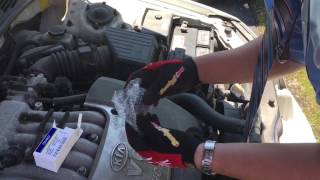
Typical fix: Replace the canister purge valve/solenoid. A YouTube video demonstrates this is a simple replacement on a 2006 Optima using only pliers. 🎬 Watch: How to replace the purge valve on your Optima
Est. part cost: $30-$50 - Cracked or Disconnected EVAP Hoses ⚪ Low Probability Over time, rubber hoses can become brittle from heat and age, leading to small cracks or splits, particularly the hoses connected to the purge and close valves.
How to confirm: Visually inspect all accessible EVAP lines in the engine bay and under the vehicle for signs of cracking, disconnection, or damage. A smoke test is the most effective way to find a small hose leak that isn't obvious.
Typical fix: Replace the damaged section of hose.
Est. part cost: $5-$20
Rare But Worth Checking
- Cracked Charcoal Canister: The canister itself can develop cracks from age, impact, or corrosion, especially on vehicles in salt-belt states as noted in Kia TSB SC135. The TSB was issued as a service campaign to inspect and, if cracked, replace the canister on certain Optima, Rondo, and Sedona models.
- Rusted Fuel Filler Neck: Corrosion on the metal fuel filler neck, where the gas cap seals, can create a poor sealing surface and cause a P0442 code. In some cases, the neck itself can develop pinhole rust leaks, which would be found with a smoke test.
- Faulty Fuel Tank Pressure Sensor (FTPS): A faulty sensor can send an incorrect reading to the vehicle's computer, tricking it into thinking there is a leak when one does not exist. On the Optima, this sensor is typically located on top of the fuel pump assembly, accessed from under the rear seat. This is an uncommon cause for a leak code.
Diagnosis Steps
- Read the code with an OBD-II scanner to confirm P0442 is present.
- Inspect the gas cap. Remove it, check the seal for cracks or damage, and ensure it is tightened until it clicks at least 3 times. Clear the code and drive for a few days to see if it returns.
- If the code returns, replace the gas cap with a new OEM part. Aftermarket caps are a frequent source of issues.
- If the code persists, perform a visual inspection of the EVAP system. Check the purge valve and hoses in the engine bay for obvious cracks or loose connections.
- Inspect the canister close valve (CCV) and charcoal canister under the vehicle, near the driver's side rear tire. Look for signs of corrosion, cracks, or damage to the valves and hoses, paying close attention to the issues described in TSB SC135.
- Test the purge valve (PCSV) in the engine bay. With the engine at idle, disconnect the hose coming from the canister and feel the port on the valve. There should be no vacuum. If there is, the valve is stuck open and needs to be replaced.
- If a visual inspection does not reveal the leak, the most effective next step is to have a professional perform a smoke test. As noted in Bulletin #PS469, if the MIL is illuminated with P0442 and the initial EVAP leak self-test results in "No Trouble Found" (NTF), a manual EVAP test is recommended to find hard-to-find small leaks.
Parts You'll Likely Need
- Fuel Tank Cap
(OEM #31010-3L600)— This is the most frequent cause of small EVAP leaks due to a worn or damaged seal. Using an OEM cap is strongly advised to ensure a proper seal.
Trusted brands: Kia (OEM), Hyundai (OEM)
OEM price range: $20-$40
Aftermarket price range: $10-$25 - Canister Close Valve (CCV)
(OEM #31453-3K500)— A very common failure on this platform due to its exposed location under the vehicle, leading to corrosion and malfunction. Also called a Shut-Off Valve or Vapor Canister Vent Solenoid.
Trusted brands: Kia (OEM), Hyundai (OEM), Dorman
OEM price range: $40-$60
Aftermarket price range: $30-$50 - Vapor Canister Purge Valve (PCSV)
(OEM #28910-25100)— This valve in the engine bay is a known failure point on many Kia/Hyundai vehicles, often getting stuck and causing a leak. Also called a Purge Control Valve.
Trusted brands: Kia (OEM), Hyundai (OEM), Bosch, Dorman, Standard Motor Products
OEM price range: $40-$55
Aftermarket price range: $25-$45
Related Codes That Often Appear With This One
- P0456 — This code indicates a 'very small' EVAP leak. The cause is often the same as P0442, and a problem might start as a P0456 and worsen to a P0442 over time.
- P0455 — This indicates a 'large' EVAP leak. While P0442 is a small leak, a component failure can sometimes be intermittent or worsen, leading to a large leak code. A TSB from Kia (SC135) notes that P0442 and P0455 can have similar causes related to corrosion of the charcoal canister.
- P0441 — This code for 'Incorrect Purge Flow' often points directly to a malfunctioning canister purge valve (PCSV), which can also cause a P0442 if it's stuck partially open.
Technical Service Bulletins (TSBs) & Recalls
- SC135 / SC135R1: A voluntary emissions service campaign for vehicles in 28 'salt belt' states to inspect for corrosion-related cracks in the evaporative canister. If a crack is found, the canister is replaced. If not, the mounting bracket is replaced with an
- Bulletin #PS469: This "Pitstop" bulletin provides guidance for manual evaporative emissions testing when dealing with hard-to-find small leaks associated with DTC P0442, especially when automated self-tests result in no trouble found.
- Bulletin #TSB-SC135R1: Notes that vehicles originally sold or currently registered in salt belt states (including AK, CT, DC, DE, IA, IL, IN, MA, MD, and others) may experience EVAP system leaks and DTC P0442 due to environmental corrosion.
Platform-Specific Known Issues
- The 2006-2010 Kia Optima is mechanically identical to the Hyundai Sonata of the same period, and they share a high failure rate for the Canister Close Valve (CCV) due to its location and susceptibility to the elements.
- Vehicles operated in 'salt belt' states are subject to Kia Service Campaign SC135, which addresses corrosion-related leaks from the charcoal canister assembly that can cause P0442 or P0455 codes.
Mechanic-Grade Diagnostic Values
- Canister Purge Solenoid Valve (PCSV) Coil Resistance — expected: 15 to 38 ohms. Failure: A reading of infinite resistance (Open Loop) or near zero ohms (short circuit) indicates a failed coil.
- Canister Close Valve (CCV) Coil Resistance — expected: 20 to 40 ohms (typical). Failure: A reading of infinite resistance (OL) indicates an open coil, while a reading near 0 Ω indicates a shorted coil. Best practice is to compare to a new part.
- Fuel Tank Pressure Sensor (FTPS) Signal Voltage, KOEO, Gas Cap OFF — expected: ~2.5V (Atmospheric Pressure). Failure: Voltage is significantly out of range. If voltage is absent, check for 5V reference and ground at the sensor.
Scan Tool Commands That Help
- Kia GDS (or equivalent professional scanner): EVAP System Functional Test / EVAP Vent Solenoid Actuation Test — This command is used to manually close the normally-open Canister Close Valve (CCV). This is an essential first step before performing a smoke test, as it seals the EVAP system, allowing it to be pressurized to find leaks. It also confirms if the valve is responding to electrical commands by listening for a 'click'.
Wiring & Ground Locations
- SENSOR 2 Fuse — Located in the main fuse box in the engine compartment.. On some Kia models, this 10-amp fuse provides power to the EVAP Canister Close Valve (CCV) circuit. A blown fuse will prevent the valve from closing, leading to a leak detection code like P0442.
- Canister Close Valve (CCV) Connector — Directly on the Canister Close Valve, located under the car near the charcoal canister, typically behind the driver's side rear wheel.. This connector is exposed to road salt and moisture, making it a common point for corrosion or wire damage that can cause an open or short in the CCV circuit, preventing it from sealing the system.
Real Owner Repair Stories
- 2CarPros forum user 'NLAKE1991' (2007 Kia Optima, 105,000 miles) — Check Engine Light with code P0442.
❌ Tried (didn't work) Replaced the gas cap, Replaced the canister purge valve
✅ What actually fixed it The user was advised by a certified expert on the forum that a smoke test was necessary to find the small leak, as it was nearly impossible to find by visual inspection alone after the common parts were already replaced. The final resolution was not posted, but the expert guidance pointed away from further parts replacement toward definitive testing.
OEM Part Supersession History
31453-3K700→31453-3K500— Part update or manufacturer change for the Canister Close Valve.
Model Year Variations Within This Range
- 2009-2010: The Kia Optima received a mid-cycle facelift for the 2009 model year (known as the MG II). While the core powertrain and EVAP system components remained largely the same as the 2006-2008 models, there could be minor differences in wiring harness routing or connector styles. Always verify part numbers with a VIN.
Diagnostic Flowchart
Other Known Issues on This Vehicle
Issues unrelated to this code that are worth knowing about as an owner of this generation:
- Harsh Downshifting / Transmission Problems 🟠 Medium — Commonly reported issue where the automatic transmission jerks or shifts harshly when slowing down, often around 20 mph. Many owners report a software update or a 'transmission adaptive value reset' fixes the issue, though dealers may suggest a costly transmission replacement. (Ref: A software update was made available to correct transmission issues.)
- Faulty Door Lock Actuators 🟡 Low — A very common complaint where door latches fail, making it difficult or impossible to open doors from the inside or outside. The cause is a faulty door latch assembly that requires replacement.
- Malfunctioning Throttle Position Switch (TPS) 🟠 Medium — Failure of the TPS is common and can cause the check engine light to illuminate, along with symptoms like engine misfiring and power loss.
- Weak Alternator 🟡 Low — Some model years, including 2006 and 2008-2010, are known for weak alternators that have trouble keeping the battery charged, especially when electrical accessories are in use. This can lead to starting problems. Kia released an upgraded alternator to address the problem.
- Failing Stop Lamp Switch 🟠 Medium — A recall was issued for 2006-2008 models for a faulty stop lamp switch. This could cause brake lights to not illuminate, cruise control to not deactivate with the brake pedal, and prevent the shifter from moving out of Park. (Ref: NHTSA Campaign ID: 13V114000)
- Damaged Clock Spring Assembly 🔴 High — A recall was issued for a clock spring that could become damaged over time, leading to high resistance in the driver's airbag circuit and potentially causing the airbag to not deploy in a crash. (Ref: NHTSA Campaign ID: 12V035000)
Used vs. New Parts: Buying Guide for This Vehicle
When a used part is the smart pick: For this repair, obtaining used parts is generally not recommended for the electronic components. However, a used charcoal canister from a low-mileage, non-salt-belt donor vehicle could be a cost-effective option if the original is physically cracked, as it is a non-wear item. Similarly, specific EVAP hoses or the fuel filler neck could be sourced from a junkyard if they are in excellent, crack-free condition.
Donor-vehicle mileage cap: roughly under 80000 miles for the part to have meaningful remaining life.
What to inspect on the donor part:
- For canisters and filler necks, inspect for any signs of rust, cracks, or physical damage.
- For hoses, ensure the rubber is still pliable and shows no signs of dry rot, cracking, or swelling.
- Verify the donor vehicle is from a dry, non-salt-belt state to minimize the risk of corrosion-related failures.
OEM-only on this vehicle (don't cheap out):
- Fuel Tank Cap: Aftermarket gas caps are notoriously problematic and a frequent cause of P0442 codes. Always use a genuine Kia/Hyundai OEM cap to ensure a proper seal.
- Canister Close Valve (CCV) and Purge Valve (PCSV): While some aftermarket brands like Dorman exist, the failure rate of these electronic valves makes OEM parts a safer long-term investment to avoid repeat repairs.
Brands owners have reported issues with on this vehicle:
- Generic, unbranded gas caps from online marketplaces or auto parts stores are frequently cited as failing to seal properly.
Real Owner Stories
Aggregated from forums and TSBs cited above. Mileages and costs reflect what owners reported in those sources.
2008 Hyundai Sonata (Platform Mate)
Symptoms: The owner suspected their own recent fuel pump work was the cause of the P0442 code.
What fixed it: A professional smoke test identified a failure of the canister close valve located behind the rear wheel.
Source hint: https://www.youtube.com/watch?v=y-uYgcsYj5w - A DIY mechanic with a 2008 Hyundai Sonata (platform mate) documents his P0442 diagnosis.
Related OBD-II Codes
Frequently Asked Questions
Does Service Campaign SC135 apply to my Kia Optima if I live in a 'salt belt' state?
Can I use an aftermarket gas cap to fix the P0442 code on my Optima?
Where is the Canister Close Valve (CCV) located on the 2006-2010 Optima?
Why does my Optima have trouble starting only after I fill up the gas tank?
Is the 2006-2010 Hyundai Sonata's EVAP system the same as my Kia Optima's?
How can I quickly test the purge valve in my engine bay?
Helpful Videos
We Have This Part in Stock



The information in this article is provided for general reference and educational purposes only. Vehicle specifications, procedures, and part compatibility can vary by production date, trim level, and region. Always consult your vehicle's factory service manual and verify part numbers before purchasing or performing repairs. Safety-critical components such as airbags, seat belts, and braking systems should be installed by a qualified professional.
- Kia Optima:
- 🎬 Helpful Videos
- 🛍️ Shop This Part
- What's Unique About the 2006-2010 Kia Optima
- Symptoms You May Notice
- Most Likely Causes
- Rare But Worth Checking
- Diagnosis Steps
- Parts You'll Likely Need
- Related Codes That Often Appear With This One
- Technical Service Bulletins (TSBs) & Recalls
- Platform-Specific Known Issues
- Mechanic-Grade Diagnostic Values
- Scan Tool Commands That Help
- Wiring & Ground Locations
- Real Owner Repair Stories
- OEM Part Supersession History
- Model Year Variations Within This Range
- Diagnostic Flowchart
- Other Known Issues on This Vehicle
- Used vs. New Parts: Buying Guide for This Vehicle
- Real Owner Stories
- 2008 Hyundai Sonata (Platform Mate)
- Related OBD-II Codes
- Frequently Asked Questions
- 🎟️ Get 5% Off