

P0442 on 1997-2006 Jeep Wrangler (TJ): Causes and Fixes for a Small EVAP Leak
For a 1997-2006 Jeep Wrangler, P0442 is most often a loose or bad gas cap. If a new OEM gas cap doesn't fix it, check for cracked EVAP hoses and a rusted fuel filler neck before suspecting other components. A new gas cap costs about $20-$40.
- Always start by checking and/or replacing the gas cap with an OEM Mopar part.
- If a new gas cap doesn't fix it, the next step is a visual inspection of all EVAP hoses for cracks, followed by a smoke test.
- Be aware that the EVAP canister is in the engine bay on 1997-2002 models and in the rear wheel well on 2003-2006 models.
- A rusted fuel filler neck is a known issue on TJs and should be a prime suspect if a smoke test reveals a leak in that area.
- Do not replace expensive parts like the canister or LDP until you have confirmed the leak location with a smoke test.
What's Unique About the 1997-2006 Jeep Wrangler

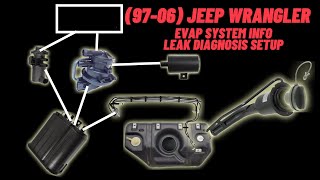
On the Jeep Wrangler TJ, this code is a very common rite of passage due to the age of the vehicle's components. Rubber hoses and seals become brittle and crack after 20+ years of use. A particularly notorious and often-overlooked issue on TJs is a rusted-out fuel filler neck, which can cause a leak that a new gas cap won't fix. Additionally, the location of the EVAP canister changed mid-generation, which is important for diagnosis: on 1997-2002 models 🎬 Watch: A breakdown of TJ EVAP system locations and diagnosis setup. it's under the hood, while on 2003-2006 models it's located near the rear passenger-side wheel well.
Symptoms You May Notice
- Check Engine Light is on
- Possible faint fuel smell (less common)
- A 'GASCAP' message may appear on the instrument cluster of later models.
- The engine light may be intermittent, as seen in NHTSA ODI #10761885 where an owner reported the P0442 code appearing and then going off after a day or two.
- Replacing the charcoal canister or purge valve before thoroughly checking the gas cap, filler neck, and all vacuum lines. A smoke test should be performed before replacing expensive components.
Most Likely Causes


- Loose, Worn, or Incorrect Gas Cap 🔴 High Probability The gas cap seal is a rubber part that degrades over time. Aftermarket locking caps are a frequent source of leaks as they often don't seal as well as the OEM design. This is the number one cause of P0442.
How to confirm: Ensure the cap is tightened until it clicks several times. Inspect the rubber O-ring on the cap for cracks, stiffness, or tearing. Check the fuel filler neck rim for rust or debris that could prevent a seal.
Typical fix: Replace the gas cap with a new OEM Mopar part. Clean any rust or dirt from the filler neck rim. This is an inexpensive and very common fix.
Est. part cost: $20-$40 - Cracked or Disconnected EVAP Hoses 🔴 High Probability The vehicle's age means the original rubber and plastic hoses are likely dry, brittle, and prone to cracking, especially the small rubber elbows and splices that connect the hard plastic lines.
How to confirm: Visually inspect all EVAP lines, starting from the purge solenoid under the hood and tracing them back to the canister and fuel tank. Bend hoses slightly to reveal hidden cracks. A smoke test is the most effective way to find the leak. Common failure points are the rubber connectors near the canister and purge valve.
Typical fix: Replace the specific cracked hose or elbow. Sometimes entire sections of the pre-formed hose assembly need to be replaced. Generic vacuum hose of the correct diameter can often be used for repairs.
Est. part cost: $5-$50 - Rusted or Cracked Fuel Filler Neck 🟡 Medium Probability The metal filler neck is highly susceptible to rusting from the inside out, especially in areas with road salt. The rust can create a pinhole leak or prevent the gas cap from sealing properly.
How to confirm: This can be very difficult to see without a smoke test. A leak here often doesn't show smoke immediately. The smoke fills the body cavity behind the fuel filler door, and will slowly become visible escaping from behind the filler door area or from under the wheel well liner after several minutes.
Typical fix: Replace the fuel filler neck assembly. 🎬 See this step-by-step walkthrough for replacing a rusted filler neck.
Est. part cost: $60-$150 - Faulty EVAP Purge Valve/Solenoid ⚪ Low Probability
How to confirm: The purge valve (located in the engine bay on all TJs) should be normally closed. You can test it by removing it and trying to blow through it; if air passes, it's stuck open and faulty. A faulty valve will often, but not always, trigger other codes like P0441.
Typical fix: Replace the purge valve/solenoid. Note that NHTSA ODI #10520663 mentions a case where an EVAP purge solenoid was replaced alongside P0442 and P0455 codes during extensive troubleshooting.
Est. part cost: $30-$60 - Cracked Charcoal Canister or Faulty Leak Detection Pump (LDP) ⚪ Low Probability The plastic canister housing can become brittle and crack from age or off-road impacts. The LDP is a mechanical part with a diaphragm that can fail internally, causing a leak that isn't visible externally.
How to confirm: Visually inspect the canister for cracks. A smoke test will reveal a leak in the canister body. Testing the LDP often requires a capable scan tool or specialized diagnostic procedures, though some bench tests are possible.
Typical fix: Replace the charcoal canister or the LDP assembly.
Est. part cost: $100-$250
Rare But Worth Checking
- Cracked Fuel Tank Rollover/Vent Valve:
Diagnosis Steps

- Read the code with an OBD-II scanner to confirm P0442 is present. Note any other codes like P0455 or P0456.
- Check the gas cap. Remove it, inspect the seal for damage, and reinstall it, making sure it clicks at least 3 times.
- If the code returns, replace the gas cap with a new OEM Mopar part. This is an inexpensive and very common fix that solves the issue in a majority of cases.
- If the code persists, perform a thorough visual inspection of all EVAP hoses and lines. On 1997-2002 models, start in the engine bay. On 2003-2006 models, inspect the lines around the rear wheel well. Pay close attention to rubber elbows and plastic T-fittings where cracks commonly form.
- If no visible leaks are found, a smoke test is the most effective next step. Connect the smoke machine to the EVAP service port (often a green-capped valve in the engine bay).
- While the system fills with smoke, carefully check for leaks at all hose connections, the purge valve, the charcoal canister, and especially around the fuel filler neck. Allow several minutes for smoke to accumulate in the body cavity to expose a rusted filler neck.
- If a leak is found on top of the fuel tank, it may be a cracked rollover valve, which requires 🎬 Watch: How to fix the common fuel tank rollover valve issue. dropping the tank for confirmation.
- Once the leak is identified, replace the faulty component. Be cautious of "unneeded repairs" as some owners have reported in NHTSA ODI #10357094 that diagnosis of P0441 and P0442 can lead to costly replacement of sensors without cause.
- Clear the code and perform a complete drive cycle to allow the EVAP monitor to run and confirm the fix.
Parts You'll Likely Need

- Gas Cap
(OEM #1997-2000: Mopar 52100116AB | 2001-2006: Mopar 52030387AB)— This is the most frequent cause of P0442. The seal wears out over time, and using a genuine Mopar cap is highly recommended for a proper seal.
Trusted brands: Mopar
OEM price range: $20-$40
Aftermarket price range: $15-$30 - Fuel Filler Neck
(OEM #2003-2006: Crown 52100495AK, Dorman 574-103)— A common failure point on TJs due to rust, causing a leak that a new gas cap cannot fix. OEM parts can be difficult to find, but quality aftermarket replacements are available.
Trusted brands: Mopar, Crown Automotive, Dorman, Spectra Premium
OEM price range: $120-$180
Aftermarket price range: $60-$100 - EVAP Hoses and Connectors — Age and heat cause the rubber and plastic lines to become brittle and crack. Often sold as bulk hose or small, pre-formed elbows.
Trusted brands: Mopar, Dorman
OEM price range: $20-$100
Aftermarket price range: $10-$50
Related Codes That Often Appear With This One
- P0455 — Indicates a large EVAP leak. If seen with P0442, it might suggest an intermittent or borderline leak. The diagnostic process is the same, but you may be looking for a more obvious failure like a disconnected hose.
- P0456 — Indicates a very small EVAP leak. This is very similar to P0442 and points to the exact same causes, often starting with the gas cap.
- P0441 — Incorrect Purge Flow. NHTSA ODI #10357094 notes that P0441 and P0442 are often cited together in consumer complaints regarding emission control systems.
Platform-Specific Known Issues
- The fuel filler neck is prone to rusting through behind the body panel, creating a hard-to-find leak that requires a smoke test to pinpoint.
- The location of the EVAP canister and associated plumbing differs between early (1997-2002, under hood) and late (2003-2006, rear wheel well) TJ models, which is critical to know for diagnosis.
- The plastic rollover/vent valves on top of the fuel tank can break, requiring a full tank replacement as the part is not sold separately and often cannot be reliably repaired.
Mechanic-Grade Diagnostic Values
- EVAP Purge Solenoid Coil Resistance — expected: 15-38 Ohms. Failure: A reading of 0 Ohms (short), infinite/OL (open), or outside the expected range indicates a faulty coil.
- EVAP Purge Solenoid Connector Power Wire Voltage (Key On, Engine Off) — expected: ~12V (Battery Voltage). Failure: 0V suggests a blown fuse (Fuse #10 in the Power Distribution Center) or a break in the power wire from the PDC to the solenoid.
Scan Tool Commands That Help
- DRB III or equivalent bidirectional scanner: EVAP System Test / Leak Detection Pump (LDP) Monitor Test — This function commands the LDP to pressurize the EVAP system, allowing a technician to monitor system integrity without waiting for the vehicle's own monitor to run. It can be used to confirm a fix or to help isolate a leak. Note that multiple actuations can generate excess vapor, potentially masking a very small (0.020") leak.
- Bidirectional Scanner (e.g., XTOOL, Innova 5610): Vent Valve Command (Open/Close) — When performing a smoke test, the normally-open vent valve must be commanded closed to seal the system. This allows the smoke to build pressure and reveal leaks. If the valve doesn't close when commanded, it indicates a faulty valve or a circuit issue.
Wiring & Ground Locations
- Purge Valve Connector — In the engine bay, on the driver's side inner fender, connected to the purge solenoid.. This 2-wire connector provides power and ground control to the purge solenoid. A poor connection or damaged wire here can cause a P0443 (circuit) code, but can also prevent the valve from operating correctly, indirectly contributing to leak codes. One wire should have battery voltage with the key on. Aftermarket pigtails are available if the original connector is damaged.
Real Owner Repair Stories
- YouTube channel 'The Flat Rate Mechanic' (2001 Jeep Wrangler) — P0442, P0455, P0456, P1486 EVAP codes
❌ Tried (didn't work) A full smoke test was performed on the entire EVAP system, from the service port back to the gas cap. No smoke was seen leaking from any hoses, the canister, or the gas cap area.
✅ What actually fixed it The Leak Detection Pump (LDP) was determined to be faulty. The mechanic noted that on these Chrysler products, it's common for the LDP to fail internally (diaphragm or vent function) without leaking externally, causing leak codes even when a smoke test passes. The LDP was replaced to resolve the codes. - YouTube channel 'Garage Couple' (Jeep Wrangler TJ (year not specified)) — Recurring EVAP leak codes (P0455, P0456, etc.)
❌ Tried (didn't work) Attempted repair of broken rollover valve nipple using ballpoint pen internals., Attempted repair using various epoxies and sealants like JB Weld, Flex Seal, and Seal-All.
✅ What actually fixed it The entire fuel tank was replaced with a good used unit. The original tank had a broken rollover/vent valve nipple, which is a non-serviceable part molded into the tank. The owner found that all temporary repairs eventually failed, and the only permanent solution was to replace the tank assembly.
Documented NHTSA Reports
- NHTSA ODI #10520663 describes a situation where an owner spent over $3500 on repairs, including replacing the EVAP purge solenoid, yet continued to face codes P0442 and P0455 alongside stalling issues.
- NHTSA ODI #10357094 highlights a common consumer complaint that OBD error codes for emission systems, specifically P0441 and P0442, can be inaccurate and lead to unneeded, costly repairs of sensors and computers.
- NHTSA ODI #10761885 reports that the engine light with code P0442 may come on occasionally and then go off after a day or two, which can be frustrating for owners attempting to diagnose the root cause.
"I Checked Everything" — The Actual Cause
- A common scenario on this platform is a passed smoke test followed by a recurring P0442 code. The cause is often a faulty Leak Detection Pump (LDP). The LDP can fail internally where its diaphragm no longer seals or vents correctly during the PCM's self-test, but it does not create an external leak for smoke to escape. Technicians familiar with Chrysler systems of this era often replace the LDP if all other components, especially hoses and the gas cap, are confirmed to be good.
OEM Part Supersession History
52030387AA, 52100552AE, 52100552AG→Mopar 52030387AB— Standard part evolution and consolidation.
Heads up: The 52030387AB part number is the correct replacement for the 2001-2006 TJ and is also specified for many later Wrangler models, indicating broad compatibility.
Model Year Variations Within This Range
- 1997-2002: The EVAP canister, LDP, and associated filter are located in the engine bay on the driver's side, making them relatively easy to access for inspection and smoke testing.
- 2003-2006: The EVAP canister and LDP were moved to the rear of the vehicle, behind the passenger-side rear wheel well liner. Access requires removing the fender flare and liner. This also changed the routing of the EVAP lines.
- 2005-2006: An emissions change for these model years made issues with the in-tank rollover/poppet valve more common, often leading to trouble filling the fuel tank. The purge solenoid part number also differs from earlier TJs.
Diagnostic Flowchart
Other Known Issues on This Vehicle
Issues unrelated to this code that are worth knowing about as an owner of this generation:
- Frame Rust/Rot 🔴 High — Extremely common, especially in the salt belt. Typically starts to become serious after 10-15 years. Key areas are near the rear control arm mounts and under the central transmission skid plate. (Ref: No official recall, but it is a widely documented design flaw where the frame traps water and debris with no drain holes.)
- Death Wobble 🔴 High — Common on both stock and lifted TJs, often appearing after 50,000 miles or when suspension components wear. It is a violent shaking of the front wheels, usually triggered by a bump at speeds between 45-60 MPH. (Ref: No recall, as it's considered a wear-and-tear issue. The primary cause is almost always a worn front track bar bushing or loose mounting bolt.)
- OPDA Failure (2005-2006 4.0L Only) 🔴 High — A design flaw specific to 2005-2006 4.0L engines. The Oil Pump Drive Assembly (OPDA) gear wears prematurely due to poor lubrication, which can lead to a loss of oil pressure and catastrophic engine failure. A common symptom is a 'laughing monkey' or chirping sound from the engine. (Ref: No recall, but a well-known issue in the community. Aftermarket replacements from Crown or Dorman are the standard fix.)
- Rear Main Seal Leak 🟡 Low — A very common oil leak on the 4.0L inline-6 engine, often appearing after 100,000 miles. It is typically a slow seep rather than a major leak.
- Cracked Exhaust Manifold 🟠 Medium — The factory exhaust manifold on the 4.0L engine is prone to cracking due to thermal cycles, causing an exhaust leak noise that sounds like a 'tick' when the engine is cold.
Used vs. New Parts: Buying Guide for This Vehicle
When a used part is the smart pick: A used fuel tank is often the only option for fixing a broken rollover valve nipple, as new OEM tanks are discontinued and the valves are non-serviceable. A fuel filler neck from a donor vehicle in a dry, salt-free climate can be a good value if it is rust-free. Body and frame components for the EVAP system, like brackets, are also good candidates for used parts.
Donor-vehicle mileage cap: roughly under 80000 miles for the part to have meaningful remaining life.
What to inspect on the donor part:
- For fuel tanks, visually inspect the rollover valve nipples for any cracks or previous repair attempts (e.g., epoxy).
- For filler necks, check for any bubbling paint or surface rust, especially on the tube that sits behind the body panel and at the flange where the gas cap seals.
- Always check part numbers to ensure compatibility, especially between early (97-02) and late (03-06) TJ models.
- Ask about the donor vehicle's history; parts from a vehicle in a 'rust belt' state are higher risk for corrosion-related failures.
OEM-only on this vehicle (don't cheap out):
- Gas Cap: Aftermarket gas caps are a notorious cause of EVAP codes on this platform. It is strongly recommended to use a genuine Mopar gas cap to ensure a proper seal.
Aftermarket brands forum-validated for this vehicle:
- Sensors: NTK and Denso are often OEM suppliers and are well-regarded for sensors.
- Filler Neck: Crown Automotive and Dorman are common, widely available aftermarket replacements.
- EVAP Canister/Solenoids: Standard Motor Products (SMP) is a reputable aftermarket brand.
Brands owners have reported issues with on this vehicle:
- Locking Gas Caps: While not a specific brand, generic aftermarket locking gas caps are frequently cited as failing to seal properly and causing EVAP codes.
- Inexpensive 'No-Name' Fuel Pumps: When replacing a fuel tank, forum users report high failure rates with unbranded or store-brand fuel pumps compared to OEM/Bosch units.
Real Owner Stories
Aggregated from forums and TSBs cited above. Mileages and costs reflect what owners reported in those sources.
1997-2006 Jeep Wrangler TJ
Symptoms: The owner was frustrated by a cycle of EVAP codes including P0442, P0455, and P0456, stating they were at their 'wit's end' trying to resolve the leaks.
What fixed it: The context indicates that in a majority of cases, replacing the gas cap with a new OEM Mopar part and ensuring it clicks at least 3 times solves the issue.
Source hint: WranglerTJForum.com - 'P0442, P0455, P0456... I'm at my wit's end!'
Related OBD-II Codes
Frequently Asked Questions
I have a 2005 Jeep Wrangler with a 'GASCAP' message on the dash; is this related to P0442?
Should I buy an aftermarket locking gas cap for my TJ to prevent fuel theft?
Where should I look for EVAP leaks on my 2004 Wrangler compared to my friend's 1998 model?
Can I use generic hoses to fix the cracked rubber elbows on my Jeep's EVAP system?
Is the 'laughing monkey' sound from my 2006 Wrangler's engine related to the P0442 code?
Why is it so hard to find the leak near my fuel filler neck?
Helpful Videos
We Have This Part in Stock



The information in this article is provided for general reference and educational purposes only. Vehicle specifications, procedures, and part compatibility can vary by production date, trim level, and region. Always consult your vehicle's factory service manual and verify part numbers before purchasing or performing repairs. Safety-critical components such as airbags, seat belts, and braking systems should be installed by a qualified professional.
- Jeep Wrangler:
- 🎬 Helpful Videos
- 🛍️ Shop This Part
- What's Unique About the 1997-2006 Jeep Wrangler
- Symptoms You May Notice
- Most Likely Causes
- Rare But Worth Checking
- Diagnosis Steps
- Parts You'll Likely Need
- Related Codes That Often Appear With This One
- Platform-Specific Known Issues
- Mechanic-Grade Diagnostic Values
- Scan Tool Commands That Help
- Wiring & Ground Locations
- Real Owner Repair Stories
- Documented NHTSA Reports
- "I Checked Everything" — The Actual Cause
- OEM Part Supersession History
- Model Year Variations Within This Range
- Diagnostic Flowchart
- Other Known Issues on This Vehicle
- Used vs. New Parts: Buying Guide for This Vehicle
- Real Owner Stories
- 1997-2006 Jeep Wrangler TJ
- Related OBD-II Codes
- Frequently Asked Questions
- 🎟️ Get 5% Off