

P0441 on 2013-2016 Dodge Dart 2.4L: Incorrect Purge Flow Causes and Fixes
For a 2013-2016 Dodge Dart with the 2.4L engine, code P0441 is most often caused by a faulty EVAP purge valve or the need for a PCM software update. This issue is also common on platform mates like the Chrysler 200 and Jeep Cherokee. Before replacing parts, check with a dealer for TSBs #18-022-17 REV. A or #18-023-16, as a simple reflash may solve the problem. If not, the purge valve is an affordable part, typically costing $25-$60. If the car is hard to start after refueling, the purge valve is
- Before buying any parts for a P0441 code on a 2.4L Dart, call a Dodge dealer with your VIN to check for software updates related to TSB #18-022-17 or #18-023-16.
- If a software update is not needed, the most likely failed part is the EVAP purge valve, located on the back of the engine.
- A key symptom of a failed (stuck open) purge valve is difficulty starting the car right after you finish refueling.
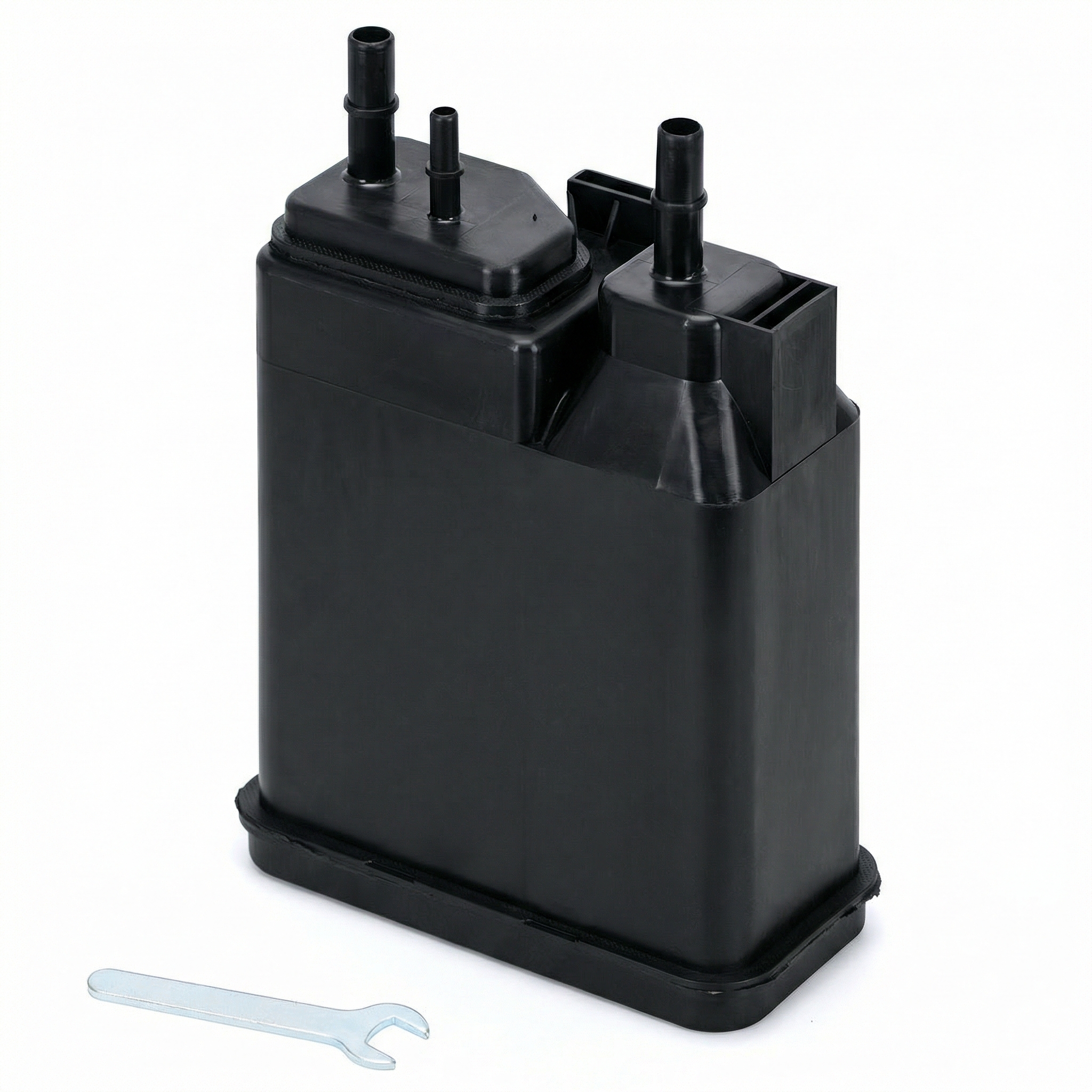
- Do not immediately assume the charcoal canister is bad; it is more durable than the purge valve and the ESIM attached to it.
What's Unique About the 2013-2016 Dodge Dart
On this specific Dodge Dart and its platform mates sharing the 2.4L Tigershark engine (like the Chrysler 200 and Jeep Cherokee), the P0441 code is not always a straightforward parts failure. Chrysler issued Technical Service Bulletins (TSBs) for 2013-2015 models, indicating that a software update for the Powertrain Control Module (PCM) can resolve a false P0441 code triggered by overly sensitive logic. Therefore, it's crucial for owners to check if their vehicle's software is up to date before spending money on parts like the purge valve, even though the valve is also a very common mechanical failure point.
Symptoms You May Notice
- Check Engine Light is on
- Difficulty starting the engine, especially after refueling
- Rough idle
- Stalling at idle when the purge valve is stuck open.
- Slight fuel smell (less common)
- Replacing the gas cap when the root cause is a software issue or a faulty purge valve.
- Replacing the charcoal canister when only the attached ESIM module has failed.
- Replacing oxygen sensors for a lean condition (e.g., P0171) when the actual cause is a vacuum leak from a purge valve stuck open.
Most Likely Causes
- Outdated Powertrain Control Module (PCM) Software 🔴 High Probability Chrysler released TSBs #18-022-17 REV. A and #18-023-16 (with multiple revisions) specifically to address this code being falsely triggered by overly sensitive software logic on 2.4L models.
How to confirm: Contact a Dodge dealership with your vehicle's VIN and ask if TSB #18-022-17 REV. A or #18-023-16 are open or applicable to your car.
Typical fix: A technician reprograms the PCM with the updated software using a proprietary wiTECH scan tool. This is a dealer-only or specialized shop fix. Based on owner reports, this service can cost between $150 and $300 if not covered by warranty.
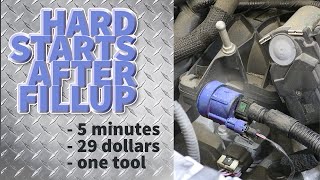
Est. part cost: $0 - Faulty EVAP Purge Valve / Solenoid 🔴 High Probability The purge valve is a constantly working solenoid that can wear out, getting stuck open or closed. When stuck open, it creates a constant vacuum leak, often causing the classic symptom of a rough idle or hard starting right after filling the gas tank. 🎬 Watch: Why your car starts hard after refueling
How to confirm: Remove the valve (located on the back of the engine). With no power applied, try to blow through it. If air passes, it is stuck open and faulty. A scan tool can also command the valve to cycle on and off to test its function while monitoring system pressure.
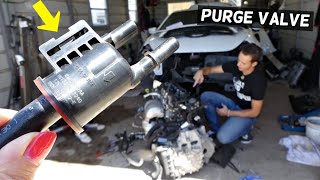
Typical fix: Replace the purge valve. The OEM Mopar part is #4627182AA. 🎬 Watch: How to locate and replace the purge valve
Est. part cost: $25-$60 - Faulty Evaporative System Integrity Monitor (ESIM) 🟡 Medium Probability The ESIM, a white plastic module on the charcoal canister, is a documented high-failure part on many Chrysler products, including the Dart. It can fail internally and cause various EVAP codes, including flow-related ones, even if a smoke test shows no leaks.
How to confirm: The ESIM is located on the charcoal canister, accessible by removing the rear passenger-side wheel and fender liner. After confirming the purge valve is good and there are no visible leaks, the ESIM is a likely suspect. Sometimes a failed ESIM will rattle when shaken, but this is not a definitive test.
Typical fix: Replace the ESIM module. A detailed replacement can be seen in online videos. 🎬 See this step-by-step ESIM replacement walkthrough
Est. part cost: $40-$60 - Loose or Faulty Gas Cap ⚪ Low Probability While more likely to cause a P0456 (small leak) or P0457 (cap off) code, a cap that doesn't seal properly can sometimes disrupt the pressure changes the system uses to monitor purge flow, leading to a P0441. Using a non-OEM cap is a common cause of sealing issues.
How to confirm: Ensure the gas cap is tightened until it clicks at least three times. Inspect the rubber seal on the cap for cracks, stiffness, or damage.
Typical fix: Replace the gas cap, preferably with an OEM part to ensure a proper seal.
Est. part cost: $15-$30
Rare But Worth Checking
- Clogged or Cracked EVAP Hoses/Lines: The rubber and plastic lines that carry fuel vapor can become brittle and crack over time, or get clogged with debris from a deteriorating charcoal canister. A visual inspection and/or a smoke test is needed to find these issues.
- Clogged Charcoal Canister: Consistently overfilling the fuel tank can force liquid gasoline into the charcoal canister, saturating the charcoal pellets and causing a blockage that prevents proper vapor flow. Shaking the canister may reveal a sloshing sound if it's saturated with fuel.
Diagnosis Steps
- Read the code with an OBD-II scanner and note any other codes present.
- Call a Dodge dealership with your VIN. Ask if TSB #18-022-17 REV. A or #18-023-16 are applicable to your vehicle. If so, a PCM reflash is the first recommended step.
- If no TSB applies, inspect the gas cap. Ensure it is tight and the seal is intact. Replace with an OEM cap if in doubt.
- Visually inspect the EVAP purge valve and its connecting hoses in the engine bay for obvious cracks or loose connections. The valve is on the back of the engine.
- Test the purge valve. Disconnect it and attempt to blow through it. It should be sealed when unpowered. If air passes, it's faulty and needs replacement.
- If the purge valve tests good, inspect the EVAP lines running to the rear of the car for damage.
- If no visible issues are found, the next most likely cause is the ESIM. Inspect it by removing the rear passenger-side wheel and fender liner.
- If the issue persists, a smoke test performed by a professional is the best way to find hairline cracks or hidden leaks in the EVAP system.
Parts You'll Likely Need
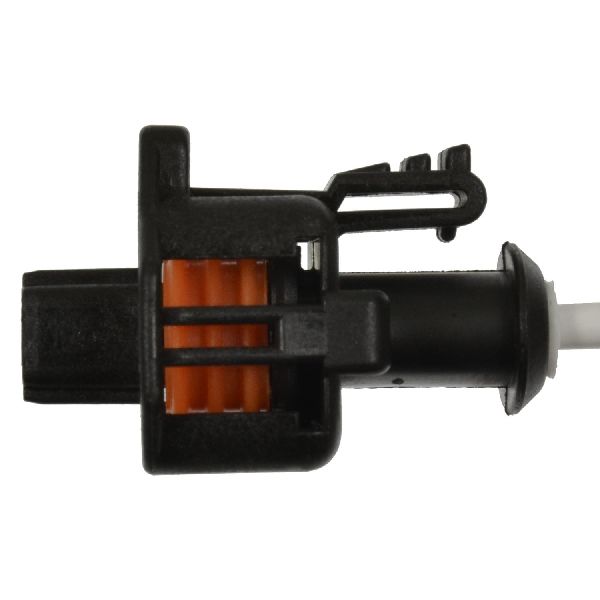
- EVAP Purge Valve / Solenoid
(OEM #4627182AA)— This is the most common mechanical failure for P0441. It gets stuck open or closed, directly causing incorrect purge flow. This part is shared across many Dodge, Jeep, and Chrysler models.
Trusted brands: Mopar, Dorman, Standard Motor Products
OEM price range: $45-$70
Aftermarket price range: $25-$50 - Evaporative System Integrity Monitor (ESIM)
(OEM #04861961AD)— A known high-failure part on this platform that can cause a variety of EVAP codes, including P0441. It's responsible for the system's self-test for leaks and flow.
Trusted brands: Mopar, Dorman, Standard Motor Products
OEM price range: $50-$70
Aftermarket price range: $30-$50
Related Codes That Often Appear With This One
- P0456 — Indicates a small EVAP leak. A failing purge valve or ESIM can trigger both a leak code and an incorrect flow code. TSB #18-022-17 REV. A addresses both P0441 and P0456 with a software update.
- P0442 — Indicates a medium EVAP leak. This can appear with P0441 if the component failure (like a purge valve stuck open) is interpreted by the PCM as both a flow problem and a leak.
- U0140 — Indicates a loss of communication with the Body Control Module. This code is also listed in the same TSBs as P0441, suggesting the PCM software update can resolve multiple unrelated electronic issues.
- P2172 — Indicates a high airflow/vacuum leak detected. A purge valve stuck open is a direct cause of a vacuum leak. This code is also listed in TSB #18-022-17 REV. A, indicating the PCM flash can resolve it alongside P0441.
Technical Service Bulletins (TSBs) & Recalls
- 18-022-17 REV. A: For 2013-2015 Darts and 2015 Chrysler 200s with 2.4L engine. Involves reprogramming the PCM to fix a list of DTCs, including P0441 (Evap Purge System Performance), P0456, P2172 (High Airflow/Vacuum Leak Detected), and U0140 (Lost Communication With Body Control Module).
- 18-023-16 (and revisions B, C, D): For 2013-2015 Darts with 2.4L engine. Also involves a PCM reflash to correct P0441 among other codes like P0116 (Engine Coolant Temperature Sensor 1 Performance) and performance issues.
Platform-Specific Known Issues
- A Powertrain Control Module (PCM) software update is required to fix false P0441 codes on many 2013-2015 Darts with the 2.4L engine, as per TSBs #18-022-17 REV. A and #18-023-16.
- The classic symptom of a hard start after refueling is extremely common on this platform and almost always points to a stuck-open EVAP purge valve.
- Manufacturer service bulletin #18-023-16 REV. D notes that reprogramming the PCM can address P0441 alongside P1D73 (AGS Performance) and P2172.
Mechanic-Grade Diagnostic Values
- EVAP Purge Valve Solenoid Resistance — expected: 14 - 36 Ohms across the two pins.. Failure: A reading of infinite resistance (open circuit) or near-zero resistance (short circuit) indicates a failed solenoid.
- EVAP Purge Valve Connector Voltage — expected: Approximately 12V (battery voltage) on one of the two pins with the Key On, Engine Off (KOEO).. Failure: No voltage suggests a wiring issue, blown fuse (F87 in some cases), or a problem with the PCM's power supply circuit.
- Fuel Tank Pressure (FTP) Sensor Live Data — expected: Approximately 2.5 volts or 0 inches of water (inH2O) with the gas cap removed (at atmospheric pressure).. Failure: A voltage that is stuck high or low and does not change when pressure/vacuum is applied indicates a faulty sensor or wiring issue.
Hidden / Shadow Codes Worth Checking
- Mode 6, TID $93: This Test ID is related to the EVAP Purge Flow Monitor. A user on a forum reported that their scanner showed this value was out of range, which led them to the root cause. (see via A professional OBD-II scanner with Mode 6 data capabilities. The description may be verbose, pointing to the Fuel Pressure sensor.)
Scan Tool Commands That Help
- wiTECH (OEM Chrysler/Dodge/Jeep): Small Leak Verification Test (SLVT) — This is a factory-level function used to confirm the integrity of the entire EVAP system after a repair has been made, without needing to complete a full drive cycle. It's the definitive way to verify a fix for any EVAP leak or flow code.
- Professional Bidirectional Scan Tool: EVAP Purge/Seal Test — This command allows a technician to manually take control of the EVAP system. You can command the purge valve to open and the vent valve to close, sealing the system. While monitoring the FTP sensor, you can verify if the purge valve is opening correctly and if the system can hold a vacuum, helping to isolate a faulty component.
Wiring & Ground Locations
- G108 — On the right side of the engine compartment, on the front wheel well cover or right rear of the engine compartment depending on engine/year.. A wiring diagram for the 2.4L Dart shows the EVAP/Purge Solenoid is grounded at this location. A corroded or loose G108 can cause intermittent or no operation of the purge solenoid.
- G104 — Lower left front of the engine block.. This is a main engine block ground. While not directly for the purge solenoid, a poor connection here can cause a host of PCM and sensor issues, potentially leading to incorrect readings and false codes.
- F87 (Fuse Box) — In the under-hood fuse box, located next to the battery.. On some Dart models, fuse F87 is a 10A fuse specifically for the purge valve solenoid. However, on other models, the solenoid is powered directly by a fused PCM circuit. If F87 exists and is blown, the solenoid will have no power.
- Battery Ground Cable — Connects the negative battery terminal to the chassis, often with a midway grounding point before the main connection.. Owners have reported that using an aftermarket battery ground cable that lacks the specific midway grounding point can cause various electrical issues, including flickering gauges and potentially unstable sensor readings.
Real Owner Repair Stories
- KBB.com user 'kramer' (2016 Jeep Cherokee (Chrysler platform mate with 2.4L engine)) — Persistent P0441 code after the check engine light came back on after clearing.
❌ Tried (didn't work) The user implies that common fixes were attempted without success.
✅ What actually fixed it The user noticed a Mode 6 value (TID $93 for the purge flow monitor) was out of range. A different scanner described this as related to the Fuel Pressure sensor. Replacing the Fuel Tank Pressure sensor, located on a tube from the gas tank to the filler neck, resolved the issue.
"I Checked Everything" — The Actual Cause
- A faulty Evaporative System Integrity Monitor (ESIM). The module's internal switch can fail electronically, causing the PCM to believe there is a flow issue or leak, but since there is no physical leak, a smoke test will pass.
- A hairline crack in the fuel filler neck. In at least one documented case, a crack was too small to be detected by a smoke machine but was found by the more sensitive onboard diagnostic system, causing a persistent code.
- A distorted fuel filler neck. Over-tightening the gas cap over time can warp the plastic filler neck, preventing the cap from creating a perfect seal. This can be intermittent and may not show up on a smoke test, but will still allow the PCM to detect a fault.
OEM Part Supersession History
4861961AA, 4861961AB, 4861961AC, 4891686AA→04861961AD— Part revision and consolidation by the manufacturer for the Evaporative System Integrity Monitor (ESIM).4627182AA→N/A— This appears to be the stable and current part number for the EVAP Purge Valve for all Dodge Dart engines.
Model Year Variations Within This Range
- 2013-2015: Models in this year range with the 2.4L engine are covered by TSBs #18-022-17 REV. A and #18-023-16 for a PCM reflash to correct overly sensitive logic that can falsely trigger a P0441 code. 2016 models are not included in these specific TSBs.
- 2013: Early models like the 2013 Dart may have a specific negative battery cable design that includes a midway grounding point. Some owners have found that generic aftermarket replacement cables lack this point, leading to poor grounding and miscellaneous electrical problems.
Diagnostic Flowchart
Real Owner Stories
Aggregated from forums and TSBs cited above. Mileages and costs reflect what owners reported in those sources.
2015 Dodge Dart 2.4L
Symptoms: Awful fuel economy (low 20s) and check engine codes P0441 & P0452.
What fixed it: A commenter suggested starting by replacing the evap canister, as the owner had already replaced the eSIM a few years prior.
Source hint: Reddit r/dodgedart thread: '2015 Dart 2.4L Poor Fuel Economy & 2 Engine Codes - P0441 & P0452'
2013-2015 Dodge Dart 2.4L
Symptoms: Check engine light with code P0441.
What fixed it: A dealer PCM flash resolved the issue, corroborating the TSBs for overly sensitive software logic.
Source hint: DodgeForum.com & Reddit
2013-2016 Dodge Dart 2.4L
Symptoms: Check engine light with code P0441.
What fixed it: Replaced the purge valve or ESIM/NVLD pump.
Source hint: DodgeForum.com & Reddit
Related OBD-II Codes
Frequently Asked Questions
Does my 2013-2016 Dodge Dart 2.4L need a software update for code P0441?
Why does my Dart 2.4L have a hard time starting right after I get gas?
What is the correct OEM part number for the purge valve on the 2.4L Tigershark engine?
Where is the ESIM located on my Dodge Dart?
How much does it cost to fix the P0441 code on a Dodge Dart?
Can a loose gas cap cause P0441 on my Dart?
Helpful Videos


Used OEM Parts in Stock

New Aftermarket Parts Available


The information in this article is provided for general reference and educational purposes only. Vehicle specifications, procedures, and part compatibility can vary by production date, trim level, and region. Always consult your vehicle's factory service manual and verify part numbers before purchasing or performing repairs. Safety-critical components such as airbags, seat belts, and braking systems should be installed by a qualified professional.
- Dodge Dart:
- 🎬 Helpful Videos
- 🛍️ Shop This Part
- What's Unique About the 2013-2016 Dodge Dart
- Symptoms You May Notice
- Most Likely Causes
- Rare But Worth Checking
- Diagnosis Steps
- Parts You'll Likely Need
- Related Codes That Often Appear With This One
- Technical Service Bulletins (TSBs) & Recalls
- Platform-Specific Known Issues
- Mechanic-Grade Diagnostic Values
- Hidden / Shadow Codes Worth Checking
- Scan Tool Commands That Help
- Wiring & Ground Locations
- Real Owner Repair Stories
- "I Checked Everything" — The Actual Cause
- OEM Part Supersession History
- Model Year Variations Within This Range
- Diagnostic Flowchart
- Real Owner Stories
- 2015 Dodge Dart 2.4L
- 2013-2015 Dodge Dart 2.4L
- 2013-2016 Dodge Dart 2.4L
- Related OBD-II Codes
- Frequently Asked Questions
- 🎟️ Get 5% Off