

OBD-II Code P0452: EVAP System Pressure Sensor Circuit Low
What P0452 means, why it triggers, and how to fix it
- Code P0452 indicates an electrical short or failure in the fuel tank pressure sensor circuit, not a physical vapor leak.
- Replacing the fuel tank pressure sensor fixes the issue in 50% of cases, but you must verify the 5-volt reference and ground wires first to avoid wasting $200+ on unnecessary parts.
- You can safely drive with a P0452 code, but your vehicle will automatically fail state emissions tests and experience a 3-5% drop in fuel economy.
- If P0452 appears immediately after a fuel pump replacement, return to the shop; the sensor or its wiring was likely pinched or left disconnected during the repair.
What Does P0452 Mean?

Code P0452 means your Powertrain Control Module (PCM) detects the voltage signal from the Evaporative Emission (EVAP) pressure sensor is lower than the manufacturer's specified range. The EVAP system captures gasoline fumes and prevents them from escaping into the air. This code points specifically to an electrical problem in the sensor's circuit—such as a short to ground or a dead sensor—rather than a physical vapor leak.
Technical definition: Evaporative Emission Control System Pressure Sensor/Switch Low Input. The PCM detects the fuel tank pressure (FTP) sensor's voltage is below the specified minimum threshold (typically under 0.1-0.5 volts) for a set duration. The sensor operates within a 0.5V-4.5V range; when the signal drops and stays below this range, the PCM flags a circuit fault.
Can I Drive With P0452?
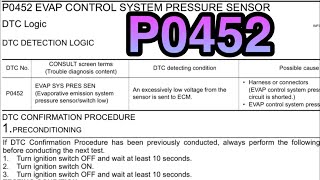
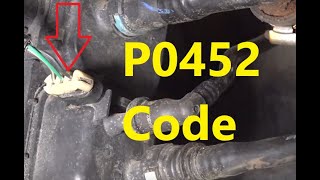
Yes, But With Caution. Yes, you can drive with a P0452 code. It does not affect engine performance or safety in the short term. However, your vehicle will fail an emissions test and emit a slight fuel odor. Driving for an extended period without addressing the issue leads to a 3-5% reduction in fuel economy. 🎬 Watch: Overview of common P0452 causes and fixes If the check engine light flashes, stop driving immediately to prevent catalytic converter damage.
Common Causes

- Faulty Fuel Tank Pressure (FTP) Sensor (Very Common) — The sensor fails internally, sending a constant low voltage signal to the computer. This accounts for roughly 50% of P0452 cases.
- Wiring or Connector Issue (Common) — The wiring harness is shorted to ground, corroded, frayed, or has a poor connection. Moisture intrusion at the connector frequently interrupts the signal.
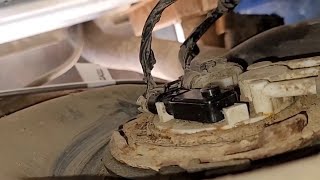
- Damaged Fuel Tank or Fuel Pump Module Gasket (Less Common) — A damaged fuel tank or leaking gasket causes a loss of system pressure. This code frequently appears immediately after a fuel pump replacement due to 🎬 Watch: Chevy Silverado fuel pressure sensor replacement walkthrough a damaged sensor or pinched wire during reinstallation.
- Damaged or Leaking EVAP Hoses (Less Common) — A crack or break in an EVAP vacuum hose occasionally triggers this code, though it more commonly sets a leak-specific code like P0455.
- Loose or Damaged Gas Cap (Rare) — A loose gas cap typically causes a leak code, but occasionally contributes to pressure readings resulting in a P0452.
- Faulty Purge or Vent Solenoid (Rare) — A stuck-closed vent valve or malfunctioning purge solenoid alters system pressure, usually accompanied by codes like P0449.
- Clogged Charcoal Canister (Rare) — A saturated charcoal canister restricts vapor flow and affects pressure readings.
- Faulty Powertrain Control Module (PCM) (Very Rare) — The PCM incorrectly interprets the sensor's signal due to an internal short. Consider this only after exhaustively testing the wiring and sensor.
Symptoms

- Check Engine Light On — This is the most common and often the only symptom you will notice. The light illuminates when the sensor voltage remains below the threshold for several minutes.
- Failed Emissions Test — With an active P0452 code and the Check Engine Light on, your vehicle automatically fails an emissions inspection due to the EVAP monitor not being 'ready'.
- Fuel Smell — You notice a faint to strong smell of gasoline around the fuel tank area or inside the cabin, as the system isn't properly managing fuel vapors.
- Slight Decrease in Fuel Economy — Because fuel vapors escape instead of being burned by the engine, you experience a small drop in your MPG, typically 3-5%.
- Difficulty Refueling — An EVAP system fault causes the fuel pump nozzle to shut off repeatedly during refueling, making it difficult to fill the tank.
- Difficulty Starting or Rough Idle — While less common for a P0452 code, a malfunctioning EVAP system occasionally leads to issues with starting the vehicle or a rough idle.
Diagnostic Flowchart
Tap your situation to follow the diagnostic path that matches what you're seeing on this code.
Common Fixes & Costs
- Replace Fuel Tank Pressure (FTP) Sensor — Parts: $40-$150, Labor: $150-$400, ~1.5 hr book time (Intermediate)
- Repair Damaged Wiring or Connector — Parts: $10-$50, Labor: $100-$300, ~1.5 hr book time (Professional)
- Replace Gas Cap — Parts: $20-$60, Labor: $0, ~0.1 hr book time (DIY)
- Replace Cracked or Leaking EVAP Hose — Parts: $20-$100, Labor: $50-$150, ~1.0 hr book time (DIY)
- Replace Charcoal Canister — Parts: $150-$400, Labor: $100-$200, ~1.2 hr book time (Intermediate)
Used vs. New Parts: Buying Guide
When a used part is worth it: Buying a used Fuel Tank Pressure (FTP) sensor is not recommended. The labor to access the sensor is significant, and the risk of a used part failing prematurely outweighs the small cost savings.
Donor-vehicle mileage cap: roughly under 40000 miles for the part to have meaningful remaining life.
Donor quality checklist:
- Source from a low-mileage vehicle from a dry climate to minimize risk of corrosion.
- Verify the exact part number matches; small variations are not compatible.
- Avoid parts from vehicles scrapped for unknown or electrical reasons.
Decision logic:
- If The FTP sensor requires dropping the fuel tank for access. → Always buy a new OEM or high-quality aftermarket sensor. The labor cost is too high to risk using a part with an unknown history.
- If The sensor is easily accessible (e.g., on the charcoal canister). → A used part from a reputable, low-mileage donor is a budget-conscious option, but a new part is still preferred for reliability.
- If The vehicle is over 150,000 miles and the budget is extremely tight. → A used part is a viable last resort, but understand it may not last long.
Warranty tradeoff: Used parts typically have a 30-90 day warranty at best. New aftermarket parts often carry a 1-year to limited lifetime warranty. New OEM parts offer a 1-year warranty.
Worst-case if a used part fails: $300-$600 if a used sensor fails after installation, as you will pay for the labor to replace it a second time.
What Happens If You Wait — Timeline
- 0-1 month: Check Engine Light illuminates with code P0452. The vehicle automatically fails an emissions test. No other symptoms are likely. (MPG impact: 0-1%% · Added cost: $0)
- 1-6 months: A faint fuel smell becomes noticeable near the gas tank. A slight decrease in fuel economy occurs as the EVAP system stops operating. (MPG impact: 1-3%% · Added cost: $10-$40 in wasted fuel.)
- 6-12 months: The ongoing electrical fault masks other developing EVAP problems. A new physical leak goes undetected because the pressure sensor provides invalid data. (MPG impact: 3-5%% · Added cost: $40-$100 in wasted fuel. The primary cost is the risk of a more complex diagnosis later.)
- 12+ months: No direct mechanical damage occurs from P0452 alone. Long-term consequences are continuous emissions test failures, persistent fuel odor, and a consistent loss in fuel economy. (MPG impact: 3-5%% · Added cost: Ongoing cost of wasted fuel and potential for expensive wiring harness repairs if corrosion spreads.)
Cost of Not Fixing It
- Short Term (0-3 months): Guaranteed failure of any state emissions inspection. A potential slight decrease in fuel economy (up to 5%) and a noticeable fuel odor. (Added cost: $20-$50 in wasted fuel, plus the cost of a failed emissions test.)
- Medium Term (3-12 months): Continued release of harmful hydrocarbon emissions. The fault masks other developing EVAP system issues, such as a clogged canister or failing vent valve. (Added cost: Negligible direct cost, but leads to more complex and expensive EVAP system diagnosis later.)
- Long Term (1+ year): No direct mechanical damage occurs from code P0452 alone. The primary long-term costs are related to repeatedly failing emissions tests and ongoing poor fuel efficiency. (Added cost: Primarily consists of ongoing fuel loss and recurring inspection fees.)
Diagnosis Steps

- Check Live Data with a Scan Tool
Use an OBD-II scanner to view the 'Fuel Tank Pressure' or 'EVAP Pressure' sensor PID. With the key on and engine off, a P0452 code typically shows a voltage stuck below 0.5V. A normal reading at atmospheric pressure (gas cap off) is 1.3V - 2.5V.
Tools: ['OBD-II Scan Tool with Live Data'] (Beginner) - Test the Sensor's Electrical Connector
Disconnect the FTP sensor. Test the connector terminals with a multimeter. You need a 5-volt reference signal from the PCM, a solid ground (near 0 ohms to chassis), and the signal wire. Missing 5V or ground indicates a wiring or PCM issue.
Tools: ['Digital Multimeter'] (Intermediate) - Check for Shorts to Ground
Disconnect the sensor and PCM connectors. Check for continuity between the signal wire terminal and a known good ground. Any continuity indicates the signal wire is shorted to ground in the harness.
Tools: ['Digital Multimeter'] (Intermediate) - Visually Inspect Wiring and Connectors
Trace the wiring from the FTP sensor. Look for visible damage, corrosion, or areas rubbing against the chassis. Moisture intrusion at the connector is a primary culprit.
Tools: ['Flashlight'] (Beginner) - Inspect the Gas Cap
Ensure the gas cap is tight and the seal is intact. While a loose cap usually triggers a leak code, it occasionally contributes to pressure anomalies.
Tools: ['None'] (Beginner) - Manually Test Sensor Response
With the sensor connected and scan tool monitoring live data, apply vacuum to the sensor's port. If voltage remains stuck low despite good power and ground, the sensor is dead.
Tools: ['Hand-held Vacuum Pump', 'OBD-II Scan Tool with Live Data'] (Advanced) - Test or Replace the FTP Sensor
If the sensor receives proper voltage and ground, wiring is intact, and there are no visible leaks, replace the sensor.
Tools: ['Basic Hand Tools'] (Intermediate) - Perform an EVAP Smoke Test
If electrical tests are inconclusive, pump smoke into the EVAP system to reveal physical leaks. This rules out a leak contributing to the pressure readings.
Tools: ['EVAP Smoke Machine'] (Advanced) - Advanced: Confirm Failure Voltage Threshold
Monitor the FTP sensor voltage PID. The code sets when voltage drops below a specific threshold (e.g., 0.22V for Honda, 0.1V for GM) for over 5 seconds.
Tools: ['Professional Scan Tool'] (Advanced) - Advanced: Low Reference Circuit Resistance Test
Measure resistance between the low reference (ground) circuit terminal on the harness connector and chassis ground. Resistance above 5 ohms indicates a poor ground skewing the sensor reading.
Tools: ['Digital Multimeter', 'Wiring Diagram'] (Advanced)
When This Code Triggers (Freeze-Frame Conditions)
- Engine Coolant Temp: 40-95°F (at startup), 180-210°F (during test) (The EVAP monitor runs after a cold soak, but the engine must reach full operating temperature for other phases of the test.)
- Fuel Level: 15-85% (The EVAP monitor will not run if the fuel tank is nearly full or empty. Most manufacturers require the tank to be between 1/4 and 3/4 full.)
- Vehicle Speed: 40-65 mph (The test is performed during a period of steady-state cruising at highway speeds, without large fluctuations in throttle.)
- Ambient Air Temperature: 40-95°F (The EVAP self-test will not run in extreme cold or extreme heat.)
Related Codes
- P0453 — This is the direct opposite of P0452. It means the pressure sensor circuit is reporting a HIGH voltage. P0452 indicates a short to ground, while P0453 indicates an open circuit or a short to power.
- P0455 — Indicates a large leak in the EVAP system. P0452 is an electrical fault, while P0455 is a physical leak fault. If the FTP sensor voltage is stuck low, the issue is P0452.
- P0456 — Indicates a very small leak in the EVAP system. A P0452 fault shows an illogical, stuck-low voltage reading. A P0456 fault sets when the sensor correctly detects a slow pressure loss.
- P0441 — Indicates incorrect purge flow in the EVAP system. A bad FTP sensor providing false data causes the PCM to misjudge purge flow. On some Chrysler/Dodge vehicles, a kinked hose causes both codes.
Climate & Environmental Factors
- Humidity and Road Salt: Moisture and road salt cause severe corrosion on the FTP sensor's electrical connector. This increases resistance or causes shorts to ground, directly triggering P0452. Apply dielectric grease during replacement to prevent this.
- Extreme Cold: Cold weather makes plastic EVAP hoses and wiring insulation brittle. Disturbing these components in freezing temperatures causes cracking, leading to wiring shorts or physical leaks.
How to Talk to a Mechanic About This Code
Say this: "I have a P0452 code, which indicates a 'low voltage input' from the fuel tank pressure sensor. I'd like to book a diagnostic appointment. Please verify the sensor's 5-volt reference, ground, and signal wire integrity before recommending a sensor replacement, as the issue could be in the wiring."
This signals that you understand P0452 is an electrical code, not a simple leak. It directs the technician to perform a proper circuit diagnosis instead of just replacing the most common part, saving you money on unnecessary labor if the fault is a simple wiring issue.
Avoid saying:
- 'My check engine light is on, can you just fix it?'
- 'I think I have an EVAP leak.'
- 'Just replace the fuel tank pressure sensor.'
Questions to ask before authorizing the repair:
- Did you test the sensor's circuit? What was the voltage reading on the signal wire?
- Was the 5V reference from the computer present at the connector?
- If the sensor needs replacement, where is it located and what is the labor charge to access it?
- If the fuel tank needs to be dropped, what is your warranty on the labor?
Where to Take It: Dealer vs Independent vs Chain
- Dealer:
Best for: Vehicles under warranty, Complex, brand-specific EVAP systems (e.g., German makes), Repairs covered by a known Technical Service Bulletin (TSB)
Downsides: Highest labor rates, typically 1.5-2x more than an independent shop., May recommend replacing entire assemblies (like the fuel pump module) when only the sensor has failed. (Typical cost: +50% vs. baseline) - Independent Shop:
Best fit. A reputable independent shop has the necessary skills for the electrical diagnosis and offers more competitive labor rates than a dealer, which is important if the fuel tank needs to be removed.
Best for: Most out-of-warranty vehicles, Standard diagnostic procedures like testing circuits and dropping fuel tanks
Downsides: Shop quality and diagnostic skill vary greatly. Vet shops by checking for ASE certifications and online reviews. (Typical cost: +0% vs. baseline) - Chain Shop:
Use with caution. Acceptable for a simple, confirmed bad sensor that is easily accessible, but AVOID for a comprehensive diagnosis, especially if wiring issues are suspected or the fuel tank must be dropped.
Best for: Simple jobs like replacing a gas cap or an easily accessible hose.
Downsides: Technicians lack the in-depth electrical diagnostic training for circuit faults., Quick to replace parts without a full diagnosis, which won't fix a wiring problem. (Typical cost: -10% vs. baseline)
When to Walk Away From the Repair
If the estimated repair cost for the P0452 code exceeds 40-50% of your car's private-party value, pause and consider your options, especially on an older, high-mileage vehicle.
- Car worth $3000, fix is $800: Walk away or sell as-is. The repair cost is a significant portion of the car's value, and it is not a worthwhile investment unless your state has no emissions testing.
- Car worth $10000, fix is $600: Fix it. The repair cost is well below the threshold and is necessary to pass emissions and maintain the vehicle's value.
- Car worth $5000, fix is $250: Fix it. This represents a simple repair (e.g., wiring fix, accessible sensor) and is a small price to pay to keep the vehicle compliant and running properly.
What Scan Tool You Need for This Code

Minimum: An OBD-II scanner that reads and displays live data streams (PIDs), specifically the 'Fuel Tank Pressure' voltage.
A basic $20 code reader only shows the P0452 code. It cannot show the live voltage from the sensor, which is essential to determine if the sensor has failed or if the wiring is shorted to ground. Without live data, you are just guessing.
Budget: Ancel BD310 or Autel MaxiAP AP200 (~$60-80) — These Bluetooth scanners connect to your smartphone and display live data, including the fuel tank pressure sensor voltage. This is sufficient to see if the voltage is stuck low, confirming the fault condition.
Mid-range: Innova 5610 or BlueDriver Pro (~$100-350) — These tools offer robust live data graphing, freeze-frame data, and provide bidirectional controls to test other EVAP components like the purge or vent solenoids. This helps rule out other system faults quickly.
Professional: Autel MK808/MS906 or Launch X431 series (~$450-1200) — Provides full bidirectional control to command EVAP components on and off, access to manufacturer-specific codes and data, and advanced diagnostic functions that mirror dealership tools. Essential for professional shops.
Rent vs buy: If this is a one-time diagnosis, many auto parts stores have a loaner tool program where you borrow a scanner capable of reading live data for free with a deposit. Buy a scanner only if you plan to do your own diagnostics regularly.
How to Clear the Code After You Fix It
- Use an OBD-II scan tool to clear the P0452 trouble code.
- Ensure the fuel tank is between 1/4 and 3/4 full.
- Perform a complete drive cycle to allow the EVAP readiness monitor to run.
Drive cycle (~30 minutes): A generic EVAP drive cycle involves: 1) A cold start after the vehicle has sat for 8+ hours. 2) Idle for 2-3 minutes. 3) Drive at a steady speed between 40-65 mph for 10-15 minutes, avoiding sharp turns. 4) Come to a stop and idle for 2-5 minutes. Repeat over several days if necessary.
Readiness monitors affected: Evaporative (EVAP) System
Before emissions retest: drive at least 100 miles to fully set monitors.
Watch out for:
- Clearing the code without performing a drive cycle results in a 'Not Ready' status, causing an emissions test failure.
- The EVAP monitor will not run if the fuel level is too high or too low, or if ambient temperatures are extreme.
- The code returns immediately if the underlying electrical fault was not properly repaired.
Will This Fail Emissions / State Inspection?
Yes — this code typically fails an OBD-II emissions inspection.
- California: An active P0452 code results in an automatic smog check failure. After repairs, a drive cycle must be completed. California allows 2001 and newer gasoline vehicles to pass with the EVAP monitor incomplete, but all other monitors must be ready.
- New York: A vehicle automatically fails the NYS emissions inspection if the Check Engine Light is on for any reason, including P0452. After clearing the code, the vehicle must be driven to set the readiness monitors before re-inspection.
- Texas: In the 17 counties requiring emissions testing, an active P0452 code causes the vehicle to fail the OBD-II portion of the inspection. For vehicles model year 2001 and newer, the test allows for one readiness monitor to be 'Not Ready'.
Most Commonly Affected Vehicles
- Ford F-150, Expedition, Escape, Focus (2005-2015) — The FTP sensor is located on top of the fuel tank, requiring tank removal. A poor connection at the sensor is a known issue; applying dielectric grease often resolves it.
- Nissan Altima, Sentra, Rogue (2009-2018) — Commonly points to a failed fuel tank pressure sensor. Replacement costs range from $500 to $675 due to high labor times.
- Subaru Crosstrek, Forester, WRX (2012-2021) — TSB #09-82-23 notes high ethanol fuel causes component clogging. TSB #07-96-15 points to a wiring harness ground point issue. Rodent damage to wiring on top of the fuel tank is also common.
- Chrysler/Dodge/Jeep 300, Charger, Grand Cherokee (2011-2020) — TSB #25-003-20 identifies a kinked EVAP hose from the factory on 3.6L models, triggering P0452 and P0441. An active P0452 code disables the remote start feature.
- Chevrolet Silverado 1500, Cruze, Uplander (2006-2014) — Frequently points to a failed fuel tank pressure sensor integrated into the fuel pump module, requiring dropping the fuel tank to replace.
- GMC Sierra, Envoy (2004-2014) — Similar to Chevrolet, these models experience P0452 due to failure of the fuel tank pressure sensor located on the fuel pump module.
- Honda Civic, CR-V, Accord (2006-2022) — The PCM triggers the code when sensor voltage drops below 0.3V. The sensor is typically located inside the fuel tank.
- Toyota RAV4, Camry, Corolla (2007-2016) — The FTP sensor (canister pressure sensor) is integrated into the canister pump module. The ECM sets the code if voltage drops below 0.45V.
Manufacturer-Specific Notes
- Chrysler/Dodge/Jeep: For some 2020 3.6L models, TSB #25-003-20 exists for a kinked EVAP purge line near the brake booster that causes P0452 and P0441. On these models, this code disables the remote start feature.
- General Motors (GM): The code definition specifically points to a circuit fault ('low voltage'), making a failed sensor or wiring issue much more likely than a physical leak. The sensor is almost always on top of the fuel tank.
- Subaru: TSB #07-96-15 addresses a poor ground connection in the engine wiring harness on some turbocharged models that causes intermittent codes. TSB #09-82-23 points to potential clogging from high-ethanol fuels.
- Honda: The PCM sets code P0452 if the FTP sensor voltage remains below a specific low threshold (e.g., 0.22V) for a set period. The sensor is typically located inside the fuel tank or on the charcoal canister.
Real Owner Stories
2007 Grand Marquis after fuel pump replacement
Immediately after a fuel pump replacement, P0452 appeared. The car ran fine, but the check engine light was on.
Outcome: The sensor or wiring was damaged during the installation. The fuel tank pressure sensor is located on top of the fuel tank and is easily disturbed.
Lesson: If P0452 appears after a fuel pump job, the new fault is directly related to the repair. Insist the shop re-inspect their work on the fuel pump module before paying for unrelated parts.
2017 Dodge Charger 5.7L at 63k miles
Check engine light came on with P0452 and no other symptoms.
Outcome: The check engine light went away on its own less than 24 hours later and did not return.
Lesson: For an isolated P0452, clear the code and drive for a few days to rule out a temporary glitch. If it returns, proceed with diagnosis.
1999 Chevy Cavalier with starting issues
After replacing the fuel filter and MAP sensor, the car would start but die immediately, showing P0452.
Outcome: This represents a misdiagnosis. P0452 does not cause severe drivability issues. The starting problem was related to other recently replaced parts (MAP sensor), not the EVAP system.
Lesson: Don't get tunnel vision on the EVAP code. If you have severe drivability problems, address those first. P0452 is likely a secondary or unrelated fault.
2001 Chevy Silverado 5.3L with P0452
Check engine light was on with code P0452. The owner tested the gas cap, which was fine.
Outcome: The owner successfully replaced the fuel tank pressure sensor in 30 minutes without major disassembly, clearing the code.
Lesson: On some trucks, partial tank lowering provides enough access to replace the sensor, saving significant labor time. This remains a high-risk, intermediate-level DIY job.
How to Prevent This Code From Triggering
- Apply Dielectric Grease to Connectors (During any repair or inspection) — Moisture and road salt cause corrosion on the FTP sensor's electrical connector, leading to shorts that trigger P0452. Dielectric grease seals the connection from moisture.
- Regularly Wash Vehicle Underbody (Monthly, especially in winter) — Washing the undercarriage removes road salt and grime that accelerate corrosion on EVAP system components, wiring harnesses, and ground points.
- Inspect and Secure EVAP Hoses (Every oil change) — Visually check EVAP hoses for cracks or loose connections. Ensuring hose integrity prevents physical stress on components and avoids introducing other EVAP codes.
- Avoid Overfilling the Fuel Tank (Every fill-up) — Topping off the tank forces liquid fuel into the charcoal canister. A saturated canister cannot manage vapors properly, affecting pressure readings and damaging components.
Frequently Asked Questions
Can a loose gas cap cause the P0452 code?
While a loose gas cap is a common cause for EVAP leak codes (like P0455), it rarely causes P0452. This code specifically points to an electrical circuit problem (low voltage), not a system leak.
What's the difference between P0452 and a leak code like P0455?
P0452 is an electrical fault code indicating the sensor's voltage signal is too low due to a short or sensor failure. P0455 is a system integrity code, meaning the computer detected a large physical leak in the EVAP system.
I just replaced my fuel pump and now I have a P0452 code. Why?
The fuel tank pressure sensor or its wiring was likely damaged, pinched, or left disconnected during the fuel pump replacement. The sensor mounts directly on the fuel pump module in many vehicles, making it highly vulnerable during this repair. Return to the shop and request they inspect their work.
Where is the fuel tank pressure sensor located?
The sensor is most commonly mounted on top of the fuel pump module inside the fuel tank. It can also be located on the charcoal canister or in-line on a vapor hose near the tank. Accessing it often requires lowering the fuel tank.
What is the most common misdiagnosis for P0452?
The most common mistake is replacing the fuel tank pressure sensor without testing its wiring and connector first. A shorted wire or corroded connector perfectly mimics a failed sensor. Thoroughly diagnosing the circuit's power, ground, and signal prevents wasting money on unnecessary parts.
Will I damage my car if I keep driving with P0452?
Driving with P0452 will not cause immediate mechanical damage to your engine or transmission. However, you will release excess fuel vapors into the atmosphere and automatically fail state emissions tests. If the check engine light begins flashing, stop immediately to prevent catalytic converter damage.
Is fixing a P0452 code expensive?
Repair costs depend entirely on the root cause and sensor location. Replacing the fuel tank pressure sensor costs between $200 and $550 if the fuel tank must be dropped. Simple wiring repairs or replacing an accessible sensor typically range from $100 to $250.
Why did my remote start stop working when the check engine light came on?
Many modern vehicles automatically disable the remote start system whenever the Check Engine Light is active as a safety precaution. Once the P0452 code is repaired and cleared, your remote start will function normally again.
Key Takeaways
- Code P0452 indicates an electrical short or failure in the fuel tank pressure sensor circuit, not a physical vapor leak.
- Replacing the fuel tank pressure sensor fixes the issue in 50% of cases, but you must verify the 5-volt reference and ground wires first to avoid wasting $200+ on unnecessary parts.
- You can safely drive with a P0452 code, but your vehicle will automatically fail state emissions tests and experience a 3-5% drop in fuel economy.
- If P0452 appears immediately after a fuel pump replacement, return to the shop; the sensor or its wiring was likely pinched or left disconnected during the repair.
Helpful Videos

The information in this article is provided for general reference and educational purposes only. Vehicle specifications, procedures, and part compatibility can vary by production date, trim level, and region. Always consult your vehicle's factory service manual and verify part numbers before purchasing or performing repairs. Safety-critical components such as airbags, seat belts, and braking systems should be installed by a qualified professional.
- 🎬 Helpful Videos
- What Does P0452 Mean?
- Can I Drive With P0452?
- Common Causes
- Symptoms
- Diagnostic Flowchart
- Common Fixes & Costs
- Used vs. New Parts: Buying Guide
- What Happens If You Wait — Timeline
- Cost of Not Fixing It
- Diagnosis Steps
- When This Code Triggers (Freeze-Frame Conditions)
- Related Codes
- Climate & Environmental Factors
- How to Talk to a Mechanic About This Code
- Where to Take It: Dealer vs Independent vs Chain
- When to Walk Away From the Repair
- What Scan Tool You Need for This Code
- How to Clear the Code After You Fix It
- Will This Fail Emissions / State Inspection?
- Most Commonly Affected Vehicles
- Manufacturer-Specific Notes
- Real Owner Stories
- 2007 Grand Marquis after fuel pump replacement
- 2017 Dodge Charger 5.7L at 63k miles
- 1999 Chevy Cavalier with starting issues
- 2001 Chevy Silverado 5.3L with P0452
- How to Prevent This Code From Triggering
- Frequently Asked Questions
- Can a loose gas cap cause the P0452 code?
- What's the difference between P0452 and a leak code like P0455?
- I just replaced my fuel pump and now I have a P0452 code. Why?
- Where is the fuel tank pressure sensor located?
- What is the most common misdiagnosis for P0452?
- Will I damage my car if I keep driving with P0452?
- Is fixing a P0452 code expensive?
- Why did my remote start stop working when the check engine light came on?
- Key Takeaways
- 🎟️ Get 5% Off