

OBD-II Code P2172: Throttle Actuator Control System - Sudden High Airflow Detected
What P2172 means, why it triggers, and how to fix it
- Code P2172 indicates a sudden, massive influx of unmetered air into the engine, forcing the vehicle into a dangerous low-power limp mode.
- A major vacuum leak—typically a ruptured PCV hose or failed intake manifold gasket—causes over 70% of P2172 codes, rather than a failed electronic component.
- Performing a $100-$150 professional smoke test is the fastest way to pinpoint hidden vacuum leaks and prevent wasting $400+ on an unnecessary throttle body replacement.
- For Chrysler, Dodge, and Jeep vehicles, check for Technical Service Bulletins (TSBs) immediately, as a $150 dealership PCM software update is frequently the required fix.
What Does P2172 Mean?

The Powertrain Control Module (PCM) detected a sudden, massive influx of unmetered air. The computer calculates expected airflow based on the gas pedal position, and the actual airflow far exceeds this limit. This unexpected air ruins the air-fuel mixture, causing immediate performance issues and triggering P2172.
Technical definition: The official SAE/OBD-II definition is "Throttle Actuator Control System - Sudden High Air Flow Detected." This code logs in drive-by-wire vehicles when the PCM detects a sudden, high rate of airflow inconsistent with the accelerator pedal position. The PCM constantly compares expected airflow (based on throttle commands) with actual airflow reported by the Manifold Absolute Pressure (MAP) sensor, triggering P2172 when a massive discrepancy occurs.
Can I Drive With P2172?
No — Do Not Drive. Driving is not recommended. This code forces the vehicle into a low-power 'limp mode' or causes the engine to stall unexpectedly, especially when coming to a stop. This creates a serious safety risk in traffic. Continuing to drive leads to catalytic converter damage from the incorrect air-fuel mixture, adding $800-$2500 to your repair bill.
Common Causes

- Major Vacuum Leak (Very Common) — The primary cause. A ruptured vacuum hose (brake booster or PCV system), a failed intake manifold gasket, or a bad throttle body gasket allows a massive amount of unmetered air into the engine.
- Failed PCV (Positive Crankcase Ventilation) System (Common) — A PCV valve stuck wide open or a cracked PCV hose acts as a significant vacuum leak, frequently triggering this code. This is a highly overlooked cause.
- Cracked or Torn Air Intake Boot (Common) — The flexible rubber tube connecting the air filter box to the throttle body develops cracks in the accordion folds, allowing unmetered air to enter after the mass airflow sensor.
- Faulty or Dirty Electronic Throttle Body (Common) — Heavy carbon buildup causes the throttle plate to stick open. Alternatively, the electronic motor or internal position sensors fail, causing the plate to open more than commanded.
- PCM Software Glitch or Failure (Less Common) — Particularly on Chrysler, Dodge, and Jeep vehicles, the original software calibration is too sensitive. A dealership software update (via a TSB) is often the required fix.
- Faulty Manifold Absolute Pressure (MAP) Sensor (Less Common) — The MAP sensor measures intake manifold vacuum. If it fails and sends a false signal of high airflow, it triggers the code even if no actual air leak exists.
- Leaking Brake Booster (Less Common) — A ruptured internal diaphragm in the brake booster creates a massive vacuum leak directly connected to the intake manifold, causing P2172 and a stiff brake pedal.
- Improperly Installed Aftermarket Parts (Uncommon) — An unsealed aftermarket cold air intake or a replacement throttle body with an uncapped vacuum port creates an immediate leak.
Symptoms

- Reduced Power or 'Limp Mode' — The vehicle has little to no response when pressing the gas pedal. The computer intentionally limits engine power to prevent unintended acceleration.
- Engine Stalls or Won't Start — The air-fuel mixture is so incorrect that the engine stalls, especially when coming to a stop or idling.
- Rough, High, or Surging Idle — The engine idles significantly higher than normal, or the idle speed surges up and down as the computer fails to correct the air-fuel mixture.
- Loud Hissing or Whistling Noise — A large vacuum leak produces a distinct sucking or whistling sound from the engine bay, pinpointing the location of the leak.
- Check Engine Light and/or ETC Light On — The check engine light illuminates. Many vehicles (especially Chrysler/Dodge/Jeep) also display a red lightning bolt symbol for the Electronic Throttle Control (ETC) warning.
- Hesitation or Stumbling on Acceleration — The engine stumbles or hesitates badly before picking up speed when pressing the accelerator.
Diagnostic Flowchart
Tap your situation to follow the diagnostic path that matches what you're seeing on this code.
Common Fixes & Costs
- Repairing a Vacuum Leak (e.g., replacing a hose) — Parts: $10-$50, Labor: $50-$150, ~0.5 hr book time (DIY)
- Repairing an Intake Manifold Gasket Leak
— Parts: $50-$250, Labor: $300-$800, ~4.5 hr book time
(Professional)
Dodge/Jeep/Chrysler (3.6L): OEM 5184331AC (Upper), 5184562AC (Lower) (Alt: Fel-Pro MS 97204 (Upper Set), Fel-Pro MS 97314 (Lower Set)) - Replacing the Throttle Body Assembly
— Parts: $250-$500, Labor: $100-$200, ~1.2 hr book time
(Intermediate)
Dodge/Jeep/Chrysler (2.4L): OEM 04891735AC (Alt: Dorman 977-025, Standard Motor Products S20176, Hitachi ETB0031) - Updating PCM Software at a Dealership — Parts: $0, Labor: $125-$250, ~1 hr book time (Professional)
- Replacing the MAP (Manifold Absolute Pressure) Sensor
— Parts: $35-$150, Labor: $50-$100, ~0.5 hr book time
(DIY)
Ford F-150 (Example): OEM CX2400 (Motorcraft) (Alt: Bosch 0261230093, Standard Motor Products AS333) - Diagnostic Service (Smoke Test) — Parts: $0, Labor: $100-$150, ~1 hr book time (Professional)
DIY vs Professional
- Replacing a Vacuum Hose — Beginner: Yes
- Replacing the MAP Sensor — Beginner: Yes
- Replacing the Throttle Body — Beginner: Yes, with caution.
- Replacing Intake Manifold Gaskets — Beginner: No, professional recommended.
- PCM Software Update — Beginner: No.
Used vs. New Parts: Buying Guide
When a used part is worth it: For a throttle body replacement, a used OEM part from a low-mileage vehicle is a cost-effective alternative to a new aftermarket part, offering better fitment.
Donor-vehicle mileage cap: roughly under 60000 miles for the part to have meaningful remaining life.
Donor quality checklist:
- Verify the part number matches your original exactly.
- Purchase from a reputable salvage yard with a 30-90 day warranty.
- Inspect the electrical connector for corrosion and the throttle bore for excessive wear.
Decision logic:
- If The new OEM part is excessively expensive (>$600) and new aftermarket options have poor reviews. → A low-mileage used OEM part offers a good balance of cost and quality.
- If The vehicle is over 10 years old and budget is the primary concern. → A used OEM throttle body is a reasonable choice, accepting the risk of a shorter lifespan.
- If The part is a simple vacuum hose or gasket. → Always buy new; the cost savings are negligible and the risk of a used rubber part failing is high.
Warranty tradeoff: Used parts typically have a 30-90 day warranty. New aftermarket parts carry a 1-year to limited lifetime warranty. New OEM parts have a 1-2 year warranty.
Worst-case if a used part fails: 200-500 if a used electronic throttle body fails after the warranty period, requiring repeat labor and a new part.
What Happens If You Wait — Timeline
- Immediate (0-100 miles): Check Engine Light and ETC light illuminate. Vehicle immediately enters 'limp mode' with severely reduced power or stalls when coming to a stop. A loud hissing may be present. (MPG impact: 10-25%% · Added cost: $0-$25 in wasted fuel)
- 1-4 weeks: If drivable, the engine runs consistently rough with a high or surging idle. The lean air-fuel mixture causes the catalytic converter to run hotter than its designed operating temperature. (MPG impact: 15-30%% · Added cost: $50-$100 in wasted fuel)
- 1-3 months: Sustained high temperatures degrade and melt the precious metals on the catalyst substrate inside the catalytic converter. Engine performance worsens, and stalling becomes unpredictable. (MPG impact: 20-40%% · Added cost: $300-$500 in wasted fuel, plus increasing risk of catalytic converter damage.)
- 3+ months: Catastrophic failure of the catalytic converter. The internal substrate breaks apart, causing an exhaust blockage. The vehicle fails emissions testing and requires converter replacement. (MPG impact: >40%% · Added cost: $1200-$2800 for catalytic converter replacement, on top of the initial repair cost.)
Cost of Not Fixing It
- Immediate (0-100 miles): Vehicle stalls in traffic, creating a severe safety hazard. Fuel economy drops by 10-25% due to the incorrect air-fuel mixture. (Added cost: 0)
- Short-Term (1-4 weeks): The lean air-fuel mixture causes the catalytic converter to overheat, leading to internal damage of the catalyst substrate and reducing its effectiveness. (Added cost: 0)
- Long-Term (1-6 months): Continued overheating causes catastrophic failure of the catalytic converter, requiring replacement to pass emissions and restore performance. (Added cost: 1200-2800)
Diagnosis Steps

- Scan for Codes and Check for TSBs
Use an OBD-II scanner to confirm P2172 and look for related codes (P0171, P0507, P2101). Record freeze frame data. Search for Technical Service Bulletins (TSBs) for your specific vehicle, as a software update is a frequent fix.
Tools: OBD-II Scanner, Internet Access (Beginner) - Perform a Visual & Auditory Inspection
With the engine running, listen for loud hissing or whistling indicating a vacuum leak. Inspect disconnected or cracked vacuum hoses (PCV, brake booster) and the flexible air intake boot for tears.
Tools: Flashlight (Beginner) - Perform a Smoke Test for Vacuum Leaks
The most effective way to find hidden air leaks. A smoke machine fills the intake system with visible vapor, which pours out of any crack, bad gasket, or leaking hose.
Tools: Automotive Smoke Machine (Intermediate) - Analyze Live Sensor Data (Fuel Trims)
At idle, observe Short-Term (STFT) and Long-Term (LTFT) fuel trims. If the sum of STFT and LTFT exceeds +15%, it strongly indicates unmetered air. A value over +25% confirms a massive vacuum leak.
Tools: Advanced OBD-II Scanner (Advanced) - Inspect and Clean the Throttle Body
Remove the air intake tube. Look for heavy carbon buildup preventing the throttle plate from closing fully. Clean it with dedicated throttle body cleaner and a soft brush. Do not force the plate open manually.
Tools: Screwdriver/Socket Set, Throttle Body Cleaner, Soft Brush (Intermediate) - Test MAP Sensor Voltage
Back-probe the MAP sensor signal wire. With Key On, Engine Off (KOEO), voltage should be near 4.5-5.0V. At idle, high manifold vacuum should pull voltage down to 1.0-1.5V. A sensor reading high voltage at idle is faulty.
Tools: Multimeter, Back-probe Pins (Advanced) - Test Throttle Body Electronics
Check the two Throttle Position Sensor (TPS) signals for smooth, inverse voltage sweeps (e.g., 0.7V to 4.3V and vice versa). Measure resistance across the throttle actuator motor terminals (typically 2-15 Ohms). Dead spots or open circuits require replacement.
Tools: Advanced Scan Tool, Multimeter, Repair Manual (Advanced) - Command Throttle Actuator and Perform Relearn
Use a bidirectional scan tool to command the throttle plate open and closed, ensuring actual position matches commanded position. Perform an 'ETC Relearn' procedure to calibrate the part after cleaning or replacement.
Tools: Bidirectional Scan Tool (Advanced)
When This Code Triggers (Freeze-Frame Conditions)
- Engine Coolant Temp: 180-200°F (Fully warmed up, as the PCM is in closed-loop operation and actively managing the air-fuel ratio.)
- RPM: 700-1200 RPM (Triggers at or returning to idle, or during light deceleration when the throttle is closing but a vacuum leak keeps air flowing.)
- Engine Load: Low (15-30%) (The discrepancy between expected and actual airflow is most pronounced when the throttle is mostly closed, but a leak allows a large volume of air past it.)
- Vehicle Speed: 0-20 mph (Sets when coming to a stop or at a complete stop, as the engine stalls or the idle surges uncontrollably due to the massive air leak.)
Related Codes
- P2173 — The sister code to P2172. While P2172 indicates a *sudden* high airflow event, P2173 points to a sustained high airflow condition. Diagnostic paths are identical.
- P0507 — 'Idle Air Control System RPM Higher Than Expected.' P2172 identifies the cause (unexpected air), while P0507 identifies the effect (uncontrollably high idle). Seeing them together strongly suggests a large vacuum leak.
- P0171 — 'System Too Lean (Bank 1).' Unmetered air creates a lean condition. Seeing P2172 and P0171 together makes a vacuum leak the almost certain culprit.
- P2101 — 'Throttle Actuator 'A' Control Motor Circuit Range/Performance.' Points specifically to an electrical fault within the throttle body. If present alongside P2172, the throttle body is failing, not a vacuum leak.
Climate & Environmental Factors
- Cold Weather: Temperatures below 32°F (0°C) make plastic and rubber components (intake gaskets, vacuum hoses) brittle and susceptible to cracking, creating vacuum leaks. Moisture can also freeze on the throttle plate, preventing it from closing.
- High Altitude: Lower atmospheric pressure at high altitude makes the PCM's airflow calculations more sensitive, potentially exacerbating a borderline vacuum leak and triggering the code earlier than at sea level.
How to Talk to a Mechanic About This Code
Say this: "I have a P2172 code, and the car is stalling and has a high idle. Since this is a high airflow code, I'd like you to start with a smoke test to rule out vacuum leaks before we look at replacing the throttle body."
This signals to the shop that you understand the most common cause of the code and want a logical, cost-effective diagnostic process. It directs them to test for a cheap-to-fix vacuum leak first.
Avoid saying:
- 'My check engine light is on.' (Too vague, invites an expensive diagnostic fishing expedition).
- 'Just replace the throttle body.' (You may be asking for an expensive and unnecessary repair; the throttle body is often not the root cause).
- 'Just fix whatever's wrong.' (This gives the shop a blank check to replace parts without your informed consent).
Questions to ask before authorizing the repair:
- Did the smoke test show any leaks? If so, where?
- If you are recommending a throttle body, what specific tests did you run to condemn it (e.g., live data, voltage tests, bidirectional control)?
- If the throttle body is replaced, does the repair estimate include the mandatory throttle relearn procedure?
- Will you provide a printout of the freeze-frame data and a list of all fault codes found?
- What is the warranty on both the parts and the labor for this specific repair?
Where to Take It: Dealer vs Independent vs Chain
- Dealer:
Best for: Vehicles under warranty., Cases where a software update (PCM flash) is a likely fix, as indicated by a TSB, especially for Chrysler, Dodge, and Jeep vehicles., Complex electrical issues that an independent shop has failed to diagnose.
Downsides: Typically the highest labor rate (1.5-2x vs. independent)., May default to replacing an entire assembly (like the intake manifold) instead of a smaller failed component (like a gasket). (Typical cost: +50% vs. baseline) - Independent Shop:
Best fit for most cases. A good independent shop effectively diagnoses and repairs the vast majority of P2172 causes, like vacuum leaks and throttle body issues, at a reasonable cost. Only seek a dealer if a known software update is required.
Best for: Most P2172 scenarios on out-of-warranty vehicles., Diagnosing and repairing common causes like vacuum leaks, PCV system faults, and throttle body cleaning/replacement.
Downsides: Quality and diagnostic capabilities vary widely; look for ASE certifications and good reviews., May not have the proprietary tools to perform PCM software updates. (Typical cost: +0% vs. baseline) - Chain Shop:
AVOID for diagnosis. While they might replace a MAP sensor if you tell them exactly what to do, they are not recommended for diagnosing a complex, drivability-related code like P2172.
Best for: Simple, unrelated maintenance like oil changes or tires.
Downsides: Technician skill varies dramatically., High pressure to meet sales targets leads to misdiagnosis and upselling unnecessary parts., Lacks the advanced diagnostic tools or experience for anything beyond a simple sensor swap. (Typical cost: -10% vs. baseline)
When to Walk Away From the Repair
If the estimated repair cost for P2172 exceeds 40-50% of your car's private-party value (use Kelley Blue Book as a guide), seriously consider selling or trading it in.
- Car worth $4000, fix is $2000: Walk away. A $2,000 repair on a $4,000 car is 50% of its value. The risk of another major repair is too high.
- Car worth $12000, fix is $1100: Fix it. An $1,100 repair (e.g., for an intake manifold gasket) is less than 10% of the car's value and is a sound investment.
- Car worth $2500, fix is $700: Borderline. A $700 repair (e.g., for a throttle body) is nearly 30% of the value. Get a second opinion and assess the car's overall health before proceeding.
What Scan Tool You Need for This Code
Minimum: A scanner that reads live sensor data, specifically MAP voltage, throttle position, and fuel trims (STFT/LTFT). A basic code reader that only shows the P-code is insufficient.
A $20 code reader only tells you P2172 is present. It cannot show the live data needed to determine if you have a vacuum leak (high fuel trims), a bad MAP sensor (incorrect voltage), or a faulty throttle body (position doesn't match command).
Budget: BlueDriver Pro (~$119) — Connects to your smartphone and provides excellent live data graphing for fuel trims, MAP, and throttle position, which is essential for diagnosing P2172. It also provides freeze-frame data.
Mid-range: Foxwell NT510 Elite (~$180) — Offers live data and crucial bidirectional controls. You can command the throttle body to open and close to test its function. It also performs the 'throttle relearn' procedure required after cleaning or replacement.
Professional: Autel MaxiCOM MK808 / MK808BT (~$450-550) — Provides full bidirectional control, advanced throttle body relearn functions for a wider range of vehicles, and accesses manufacturer-specific codes and data that cheaper scanners miss.
Rent vs buy: For a one-time diagnosis, many auto parts stores offer a 'Loan-A-Tool' program where you pay a fully refundable deposit for a scanner. If you plan to do your own maintenance, buying a midrange scanner is a worthwhile investment.
How to Clear the Code After You Fix It
- Use an OBD-II scan tool to clear the P2172 code and any related codes.
- Perform a throttle body relearn procedure if the throttle body was cleaned or replaced.
- Perform a drive cycle to allow the vehicle's readiness monitors to run.
Drive cycle (~20 minutes): 1) Cold start and idle for 2-3 minutes. 2) Drive in mixed city/highway conditions, including steady-state cruising and stop-and-go traffic. 3) Allow the vehicle to cool down completely and repeat if necessary.
Readiness monitors affected: Catalyst Monitor, Evaporative System Monitor, O2 Sensor Monitor, Fuel System Monitor
Before emissions retest: drive at least 50 miles to fully set monitors.
Watch out for:
- Disconnecting the battery does not clear the code from permanent memory and erases adaptive learning values, causing rough running.
- Failing to perform a required throttle body relearn procedure after service causes the code to return immediately.
- The code returns instantly if the underlying vacuum leak or mechanical fault is not repaired.
Will This Fail Emissions / State Inspection?
Yes — this code typically fails an OBD-II emissions inspection.
- California: An active P2172 code causes an automatic smog check failure. All OBD-II readiness monitors must be 'Ready' before a re-test.
- New York: The NYS DMV vehicle inspection includes an OBD-II scan. P2172 results in an immediate emissions test failure.
- Texas: In the 17 Texas counties requiring emissions testing, an illuminated Check Engine Light and P2172 cause an automatic failure.
Most Commonly Affected Vehicles
- Dodge Journey, Avenger, Caliber, Dart (2008-2017) — Extremely common on 2.4L and 3.6L engines. Often caused by failed intake manifold gaskets or a software glitch requiring a dealer PCM update. Plastic intake manifolds are prone to cracking.
- Jeep Compass, Patriot, Cherokee, Renegade (2007-2018) — The 2.4L MultiAir engine is notorious for this code. TSB 18-004-16 addresses a false P2172 on 2014-2015 Cherokees with a software update.
- Chrysler 200, Sebring (2007-2017) — Shares engines and electronics with Dodge, making them equally susceptible to intake gasket leaks or software issues.
- Ford F-150, Focus, Fusion, Edge, Escape (2004-2015) — A failing electronic throttle body is a very common cause. TSB 10-21-6 addresses related throttle body issues on some 2010-2011 models.
- Chevrolet Cruze, Sonic, Trax (2011-2018) — Frequently related to the integrated PCV system on 1.4L and 1.8L engines. A ruptured diaphragm in the valve cover creates a massive vacuum leak.
- Nissan Altima, Sentra, Rogue (2005-2015) — A torn or cracked flexible air intake hose between the air filter box and throttle body is the primary cause. Cracks hide in the accordion folds.
- Honda Accord, Civic, CR-V (2005-2013) — Less common, but often related to a faulty/dirty electronic throttle body or a failing MAP sensor.
- Subaru Forester, Outback, Impreza (2005-2014) — Points to a large vacuum leak from a cracked intake component or a malfunctioning electronic throttle body.
Manufacturer-Specific Notes
- Chrysler/Dodge/Jeep: Notorious for setting P2172 due to intake manifold gasket leaks or software glitches. Always check for a PCM software update TSB before replacing expensive parts.
- General Motors (Chevrolet): On 1.4L and 1.8L Ecotec engines, the PCV system is integrated into the valve cover. A failure here is a very common cause of a massive vacuum leak triggering P2172.
- Nissan: The flexible, accordion-style air intake duct is a frequent failure point. It cracks in the folds, creating a large air leak that is a primary cause of P2172.
- Ford: Prone to electronic throttle body failure. Ford issued Customer Satisfaction Program 13N03, extending the warranty on the throttle body to 10 years/150,000 miles for certain 2009-2013 models.
Real Owner Stories
2016 Chrysler 200 with 2.4L Engine
Car suddenly went into limp mode with the red lightning bolt and check engine light on. The idle was very high and rough. Another shop had recently replaced the throttle body.
What they tried:
- The owner took it to a dealership. The technician scanned the codes and found P2172 and P2173.
Outcome: A visual inspection revealed the new aftermarket throttle body had an extra vacuum port nipple left uncapped. The technician capped the port, performed an ETC relearn, and cleared the codes. The problem was solved.
Lesson: If the code appears after a part replacement, suspect an installation error. Aftermarket parts may have slight differences (like extra ports) that must be addressed.
Jeep Patriot with 2.4L Engine
Check engine light came on with code P2172. The owner was concerned about a major repair.
What they tried:
- Visual inspection of vacuum hoses.
- Inspection and cleaning of the throttle body.
Outcome: The throttle body plate was extremely dirty with carbon buildup, preventing it from closing properly. A thorough cleaning resolved the issue and the code did not return.
Lesson: Always start with the simplest fixes. A dirty throttle body is a common cause, and cleaning it costs very little compared to replacing parts.
Ram Truck with 234k Miles
The truck suddenly threw a P2172 code. The owner suspected a common vacuum leak or cracked manifold.
What they tried:
- Scanned for codes.
- Performed a physical inspection of the engine.
Outcome: The owner discovered a broken exhaust valve spring on cylinder #6, which bent a pushrod. This unusual mechanical failure caused the airflow code. The repair involved replacing the spring and pushrod.
Lesson: While vacuum leaks are the most common culprits, P2172 sometimes points to a serious internal engine mechanical failure if the usual suspects check out.
Jeep JK stalled at a red light
The vehicle stalled, sputtered, and the red lightning bolt light came on, logging code P2172.
What they tried:
- The owner replaced the PCV valve and disconnected the battery. The code returned along with a P0302 (Cylinder 2 Misfire).
Outcome: The issue was traced to a hidden vacuum leak. The combination of the high airflow code (P2172) and a misfire code (P030x) strongly indicated a significant vacuum leak affecting a specific cylinder.
Lesson: When P2172 is paired with a cylinder-specific misfire code, it strongly suggests a vacuum leak near that cylinder's intake runner, such as a failed intake manifold gasket.
How to Prevent This Code From Triggering
- Clean the electronic throttle body (Every 75,000 miles or when changing the air filter) — Removes carbon buildup that causes the throttle plate to stick, preventing it from closing properly and triggering a high airflow code.
- Periodically inspect vacuum hoses (During every oil change) — Allows for early detection of brittle, soft, or cracking rubber hoses before they fail completely and create a large vacuum leak.
- Use high-quality fuel and occasional fuel system cleaners (Every fill-up (fuel), every 10,000-15,000 miles (cleaner)) — Detergents help prevent the formation of carbon deposits in the intake and on valves, which contribute to parts like the PCV valve and throttle plate sticking.
- Install an oil catch can (especially on direct-injection engines) (One-time installation) — Prevents oil vapor from the crankcase from recirculating into the intake manifold, significantly reducing carbon buildup on intake valves and the throttle body.
- Ensure engine reaches full operating temperature regularly (Weekly) — Driving at highway speeds for at least 15-20 minutes allows the engine to burn off moisture and carbon deposits that accumulate during short, low-speed trips.
Frequently Asked Questions
What is the most common misdiagnosis for P2172?
The most common and costly mistake is replacing the electronic throttle body assembly when the actual cause is a simple, inexpensive vacuum leak. Always perform a smoke test to definitively rule out vacuum leaks before replacing an expensive throttle body.
My mechanic replaced the throttle body, but the code came back. What now?
This indicates the original problem was misdiagnosed. Either an underlying vacuum leak was never found, or the mechanic failed to perform a mandatory 'throttle body relearn' procedure to calibrate the new part.
Can I just clear the code and see if it comes back?
You can, but it is not a fix. P2172 indicates a significant physical or electrical problem, and the code returns immediately. Ignoring it leads to severe drivability issues and potential catalytic converter damage.
What does 'unmetered air' mean?
Unmetered air enters the engine without being measured by the mass airflow sensor or passing through the throttle body. This is almost always caused by a leak, like a cracked hose or a bad gasket, in the intake system.
What is the red lightning bolt light on my dash?
On many Chrysler, Dodge, and Jeep vehicles, a red lightning bolt symbol is the Electronic Throttle Control (ETC) warning light. It illuminates when the computer detects a serious problem with the drive-by-wire throttle system, frequently appearing alongside P2172.
Why is a smoke test necessary?
Many vacuum leaks are impossible to see with the naked eye. A smoke test fills the intake system with vapor, which visibly escapes from any crack or bad seal. It is the fastest, most reliable diagnostic method for this code.
My mechanic says I need a 'throttle body relearn.' What is that?
After cleaning or replacing an electronic throttle body, the computer's memory of the old part's positions is inaccurate. A relearn procedure calibrates the system to the new part, which is essential for proper idle and throttle response.
Can a dirty air filter cause code P2172?
No, a dirty air filter does not cause P2172. This code triggers when *too much* air enters the engine unexpectedly. A clogged air filter restricts airflow and causes entirely different performance issues and codes.
Key Takeaways
- Code P2172 indicates a sudden, massive influx of unmetered air into the engine, forcing the vehicle into a dangerous low-power limp mode.
- A major vacuum leak—typically a ruptured PCV hose or failed intake manifold gasket—causes over 70% of P2172 codes, rather than a failed electronic component.
- Performing a $100-$150 professional smoke test is the fastest way to pinpoint hidden vacuum leaks and prevent wasting $400+ on an unnecessary throttle body replacement.
- For Chrysler, Dodge, and Jeep vehicles, check for Technical Service Bulletins (TSBs) immediately, as a $150 dealership PCM software update is frequently the required fix.
Helpful Videos
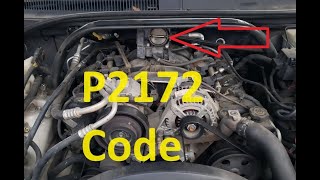

The information in this article is provided for general reference and educational purposes only. Vehicle specifications, procedures, and part compatibility can vary by production date, trim level, and region. Always consult your vehicle's factory service manual and verify part numbers before purchasing or performing repairs. Safety-critical components such as airbags, seat belts, and braking systems should be installed by a qualified professional.
- 🎬 Helpful Videos
- What Does P2172 Mean?
- Can I Drive With P2172?
- Common Causes
- Symptoms
- Diagnostic Flowchart
- Common Fixes & Costs
- DIY vs Professional
- Used vs. New Parts: Buying Guide
- What Happens If You Wait — Timeline
- Cost of Not Fixing It
- Diagnosis Steps
- When This Code Triggers (Freeze-Frame Conditions)
- Related Codes
- Climate & Environmental Factors
- How to Talk to a Mechanic About This Code
- Where to Take It: Dealer vs Independent vs Chain
- When to Walk Away From the Repair
- What Scan Tool You Need for This Code
- How to Clear the Code After You Fix It
- Will This Fail Emissions / State Inspection?
- Most Commonly Affected Vehicles
- Manufacturer-Specific Notes
- Real Owner Stories
- 2016 Chrysler 200 with 2.4L Engine
- Jeep Patriot with 2.4L Engine
- Ram Truck with 234k Miles
- Jeep JK stalled at a red light
- How to Prevent This Code From Triggering
- Frequently Asked Questions
- What is the most common misdiagnosis for P2172?
- My mechanic replaced the throttle body, but the code came back. What now?
- Can I just clear the code and see if it comes back?
- What does 'unmetered air' mean?
- What is the red lightning bolt light on my dash?
- Why is a smoke test necessary?
- My mechanic says I need a 'throttle body relearn.' What is that?
- Can a dirty air filter cause code P2172?
- Key Takeaways
- 🎟️ Get 5% Off